



Introduction
The barbell hip thrust is one of the most effective exercises for developing strong, powerful, and well-developed glutes. Alongside glute bridge variations, it belongs to the category of bent-knee hip-extension exercises, in which the knees remain flexed to reduce hamstring dominance and place greater emphasis on the gluteus maximus.
Unlike traditional hip-hinge exercises such as deadlifts or Romanian deadlifts, the barbell hip thrust loads the hips horizontally rather than vertically. This horizontal force vector closely resembles the mechanics of sprinting, jumping, accelerating, and many other athletic movements, which is one reason the exercise has become extremely popular in both strength-training and sports-performance environments.
Another major advantage of the barbell hip thrust is that it heavily loads the glutes in their shortened position, which can create significant muscular tension and a strong glute contraction at lockout. This makes the movement highly effective for:
- Glute hypertrophy
- Hip-extension strength
- Sprint performance
- Lower-body power production
- Athletic movement transfer
Compared to the glute bridge performed on the floor, the hip thrust is performed in an elevated upper-back position on a bench or box. This increases the range of motion and keeps the shins closer to vertical throughout the movement.
In my experience as a coach, the barbell hip thrust works especially well for lifters who want stronger glutes without placing excessive compressive stress on the spine. It is also extremely useful for athletes looking to improve acceleration, jumping power, and hip-extension mechanics.
The key is not simply lifting the bar upward. The real focus should be on driving through the hips under control, maintaining stable spinal positioning, and creating strong glute contraction at the top of every repetition.
Other Names for the Barbell Hip Thrust
The barbell hip thrust may go by several names depending on the coaching style, gym environment, or training focus. While the terminology can vary slightly, all versions refer to the same basic bent-knee hip-extension movement pattern performed with external resistance across the hips.
- Barbell hip thrust
- Hip thrust
- Barbell glute thrust
- Glute hip thrust
- Loaded hip thrust
- Barbell glute bridge (sometimes incorrectly used interchangeably)
In strength-training and athletic-performance environments, the exercise is often simply called a “hip thrust,” especially when performed with a barbell setup.
Required Equipment for the Barbell Hip Thrust
The barbell hip thrust requires a stable setup that allows controlled hip extension and safe loading across the hips.
Essential Equipment
- Barbell
- Weight plates
- Flat bench or hip-thrust bench
- Barbell pad or hip pad
Optional (but helpful)
- Resistance bands – useful for additional glute tension
- Flat training shoes – improve stability and force transfer
- Non-slip flooring – improves setup stability
- Dedicated hip-thrust machine or pad attachment
Few exercises match the barbell hip thrust when the primary goal is maximizing glute development. The horizontal loading pattern creates tremendous tension at lockout and carries over extremely well to sprinting, jumping, and athletic hip-extension power.
How to Perform the Barbell Hip Thrust with Proper Form
Step 1 — Position Your Upper Back on the Bench
Sit on the floor with your upper back positioned firmly against a stable padded bench. The bench should support the area around the lower shoulder blades rather than the neck.
Step 2 — Place the Barbell Across the Hips
Roll a padded barbell over your legs and position it directly in the hip crease slightly above the pelvis. Using a hip pad usually makes the exercise significantly more comfortable.
Step 3 — Set Your Foot Position
Place your feet approximately shoulder-width apart with the knees bent. At the top of the movement, the shins should be close to vertical for optimal glute activation.
Step 4 — Brace the Core and Prepare
Brace your core gently, keep your chin slightly tucked, and maintain a neutral spine before beginning the movement. Your torso should remain stable against the bench throughout the exercise.
Step 5 — Drive the Hips Upward
Push through your heels and extend the hips upward by squeezing the glutes forcefully. The movement should come from the hips rather than excessive lower-back extension.
Step 6 — Reach Full Hip Extension
Raise the hips until your body forms a relatively straight line from the shoulders to the knees. Avoid leaning backward excessively or arching the lower back aggressively at lockout.
Step 7 — Pause and Squeeze the Glutes
Pause briefly in the top position while maintaining strong glute contraction and stable pelvic alignment.
Step 8 — Lower Under Control
Slowly lower the hips back toward the floor under control while maintaining tension on the glutes and keeping the torso stable.


The biggest mistake I commonly see with barbell hip thrusts is excessive lower-back arching at lockout. The goal should be powerful hip extension and strong glute contraction, not turning the top position into a spinal hyperextension movement.
Video Demonstration
Watching a proper demonstration is especially useful for the barbell hip thrust because many lifters struggle with foot positioning, pelvic control, or excessive lumbar extension. Pay attention to the stable upper-back position, vertical shin angle, and controlled glute-driven lockout throughout each repetition.
Barbell hip thrusts are one of the best exercises for maximizing glute hypertrophy because the movement creates extremely high muscular tension in the shortened glute position at lockout.
Muscles Worked in the Barbell Hip Thrust
Primary Muscles
The primary muscles responsible for the movement are the hip extensors and the posterior chain muscles. These include the gluteus maximus, hamstrings (semitendinosus, semimembranosus, biceps femoris), and adductor magnus.
Secondary Muscles
Several surrounding muscles assist the movement and contribute to stabilization during the exercise. These include the gluteus medius, gluteus minimus, erector spinae (iliocostalis, longissimus, spinalis), rectus femoris, vastus lateralis, vastus medialis, and vastus intermedius.
Stabilizing Muscles
Stabilizing muscles help maintain posture, pelvic alignment, spinal positioning, and lower-body control throughout the movement. These include the abdominal stabilizers, obliques, deep spinal stabilizers, upper-back musculature, and foot stabilizers.
Antagonist Muscles
The muscles opposing hip extension are primarily the hip flexors. These include the iliopsoas, tensor fasciae latae, rectus femoris, and sartorius.
How the Barbell Hip Thrust Works: Biomechanics & Mechanics
The barbell hip thrust is a bent-knee hip-extension exercise driven primarily by glute contraction and horizontal force production. Unlike traditional deadlift variations that load the body vertically, the hip thrust loads the hips horizontally, closely resembling many athletic movement patterns, such as sprinting and forward acceleration.
Key Joint Action
The primary joint action is hip extension, in which the hips move upward from a flexed position to full extension through strong glute-driven force production.
Horizontal Loading Advantage
One of the biggest advantages of the barbell hip thrust is the horizontal load vector created by the barbell placement across the hips. This loading pattern has a strong transfer to:
- Sprinting
- Jumping
- Acceleration
- Change-of-direction mechanics
- Athletic propulsion movements
Glute-Dominant Mechanics
Because the knees remain bent throughout the movement, hamstring contribution is partially reduced, which forces the glutes to become the dominant hip extensors.
Peak Tension at Lockout
The exercise creates very high glute tension near the top position when the hips reach full extension. This shortened-position loading is one reason the hip thrust is considered extremely effective for glute hypertrophy.
Spinal Position Importance
Maintaining neutral spinal alignment is essential throughout the exercise. Excessive lumbar extension at lockout reduces glute emphasis and increases unnecessary stress on the lower back.
Shin Angle and Foot Position
Foot positioning strongly influences muscular recruitment during hip thrusts. Keeping the shins relatively vertical at the top usually creates the best balance between glute activation and movement efficiency.
Common Mechanical Errors
Common mistakes include overextending the lower back, placing the feet too far forward or backward, losing pelvic control, pushing through the toes instead of the heels, and turning the movement into excessive spinal extension.
The most important factor is maintaining controlled hip extension and strong glute-driven movement rather than simply moving the heaviest possible load.
Technique Optimization Tips
The barbell hip thrust becomes significantly more effective when movement quality and glute tension remain the priority. Small adjustments in setup and execution can noticeably improve glute activation and overall movement efficiency.
- Keep the shins relatively vertical at lockout.
- Drive through the heels throughout the movement.
- Maintain a neutral spine during every repetition.
- Keep the chin slightly tucked to improve pelvic positioning.
- Pause briefly at the top for stronger glute contraction.
- Lower the hips under control instead of dropping quickly.
- Keep the upper back firmly supported against the bench.
- Avoid excessive lower-back arching at lockout.
The barbell hip thrust usually becomes far more effective when you prioritize controlled pelvic positioning, strong glute contraction, and smooth hip extension mechanics instead of aggressively arching the lower back at lockout.
In many cases, glute development stalls because people train hard but not effectively. Learn why your glutes may not be responding properly in Why Your Glutes Aren’t Growing.
Technical Emphasis & Targeting Adjustments
Although the barbell hip thrust is mechanically simple, small adjustments in setup and execution can significantly influence glute activation, pelvic positioning, and overall movement efficiency. In practical training situations, these modifications are often useful for maximizing glute recruitment and improving hip-extension mechanics.
- Keep the shins relatively vertical at the top position to optimize glute tension.
- Push through the heels, not the toes, on every repetition.
- Maintain slight posterior pelvic control at lockout to reduce lower-back compensation.
- Pause briefly at peak contraction for stronger glute activation.
- Slow down the eccentric phase to increase muscular tension.
- Keep the knees aligned with the feet throughout the movement.
- Use controlled repetitions instead of bouncing through the range of motion.
- Maintain stable upper-back contact with the bench during every repetition.
The main takeaway is that controlled hip extension and strong glute contraction usually matter far more than simply loading the barbell heavier.
Barbell Hip Thrust Benefits and Drawbacks
The barbell hip thrust is widely considered one of the best exercises for glute hypertrophy and hip extension strength because it creates extremely high gluteal muscular tension while keeping spinal compression relatively low. However, like any exercise, it also has limitations.
Benefits
- Extremely effective for glute hypertrophy and strength.
- Strong horizontal loading transfer to athletic movements.
- High glute activation at lockout.
- Lower spinal compression compared to many deadlift variations.
- Excellent accessory exercise for sprinting and jumping performance.
- Beginner-friendly once the proper setup is learned.
- Allows progressive overload with relatively stable mechanics.
Drawbacks
- Setup can initially feel awkward or uncomfortable.
- Poor pelvic positioning may lead to excessive lower-back compensation.
- Bench height and foot placement strongly influence exercise quality.
- Heavy loading may irritate the hips without proper padding.
- Excessive weight often reduces movement quality and glute activation.
The barbell hip thrust usually works best when you focus on smooth glute-driven hip extension, controlled pelvic positioning, and stable lockout mechanics instead of simply chasing heavier loads at the expense of movement quality.
Barbell Hip Thrust Variations
All barbell hip thrust variations follow the same basic movement pattern of extending the hips against resistance while maintaining stable upper-body positioning. Their main differences lie in loading style, unilateral demands, range of motion, and overall gluteal emphasis.
Glute Bridge
The glute bridge is one of the simplest hip-thrust variations and is often used as a beginner-friendly alternative. Unlike the standard hip thrust, this movement is performed on the floor without an elevated upper back.
Because the range of motion is smaller, the exercise is easier to control and places slightly less demand on hip mobility and setup mechanics. This makes it useful for beginners, warm-ups, and glute activation routines.

Dumbbell Hip Thrust
This variation replaces the barbell with a dumbbell positioned across the hips. It targets the same primary muscles while reducing setup complexity and often feels more comfortable for beginners.
Dumbbell hip thrusts are especially useful for:
- Home workouts
- Moderate-load glute training
- Higher-repetition sets
- Beginners learning hip-thrust mechanics

Machine Hip Thrust
The machine hip thrust uses a dedicated hip-thrust machine with a padded resistance system. This variation usually feels more stable and comfortable while allowing faster setup and easier adjustments to loading.
Machine variations are particularly useful for:
- High-volume hypertrophy training
- Beginners uncomfortable with the barbell setup
- Reducing setup time between sets
- Controlled glute-focused training
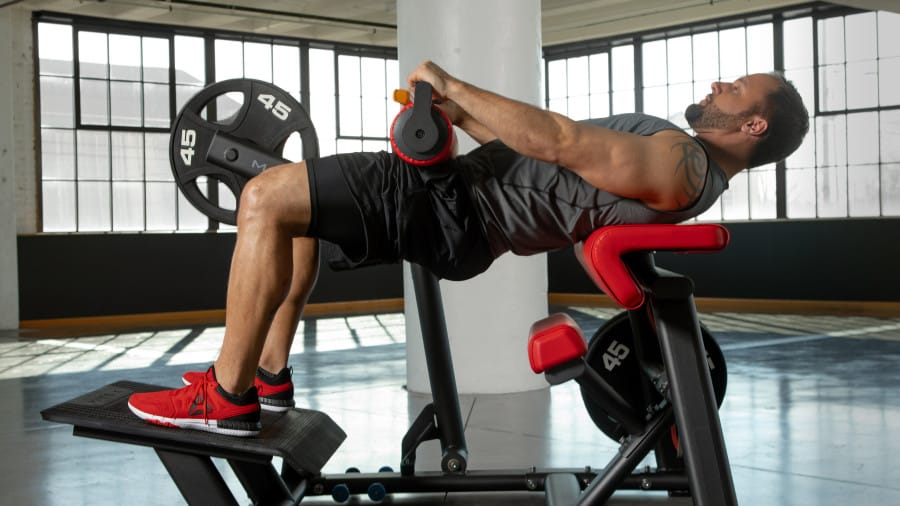
Single-Leg Hip Thrust
The single-leg hip thrust increases unilateral stability demands by requiring the movement to be performed primarily on one leg. This variation strongly challenges pelvic control, glute activation, and lower-body balance.
Because of the increased stability requirement, lighter loading is usually sufficient compared to bilateral hip thrusts.

Replacement Exercises for the Barbell Hip Thrust
If barbell hip thrusts are unavailable, or you want additional variety in your glute and posterior chain training, several other exercises can effectively target the glutes, hamstrings, hip extensors, and surrounding stabilizers with similar hip-extension mechanics.
- Cable Pull-Through Exercise
- Glute Bridge
- Mini Band Lateral Walk
- Reverse Hyperextension
- Standing Hip Flexion
- Cable Hip Adduction
- Cable Hip Abduction
- Standing Hip Extension
- Standing Machine Hip Adduction
- Standing Machine Hip Abduction
- Seated Hip Abduction
- Seated Hip Adduction
- Cable Glute Kickback Exercise
- Clamshell Exercise
- Romanian Deadlift
- Kettlebell Swing
For a complete overview of all recommended movements and variations, explore our full glute & posterior-chain exercise database, where you can find the best exercises for glute development, hip-extension strength, lower-body power, and athletic performance.
Who Should Use This Exercise?
The barbell hip thrust can be useful for a wide range of trainees because it combines high glute activation, potential for progressive overload, and relatively low spinal compression. In practical training situations, it works especially well for improving glute strength, athletic hip extension, and lower-body power production.
- Lifters wanting maximum glute hypertrophy
- Athletes focused on sprinting, jumping, and acceleration
- Individuals improving hip-extension strength
- Beginners learning glute-dominant movement patterns
- People wanting lower-back-friendly posterior-chain training
- Trainees seeking stronger lockout power for deadlifts and squats
- Lifters wanting improved lower-body power and force production
Who Should Avoid or Modify It?
Although the barbell hip thrust is generally safe when performed correctly, some individuals may still need to modify the movement or reduce loading due to mobility limitations, setup discomfort, or lower back limitations.
- People unable to maintain neutral spinal alignment
- Individuals experiencing hip discomfort from barbell pressure
- Lifters excessively arching their lower back at lockout
- People struggling with pelvic control during hip extension
- Anyone using unstable bench setups
- Trainees loading the movement too heavily at the expense of technique
Where This Exercise Fits in a Workout
The barbell hip thrust is best used as a primary glute-focused compound exercise within lower-body, posterior-chain, athletic-performance, or hypertrophy-focused training sessions. In most practical situations, it works especially well early in the workout when the glutes and hip extensors are still fresh enough to produce high levels of force.
- As a primary glute-development exercise
- During lower-body hypertrophy workouts
- Within athletic power and sprint-training programs
- As a posterior-chain strength movement
- Before accessory glute and hamstring exercises
- During lower-back-friendly lower-body sessions
The main takeaway is that barbell hip thrusts work best as a controlled hip-extension movement focused on maximizing glute tension, lower-body power, and strong lockout mechanics rather than simply moving the heaviest possible load.
Sets and Reps Recommendations
The barbell hip thrust responds extremely well to moderate repetition ranges with controlled tempo and strong glute contraction at lockout. In my experience as a coach, the best results usually come from consistent progressive overload combined with strict movement quality and controlled pelvic positioning.
- Sets: 3–5 per workout
- Reps: 6–15 reps
- Tempo: Controlled lowering phase with explosive but controlled hip drive
- Rest time: 60–120 seconds between sets
Additional Programming Tips
- Focus on driving through the heels during every repetition
- Keep the shins relatively vertical at lockout
- Pause briefly at the top for a stronger glute contraction
- Maintain stable upper-back support throughout the set
- Avoid excessive lumbar extension at lockout
- Use moderate-to-heavy loading while maintaining strict movement quality
- Pair hip thrusts with Romanian deadlifts, lunges, or glute-focused accessories for balanced posterior-chain development
What usually produces the best results is controlled, glute-driven hip extension and consistent, progressive overload, rather than sacrificing movement quality for heavier weights.
Barbell Hip Thrust vs. Glute Bridge
The barbell hip thrust and glute bridge are both excellent bent-knee hip-extension exercises designed to strengthen the glutes and posterior chain, but they differ significantly in range of motion, loading potential, and overall movement mechanics.
| Training Factor | Barbell Hip Thrust | Glute Bridge |
|---|---|---|
| Upper-Back Position | Elevated on the bench | On floor |
| Range of Motion | Larger | Smaller |
| Glute Activation | Extremely high | High |
| Loading Potential | Very high | Moderate |
| Setup Complexity | Moderate | Simple |
| Stability Requirement | Moderate | Low |
| Beginner Accessibility | Good | Excellent |
| Best Use | Glute hypertrophy and strength | Beginner training and activation |
Conclusion: Both exercises are highly effective for glute development, but the barbell hip thrust usually provides greater loading potential and a larger range of motion, while the glute bridge is often easier for beginners and warm-up routines.
For many lifters, both exercises can complement each other effectively within a balanced glute-training program.
Closing Thoughts
The barbell hip thrust is one of the most effective exercises for building stronger, more powerful, and better-developed glutes while also improving hip-extension mechanics and lower-body performance. Its combination of high glute activation, horizontal loading, and relatively low spinal compression makes it extremely valuable for both physique-focused and athletic training programs.
In my experience, the biggest improvements usually come from controlled hip-driven movement, strong glute contraction, proper pelvic positioning, and consistent progressive overload rather than simply trying to lift the heaviest possible weight.
This exercise can be especially useful for athletes, bodybuilders, strength trainees, and anyone wanting stronger glutes with less spinal stress than many traditional heavy hip-hinge movements.
Ultimately, the goal is simple: use barbell hip thrusts to improve glute hypertrophy, hip-extension strength, lower-body power, and athletic performance through controlled, high-quality repetitions over the long term.
Frequently Asked Questions
Why do I feel barbell hip thrusts in my quads instead of my glutes?
This often happens when your feet are too close to your body or you push too much through the toes. Move the feet slightly farther forward, drive through the heels, and focus on squeezing the glutes at the top.
Why do I feel barbell hip thrusts in my lower back?
Lower-back tension usually comes from excessive arching at lockout. Keep the ribs down, brace the core, tuck the chin slightly, and finish the rep by squeezing the glutes instead of leaning backward.
How heavy should barbell hip thrusts be?
The weight should be heavy enough to challenge the glutes but light enough to maintain full control, proper pelvic position, and a strong pause at the top. If you lose lockout control, the load is too heavy.
Are barbell hip thrusts better than squats for glutes?
Barbell hip thrusts usually create more direct glute tension at lockout, while squats train more total lower-body musculature. For complete development, both exercises can be useful.
Should I pause at the top of a barbell hip thrust?
Yes. A short pause at the top improves glute contraction, reduces momentum, and helps prevent the lower back from taking over the movement.
How often should I do barbell hip thrusts?
Most lifters can train barbell hip thrusts one to three times per week, depending on total lower-body volume, recovery, and training goal.
Are barbell hip thrusts good for athletes?
Yes. Barbell hip thrusts strengthen horizontal hip extension, which can support sprinting, acceleration, jumping, and other explosive athletic movements.
