



The infraspinatus is the largest of the four rotator cuff muscles and the only one you can actually see on a lean, developed physique — yet it’s also the second most commonly torn rotator cuff muscle, right behind the supraspinatus. Understanding the functional anatomy of the infraspinatus explains why this muscle is simultaneously one of the most visually rewarding to develop and one of the most important to protect, and why the specific exercise you choose to train it with makes a measurable difference.
Quick Answer
The infraspinatus is the largest and thickest of the four rotator cuff muscles, covering most of the back of the shoulder blade below its spine. It’s the primary external rotator of the shoulder, working alongside the smaller teres minor, and it also plays a major role in stabilizing the head of the humerus within the shoulder socket. Its medial portion is visible on the surface of a lean physique, making it the only rotator cuff muscle that can actually be seen from the outside.
| Muscle type | Largest of the four rotator cuff muscles |
|---|---|
| Primary functions | External rotation of the shoulder |
| Secondary functions | Shoulder joint stabilization, horizontal abduction assistance |
| Innervation | Suprascapular nerve (C5–C6) |
| Blood supply | Suprascapular artery, circumflex scapular artery |
| Common exercises | Side-lying external rotation, cable external rotation, face pulls |
| Main bodybuilding role | Shoulder stability and external rotation strength |
Overview
The infraspinatus is one of four muscles that make up the rotator cuff, alongside the supraspinatus, teres minor, and subscapularis. Unlike its three rotator cuff counterparts, which are entirely hidden beneath surrounding muscle, part of the infraspinatus sits close enough to the surface to be visible in lean, developed physiques — making it the one rotator cuff muscle lifters can actually see the payoff of training.
Despite this visibility, the infraspinatus rarely receives the same attention as the deltoid beneath it. This is a missed opportunity in more ways than one: beyond its aesthetic contribution, the infraspinatus is central to shoulder stability and one of the muscles most frequently implicated in overuse injuries among lifters and overhead athletes. To see how it fits into the rest of your muscular system, check out our interactive muscle anatomy tool.
Anatomy & Location
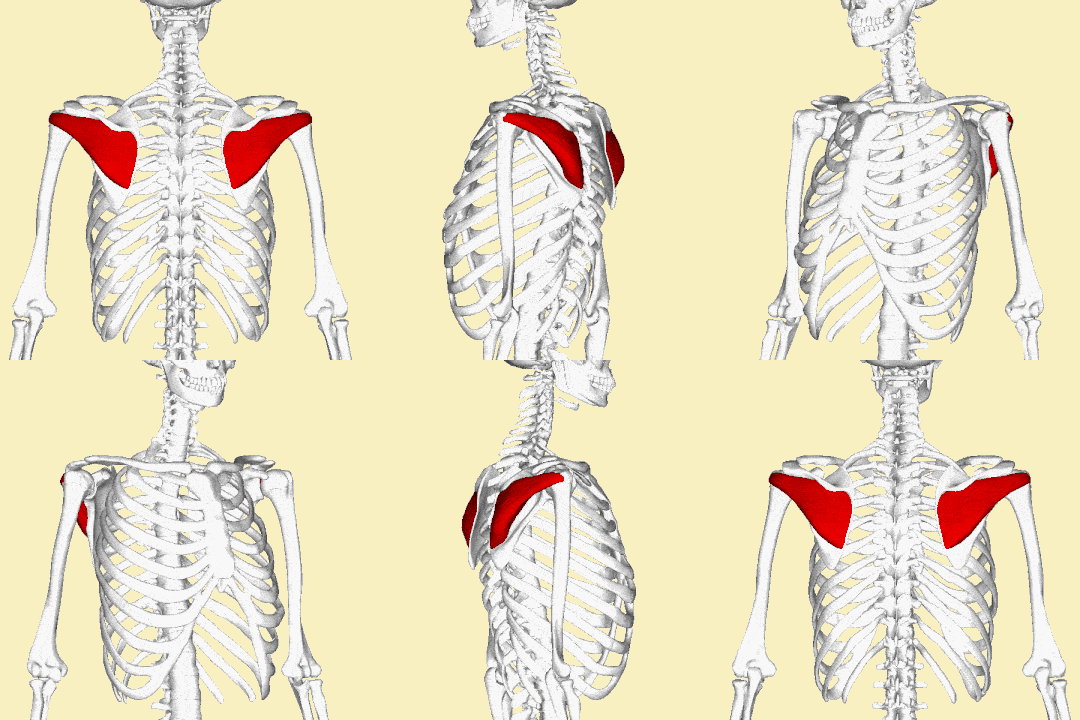
The infraspinatus is a thick, triangular muscle covering most of the infraspinous fossa — the broad depression on the back of the scapula, below its spine. Its fibers run obliquely between multiple internal tendinous divisions, giving it a multipennate structure rather than the simpler parallel fiber arrangement seen in some other rotator cuff muscles. The medial portion of the muscle lies close enough to the surface to be visible externally, while the rest is covered by the posterior deltoid.

Characteristics at a Glance
| Characteristic | Value |
|---|---|
| Shape | Thick, triangular, multipennate |
| Size | Largest of the four rotator cuff muscles |
| Location | Back of the shoulder blade, below the scapular spine |
| Crosses | Shoulder (glenohumeral) joint |
The infraspinatus is functionally and structurally very similar to the teres minor, which sits directly below it — the two share a comparable fiber direction and function so closely that they can be difficult to distinguish by feel, and in some individuals their fibers are partially fused.
Origin, Insertion, Innervation & Blood Supply
| Attribute | Detail |
|---|---|
| Origin | Infraspinous fossa of the scapula |
| Insertion | Middle facet of the greater tuberosity of the humerus |
| Innervation | Suprascapular nerve (C5–C6) |
| Blood supply | Suprascapular artery, with contributions from the circumflex scapular artery |
The infraspinatus shares its nerve supply with the supraspinatus — both are innervated by the suprascapular nerve, which explains why nerve compression at the suprascapular notch can weaken both muscles simultaneously. According to StatPearls’ anatomical reference on the rotator cuff, this shared nerve pathway is clinically significant because suprascapular nerve entrapment can present as combined weakness of both muscles rather than an isolated single-muscle problem. Kenhub’s reference on the rotator cuff muscles notes that the infraspinatus insertion sits on the middle facet of the greater tuberosity, directly adjacent to the supraspinatus’s insertion on the superior facet — the two tendons blend together closely enough that some anatomical descriptions treat them as a continuous structure rather than two entirely separate attachments.
Function
The infraspinatus’s primary role is external rotation of the shoulder — rotating the arm outward, as in reaching behind to fasten a seatbelt or throwing a frisbee. It works alongside the teres minor to produce this motion, though the infraspinatus is the larger and generally stronger contributor of the two. Due to its line of pull, the infraspinatus is a more effective external rotator when the arm is closer to the side of the body; as the arm abducts further from the torso, its mechanical leverage for rotation decreases, even though the muscle continues contributing to shoulder stability at higher abduction angles. Beyond rotation, the infraspinatus provides a compressive, downward force on the humeral head, helping counteract the upward pull the deltoid exerts on the arm during overhead movement.
A widely cited EMG study examining common shoulder external rotation exercises found that side-lying external rotation produced the greatest activation of both the infraspinatus (62% of maximum voluntary contraction) and the teres minor (67%) among the seven exercises tested, while a prone horizontal abduction variation with full external rotation produced the highest activation for the supraspinatus and deltoid muscles instead. This is a useful, practical finding: if the infraspinatus is the specific target, side-lying external rotation appears to be the more effective choice than standing or prone variations.
Synergists & Antagonists
Synergists (muscles that work alongside the infraspinatus to help produce the same movement):
- Teres minor — the primary partner in external rotation, working almost identically alongside the infraspinatus
- Posterior deltoid — assists external rotation and horizontal abduction
Antagonist (the muscle group that opposes the infraspinatus’s action, working in the opposite direction):
- Subscapularis — the primary internal rotator, directly opposing external rotation
- Pectoralis major and latissimus dorsi — both contribute to internal rotation, opposing the infraspinatus
Common Exercises

| Exercise | Role of the Infraspinatus |
|---|---|
| Side-lying external rotation | Prime mover (highest EMG activation) |
| Cable external rotation | Prime mover |
| Band external rotation | Prime mover |
| Face pull | Major contributor |
For a complete rotator cuff training program, see our full guide: 12 Best Rotator Cuff Exercises for Strong, Stable & Pain-Free Shoulders.
Bodybuilder’s Take
“Since I can actually see my infraspinatus, should I train it like a regular muscle for size?” To a degree, yes — unlike the other three rotator cuff muscles, developing the infraspinatus does have a visible aesthetic payoff, contributing to the fuller, more three-dimensional look of the upper back and posterior shoulder. That said, it still responds better to controlled, moderate-rep training than to the kind of heavy, low-rep loading used for larger muscle groups, since it’s a joint stabilizer first and a size-focused muscle second.
“Does grip or body position really matter for external rotation exercises?” Based on the available research, yes. Side-lying external rotation consistently produces higher infraspinatus activation than standing or prone variations, likely because the side-lying position removes assistance from gravity and other muscles that can otherwise compensate. If you’ve been doing only standing cable or band external rotations, adding a side-lying variation may meaningfully improve the directness of your training for this muscle.
“Why does external rotation feel weaker when my arm is raised overhead compared to at my side?” This is expected, not a sign of a problem. The infraspinatus’s leverage for producing external rotation force decreases as the arm moves further from the body, which is a normal consequence of the muscle’s line of pull rather than a functional weakness.
Common beginner mistakes:
- Only performing standing external rotation exercises, missing the higher activation available from side-lying positions
- Using too much weight, which encourages compensation from the posterior deltoid and reduces the training effect on the infraspinatus specifically
- Neglecting external rotation training entirely while focusing only on internal-rotation-dominant pressing movements
Common Conditions
This section is educational and should not replace professional medical advice.
The infraspinatus is the second most commonly torn rotator cuff muscle, behind only the supraspinatus, typically resulting from repetitive overuse rather than a single traumatic event. Tendinopathy — chronic irritation and degeneration of the tendon — often precedes a full tear, and it’s frequently associated with a gradual decline in external rotation strength rather than sudden, obvious symptoms. The muscle is also a common site of trigger points, which can produce localized shoulder discomfort and pain radiating down the arm. Persistent shoulder pain, weakness during external rotation, or discomfort that worsens with overhead activity should be evaluated by a healthcare professional rather than treated through.

Best Stretches for the Infraspinatus Muscle
Keeping your infraspinatus muscle flexible offers several benefits, such as improving your shoulder range of motion and reducing the risk of injury. To help maintain or improve flexibility in your infraspinatus, here are some excellent stretching exercises you can incorporate into your routine:
- Passive internal rotation stretch: Stand near a doorway and, using the arm on the side of the muscle you wish to stretch, bend your elbow to 90 degrees and place your palm against the door frame. Keep your elbow close to your body and gently rotate your torso in the opposite direction until you feel a stretch in your shoulder.
- Cross-body stretch: Stand or sit straight, then take the arm on the side you wish to stretch and move it across your body. Use your other hand to pull the elbow closer to your chest. You should feel a stretch in the back of your shoulder.
- Sleeping stretch: This stretch can be done while lying down. On one side, bend the elbow of the top arm at a 90-degree angle and press it into a pillow or the mattress. The stretch is felt at the back of the shoulder.
Common Myths
Myth: The infraspinatus and teres minor are basically the same muscle. They’re closely related in function and location, and are sometimes partially fused, but they’re anatomically distinct muscles with separate origins and slightly different relative contributions to external rotation strength.
Myth: You can train the infraspinatus heavy, just like any other muscle. Because it’s primarily a stabilizer and its tendon is vulnerable to overuse injury, the infraspinatus generally responds better to lighter loads with strict control than to heavy progressive overload.
Myth: If you can see your infraspinatus, it must already be strong. Visibility depends heavily on body fat levels and overall shoulder development, not necessarily on how well the muscle actually functions as a rotator cuff stabilizer — a visible infraspinatus can still be undertrained relative to its stabilizing role.
Key Takeaways
- The infraspinatus is the largest rotator cuff muscle and the only one visible externally on a lean physique.
- Its main job is external rotation, working closely alongside the teres minor.
- EMG research shows side-lying external rotation produces the highest infraspinatus activation among common exercises.
- It’s the second most commonly torn rotator cuff muscle, usually from gradual overuse rather than sudden injury.
- Like any rotator cuff muscle, it responds better to controlled, moderate loading than heavy progressive overload.
Frequently Asked Questions
What is the main function of the infraspinatus?
Its main job is externally rotating the shoulder, rotating the arm outward, while also helping stabilize the head of the humerus in the shoulder socket.
Why is the infraspinatus the only visible rotator cuff muscle?
Its medial portion sits close enough to the surface to be visible on a lean physique, while the supraspinatus, teres minor, and subscapularis are all completely covered by surrounding muscle.
What is the best exercise for the infraspinatus?
EMG research has found side-lying external rotation produces the highest infraspinatus activation among commonly used exercises, outperforming standing and prone variations.
How common are infraspinatus injuries?
The infraspinatus is the second most commonly torn rotator cuff muscle, behind only the supraspinatus, typically developing gradually from repetitive overuse rather than a single injury.
Are the infraspinatus and teres minor the same muscle?
No, though they’re closely related and sometimes partially fused. They’re anatomically distinct muscles that work together to produce external rotation.
Sources & References
Every claim in this guide is grounded in anatomical references and published research. Explore the primary sources below.
