


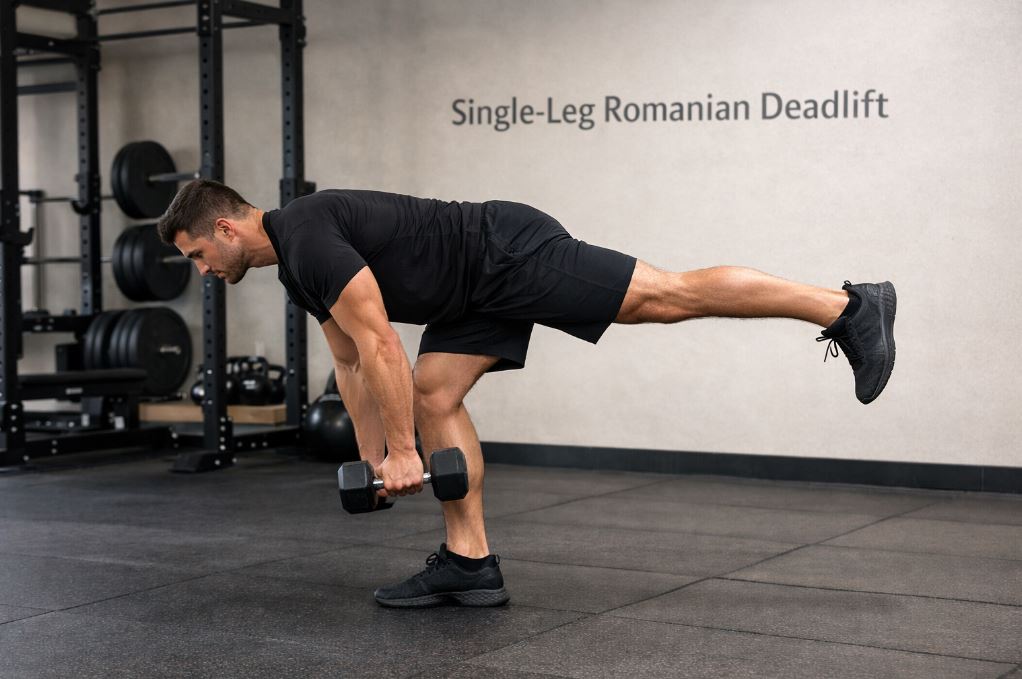
Overview (Why This Exercise Exists)
The single-leg Romanian deadlift (SL RDL) is one of the most effective unilateral exercises for developing hamstring strength, hip stability, and real-world balance. Unlike bilateral deadlifts, the SL RDL challenges each leg independently, exposing strength asymmetries while demanding high levels of coordination and control.
This exercise is widely used in athletic training, rehabilitation, and advanced strength programs because it combines hip-hinge mechanics, posterior-chain loading, and frontal-plane stability in a single movement. When performed correctly, it strengthens not only the hamstrings and glutes but also the stabilizing muscles of the hip, knee, and ankle.
Coach’s Note
The single-leg Romanian deadlift doesn’t just build muscle — it teaches your body how to truly own single-leg hip extension under load. This quality is essential for sprinting, cutting, lifting, and long-term injury resilience, yet it’s often missing in purely bilateral training programs.
Equipment Needed
The SL RDL is highly adaptable and can be performed with minimal equipment:
- Dumbbell (most common and beginner-friendly)
- Kettlebell
- Barbell (advanced)
- Optional: Weight vest
- Optional: Barefoot or minimalist shoes (for foot stability emphasis)
Step-by-Step Instructions for the Single-Leg Romanian Deadlift
A. Starting Position (Setup)
- Stand tall with feet hip-width apart, holding the weight in the opposite hand of the working leg (or in the same hand as the working leg). Or you can hold the weight in each hand if you feel this will provide a more stable body position.
- Shift your weight onto one leg and lightly lift the non-working leg behind you.
- Keep a soft bend in the working knee.
- Brace your core and set your shoulders down and back.
- Maintain a neutral spine from head to tailbone.
Key cue: Think “long spine, heavy hips” before you start moving.
B. Movement (Execution)
- Inhale and brace your core.
- Hinge at the hip by pushing your hips straight back.
- Allow the free leg to extend naturally behind you as a counterbalance.
- Lower the weight toward the floor while keeping it close to your shin.
- Stop when you feel a strong hamstring stretch or when your torso approaches parallel to the ground.
- Drive the hips forward to return to standing.
- Exhale as you finish the rep, keeping balance and control.
Tempo recommendation:
Controlled eccentric (3–4 seconds down), smooth and deliberate concentric.
Muscles Worked in Single-Leg Romanian Deadlift
Primary Muscles
Secondary Muscles
Stabilizers
- Gluteus medius
- Core musculature
- Foot and ankle stabilizers
- Upper back and lats
Common Mistakes
- Rotating the hips open reduces hamstring loading and the demand for stability.
- Rounding the lower back: shifts stress away from the hips and onto the spine.
- Using momentum: turns the movement into a balance drill instead of strength work.
- Letting the knee collapse inward compromises knee and hip mechanics.
- Rushing progression: adding load before mastering control.
Performance Tips (Coach’s Cues)
- “Hips back, not down.” This is a hinge, not a squat.
- “Show your back pocket to the wall.” Encourages proper hip shift.
- Keep the weight slow and close to the leg.
- Use your free foot as a counterbalance, not a kick.
- Start light. Control always comes before load.
Exercise Variations
1) Dumbbell Single-Leg RDL
Hold a dumbbell in the opposite hand.
Why it works: Encourages better hip alignment and anti-rotation control.
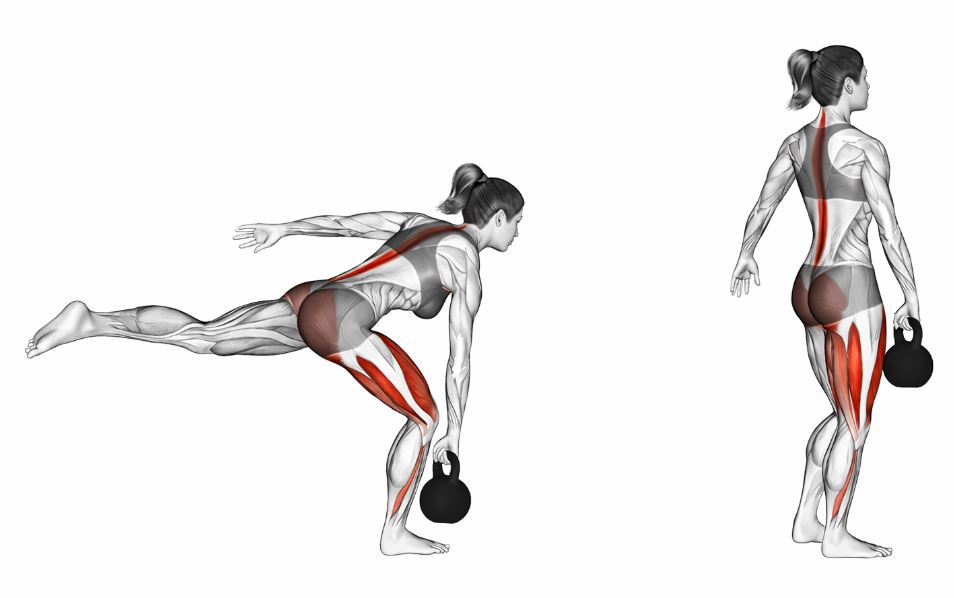
2) Kettlebell Single-Leg RDL
Hold the kettlebell centrally or contralaterally.
Why it works: Smooth load path and beginner-friendly setup.
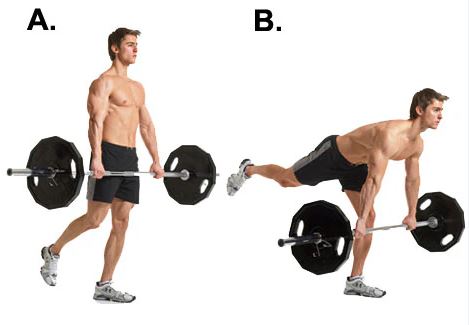
3) Barbell Single-Leg RDL
Use a light barbell once balance is mastered.
Why it works: Higher posterior-chain loading with greater technical demand.
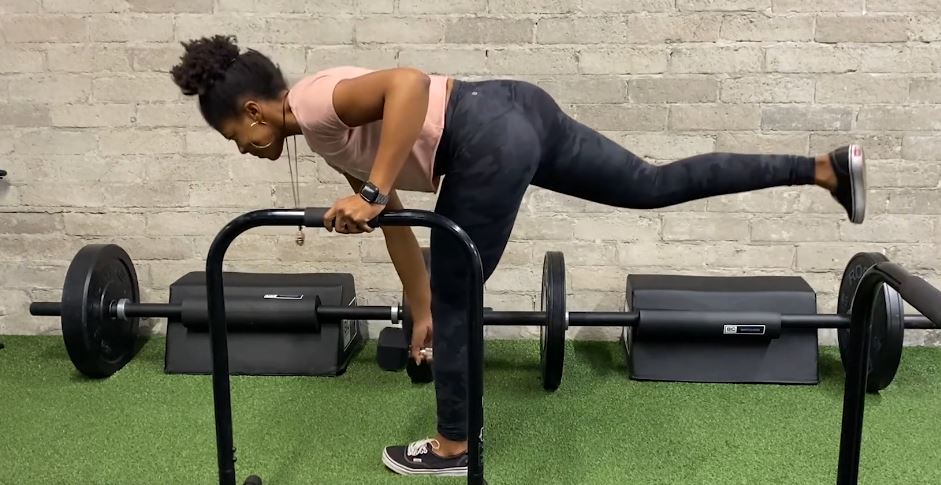
4) Assisted Single-Leg RDL
Lightly hold onto a rack or wall.
Why it works: Ideal for beginners or rehab scenarios.
5) Deficit Single-Leg RDL
Stand on a small plate or step.
Why it works: Increases range of motion and hamstring stretch under control.
Alternative / Replacement Exercises
If SL RDLs are not suitable, consider:
- Bilateral Romanian Deadlift
- Hip Thrust (single-leg)
- Bulgarian Split Squat
- Cable Pull-Through
- Stability Ball Hamstring Curl
- Good Morning (light load)
Each option emphasizes posterior-chain strength with varying stability demands.
Key Benefits of Doing Single-Leg Romanian Deadlift
- Unilateral hamstring and glute strength
- Improved balance and coordination
- Correction of left–right strength asymmetries
- Enhanced hip and knee stability
- Strong transfer to athletic movement
- Minimal equipment, high effectiveness
Who Should Use This Exercise?
- Athletes involved in running, jumping, and cutting
- Lifters aiming to correct strength imbalances
- Individuals rehabbing from lower-body injuries
- Anyone wanting better single-leg control and stability
- Advanced trainees seeking higher-quality posterior-chain work
Who Should Be Cautious?
- Those with acute hamstring or hip injuries
- Individuals with severe balance limitations (start assisted)
- Lifters rushing load progression
- Anyone experiencing pain rather than muscular tension
When in doubt, regress the movement and rebuild control first.
Programming Insight (Short but Powerful)
Single-leg RDLs work best 2–3 times per week with moderate volume. Start with 2–4 sets of 6–10 reps per leg, focusing on slow eccentrics and perfect balance. They pair exceptionally well with bilateral hinges on other training days, allowing you to address both maximal strength and unilateral control.
Placement: Accessory work after compound lifts or as a primary movement in unilateral-focused sessions.
Single-Leg vs. Bilateral Romanian Deadlift — Key Differences Explained
While both single-leg and bilateral Romanian deadlifts are excellent posterior-chain exercises, they serve different purposes depending on training goals, experience level, and movement quality. The bilateral RDL allows for heavier loading and maximal hamstring strength development, while the single-leg RDL prioritizes unilateral control, balance, and asymmetry correction. Understanding when to use each variation helps you build strength more intelligently—not just harder.
| Criteria | Single-Leg Romanian Deadlift (SL RDL) | Bilateral Romanian Deadlift |
|---|---|---|
| Primary training goal | Unilateral strength & control | Maximal posterior-chain strength |
| Load potential | Low to moderate | High |
| Balance & coordination demand | Very high | Low |
| Asymmetry correction | Excellent | Limited |
| Hip stability requirement | High (especially glute medius) | Moderate |
| Core anti-rotation demand | High | Low |
| Hamstring stretch under load | Moderate to high | High |
| Technical complexity | High | Moderate |
| Beginner suitability | Limited (assisted recommended) | High |
| Athletic transfer | Very high | Moderate to high |
| Fatigue cost | Lower systemic fatigue | Higher systemic fatigue |
Conclusion
The single-leg Romanian deadlift is far more than a balance exercise—it’s a powerful tool for building resilient hamstrings, strong hips, and symmetrical lower-body strength. By challenging your body to control load on one leg at a time, the SL RDL reinforces movement quality that carries over to sport, lifting, and everyday performance. Master it patiently, load it intelligently, and it will pay dividends well beyond aesthetics.
Why does the single-leg Romanian deadlift expose weaknesses so quickly?
Because it removes the ability to compensate with the stronger side. Any deficit in hip stability, hamstring strength, or foot control becomes immediately noticeable when load is supported by one leg only.
Should the free leg stay straight or slightly bent during SL RDLs?
Both are acceptable. A slightly bent free leg often improves balance and hip control, while a straighter leg can increase posterior-chain tension. The key is maintaining pelvic alignment, not leg position perfection.
Is it normal to feel SL RDLs more in the glutes than hamstrings?
Yes. Depending on hip anatomy, stance, and depth, some lifters feel greater glute involvement. This usually indicates good hip extension mechanics rather than a flaw in execution.
Can single-leg RDLs improve ankle and foot stability?
Absolutely. The exercise heavily challenges the foot’s ability to maintain a stable tripod position, which can improve ankle control and proprioception over time.
Why do SL RDLs feel much harder on one side?
Side-to-side differences in hip mobility, glute medius strength, or balance are extremely common. SL RDLs are one of the best tools for identifying and gradually correcting these asymmetries.
Are single-leg RDLs useful for people who don’t play sports?
Yes. Everyday activities like walking, climbing stairs, and lifting objects often occur on one leg at a time. SL RDLs train the body to handle these demands more efficiently and safely.
Should SL RDLs be trained barefoot or with shoes?
Both options work. Training barefoot or in minimalist shoes can enhance foot awareness and stability, while lifting shoes or trainers may offer more comfort when external load increases.
Can single-leg RDLs help with lower-back issues?
Indirectly, yes. By improving hip hinge control and reducing reliance on spinal movement, SL RDLs can help offload the lower back during posterior-chain training.
Is it better to slow down the eccentric or pause at the bottom?
Both strategies are effective. Slowing the eccentric improves control and tissue tolerance, while pausing briefly at the bottom reinforces balance and positional strength.
How long does it take to see improvements from single-leg RDLs?
Most lifters notice better balance and control within a few weeks. Strength and symmetry improvements typically follow with consistent practice and sensible loading.
