
📢 Educational Purpose Disclaimer
This article is intended for educational and informational purposes only. It does not promote or encourage the use of anabolic steroids. Any use of performance-enhancing substances without proper medical supervision carries serious health risks—especially for women. The following content is based on scientific evidence and expert analysis to raise awareness and help women make informed decisions.
How Steroids Work in the Female Body
Anabolic steroids are synthetic derivatives of testosterone, a hormone naturally found in both men and women—but in significantly different amounts. While men produce approximately 6–7 mg of testosterone daily, women produce just 0.3–0.4 mg. This enormous difference in baseline makes women far more sensitive to external androgens.
When anabolic steroids are introduced into the female body, they bind to androgen receptors, promoting protein synthesis, muscle growth, and changes in metabolism. However, due to the hormonal sensitivity, these effects often come with severe side effects at even low doses.
Unique Risks of Steroid Use in Women
The anabolic steroids’ effects on women differ greatly from those in men, not just in scale but in type and severity. Below are the most commonly reported female-specific risks:
1. Virilization
One of the most recognizable signs of steroid use in women is virilization—a process where women begin to develop masculine features. These include:
- Deepening of the voice
- Increased facial and body hair
- Enlargement of the clitoris (clitoromegaly)
- Male-pattern baldness
Mechanism: Excess androgens override estrogenic influence and stimulate androgen receptors in the skin, hair follicles, and vocal cords.
Permanence: While some effects may be partially reversible upon cessation, changes like voice deepening and clitoral enlargement may be permanent.
2. Menstrual Irregularities and Hormonal Dysfunction
Women who use steroids frequently experience:
- Irregular or absent periods (amenorrhea)
- Disrupted ovulation
- Reduced fertility
Mechanism: External androgens suppress the hypothalamic-pituitary-ovarian axis (HPOA), reducing luteinizing hormone (LH) and follicle-stimulating hormone (FSH).
Long-Term Consequence: Chronic suppression may lead to persistent infertility or early menopause.
3. Psychological Side Effects
- Mood swings
- Increased aggression (“roid rage”)
- Anxiety or depressive symptoms
Cause: Steroids alter neurotransmitter activity, particularly serotonin, and dopamine regulation.
Study: A study published in JAMA Psychiatry noted higher levels of psychiatric comorbidity among female AAS users compared to non-users. Furthermore, a large-scale survey titled “The Anabolic 500 Survey” examined the psychological effects of anabolic steroid abuse among both male and female users. The findings revealed that female users reported significantly higher rates of anxiety, mood swings, and body image disturbances compared to non-users.
4. Skin and Cosmetic Changes
- Severe acne
- Oily skin
- Altered fat distribution (more visceral fat)
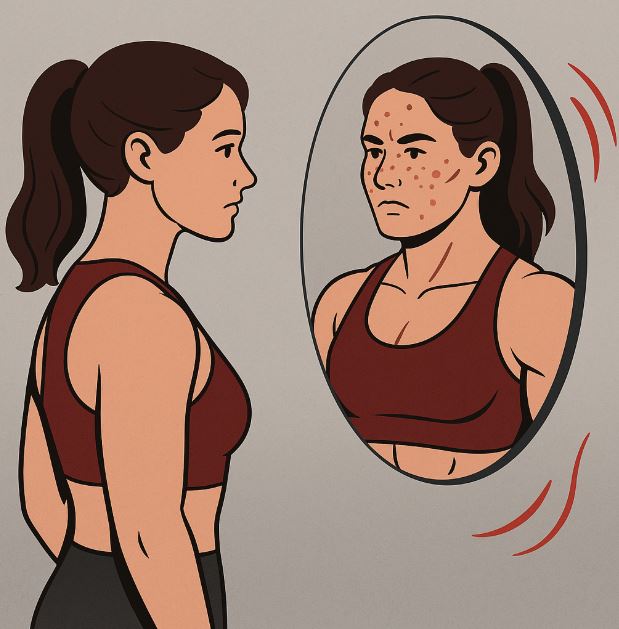
Cause: Anabolic steroids elevate androgen levels, which overstimulate sebaceous glands—leading to oily skin and severe acne. They also disrupt normal fat distribution and stimulate male-pattern hair loss. These effects occur due to heightened sensitivity of female skin and hair follicles to androgens.
These cosmetic effects often compound emotional distress, leading to reduced self-esteem despite physique improvements.
Understanding the Risks at a Glance
The table below summarizes the most commonly reported side effects of anabolic steroid use in women, categorized by severity and potential reversibility. While not all users will experience every symptom, this overview highlights how even short-term exposure to these substances can lead to significant physiological and psychological changes—some of which may be permanent. Understanding these risks is essential before making any decision involving performance-enhancing drugs.
| Side Effect | Description | Reversible? | Severity |
|---|---|---|---|
| Virilization | Development of masculine traits (deep voice, facial hair, clitoral enlargement) | Partially | 🔴 Severe |
| Menstrual Irregularities | Disruption or loss of menstrual cycle (amenorrhea) | Possibly | 🟠 Moderate |
| Infertility | Suppression of ovulation and reproductive hormones | Rarely | 🔴 Severe |
| Acne & Oily Skin | Increased sebum production and clogged pores | Yes | 🟡 Mild to Moderate |
| Hair Loss | Androgenic alopecia (male-pattern baldness) | Rarely | 🟠 Moderate |
| Voice Deepening | Thickening of vocal cords, resulting in deeper voice | No | 🔴 Severe |
| Mood Swings / Aggression | Irritability, anxiety, or “roid rage” episodes | Yes | 🟠 Moderate |
| Breast Reduction | Loss of fatty tissue in the breast area | Partially | 🟡 Mild to Moderate |
| Hirsutism | Excess hair growth on face, arms, chest, or back | Sometimes | 🟠 Moderate |
| Emotional Instability | Anxiety, depression, or mood disorders | Varies | 🟠 Moderate |
Reversibility: Are the Effects Permanent?
As shown in the table, while some side effects, such as acne or temporary hair growth, may resolve after the cycle, others—especially voice deepening and clitoromegaly—are often irreversible.
Studies have shown that even after short-term use, some virilizing effects persist for years. The female endocrine system is more susceptible to disruption, making recovery unpredictable and often incomplete.
A study published in Drug and Alcohol Dependence (Hildebrandt et al., 2007) confirms that even short-term AAS use can lead to prolonged physiological and psychological alterations in women.
Differences Between Male and Female Responses to Anabolic Steroids
While anabolic steroids affect both men and women, the physiological and hormonal responses can differ significantly due to biological sex. The following table highlights the key differences in how each sex reacts to AAS use, ranging from hormonal disruption and physical changes to psychological effects and recovery potential. These distinctions are crucial when evaluating the risk-to-benefit ratio, especially for female users.
| Aspect | Male Response | Female Response |
|---|---|---|
| Hormonal Impact | Testosterone suppression with possible recovery | Disruption of menstrual cycle and estrogen dominance |
| Voice Changes | No significant changes | Deepening of voice, often irreversible |
| Muscle Growth | Significant gains, dose-dependent | Significant but riskier due to hormonal imbalance |
| Skin and Hair | Possible acne and hair loss | Severe acne, facial hair growth, hair thinning |
| Psychological Effects | Aggression, mood swings | Heightened emotional instability, anxiety |
| Reversibility | Most effects reversible with PCT | Several effects irreversible or slow to reverse |
| Fertility | Temporary suppression | Risk of long-term or permanent infertility |
🔍 Conclusion: Women are more susceptible to adverse effects, and the risk-to-benefit ratio is dramatically less favorable than for men.
Most Common Steroids Used by Women
Despite the risks, some women use anabolic steroids in pursuit of muscle tone, fat loss, or competitive advantage. Common choices include:
1. Anavar (Oxandrolone)
Known for being “milder,” Anavar is preferred due to its low androgenic rating. Still, virilization occurs with prolonged use or high doses.
2. Winstrol (Stanozolol)
Popular among fitness competitors, but very virilizing. Acne and voice deepening are reported even at low doses.
3. Primobolan (Methenolone)
Often considered “safe,” but studies are scarce. Long-term impact on fertility remains unclear.
4. Clenbuterol
Technically not a steroid, but widely used for fat loss. Known to cause cardiac hypertrophy, insomnia, and tremors.
Why Underground Labs Are Even Riskier for Women
Women require precise microdosing to avoid extreme virilization. Underground labs typically manufacture products dosed for men, often underdosed or overdosed, and sometimes mislabelled altogether.
One analysis of anabolic steroid samples revealed that more than two-thirds of the tested products contained either dangerous contaminants or undeclared substances, posing major health concerns for users. Additionally, a separate investigation carried out in Australia showed that 13% of the samples had contents that did not match the label claims, further emphasizing the inconsistent and unregulated nature of underground steroid manufacturing.
This poses a double threat for women:
- Unintended high dosages
- Unknown compounds with unknown side effects
For a deeper understanding of the dangers of sourcing anabolic steroids from unreliable online vendors, especially when it comes to underground labs and counterfeit products, make sure to read our in-depth article: Safe vs. Unsafe Sources: Why Buying Steroids Online is Dangerous.
Do Female Bodybuilding Competitors Use Anabolic Steroids?
When looking at the elite athletes in Olympia-level competitions—from Ms. Olympia to Women’s Physique, Figure, Fitness, Bikini, and Wellness—one cannot ignore the striking muscularity and conditioning some women display. This naturally raises the question: Are anabolic steroids involved?
The reality is that in many open bodybuilding divisions, particularly Ms. Olympia and Women’s Physique, the use of anabolic-androgenic steroids (AAS) is widely reported and even expected. Achieving such dense muscle mass, extreme leanness, and vascularity often surpasses what’s naturally attainable for women—even with elite genetics, perfect nutrition, and training.
In categories like Figure and Fitness, the use of lower-dose steroids or alternative performance-enhancing drugs (such as clenbuterol or SARMs) may also occur, though less aggressively than in heavier divisions.
For Bikini and Wellness, the standard emphasizes softer, more feminine lines. However, some competitors have admitted to using mild anabolics like Anavar or Primobolan to retain muscle while dieting, improve hardness, or reduce body fat. It’s important to note that even mild compounds can lead to long-term hormonal changes in women.
💬 “It is virtually impossible for a woman to achieve the look seen in Ms. Olympia without the use of anabolic agents,” notes Dr. Harrison Pope, a leading researcher in steroid use in athletics.
Despite testing protocols at some shows, many federations are untested, or testing is infrequent and easily bypassed. As such, performance-enhancing drug use remains prevalent—especially at the highest levels of female physique sports.
Safer Alternatives & Natural Support
For women looking to improve strength and physique without risking hormonal disaster, consider:
- Creatine monohydrate – improves strength and lean mass without hormonal disruption
- Whey protein + BCAA – supports recovery and muscle preservation
- High-intensity resistance training – proven to enhance body composition naturally
- Proper periodization and recovery – protects hormonal balance and performance
Conclusion: Understanding the Anabolic Steroids Effects on Women
In summary, the anabolic steroids’ effects on women are significantly more complex and potentially dangerous than often acknowledged. While short-term gains in muscle mass and strength may seem appealing, these substances can trigger irreversible hormonal imbalances, severe virilization symptoms, and long-term fertility issues. The female body is particularly sensitive to exogenous androgens, and even low doses can result in pronounced side effects.
It is crucial that women—especially those involved in competitive bodybuilding or physique sports—approach this topic with a full understanding of the risks involved. Education, medical oversight, and informed decision-making should always take precedence over any performance-enhancing choices. For most, the risks far outweigh the benefits.
Key Takeaways
- Even low doses of anabolic steroids can cause irreversible effects in women.
- Female hormonal systems are far more sensitive to external androgens.
- Virilization, fertility loss, and psychological effects are common and often permanent.
- Natural alternatives offer safer paths to strength and aesthetic goals.
- Products from underground labs are particularly hazardous due to a lack of microdosing and rigorous purity testing.
📚 Consulted Literature
- Magnolini, R. et al. (2021). Use and abuse of anabolic androgenic steroids among women: A review of prevalence, adverse effects, and motivations. BMC Public Health, 21(1), 1–9.
- Nieschlag, E., & Behre, H. M. (2012). Testosterone: Action, Deficiency, Substitution (4th ed.). Cambridge University Press.
- Kicman, A. T. (2008). Pharmacology of anabolic steroids. British Journal of Pharmacology, 154(3), 502–521.
- Parkinson, A. B., & Evans, N. A. (2006). Anabolic androgenic steroids: A survey of 500 users. Medicine & Science in Sports & Exercise, 38(4), 644–651.
- Gruber, A. J., & Pope, H. G. (2000). Compulsive weight lifting and anabolic drug abuse among women. The American Journal on Addictions, 9(3), 203–209.
- Evans-Brown, M. et al. (2009). Human enhancement drugs: The emerging challenges to public health. Drug Testing and Analysis, 1(9-10), 367–372.
- Handelsman, D. J. (2019). Androgen misuse and abuse. Best Practice & Research Clinical Endocrinology & Metabolism, 33(4), 101271.
- Frati, P. et al. (2015). Anabolic androgenic steroid (AAS) related deaths: Autoptic, histopathological and toxicological findings. Current Neuropharmacology, 13(1), 146–159.
- Kanayama, G. et al. (2008). The epidemiology of anabolic–androgenic steroid use among men and women. Current Opinion in Endocrinology, Diabetes and Obesity, 15(3), 243–252.
- Stojkovic, M. et al. (2020). Analyzing underground AAS samples: Quality control and health concerns. International Journal of Drug Policy, 83, 102856.
