


Overview (Why This Exercise Exists)
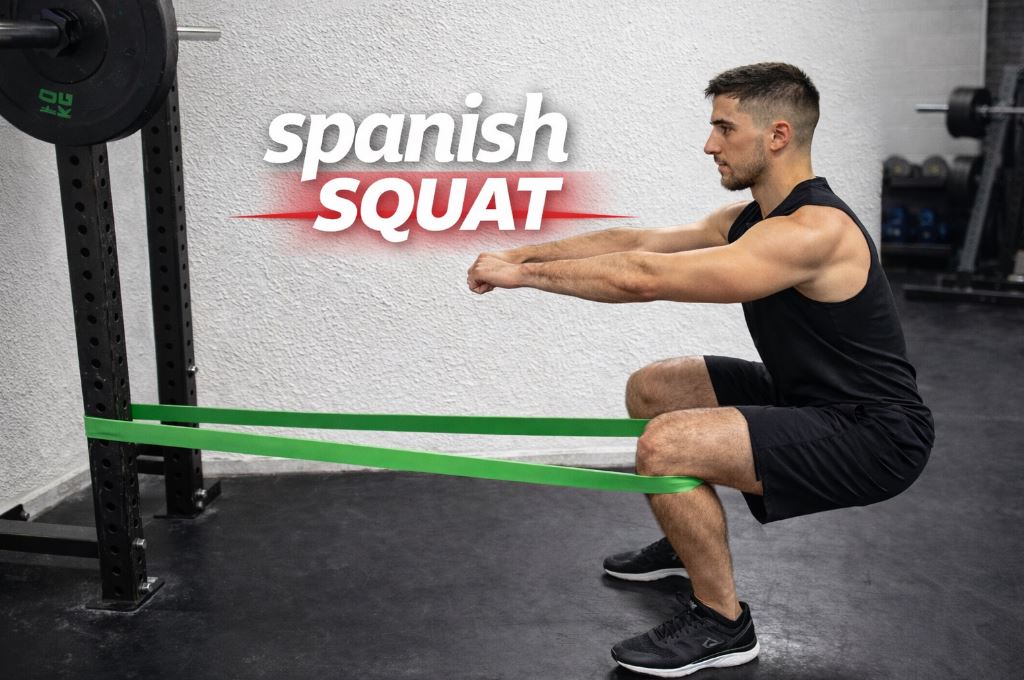
The Spanish squat is one of the most knee-friendly lower-body exercises you can perform, especially if your goal is to strengthen the quadriceps while reducing stress on the knee joint. Originally popularized in rehabilitation and athletic training settings, this squat variation uses external band resistance behind the knees to promote an upright torso, strong quad activation, and improved knee mechanics.
Unlike traditional squats that may aggravate anterior knee pain in some individuals, the Spanish squat shifts tension in a way that often reduces discomfort while still allowing high-quality quad loading. This makes it a powerful option not only for rehab scenarios, but also for lifters who want healthier knees without sacrificing leg strength.
Coach’s Note
The Spanish squat teaches your quads to produce force while the knee is supported — not avoided. This is exactly what many people with knee pain are missing in their training. Instead of constantly working around discomfort, this exercise allows you to rebuild confidence, strength, and proper knee mechanics under controlled conditions.
Equipment Needed
The Spanish squat is simple to set up and requires minimal equipment:
- A thick resistance band (heavy loop band works best)
- A solid anchor point (rack post, squat stand, heavy immovable object)
- Optional: weight vest or dumbbells (advanced loading)
- Optional: lifting shoes or wedges (to further emphasize quads)
Step-by-Step Instructions for the Spanish Squat
A. Starting Position (Setup)
- Secure a thick resistance band around a stable anchor at knee height.
- Step inside the band so it sits behind both knees, just below the joint line.
- Walk backward until the band is under tension and gently pulling your knees forward.
- Stand with feet about shoulder-width apart, toes slightly turned out.
- Keep your torso upright, chest tall, and core braced.
Key cue: You should already feel your quads working before you even descend.
B. Movement (Execution)
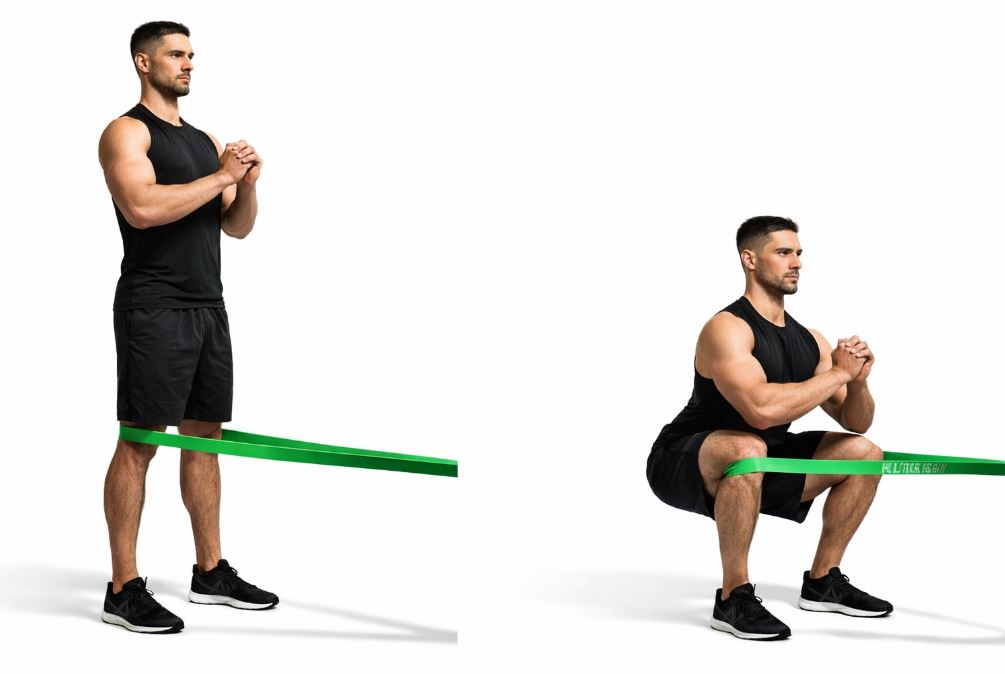
- Inhale and brace your core.
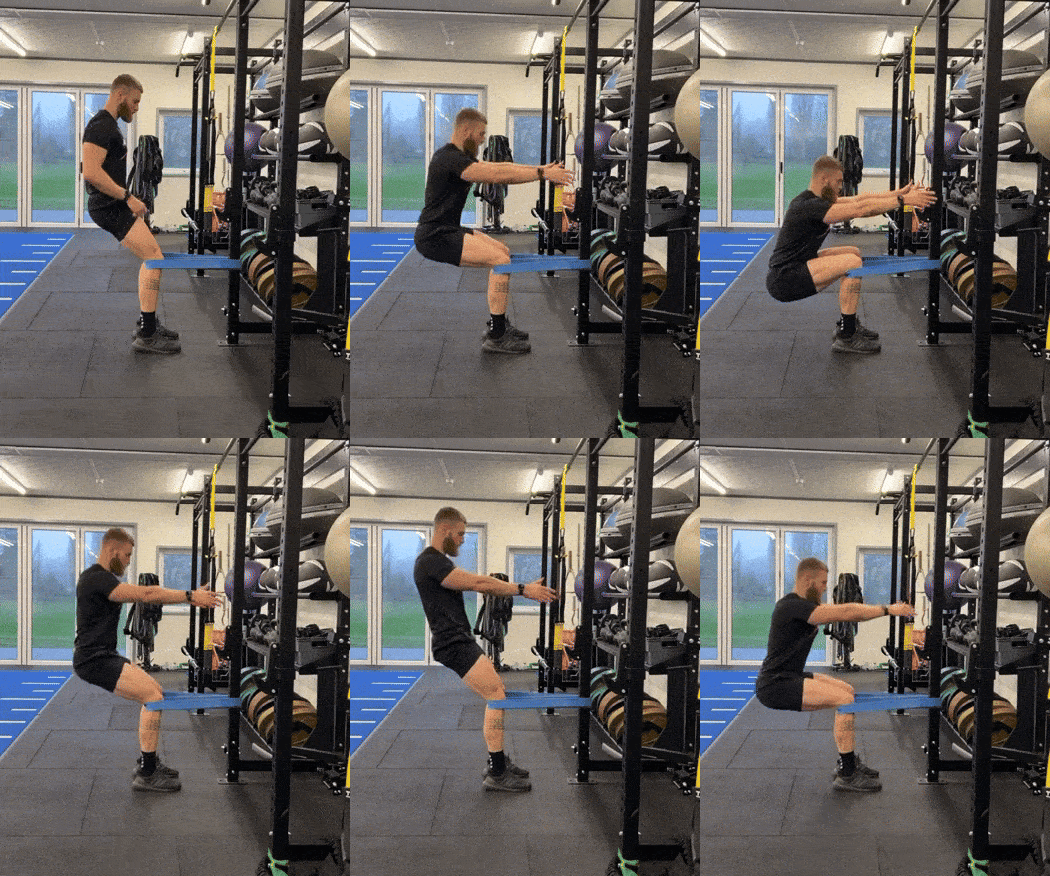
- Sit straight down into the squat while allowing the band to support forward knee travel.
- Keep your torso tall and avoid excessive hip hinge.
- Descend until your thighs are at least parallel to the floor, or as deep as comfort allows.
- Pause briefly at the bottom if desired.
- Drive through mid-foot to stand back up while maintaining tension in the band.
- Exhale as you return to the top.
Tempo recommendation:
Controlled descent (2–3 seconds), controlled ascent. Avoid bouncing.
Muscles Worked
Primary Muscles
- Quadriceps (especially vastus medialis and rectus femoris)
Secondary Muscles
Stabilizers
- Core muscles
- Calves
- Foot stabilizers
- Hip stabilizers
Common Mistakes
- Using a band that’s too light: insufficient tension reduces the knee-support benefit.
- Leaning forward excessively: turns the movement into a hip-dominant squat.
- Allowing the knees to collapse inward defeats the purpose of controlled knee mechanics.
- Rushing the reps: removes tension and reduces quad activation.
- Standing too close to the anchor: limits effective band assistance.
Performance Tips (Coach’s Cues)
- “Sit straight down.” Think elevator, not hinge.
- “Let the band help your knees.” Don’t fight forward knee travel.
- “Feel the quads early.” If you don’t feel them immediately, adjust band tension.
- Pause squats work extremely well here for control and pain reduction.
- Foot pressure matters: keep weight evenly distributed across the foot.
Exercise Variations
1) Spanish Squat Isometric Hold
Hold the bottom position for 20–60 seconds.
Why it works: Excellent for pain modulation and quad activation without joint movement.
2) Weighted Spanish Squat
Hold dumbbells, a kettlebell, or wear a weight vest.
Why it works: Adds progressive overload while keeping the knees in a friendly position.
3) Heel-Elevated Spanish Squat
Use wedges or plates under the heels.
Why it works: Increases quad bias and knee flexion demand.
4) Spanish Squat with Tempo
Slow eccentric (4–5 seconds) and pause at the bottom.
Why it works: Builds tendon tolerance and positional strength.
5) Spanish Squat to Box
Squat down to a box or bench.
Why it works: Ideal for beginners or those rebuilding confidence with knee flexion.
Alternative / Replacement Exercises
If Spanish squats aren’t available or suitable, consider:
- Cyclist Squat
- Sissy Squat
- Heel-Elevated Goblet Squat
- Wall Sit
- Leg Press (feet low on platform)
- Terminal Knee Extensions (TKEs)
These can complement Spanish squats depending on comfort and training goals.
Spanish Squat vs. Traditional Back Squat — Key Differences Explained
While both the Spanish squat and the traditional back squat target the lower body, they serve very different purposes depending on knee tolerance, training goals, and movement quality. The Spanish squat is designed to support forward knee travel and reduce joint stress, making it ideal for knee-friendly quad development and rehabilitation scenarios. In contrast, the traditional back squat emphasizes total lower-body strength and axial loading, demanding greater coordination, mobility, and joint resilience.
Understanding these differences helps you choose the right tool for the right phase of training.
| Criteria | Spanish Squat | Traditional Back Squat |
|---|---|---|
| Primary focus | Quadriceps isolation with knee support | Full lower-body strength |
| Knee joint stress | Low to moderate (often pain-reducing) | Moderate to high (load-dependent) |
| Forward knee travel | Encouraged and supported | Often limited or controlled |
| Torso position | Upright | Inclined forward (varies by style) |
| Axial spinal loading | Minimal | High |
| Skill & mobility demands | Low to moderate | High |
| Rehab/pain management | Excellent | Limited (context-dependent) |
| Load potential | Low to moderate external load | High external load |
| Beginner-friendly | Very high | Moderate |
| Athletic transfer | Indirect (supportive role) | Direct (force production) |
Key Benefits of Doing the Spanish Squat
- Strong quad activation with reduced knee stress
- Improved knee tracking and mechanics
- Excellent option for anterior knee pain
- Builds confidence in knee flexion
- Minimal equipment, high effectiveness
- Great bridge between rehab and full squatting
Who Should Use This Exercise?
- Lifters with knee discomfort during traditional squats
- Athletes returning from knee-related injuries
- Anyone needing quad strength without heavy axial loading
- Beginners learning proper squat mechanics
- Advanced lifters looking for knee-friendly quad volume
Who Should Be Cautious?
- Individuals with acute knee injury or swelling
- Those with poor band setup (unstable anchors)
- People experiencing pain that worsens during the movement
- Anyone ignoring proper progression and loading strategy
If pain persists, consult a qualified professional.
Programming Insight (Short but Powerful)
Spanish squats work best 2–3 times per week, either as a main quad movement or as an accessory. Start with 2–4 sets of 8–15 reps, or 30–60 second isometric holds. They pair extremely well with hip-dominant movements (RDLs, hip thrusts) to create balanced lower-body development without excessive knee strain.
Placement: Warm-up, rehab block, or accessory work after compound lifts.
Conclusion
The Spanish squat is a rare exercise that delivers both performance and joint-friendly benefits. Supporting forward knee travel and promoting upright posture allows you to train your quads hard while respecting the knee joint. Whether you’re managing knee pain, rebuilding strength, or simply looking for a smarter way to load your legs, the Spanish squat deserves a permanent place in your training toolbox.
Can Spanish squats improve patellar tendon tolerance over time?
Yes. Spanish squats are commonly used to gradually increase load tolerance of the patellar tendon because they allow controlled knee flexion under constant quad tension. When performed consistently, they can help reintroduce stress in a predictable and joint-friendly manner.
Why do Spanish squats often feel easier on the knees than regular squats?
The resistance band provides forward support at the knee, reducing shear forces while allowing natural knee travel. This changes how forces are distributed across the joint, often making the movement feel smoother and less threatening to sensitive knees.
Are Spanish squats better performed before or after heavy leg training?
In most cases, Spanish squats work best before heavy leg training as a primer or activation tool. They can improve quad engagement and knee confidence before compound lifts, but they can also be used after training for controlled volume if knee stress is a concern.
Can Spanish squats help improve squat depth in traditional squats?
Indirectly, yes. By reinforcing upright torso mechanics and improving comfort in deep knee flexion, Spanish squats can help lifters feel more confident and stable at greater depths when returning to traditional squat variations.
Is there an optimal band tension for Spanish squats?
The band should be thick enough to create noticeable forward pull at the knees without forcing balance loss. If the band is too light, the knee-support effect is minimal; if it’s too heavy, it can disrupt posture and foot pressure. Moderate to heavy bands usually work best.
Can Spanish squats be used during deload or recovery weeks?
Absolutely. Spanish squats are an excellent deload or recovery-week exercise because they maintain quad stimulus without high axial loading. They allow continued lower-body training while reducing overall fatigue and joint stress.
Do Spanish squats transfer to athletic performance?
Spanish squats don’t directly increase maximal strength or sprint speed, but they support performance by improving knee mechanics, quad strength, and movement confidence. This makes them a valuable support exercise rather than a primary performance driver.
Should Spanish squats be trained with higher reps or longer isometric holds?
Both approaches are effective, but they serve different purposes. Higher reps (10–15) emphasize muscular endurance and movement quality, while longer isometric holds (30–60 seconds) are often used for pain modulation and tendon-focused adaptations.
