

Overview (Introduction)
The barbell back squat is widely considered the king of all exercises—and for good reason. This powerful multi-joint movement targets the quadriceps, glutes, and posterior chain, while also demanding full-body stability, coordination, and control. As a coach working with lifters and athletes, I can confidently say that few exercises deliver the same level of strength, muscle growth, and overall athletic development as a properly executed squat.
What sets the barbell back squat apart is its ability to develop not just the legs, but the entire body as a system. Unlike machine-based exercises, the squat requires you to stabilize the load, maintain spinal integrity, and coordinate multiple joints simultaneously. This creates a unique training stimulus that improves mobility, balance, and neuromuscular efficiency, making it essential for both performance and physique goals.
In practice, I’ve seen that mastering the squat is often a turning point in a lifter’s progress. Whether your goal is to build muscle, increase strength, or enhance athletic performance, the barbell back squat provides a foundation that few other exercises can match. When performed with proper technique and progressive overload, it becomes one of the most effective tools for long-term development.
Equipment Needed
Before performing the barbell back squat, having the right setup and equipment is essential—not just for performance, but for long-term safety and progression. Unlike machine-based exercises, the squat requires you to control and stabilize the load, which makes proper equipment selection even more important.
As a coach working with lifters and athletes, I always emphasize that your setup can either support your technique or completely undermine it. The goal is to create a stable environment where you can focus on movement quality and progressive overload.
- Barbell
- Squat rack or power rack
- Weight plates
- Flat, stable footwear (or weightlifting shoes for improved ankle positioning)
- Optional: lifting belt (for added core support during heavier sets)
In practice, the squat rack should be set so that you can unrack the bar with minimal effort, without having to tiptoe or bend your knees excessively. This small detail alone can significantly improve stability and reduce unnecessary energy expenditure before the set even begins.
Step-by-Step Instructions for the Barbell Back Squat
Executing the barbell back squat correctly starts with a strong, stable setup. As a coach, I can tell you that most squat problems don’t begin at the bottom—they start before the first rep even happens. A precise setup ensures proper bar control, joint alignment, and efficient force transfer throughout the entire movement.
A. Starting Position (Setup)
Proper setup creates the foundation for a safe and powerful squat.
- Set the barbell on the rack at about upper chest height so you can unrack it without excessive effort.
- Step under the bar and position it across your upper back (traps for high-bar, rear delts for low-bar).
- Grip the bar slightly wider than shoulder-width, keeping your hands tight to create upper-back tension.
- Pull your shoulder blades together and down to create a stable “shelf” for the bar.
- Unrack the bar by extending your legs, then take 1–2 small steps back to establish your stance.
- Position your feet slightly wider than shoulder-width, with toes pointing slightly outward.
- Distribute your weight evenly across the mid-foot and heel.
- Keep your chest up, spine neutral, and core braced before initiating the movement.
Key coaching cue: Before you descend, create full-body tension—think “tight from head to toe” to maintain stability under the bar.
B. Movement (Execution)
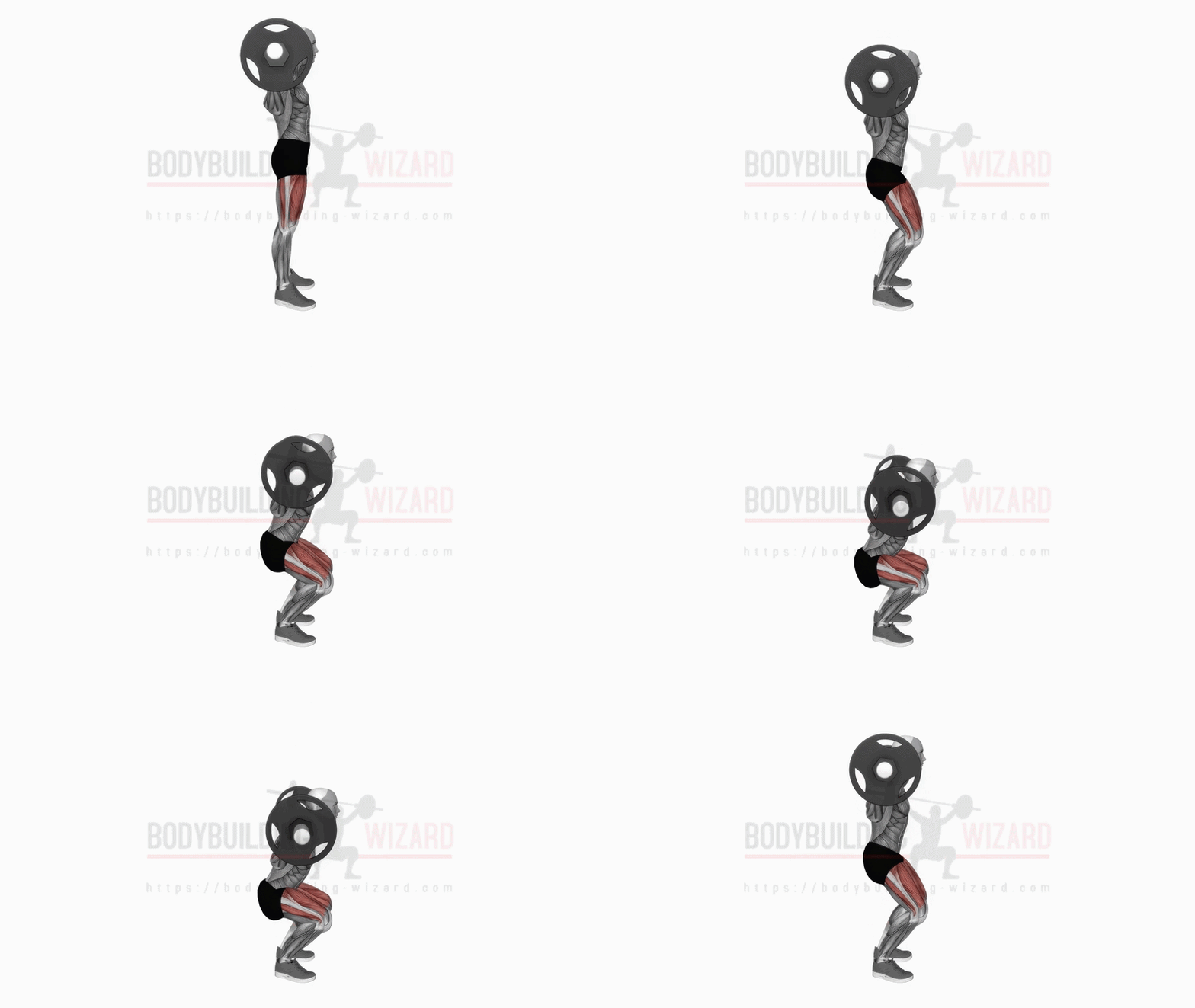
Once you’re properly set up, the goal of the barbell back squat is to move the weight efficiently while maintaining balance, alignment, and full-body tension. As a coach, I always emphasize that a good squat is not just about going up and down—it’s about controlled positioning and force production through the entire movement.
- Inhale deeply and brace your core before initiating the descent.
- Begin the movement by pushing your hips back slightly, while simultaneously bending your knees.
- Keep your chest up and your spine in a neutral position throughout the descent.
- Lower your body until your thighs are at least parallel to the floor (or deeper if mobility allows).
- Ensure your knees track in line with your toes and remain stable.
- At the bottom position, maintain tension—do not relax or collapse.
- Drive upward by pushing through your mid-foot and heels, extending your knees and hips together.
- Exhale as you pass the most difficult portion of the lift.
- Return to the starting position without locking out aggressively.
Tempo recommendation: 2–3 seconds down, brief pause, controlled but powerful ascent.
Performance Optimization Tips (Coach’s Cues)
Once you’ve learned the basics, the barbell back squat becomes a game of precision. As a coach, I’ve seen that small technical details can make a massive difference in how strong you feel under the bar and how effectively you stimulate the target muscles.
- Brace your core before every rep: Think “big breath into the belly” and lock your torso in place before descending.
- Keep the bar over your mid-foot: This ensures balance and efficient force transfer throughout the movement.
- Drive your knees in line with your toes: Prevents collapse and improves stability at the bottom.
- Maintain upper-back tightness: Actively pull the bar into your back to create a stable shelf.
- Control the descent: Don’t drop into the squat—own every inch of the movement.
- Use a full range of motion: Go as deep as your mobility allows while maintaining proper form.
- Push the floor away on the way up: This cue helps generate more power and engage the entire lower body.
- Stay tight at the bottom: Avoid relaxing or “losing tension” before driving upward.
Resistance Curve Insight
The squat is typically most challenging in the bottom and mid-range, where leverage is reduced, and the muscles must produce the greatest force. This is often referred to as the “sticking point.”
This is why proper bracing, depth, and bar path are critical—losing position in the bottom phase can significantly reduce force output and increase injury risk.
Muscles Worked in the Barbell Back Squat
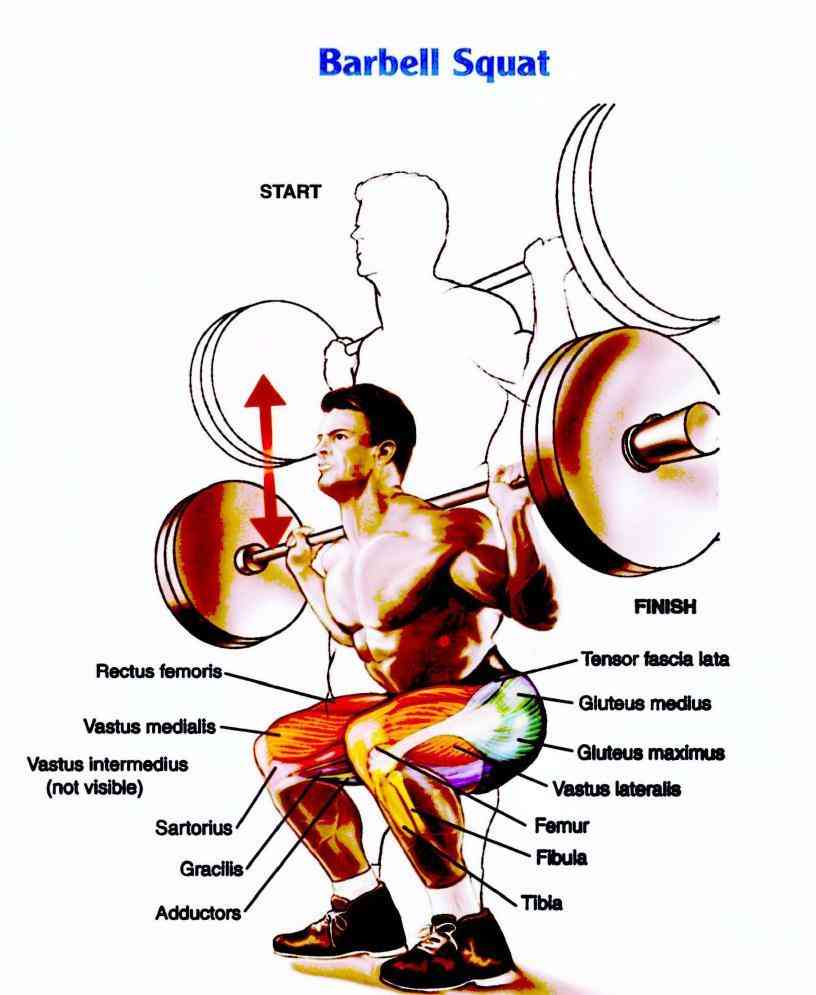
The barbell back squat is a true full-body compound exercise, but its primary focus remains on the lower body, particularly the quadriceps and glutes. What makes this movement unique is how multiple muscle groups must work together to stabilize the body and move heavy loads efficiently.
As a coach working with lifters and athletes, I often describe the squat as a coordination of force across the entire body, not just a leg exercise. The better this coordination, the stronger and more efficient the squat becomes.
Primary Muscles
- Quadriceps (vastus lateralis, vastus medialis, vastus intermedius, rectus femoris): Responsible for knee extension and the primary drivers during the ascent phase.
- Gluteus maximus: Plays a major role in hip extension, especially when driving out of the bottom position.
Secondary Muscles
- Hamstrings: Assist in hip extension and help stabilize the knee joint throughout the movement.
- Adductors: Contribute to hip stability and assist in force production, particularly in deeper squats.
Stabilizers
- Spinal erectors: Maintain a neutral spine and resist forward collapse under load.
- Core musculature: Provides intra-abdominal pressure and stabilizes the torso.
- Upper back (trapezius, rhomboids): Helps support the barbell and maintain posture.
- Calves (gastrocnemius and soleus): Stabilize the ankle joint and assist in balance.
From my experience, one of the biggest mistakes lifters make is thinking of the barbell back squat as just a “leg exercise.” In reality, it’s a full-body strength movement that requires coordination, stability, and tension from head to toe.
When everything works together properly—the quads, glutes, core, upper back, and breathing mechanics—the squat becomes one of the most powerful tools for building strength, muscle, and athletic performance.
Technical Emphasis & Targeting Adjustments
The barbell back squat can be adjusted in several ways to shift emphasis between the quadriceps, glutes, hips, and posterior chain. As a coach, I see this as one of the biggest reasons the squat is so valuable: small changes in stance, depth, and bar position can dramatically change how the exercise feels and which muscles are loaded most.
Bar Position
| Bar Position | Muscle Emphasis / Training Effect |
|---|---|
| High-bar squat | More upright torso, greater knee flexion, stronger emphasis on the quadriceps |
| Low-bar squat | More forward torso angle, greater hip involvement, stronger emphasis on the glutes, hamstrings, and posterior chain |
Stance Width
| Stance | Muscle Emphasis / Training Effect |
|---|---|
| Shoulder-width stance | Balanced development of the quads, glutes, and adductors |
| Narrower stance | More knee flexion and greater relative emphasis on the quadriceps |
| Wider stance | More hip involvement and greater emphasis on the glutes and adductors |
Squat Depth
| Depth | Muscle Emphasis / Training Effect |
|---|---|
| Partial squat | Allows heavier loading but reduces full-range quad and glute stimulation |
| Parallel squat | Strong balance of strength, hypertrophy, and joint control |
| Deep squat | Greater range of motion, more hip and quad demand, but requires excellent mobility and control |
In my experience, the best squat variation is not always the one that looks most impressive—it is the one your body can perform with the best control, depth, and consistency. If your goal is quad development, a slightly more upright, high-bar squat usually works better. If your goal is maximal strength, a low-bar squat with more hip involvement may allow heavier loading.
For most lifters, the smartest approach is to start with a controlled, shoulder-width high-bar squat, then adjust stance and depth only after the basic movement pattern is solid.
Exercise Variations
The barbell back squat is the foundation, but there are several variations that can shift emphasis, improve weaknesses, or accommodate different mobility levels. As a coach, I regularly use these variations to target specific goals—whether it’s quad development, strength, or technique refinement.
1) Front Squat
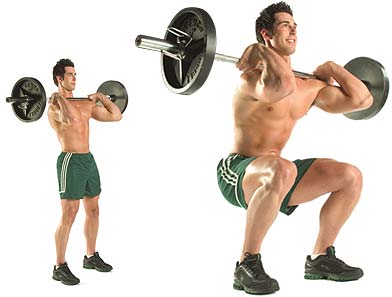
How to perform:
- Position the barbell across your shoulders (front rack position).
- Keep your elbows high and chest upright.
- Descend by bending your knees and hips while maintaining a vertical torso.
- Drive back up while keeping the bar stable, and your core braced.
Why it works:
The front squat places a greater emphasis on the quadriceps and requires a more upright posture, which also increases core demand.
2) Smith Machine Squat
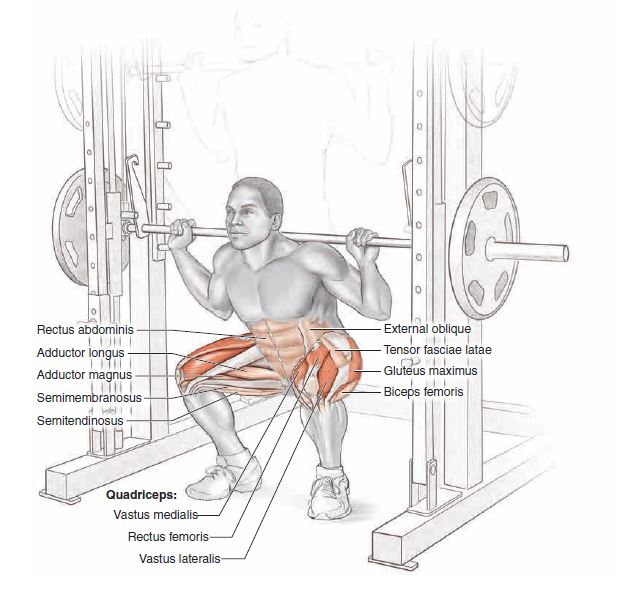
How to perform:
- Stand under the bar in a Smith machine with feet slightly forward.
- Unrack the bar and descend while maintaining balance along the fixed path.
- Push back up while keeping your torso stable.
Why it works:
The fixed bar path provides stability and control, making it useful for beginners or for higher-rep hypertrophy work without worrying about balance.
3) Hack Squat (Machine)
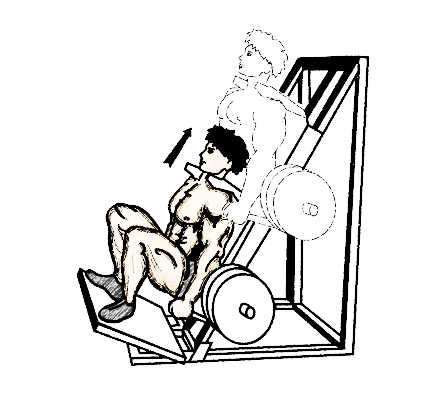
How to perform:
- Position yourself in the hack squat machine with your back against the pad.
- Place your feet on the platform and descend under control.
- Drive upward through your heels to return to the starting position.
Why it works:
This variation closely targets the quadriceps with reduced spinal loading and is excellent for hypertrophy-focused training.
4) Dumbbell Squat
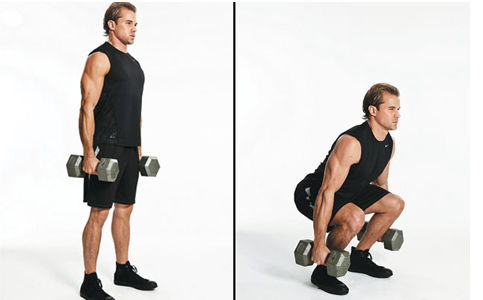
How to perform:
- Hold dumbbells at your sides or in front of your shoulders.
- Perform a standard squat while maintaining balance and control.
Why it works:
A more accessible variation that still develops the legs while requiring less technical skill and spinal loading.
5) Bodyweight Squat (Deep Squat)
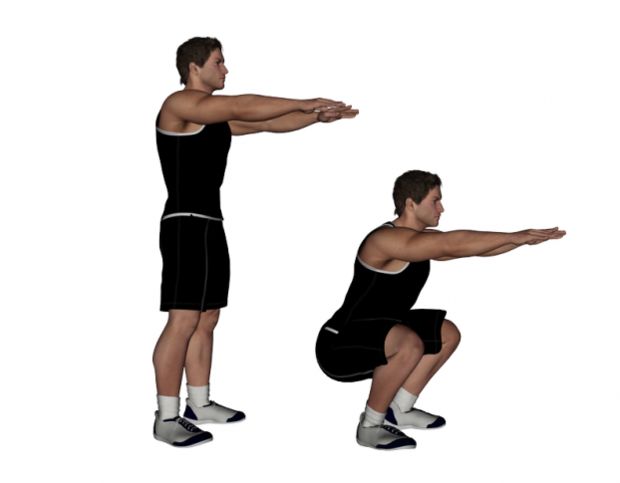
How to perform:
- Stand with feet shoulder-width apart.
- Lower your body under control to full depth.
- Push back up while maintaining proper alignment.
Why it works:
Ideal for beginners or mobility work, helping develop proper squat mechanics before adding load.
Alternative / Replacement Exercises for the Barbell Back Squat
While the barbell back squat is one of the most effective lower-body exercises you can perform, it’s not always the best or most practical option for every lifter. As a coach, I often adjust exercise selection based on mobility, injury history, equipment availability, or specific training goals.
If you cannot perform the squat safely—or simply want to add variety—these exercises can effectively replace or complement the movement.
- Leg Press: A machine-based compound exercise that allows heavy loading with less demand on balance and spinal stability.
- Bulgarian Split Squat: A unilateral movement that builds strength, balance, and muscle symmetry while placing significant demand on the quads and glutes.
- Step-Ups: A functional movement that improves coordination, stability, and single-leg strength.
- Lunges (Barbell or Dumbbell): Effective for building leg strength and addressing imbalances between sides.
- Leg Extension: An isolation exercise that directly targets the quadriceps and is ideal for finishing sets or adding extra volume.
In my experience, no single exercise can fully replace the barbell back squat—but several movements can come close depending on your goal. If your priority is quad hypertrophy, combining leg press and leg extensions can be highly effective. If your goal is functional strength and balance, unilateral movements like Bulgarian split squats and lunges are excellent alternatives.
The key is not to chase one “perfect” exercise, but to build a program where each movement contributes to your overall strength, muscle development, and long-term progress.
Key Benefits of the Barbell Back Squat
The barbell back squat is often called the king of all exercises for a reason—it delivers unmatched benefits for strength, muscle growth, and overall athletic performance. As a coach, I consistently prioritize squats because few movements provide the same return on investment.
- Full-body strength development: Engages the lower body, core, and upper back simultaneously, making it one of the most efficient strength-building exercises.
- Superior muscle-building potential: Heavily loads the quadriceps and glutes, two of the largest muscle groups in the body.
- High progressive overload capacity: Allows you to safely increase weight over time, which is essential for long-term growth.
- Improves functional strength: Transfers directly to real-world movements like lifting, jumping, and athletic performance.
- Enhances core stability: Requires strong bracing and spinal control under load.
- Boosts hormonal response: Heavy compound movements like squats can stimulate a greater overall training response.
- Builds mobility and coordination: Encourages proper hip, knee, and ankle movement patterns when performed correctly.
Who Should Use This Exercise?
The barbell back squat is one of the most versatile and valuable exercises you can include in your training program. When performed correctly, it can benefit nearly every type of lifter—from beginners building a foundation to advanced athletes pushing performance limits.
- Beginners: An essential movement for developing foundational strength, coordination, and proper movement patterns (starting with bodyweight or light loads).
- Intermediate and advanced lifters: A primary strength lift that allows progressive overload and long-term muscle development.
- Bodybuilders: Highly effective for building quadriceps and glute mass, contributing to overall lower-body size and symmetry.
- Athletes: Improves power, balance, and force production, which carry over to sports performance.
- Lifters seeking functional strength: Trains real-world movement patterns like sitting, standing, and lifting.
- Individuals aiming for full-body development: One of the few exercises that effectively integrates multiple muscle groups in a single movement.
Barbell Back Squat vs Leg Press: Which Is Better?
The barbell back squat and the leg press are two of the most popular lower-body exercises, but they serve different roles in a training program. While both target the quadriceps and glutes, the way they load the body and the overall training effect differ.
As a coach working with lifters and athletes, I rarely frame this as a competition. Instead, I see these exercises as complementary tools—each with unique advantages depending on your goal.
| Criteria | Barbell Back Squat | Leg Press |
|---|---|---|
| Movement Type | Free-weight compound | Machine-based compound |
| Stability Requirement | Very high | Low |
| Load Potential | High | Very high |
| Spinal Loading | High | Low |
| Core Engagement | Very high | Low |
| Quad Isolation | Moderate | High |
| Functional Carryover | Very high | Moderate |
If your goal is to build maximum strength, coordination, and full-body development, the barbell back squat should be your primary lift. It teaches you how to control and stabilize weight in space, which is essential for long-term progression.
If your goal is to increase training volume, isolate the quadriceps, and safely push closer to muscular failure, the leg press is an excellent addition.
In practice, the best results come from using both:
- Barbell back squat for strength, coordination, and full-body development
- Leg press for targeted hypertrophy and additional volume
Where This Exercise Fits in a Workout
The barbell back squat is most effective when used as the primary compound movement in a lower-body or full-body workout. Because it requires high levels of strength, coordination, and focus, it should be performed early in the session, when your energy and concentration are at their peak.
As a coach working with lifters and athletes, I almost always program squats as the first or second exercise, depending on the workout’s overall structure. This ensures optimal performance and reduces the risk of a technical breakdown due to fatigue.
Recommended Placement
- As the main lift (most common), perform it at the beginning of your workout for maximum strength and power output.
- In full-body programs: Often placed early, after a general warm-up, to stimulate multiple muscle groups.
- In strength-focused sessions, it is used as the primary movement with heavier loads and longer rest periods.
Sets & Reps Guidelines
- Strength focus: 3–5 sets of 3–6 reps
- Hypertrophy (muscle growth): 3–5 sets of 6–12 reps
- Technique/beginner training: 2–4 sets of 8–12 reps with lighter loads
In my experience, the barbell back squat delivers the best results when it’s treated as a priority lift, not something you squeeze in at the end of a workout. If you’re fatigued before you even get under the bar, your technique and performance will suffer.
Approach each set with focus, intention, and proper preparation—this is where real strength is built.
Conclusion
The barbell back squat truly earns its reputation as the king of all exercises by delivering unmatched benefits for strength, muscle growth, and full-body development. It is not just a leg exercise—it is a foundational movement that builds coordination, stability, and power across the entire body.
As a coach, I consistently see that lifters who prioritize proper squat technique and progressive overload make the fastest and most sustainable progress. The key is not simply lifting heavier weights, but mastering control, depth, and consistency with every repetition.
When performed correctly and programmed intelligently, the barbell back squat becomes one of the most powerful tools you can use to transform your physique and elevate your overall performance.
What is the barbell back squat?
The barbell back squat is a compound lower-body exercise where a barbell is placed on the upper back, and the lifter lowers their body by bending the hips and knees before standing back up.
What muscles does the barbell back squat work?
The barbell back squat primarily targets the quadriceps and glutes, while also engaging the hamstrings, adductors, core, and upper back.
How deep should you squat?
You should aim to squat until your thighs are at least parallel to the floor, or deeper if your mobility allows, while maintaining proper form.
Is the barbell back squat safe?
Yes, the barbell back squat is safe when performed with proper technique, appropriate weight, and good mobility. Poor form is the main cause of injuries.
Should your knees go past your toes in a squat?
It’s normal for the knees to move slightly past the toes, depending on your body structure and squat depth. The key is maintaining control and alignment.
What is the best stance for barbell back squats?
A shoulder-width stance with slightly turned-out toes works best for most lifters, but individual variations may apply.
How often should I do barbell back squats?
Most lifters benefit from performing the barbell back squat 1–3 times per week, depending on their program and recovery.
What is the difference between high-bar and low-bar squat?
High-bar squats emphasize the quadriceps with a more upright torso, while low-bar squats shift more load to the hips, glutes, and posterior chain.
Can beginners do barbell back squats?
Yes, beginners can perform the barbell back squat, but they should start with bodyweight or light loads to learn proper technique.
How do I improve my barbell back squat?
Focus on proper technique, progressive overload, mobility work, and consistent practice to improve your squat over time.

1 Comment
It is really a great and helpful piece of info. I’m happy that you simply shared this helpful information with us. Please keep us up to date like this. Thank you for sharing.|