
Overview (Introduction)
The dumbbell squat is one of the best beginner-friendly lower-body exercises for building strong, stable, and well-developed legs. Unlike the barbell squat, where the load sits on your back, the dumbbell squat places the weight at your sides, making it easier to control and significantly reducing stress on the spine.
As a coach working with lifters and athletes, I often use the dumbbell squat as a starting point for developing proper squat mechanics. It allows beginners to focus on key fundamentals—like balance, depth, and posture—without being overwhelmed by heavy loading or complex setup. At the same time, it remains effective enough for more experienced lifters when used for higher-rep hypertrophy work.
Another major advantage is its versatility. The dumbbell squat can be used to build quadriceps and glute strength, improve coordination, and even serve as a transition toward more advanced movements like the barbell squat. When performed with control and proper technique, it becomes a highly effective tool for both muscle development and long-term progression.
Equipment Needed
To perform the dumbbell squat effectively, you don’t need much equipment—but using the right setup can significantly improve both your stability and movement quality. This is one of the reasons why it’s such a popular exercise for beginners and home workouts.
As a coach working with lifters and athletes, I often use the dumbbell squat because it removes many of the setup barriers found in barbell training while still delivering a strong lower-body stimulus.
- Dumbbells (pair or single, depending on variation)
- Flat, stable surface (gym floor or non-slip area)
- Supportive footwear (or barefoot for better balance and foot control)
In practice, the most important factor is maintaining balance and control, since the load is held at your sides rather than fixed on your body. This makes proper stance and foot positioning even more important for a smooth and stable squat.
Step-by-Step Instructions for the Dumbbell Squat
Executing the dumbbell squat correctly starts with a stable, balanced setup. As a coach, I always emphasize that this exercise is about control and positioning, not just moving the weight. If your setup is solid, everything that follows becomes much easier and more effective.
A. Starting Position (Setup)
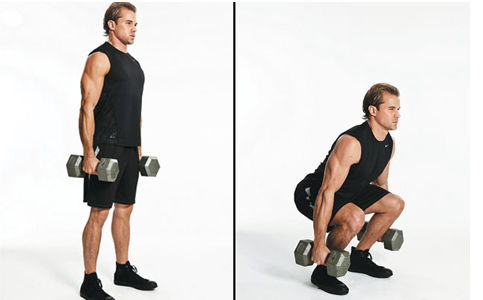
- Stand upright with your feet about shoulder-width apart or slightly wider.
- Hold a pair of dumbbells at your sides with a neutral grip (palms facing each other).
- Keep your arms fully extended and relaxed, allowing the dumbbells to hang naturally.
- Distribute your weight evenly across your mid-foot and heels.
- Pull your shoulders back slightly and keep your chest up.
- Maintain a neutral spine with your core lightly braced.
- Keep your head in a neutral position, looking forward.
Key coaching cue: Think “tall and tight” before you descend—your posture at the start determines the quality of the entire rep.
B. Movement (Execution)
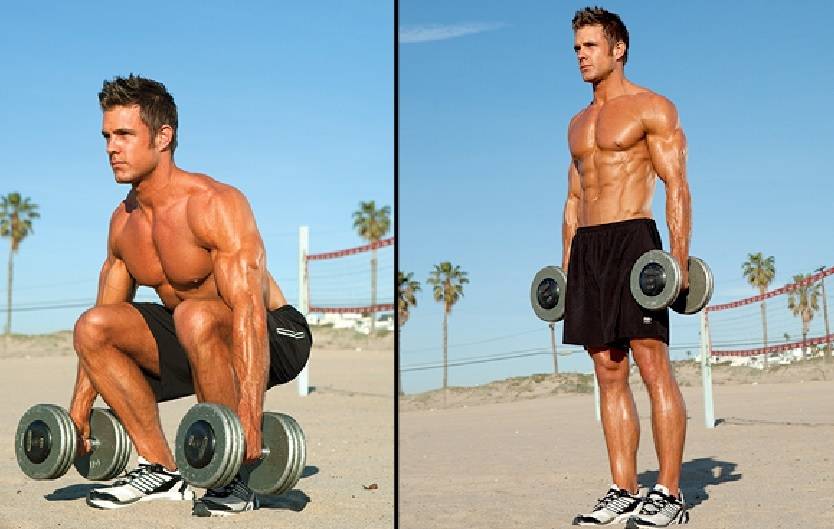
Once your setup is stable, the goal of the dumbbell squat is to move through a full range of motion while maintaining balance, control, and proper alignment. As a coach, I always emphasize that this exercise should feel smooth and controlled—not rushed or unstable.
- Inhale and brace your core before initiating the descent.
- Begin by pushing your hips back slightly while bending your knees.
- Lower your body under control until your thighs are at least parallel to the floor (or deeper if mobility allows).
- Keep your chest up and your spine in a neutral position throughout the movement.
- Ensure your knees track in line with your toes.
- Keep the dumbbells hanging naturally at your sides without swinging.
- At the bottom, pause briefly while maintaining tension.
- Drive upward by pushing through your mid-foot and heels, extending your knees and hips together.
- Exhale as you pass the most difficult part of the movement.
- Return to the starting position without losing balance or posture.
Tempo recommendation: 2–3 seconds down, brief pause, controlled ascent.
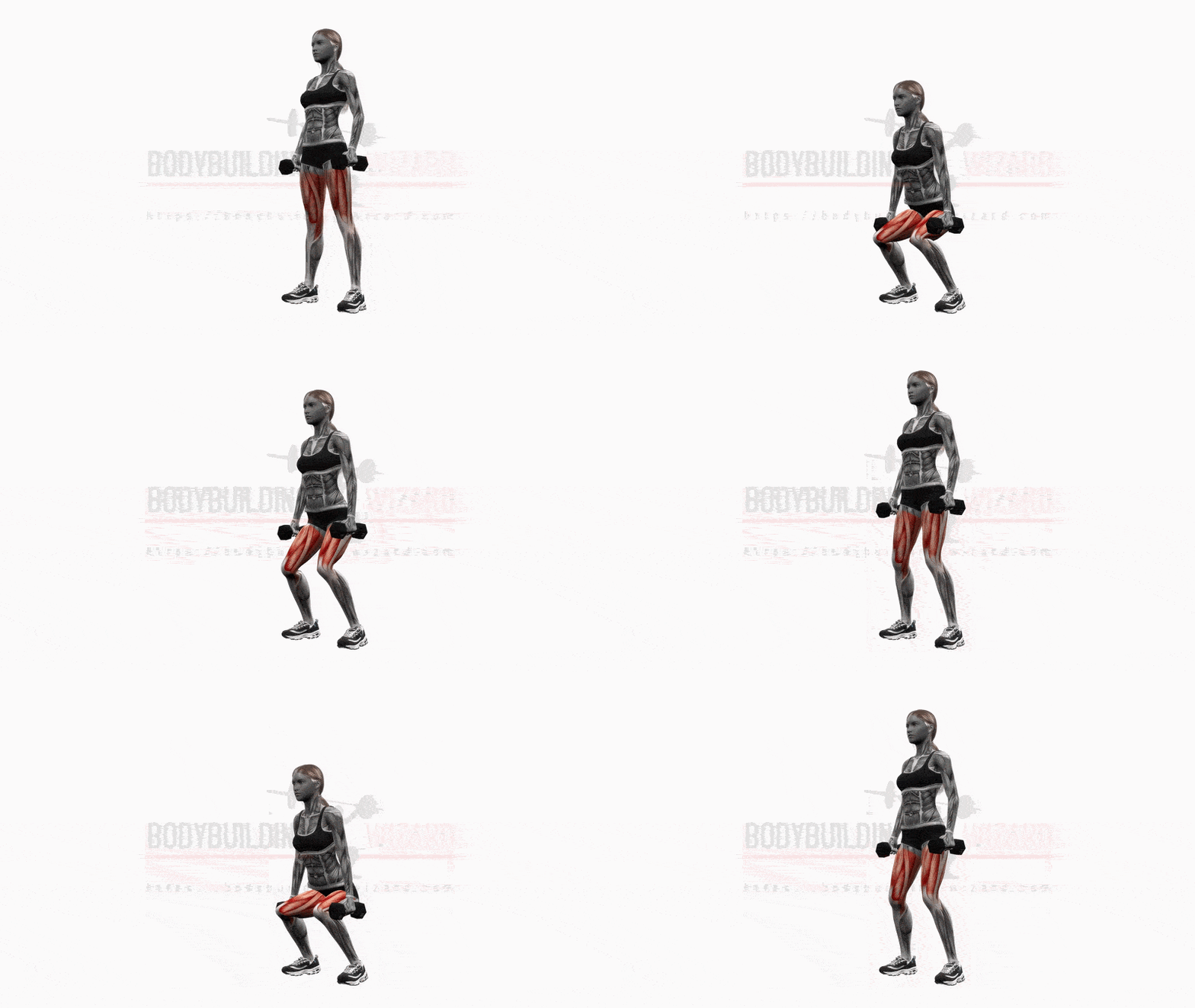
Resistance Curve Insight
The dumbbell squat is typically most challenging in the bottom and mid-range, similar to other squat variations. However, because the load is held at your sides, the exercise often feels more stable and allows for smoother control throughout the movement.
Performance Optimization Tips (Coach’s Cues)
Once you’ve learned the basics, the dumbbell squat becomes a powerful tool for building muscle and refining movement quality—if you execute it with precision. As a coach, I’ve found that the biggest improvements come from small technical adjustments and consistent control, not just increasing weight.
- Brace your core before every rep: Think “tight and stable” to protect your spine and improve balance.
- Keep the dumbbells stable at your sides: Avoid swinging them—let your legs do the work.
- Drive your knees in line with your toes: This ensures proper joint alignment and better quad activation.
- Stay upright throughout the movement: Maintain chest-up posture to reduce forward lean.
- Control the descent: Lower slowly to maximize muscle engagement and maintain balance.
- Push through your heels and mid-foot: This improves force production and overall stability.
- Use a full range of motion: Go as deep as your mobility allows without compromising form.
- Focus on smooth, controlled reps: Consistency beats speed when it comes to results.
Muscles Worked in the Dumbbell Squat
The dumbbell squat is a compound lower-body movement that primarily targets the quadriceps and glutes, while also engaging several supporting muscles to maintain balance and stability. Because the load is held at your sides, this variation often feels more natural and controlled, especially for beginners.
As a coach working with lifters and athletes, I often use the dumbbell squat to help clients develop proper muscle coordination and movement awareness, which later transfers to more advanced squat variations.
Primary Muscles
- Quadriceps (vastus lateralis, vastus medialis, vastus intermedius, rectus femoris): Responsible for knee extension and the primary drivers during the ascent phase.
- Gluteus maximus: Plays a key role in hip extension, especially when pushing out of the bottom position.
Secondary Muscles
- Hamstrings: Assist in hip extension and help stabilize the knee joint.
- Adductors: Contribute to hip stability and assist in force production.
Stabilizers
- Core musculature: Maintains balance and spinal alignment throughout the movement.
- Spinal erectors: Help keep the torso upright and resist forward collapse.
- Calves (gastrocnemius and soleus): Stabilize the ankle joint and assist with balance.
From my experience, the dumbbell squat is one of the best exercises for learning how to feel the quads and glutes working together. Because the movement is less technically demanding than barbell squats, it allows you to focus more on muscle activation and control, which is crucial for long-term progress.
Technical Emphasis & Targeting Adjustments
The dumbbell squat may look simple, but small adjustments in stance, depth, and dumbbell position can significantly change how the exercise feels and which muscles are emphasized. As a coach, I often use these tweaks to shift focus toward the quads, glutes, or overall balance and control.
Stance Width
| Stance | Muscle Emphasis / Training Effect |
|---|---|
| Shoulder-width stance | Balanced development of quadriceps, glutes, and adductors |
| Narrower stance | Increased knee flexion and greater emphasis on the quadriceps |
| Wider stance | More hip involvement and greater emphasis on the glutes and adductors |
Squat Depth
| Depth | Muscle Emphasis / Training Effect |
|---|---|
| Partial squat | Allows heavier loads but reduces overall muscle activation |
| Parallel squat | Strong balance of strength, control, and hypertrophy |
| Deep squat | Greater range of motion and increased activation of quads and glutes, but requires good mobility |
Dumbbell Position
| Position | Effect |
|---|---|
| At sides (neutral grip) | Most stable and beginner-friendly, balanced muscle recruitment |
| Front-loaded (goblet style) | Encourages a more upright torso and increases quad and core engagement |
In my experience, the dumbbell squat is most effective when you first master the basic stance and depth, then gradually experiment with variations like goblet squats or stance adjustments. Trying to overcomplicate the movement too early often leads to poor technique and reduced results.
Exercise Variations (Goblet, Sumo, Front-Loaded)
The dumbbell squat can be easily modified to target different muscle groups, improve technique, or add variety to your training. As a coach, I often rotate through these variations to emphasize specific goals such as quad development, glute activation, or posture improvement.
1) Goblet Squat
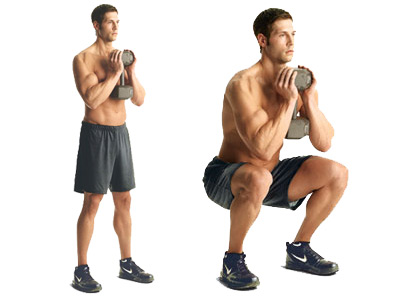
How to perform:
- Hold a single dumbbell vertically close to your chest.
- Keep your elbows pointing down and your torso upright.
- Squat down under control and return to standing.
Why it works:
The goblet squat encourages a more upright torso and is one of the best variations for improving squat mechanics and quad activation, especially for beginners.
2) Sumo Dumbbell Squat
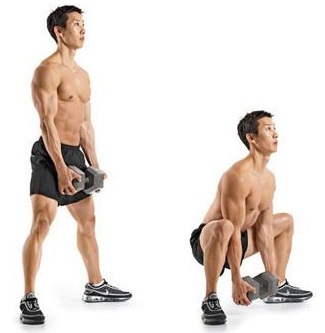
How to perform:
- Stand with a wider-than-shoulder-width stance, toes pointed outward.
- Hold one dumbbell between your legs.
- Lower your body by bending your knees and hips, then return to standing.
Why it works:
This variation shifts more emphasis onto the glutes, inner thighs (adductors), and hips, making it ideal for developing lower-body strength from a different angle.
3) Dumbbell Front Squat
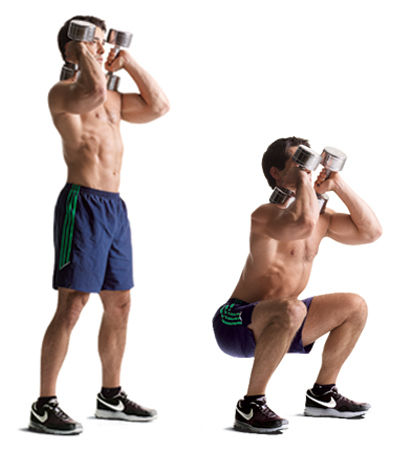
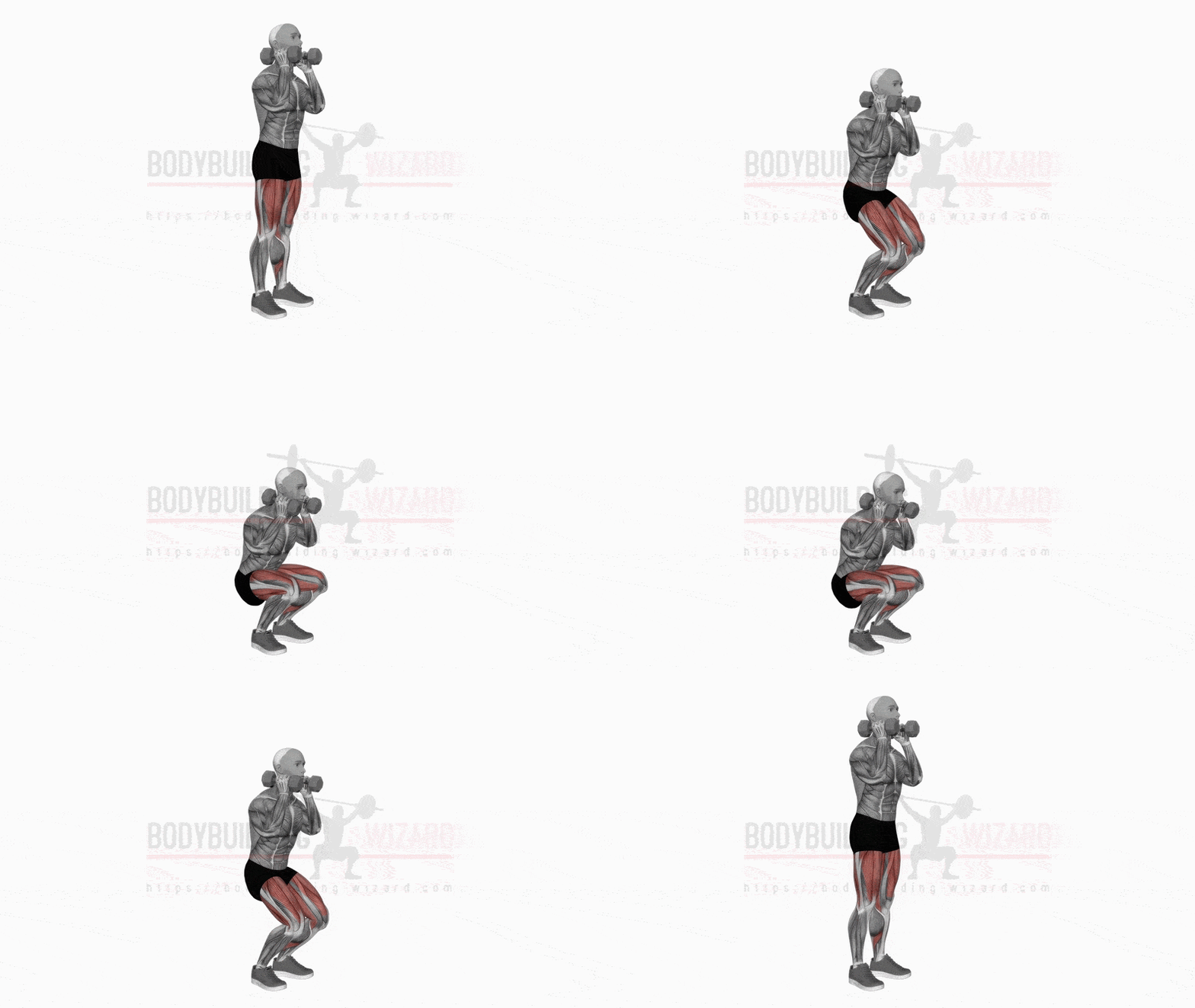
How to perform:
- Hold two dumbbells at shoulder level (front rack position).
- Keep your elbows slightly forward and your torso upright.
- Perform a squat while maintaining control and balance.
Why it works:
The front-loaded position increases core activation and quad engagement, similar to a barbell front squat, while still being more accessible and easier to control.
Alternative / Replacement Exercises for the Dumbbell Squat
While the dumbbell squat is a versatile and beginner-friendly exercise, there are several effective alternatives you can use depending on your goal, experience level, or equipment availability. As a coach, I often rotate these movements to either increase loading potential or target specific weaknesses. For a full overview of the most effective movements, read our article on the best quadriceps exercises for muscle growth.
- Barbell Back Squat: The best option for building maximum strength and allowing progressive overload with heavier weights.
- Barbell Front Squat: A more quad-focused alternative that reinforces upright posture and core stability.
- Leg Press: A machine-based compound exercise that allows high loading with less balance and stability demand.
- Hack Squat: Provides strong quadriceps activation in a controlled movement pattern.
- Bulgarian Split Squat: A unilateral exercise that improves balance, coordination, and muscle symmetry.
- Step-Ups: A functional movement that enhances single-leg strength and stability.
- Leg Extension: An isolation exercise ideal for directly targeting the quadriceps.
In my experience, the dumbbell squat is not just a “beginner exercise”—it’s a highly effective movement that can be used at any level when programmed correctly. However, if your goal is to lift heavier loads or maximize strength, transitioning to barbell-based movements or machine exercises may be more efficient.
The key is to choose the right tool for your goal while maintaining proper technique and consistency.
Key Benefits of the Dumbbell Squat
The dumbbell squat is one of the most accessible and effective lower-body exercises, especially for building strength, muscle, and movement control without the complexity of barbell training. As a coach, I regularly use this exercise to develop both beginners and experienced lifters because of its versatility and low barrier to entry.
- Beginner-friendly and easy to learn: Simple setup and natural movement pattern make it ideal for building confidence and technique.
- Reduced spinal stress: The load is held at your sides, placing less pressure on the lower back compared to barbell squats.
- Improves balance and coordination: Requires control and stability throughout the entire movement.
- Targets quads and glutes effectively: Provides strong lower-body stimulation, especially when performed with a full range of motion.
- Versatile and adaptable: Can be modified with different stances, loads, and variations to suit any fitness level.
- Minimal equipment required: Perfect for home workouts or limited gym setups.
- Great transition exercise: Helps prepare you for more advanced movements like barbell squats.
Who Should Use This Exercise?
The dumbbell squat is one of the most versatile lower-body exercises and can be effectively used by a wide range of individuals—from beginners learning proper movement patterns to advanced lifters adding volume or refining technique.
- Beginners: Ideal for learning squat mechanics, balance, and coordination without the complexity of barbell training.
- Home trainees: Perfect for those training with limited equipment, as dumbbells are widely accessible and easy to use.
- Individuals with lower back concerns: The reduced spinal loading makes it a safer alternative to barbell squats.
- Intermediate and advanced lifters: Useful for adding volume, improving control, and targeting the quads and glutes with higher reps.
- Athletes: Helps build functional strength, coordination, and movement efficiency.
- Those transitioning to barbell squats serve as a stepping stone to develop confidence and technique before progressing to heavier lifts.
Dumbbell Squat vs Barbell Squat: Which Is Better?
The dumbbell squat and barbell squat are both highly effective lower-body exercises, but they serve different purposes depending on your experience level, goals, and available equipment. As a coach working with lifters and athletes, I use both strategically rather than choosing one over the other.
| Criteria | Dumbbell Squat | Barbell Squat |
|---|---|---|
| Load Potential | Moderate | Very high |
| Stability Requirement | Moderate | High |
| Spinal Loading | Lower | Higher |
| Core Engagement | Moderate | High |
| Quad & Glute Activation | High | Very high |
| Ease of Learning | Easy (beginner-friendly) | Moderate to difficult |
| Equipment Needed | Dumbbells only | Barbell + rack |
If your goal is to build maximum strength and lift heavy weights, the barbell squat is the superior option. It allows for greater progressive overload and full-body development.
If your goal is to improve technique, balance, and control, or if you are just starting out, the dumbbell squat is often the better choice. It provides a safer and more accessible way to learn the squat pattern.
In practice, the best results come from using both:
- Dumbbell squat for technique, control, and higher-rep hypertrophy work
- Barbell squat for strength, overload, and long-term progression
Where This Exercise Fits in a Workout
The dumbbell squat is a versatile movement that can be incorporated into different parts of your workout depending on your goal. Because it’s easier to control than barbell squats, it works well as both a primary movement for beginners and a secondary or accessory exercise for more advanced lifters.
As a coach working with lifters and athletes, I often program the dumbbell squat based on experience level and training focus. It’s one of those exercises that can adapt to almost any routine.
Recommended Placement
- As a main lift (beginners): Perform at the start of your workout to build technique, confidence, and foundational strength.
- As a secondary movement: Use after barbell squats to add volume and reinforce proper movement patterns.
- In full-body workouts: Works well early in the session to engage multiple muscle groups.
- In-home workouts: Often serve as the primary lower-body exercise due to minimal equipment requirements.
Sets & Reps Guidelines
- Hypertrophy (muscle growth): 3–4 sets of 8–15 reps
- Endurance/conditioning: 2–4 sets of 12–20 reps
- Technique/beginner training: 2–4 sets of 10–15 controlled reps
In my experience, the dumbbell squat works best when you focus on control, consistency, and full range of motion, rather than chasing heavier weights. It’s an excellent exercise for building a strong foundation and reinforcing good habits that will carry over to more advanced lifts.
Conclusion
The dumbbell squat is one of the most practical and effective exercises for building lower-body strength, muscle control, and proper squat mechanics. Its simplicity makes it ideal for beginners, while its versatility allows more advanced lifters to use it for volume, technique refinement, and targeted muscle work.
As a coach, I’ve seen that mastering the dumbbell squat creates a strong foundation for long-term progress. It teaches you how to move with control, maintain balance, and develop the coordination needed for more advanced lifts.
When performed consistently and with proper technique, the dumbbell squat becomes far more than just a beginner exercise—it becomes a reliable tool for building stronger, more functional legs.
What is a dumbbell squat?
The dumbbell squat is a compound lower-body exercise performed by holding dumbbells while squatting, primarily targeting the quads and glutes.
What muscles does the dumbbell squat work?
The dumbbell squat mainly works the quadriceps and glutes, while also engaging the hamstrings, calves, core, and lower back stabilizers.
Is the dumbbell squat good for beginners?
Yes, the dumbbell squat is one of the best beginner exercises because it is easy to learn and helps develop proper squat technique.
Is the dumbbell squat as effective as the barbell squat?
The dumbbell squat is very effective for muscle development and technique, but the barbell squat allows heavier loading for maximum strength gains.
How heavy should dumbbells be for squats?
Choose a weight that allows you to maintain proper form for your target reps. Beginners should start light and gradually increase the load.
Should your heels stay on the ground during a dumbbell squat?
Yes, your heels should remain firmly on the ground to maintain balance and proper force production.
How deep should you squat with dumbbells?
You should aim for at least parallel depth or deeper if your mobility allows while maintaining proper form.
Can dumbbell squats build muscle?
Yes, the dumbbell squat can build muscle effectively, especially when performed with proper form, sufficient volume, and progressive overload.
What is the difference between goblet squat and dumbbell squat?
The goblet squat holds the weight in front of the body, while the dumbbell squat typically holds weights at the sides, affecting posture and muscle emphasis.
How often should I do dumbbell squats?
Most people can perform dumbbell squats 2–3 times per week, depending on their program and recovery.
