



Introduction
The stiff-leg deadlift is one of the most powerful compound exercises for developing the hamstrings, glutes, and the entire posterior chain through loaded hip-hinging. Unlike machine-based leg curl variations that isolate knee flexion, the stiff-leg deadlift places a heavy emphasis on the hamstrings in their hip-extension role while subjecting them to intense stretch tension.
This exercise is essentially the top half of a conventional deadlift performed with minimal knee flexion. Because the knees remain relatively stiff throughout the movement, the quadriceps contribute far less, forcing the hamstrings and glutes to handle most of the workload. The result is a highly effective mass-building movement that can produce exceptional posterior-chain development when performed correctly.
The stiff-leg deadlift is also one of the most technically demanding hamstring exercises. Proper spinal positioning, hip control, and movement mechanics are critical because poor execution shifts stress from the hamstrings to the lower back. For this reason, beginners should start with lighter weights and focus on mastering technique before progressing to heavier loads.
When executed properly, the stiff-leg deadlift creates tremendous stretch-mediated tension in the hamstrings — one of the main reasons this exercise is known for causing intense muscle soreness and long-term hypertrophy adaptations.
Required Equipment
To perform the stiff-leg deadlift correctly, you need:
- Barbell
- Weight plates
- Flat lifting surface
- Optional lifting straps for grip support
Because the stiff-leg deadlift is a free-weight compound movement, stability and technique are far more important than simply adding weight. Most lifters should begin conservatively and prioritize proper hip hinging mechanics before attempting heavy loads.
Unlike conventional deadlifts, the stiff-leg variation minimizes knee flexion and places much greater stretch tension directly on the hamstrings. This makes the exercise extremely effective for posterior-chain hypertrophy but also significantly more demanding on flexibility, spinal positioning, and movement control.
Other Names for the Stiff-Leg Deadlift
This exercise may also be referred to as:
- Straight-Leg Deadlift
- Barbell Straight-Leg Deadlift
- Stiff-Legged Deadlift
- SLDL
- Straight-Leg Barbell Deadlift
Although terminology varies, all versions involve a hip-dominant deadlift pattern performed with minimal knee bend to maximize hamstring loading.
How to Perform the Stiff-Leg Deadlift
Starting Position (Setup)
Proper setup is essential because the stiff-leg deadlift places significant tension on the hamstrings and lower back. Small technical errors can quickly shift stress away from the posterior chain and increase spinal strain.
- Stand upright with your feet hip-width apart.
- Hold the barbell in front of your thighs using an overhand grip.
- Keep your knees slightly bent but fixed throughout the movement.
- Retract the shoulders slightly and keep the chest proud.
- Maintain a neutral spine with a slight natural lumbar arch.
- Brace the core before initiating the descent.
The knees should remain “soft” rather than fully locked, but the knee angle should not change significantly during the exercise.

Execution (Movement Phase)
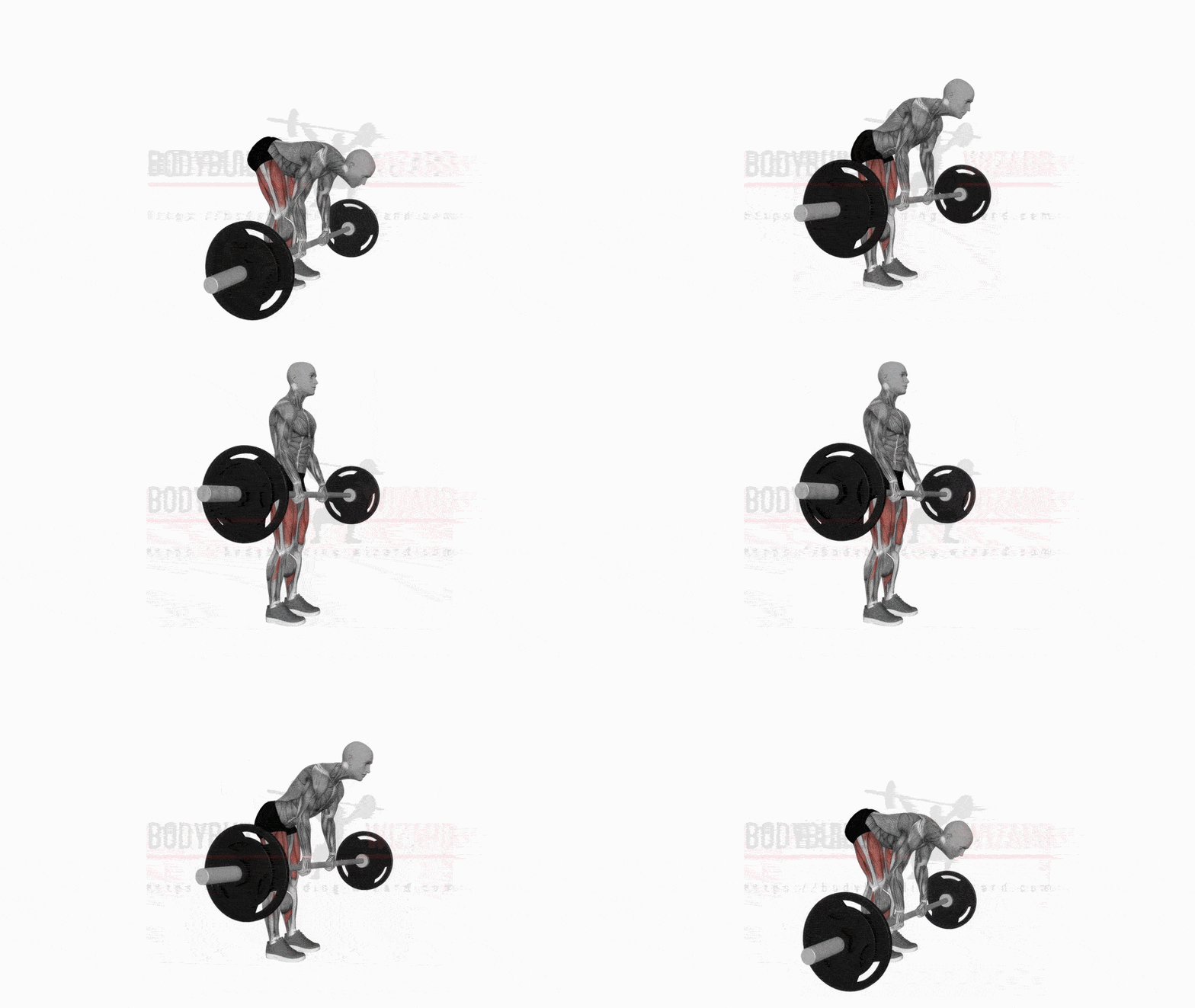
- Initiate the movement by pushing the hips backward.
- Lower the bar slowly while keeping it close to the legs.
- Maintain a flat back and neutral head position throughout the descent.
- Continue lowering until the maximal hamstring stretch is reached without spinal rounding.
- Drive the hips forward to return to the starting position.
- Squeeze the glutes and hamstrings at the top without leaning back excessively.
The stiff-leg deadlift should feel like a controlled hip hinge — not a squat and not a lower-back movement.
Technique Optimization Tips for the Stiff-Leg Deadlift
Because this exercise places the hamstrings under extreme stretch tension, strict technique is critical for both effectiveness and safety.
- Keep the barbell close to the body at all times.
- Push the hips backward rather than bending downward.
- Maintain a neutral spine throughout the movement.
- Avoid excessive knee bending during the descent.
- Lower only as far as hamstring flexibility allows.
- Control the eccentric phase slowly.
- Keep the shoulders pulled back and chest open.
A highly effective cue is: “Reach the hips back while dragging the bar down the legs.”

Mechanical Resistance Analysis
The stiff-leg deadlift places heavy emphasis on the hamstrings because knee movement remains minimal while the hips move through large ranges of flexion and extension. This creates substantial eccentric loading and stretch-mediated tension within the posterior chain.
Compared to leg curl variations, the stiff-leg deadlift trains the hamstrings more functionally because the muscles work simultaneously with the glutes, spinal erectors, and upper back stabilizers. This allows for significantly greater loading potential and more extensive posterior chain recruitment.
The exercise becomes most challenging near the bottom position, where the hamstrings are maximally stretched, and leverage is at its lowest. For this reason, flexibility, spinal stability, and eccentric control play enormous roles in both performance and injury prevention.
Common Mistakes
The stiff-leg deadlift is highly effective, but it is also one of the easiest hamstring exercises to perform incorrectly. Poor technique can quickly shift stress from the hamstrings to the lower back.
- Rounding the lower back during the descent
- Allowing the bar to drift away from the body
- Turning the movement into a squat
- Bending the knees excessively
- Lowering beyond available hamstring mobility
- Jerking or bouncing the weight at the bottom
- Hyperextending the spine at the top
One of the biggest mistakes is chasing range of motion instead of maintaining proper spinal alignment. The bar only needs to travel as low as your hamstring flexibility allows while keeping the back neutral.
Muscles Involved in the Stiff-Leg Deadlift
Understanding muscle recruitment helps explain why the stiff-leg deadlift is one of the best overall posterior-chain exercises.

MAIN MUSCLES:
SECONDARY MUSCLES:
Spinal erectors, adductor magnus, and upper back musculature
ASSISTING MUSCLES:
Forearms, trapezius, core stabilizers
ANTAGONISTS:
Stiff-Leg Deadlift Pros and Cons
The stiff-leg deadlift is one of the most powerful exercises for developing the hamstrings and posterior chain because it combines heavy loading with extreme stretch tension. However, its technical demands also make proper execution especially important.
Advantages
- Exceptional hamstring stretch tension
Few exercises place the hamstrings under as much loaded stretch as the stiff-leg deadlift. - Excellent posterior-chain development
The movement simultaneously trains the hamstrings, glutes, spinal erectors, and upper back stabilizers. - Strong hypertrophy potential
Heavy loading combined with eccentric tension makes the exercise highly effective for muscle growth. - Functional strength carryover
The hip-hinge mechanics transfer well to athletic performance and many real-world lifting patterns. - Minimal equipment requirements
Only a barbell and plates are needed to perform the exercise effectively.
Potential Drawbacks
Despite its benefits, the stiff-leg deadlift also has limitations and risks.
- High technical demand
Poor spinal positioning can quickly increase lower-back stress. - Greater injury risk than machine curls
Free-weight hip hinging requires significantly more control and coordination. - Hamstring soreness can be extreme
The loaded stretch often produces severe delayed-onset muscle soreness, especially in beginners. - Not ideal for complete beginners
Many new lifters lack the flexibility, mobility, or hip-hinge mechanics required to perform the exercise safely.
Many lifters mistakenly treat the stiff-leg deadlift as a lower-back exercise or try to force excessive range of motion by rounding the spine. In reality, the goal is controlled hamstring loading through proper hip hinging — not touching the floor at all costs.
As a coach working with athletes and physique-focused lifters, I’ve consistently found that the best results come from moderate loads, slow eccentrics, and stopping the descent the moment spinal position begins to deteriorate.
Stiff-Leg Deadlift Variations
Small changes in equipment, range of motion, or knee position can significantly alter hamstring recruitment, loading mechanics, and the overall feel of the exercise. Strategically rotating variations can help improve long-term posterior chain development while reducing overuse stress.
Dumbbell Stiff-Leg Deadlift
Using dumbbells instead of a barbell allows greater freedom of movement and may feel more natural for beginners learning hip-hinge mechanics. Dumbbells can also slightly increase the range of motion, depending on mobility and body structure.

Romanian Deadlift
The Romanian deadlift is mechanically very similar but usually involves slightly more knee flexion and a greater emphasis on controlled eccentric tension. Many lifters find it safer and easier to learn than strict stiff-leg deadlifts.

Deficit Stiff-Leg Deadlift
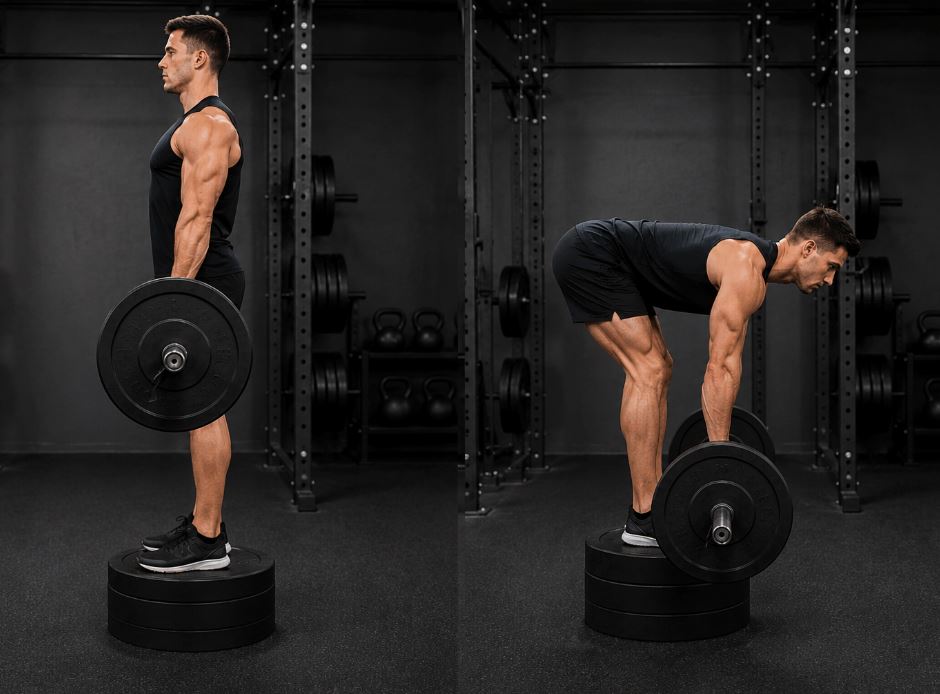
Standing on an elevated platform increases the range of motion and hamstring stretch tension. However, this variation also significantly increases mobility demands and lower-back stress, making it appropriate only for advanced lifters with excellent technique.
Single-Leg Stiff-Leg Deadlift
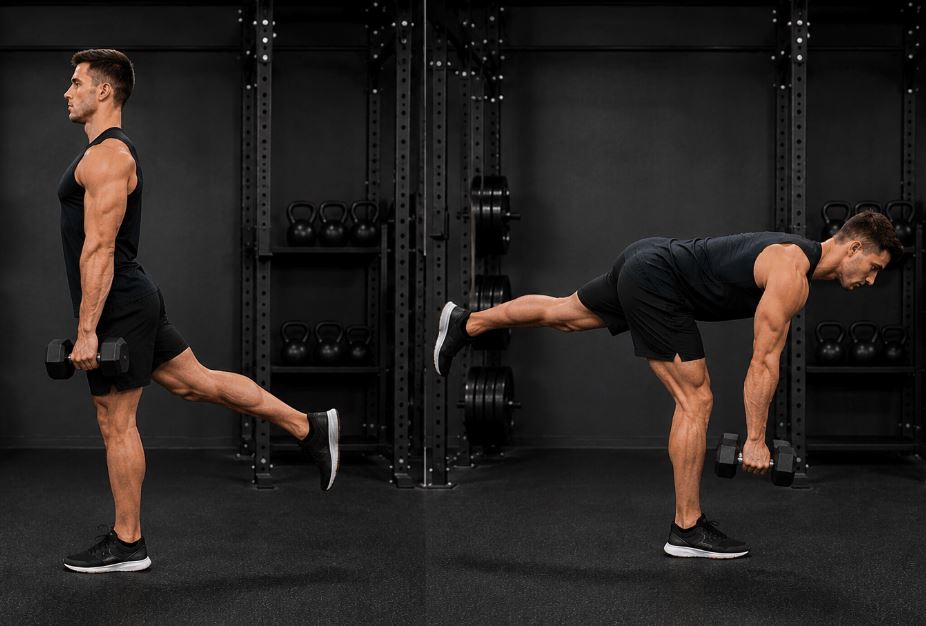
Performing the movement unilaterally increases balance demands, hip stability, and muscular coordination while also helping correct left-to-right imbalances.
Smith Machine Stiff-Leg Deadlift
The Smith machine provides additional stability and reduces the need for balance. This allows some lifters to focus more directly on hamstring tension and controlled tempo.

Alternative Exercises for Hamstring Development
Although the stiff-leg deadlift is one of the best posterior-chain exercises, combining it with hip-dominant and knee-flexion movements usually produces more complete hamstring development.
Lying Leg Curl
The lying leg curl isolates knee flexion and allows direct hamstring training with minimal lower-back involvement. It works especially well alongside heavy hip-hinge movements.

Seated Leg Curl
The seated leg curl trains the hamstrings in a stretched position due to hip flexion and is highly effective for hypertrophy-focused hamstring work.

Nordic Hamstring Curl
The Nordic hamstring curl is one of the most demanding eccentric hamstring exercises and is widely used for injury prevention and athletic development.

Glute-Ham Raise
The glute-ham raise combines hip extension and knee flexion into one challenging posterior-chain exercise that develops both strength and muscular coordination.

Stiff-Leg Deadlift vs Romanian Deadlift
Both exercises are highly effective hip-hinge movements for developing the hamstrings and posterior chain, but small differences in knee position, range of motion, and execution significantly change how the muscles are loaded. Understanding these distinctions helps you choose the best variation based on your goals, mobility, and training experience.
Conclusion: Both exercises are exceptional for hamstring and posterior-chain development. The stiff-leg deadlift creates greater hamstring stretch tension and technical challenge, while the Romanian deadlift usually offers safer loading mechanics and better overall control for most lifters.
Why Stretch Tension Makes the Stiff-Leg Deadlift So Effective
One of the main reasons the stiff-leg deadlift is so effective for hamstring growth is the extreme stretch tension created during the eccentric phase. Because the knees remain relatively fixed while the hips hinge deeply backward, the hamstrings are lengthened under heavy load throughout the descent.
This type of loading creates high levels of mechanical tension — one of the primary drivers of hypertrophy. Many lifters also experience intense delayed-onset muscle soreness after stiff-leg deadlifts because the hamstrings are exposed to substantial eccentric stress at long muscle lengths.
However, this same benefit is also why the exercise must be approached carefully. Excessive range of motion, poor spinal positioning, or uncontrolled tempo can quickly shift tension away from the hamstrings and place unnecessary stress on the lumbar spine.
Final Thoughts
The stiff-leg deadlift is one of the best exercises for building stronger hamstrings, glutes, and posterior chain through heavy, stretch-focused hip-hinging.
When performed with proper spinal alignment, controlled eccentrics, and disciplined technique, it becomes an outstanding mass-building movement that dramatically improves hamstring hypertrophy and overall posterior strength. Because of its technical demands, however, mastering form should always take priority over chasing heavier weights.
Why does the stiff-leg deadlift cause more hamstring soreness than leg curls?
The stiff-leg deadlift places the hamstrings under heavy eccentric tension while they are fully stretched. This combination of stretch and loading creates much greater muscle damage and mechanical stress than most machine-based hamstring exercises.
Should the knees be completely locked during stiff-leg deadlifts?
For most lifters, no. Keeping a very slight knee bend is usually safer and allows better hip hinging mechanics while still maintaining strong hamstring emphasis. Fully locked knees often increase unnecessary stress on the joints and lower back.
Why do some lifters feel stiff-leg deadlifts mostly in the lower back?
This usually happens when the hips stop moving backward and the spine begins compensating instead. Poor hamstring mobility, excessive range of motion, or loss of spinal neutrality are the most common causes.
Are stiff-leg deadlifts better for hamstrings than Romanian deadlifts?
Not necessarily better — just different. Stiff-leg deadlifts generally create greater stretch tension, while Romanian deadlifts usually allow safer loading mechanics and more consistent posterior-chain control for most lifters.
Should stiff-leg deadlifts touch the floor?
In most cases, no. The range of motion should end once maximal hamstring stretch is reached without spinal rounding. For many lifters, this occurs somewhere between mid-shin and just above the ankles.
Why is bar path so important during stiff-leg deadlifts?
Keeping the bar close to the legs reduces leverage stress on the lower back and maintains better hamstring loading. When the bar drifts forward, spinal stress increases dramatically while hamstring efficiency decreases.
Can stiff-leg deadlifts improve athletic performance?
Yes. Stronger hamstrings and glutes improve sprinting mechanics, jumping power, deceleration control, and posterior-chain force production. However, athletes usually benefit most when stiff-leg deadlifts are combined with explosive movements and unilateral training.
Are lifting straps useful for stiff-leg deadlifts?
For many advanced lifters, yes. Hamstrings are often capable of handling more load than grip strength can support during high-rep or heavy posterior-chain training. Straps can help maintain focus on hamstring tension instead of grip fatigue.

1 Comment
Way cool! Some extremely valid points! I appreciate you penning this post and also the rest of the website is also very good.|