



The lat prayer pulldown is a kneeling cable exercise in which you hold a rope or bar attached to a high pulley and pull it down in an arc by moving only at the shoulders, with the elbows slightly bent and fixed. The torso stays inclined forward, and the hands finish near your head, a position that resembles praying, which gives the exercise its name. It trains the latissimus dorsi and teres major with very little involvement of the elbow flexors.
The movement belongs to the pullover family, along with the dumbbell pullover and the machine pullover, but the direction of resistance makes a real difference. In a study of the barbell pullover, the pectoralis major was more active than the latissimus dorsi, and the activation depended on the lever arm of the external load. With a cable pulling from above, the lat prayer pulldown loads the arms in a different part of the range, which is one reason many lifters feel their lats more strongly on it.
In this guide, you’ll learn how to perform the lat prayer pulldown with proper form, which muscles it works, how to program it, and how it compares with the standing straight-arm lat pulldown.
The lat prayer pulldown (kneeling lat prayer) is a single-joint cable exercise performed kneeling in front of a high pulley, in which a rope or bar is pulled downward in an arc through shoulder extension, with the elbows slightly bent and fixed and the torso inclined forward, until the hands reach the area of the head. The exercise mainly trains the latissimus dorsi and teres major, with help from the long head of the triceps and the pectoralis major.
When clients first see the lat prayer pulldown, they often think it’s a cable crunch with straight arms or just a kneeling version of the straight-arm pulldown. I understand why: from a distance, all three look similar. The difference is which joint moves. In the lat prayer pulldown, only the shoulders move. The torso stays at the same angle, and the elbows stay slightly bent.
If the torso bends forward and down during the rep, the abs take over and the exercise turns into a cable crunch. If the elbows bend and straighten, the triceps join in and it starts to look like a pushdown. The straight-arm pulldown uses the same shoulder action as the lat prayer, but in a standing position and through a different part of the range. I use the lat prayer when I want clients to feel their lats in the overhead, stretched position without the arms doing the work.
— Krunoslav, Ph.D. in Kinesiology
Other Names for the Lat Prayer Pulldown
You’ll come across this exercise under several names:
- Kneeling lat prayer – the most common short name.
- Kneeling cable pullover – highlights its connection to the pullover family.
- Kneeling straight-arm pulldown – describes the arm action in a kneeling position.
- Lat prayer – an informal gym name.
Required Equipment
You need a high pulley and a suitable attachment. If you’re new to cables, our beginner’s guide to cable pulley machines covers the basics:
- High cable pulley. A cable column or crossover station set at its highest position.
- Rope or straight-bar attachment. A rope is the most common choice; a straight bar or EZ-bar also works.
- Knee pad or mat. Makes kneeling more comfortable during longer sets.
How to Perform the Lat Prayer Pulldown
The lat prayer pulldown is simple, but the setup decides whether your lats or your abs do the work. Set the cable distance and torso angle before the first rep.
Starting Position

Attach a rope to the high pulley, then:
- Kneel facing the cable about one to two steps away, so the cable is under tension when your arms reach up toward the pulley.
- Hold the rope with both hands in a neutral grip, palms facing each other.
- Sit your hips slightly back and incline your torso forward, roughly 30–45 degrees from vertical.
- Extend your arms up and forward toward the pulley with a slight, fixed bend in the elbows, letting the shoulder blades rise naturally into a stretch.
- Keep your spine and neck neutral and brace your trunk lightly.
Execution

From the stretched position, move only at the shoulders:
- Pull the rope down in an arc by bringing your upper arms toward your torso, keeping the elbow bend constant.
- Let the shoulder blades move down naturally as the arms come down.
- Keep your torso angle and hip position the same throughout; don’t crunch forward or sit back.
- Stop when your upper arms are roughly in line with your torso and your hands are near the top of your head or forehead, then pause briefly.
- Return the rope under control along the same arc until your arms are fully reaching toward the pulley again.
- Exhale during the pull and inhale as you return.
Each rep should look like the arms are the only thing moving. If your body moves with them, lower the weight.
Video Demonstration
The video below shows the lat prayer pulldown from setup to the final rep. Notice how far the lifter kneels from the cable and how the torso keeps the same angle throughout the set.
Watch the elbows and the torso. In a good rep, the elbow bend stays the same, and the torso stays still, while the arms travel through a wide arc. Filming yourself from the side makes it easy to see whether you start crunching forward.

The most common mistake I see on the lat prayer pulldown is what I call the “deep bow.” With every rep, the lifter bows a little lower, like someone praying more and more fervently, until the forehead almost touches the floor. The name of the exercise doesn’t help. By the end of the set, the abs are doing most of the work and the lats are barely involved.
With clients, I ask them to pick a spot on the floor in front of them and keep looking at it, so the head and torso stay at the same height. Only the arms are allowed to move. The weight usually has to come down quite a bit, but most clients are surprised how strongly they feel their lats in the stretched position at the top. Some even tell me it’s the first time they’ve really felt their lats on any cable exercise.
Quick Form Checklist
Check these points before and during every set:
- Kneeling far enough back for tension at the top
- Torso inclined and fixed, hips still
- Slight, constant bend in the elbows
- Arms finish roughly in line with the torso, hands near the head
- Controlled return to a full stretch
On the lat prayer pulldown, the attachment changes how your hands and elbows feel through the arc. This is the overview I give my clients:
| Attachment | Hand Position | Typical Characteristics |
|---|---|---|
| Rope (neutral grip) | Palms facing each other; hands can separate slightly at the bottom | The standard choice; comfortable for most shoulders and wrists |
| Straight bar or EZ-bar (pronated grip) | Palms facing down, hands about shoulder width | A fixed hand position; some lifters find it easier to keep the elbows still |
| Single D-handle (one arm) | Neutral or slightly pronated, free to rotate | Lets you train each side separately and focus on one lat at a time |
I start almost every client with the rope, because it lets the hands find a comfortable position and separate slightly at the bottom of the arc. When a client has trouble keeping the elbows fixed, a straight bar or EZ-bar can help, because the fixed hand position makes it harder to sneak in a triceps extension.
The single-handle version is my choice for clients who feel one lat clearly better than the other. Working one side at a time makes it easier to focus on the weaker side and to keep the torso still. Whatever attachment you use, the rule is the same: the elbow angle stays fixed, and only the shoulders move.
— Krunoslav, Ph.D. in Kinesiology
Technical Emphasis & Targeting Adjustments
Small changes in how you perform the lat prayer pulldown shift where you feel it. Use these cues as practical adjustments:
- Constant elbow bend → more lat emphasis. Keeping the elbows fixed prevents the triceps from turning the exercise into a pushdown.
- Torso fixed → less abdominal takeover. Holding the same torso angle keeps the work at the shoulders rather than in the abs.
- Reach long at the top → more stretch. Letting the arms reach fully toward the pulley and the shoulder blades rise trains the lats in their lengthened position.
- Think “elbows toward the hips” → stronger lat focus. This internal cue helps many lifters feel the lats; in a study of the lat pulldown, specific instruction to focus on the lats increased latissimus dorsi activity in untrained women.
- Slow return for about 3 seconds → more eccentric control. A controlled return makes the top stretch easier to feel and harder to rush through.
Common Lat Prayer Pulldown Mistakes
Most lat prayer pulldown mistakes come from letting other muscles take over. Watch for these:
- Crunching forward. Bending the torso down turns the exercise into a kneeling cable crunch. Keep the torso angle fixed.
- Bending and straightening the elbows. Changing the elbow angle brings in the triceps. Keep a slight, constant bend.
- Kneeling too close to the cable. If the cable goes slack at the top, you lose tension in the stretched position. Move back until the arms are pulled up toward the pulley.
- Sitting back with the hips. Moving the hips back and forth adds momentum. Keep the hips still.
- Using too much weight. Heavy loads almost always lead to crunching or elbow bending. Choose a weight you can control with the arms alone.
Find your kneeling spot by testing the stretch, not by guessing. Kneel with your arms reaching toward the pulley and slowly shuffle back on your knees until you feel the cable pulling your arms up and forward into a clear stretch along the sides of your back. That’s your spot.
If you kneel too close, the cable hangs almost vertically and the top of each rep feels easy. If you kneel too far back, the rope pulls you forward and you’ll have to fight to stay in position. Once you find the right distance, place your knee pad there and use the same spot every session, so every set starts from the same position.
Mechanical Considerations
In the lat prayer pulldown, the shoulder moves from an overhead position toward the torso, while the elbow stays fixed. Because the torso is inclined and the cable pulls from above and in front, the arms meet strong resistance when they’re reaching overhead, where the lats are lengthened. As the arms come down toward the head, the angle between the cable and the arms changes, and the resistance at the shoulder generally decreases. This is biomechanical reasoning, not a measured result, and the exact profile depends on how far you kneel from the pulley.
No study appears to have examined the lat prayer pulldown directly. There’s growing interest in training muscles at long lengths: for example, cable elbow extensions performed with the arm overhead produced about 1.4 times more triceps growth than the same exercise with the arm at the side. That study looked at the triceps, not the lats, so it can’t prove the same effect for this exercise, but it’s a reasonable argument for exercises that load the lats in a stretched position.
Muscles Worked by the Lat Prayer Pulldown
The lat prayer pulldown is an isolation exercise, because only the shoulder joint moves:
MAIN
- Latissimus dorsi – extends the shoulder, bringing the arms down from overhead.
- Teres major – works with the lats in shoulder extension.
SECONDARY
- Triceps brachii (long head) – crosses the shoulder and assists shoulder extension.
- Pectoralis major – the lower fibers assist in bringing the arms down from overhead; see our chest muscles anatomy guide.
- Posterior deltoid – assists shoulder extension.
STABILIZERS
- Rectus abdominis and other core muscles – hold the torso at a fixed angle.
- Lower trapezius, rhomboids, and serratus anterior – control the shoulder blades.
- Rotator cuff and forearm muscles – stabilize the shoulder and hold the attachment.
Pros and Cons
The lat prayer pulldown is a useful accessory exercise, with a few limitations:
Advantages
- Minimal arm involvement. With the elbows fixed, the biceps barely contribute, so the lats can’t hide behind the arms.
- Training in the stretched position. The overhead start loads the lats where they’re lengthened.
- Helps you feel the lats. Many lifters who struggle with feeling their lats on pulldowns find it easier here.
- Easy on the joints. Light to moderate loads and a guided cable path make it comfortable for most lifters.
Potential Drawbacks
- Limited loading. As an isolation exercise, it doesn’t allow heavy loads.
- Easy to turn into a crunch. Without attention, the abs take over.
- Not a replacement for compound pulls. It complements, rather than replaces, pulldowns, pull-ups, and rows.
- Kneeling can be uncomfortable. A pad or mat helps with sensitive knees.
Safety Considerations
The lat prayer pulldown is one of the safer back exercises, because the loads are moderate and the cable guides the movement. Keep these points in mind:
- Respect your shoulder range. If the overhead position is uncomfortable, kneel slightly closer to the cable to reduce the stretch.
- Protect your knees. Use a pad or mat, especially on hard floors.
- Control the return. Letting the cable yank the arms back overhead pulls the shoulders abruptly into their end range.
- Check the attachment. Make sure the rope or bar is securely clipped before you start.
Lat Prayer Pulldown Variations
These variations let you change the attachment, the position, or the focus:
Straight-Bar Lat Prayer Pulldown
Difficulty: Beginner
Use a straight bar or EZ-bar with an overhand grip. The fixed hand position helps some lifters keep the elbows still.
Single-Arm Lat Prayer Pulldown
Difficulty: Intermediate
Use a D-handle and train one side at a time. It helps you focus on a weaker side and supports more symmetrical muscle development, though your trunk has to work harder to stay square.
Standing Lat Prayer Pulldown
Difficulty: Intermediate
Stand facing the pulley and hinge forward at the hips, keeping the same arm action. Without kneeling, it’s harder to keep the hips still, so it requires more control.
Paused Lat Prayer Pulldown
Difficulty: Beginner to intermediate
Hold the stretched position at the top for one to two seconds before each pull. The pause emphasizes the lengthened position, removes any bounce, and adds time under tension.
Replacement Exercises
If you want a similar training effect, or need a different setup, these exercises are good substitutes:
- Straight-Arm Lat Pulldown. The standing version with the same shoulder action, covering a different part of the range.

- Machine Pullover. A guided pullover machine trains shoulder extension with back support.

- Dumbbell Pullover. A classic free-weight alternative that requires only a bench and a dumbbell.

- Single-Arm Lat Pulldown. The single-arm lat pulldown combines a long range of motion with a multi-joint pull.
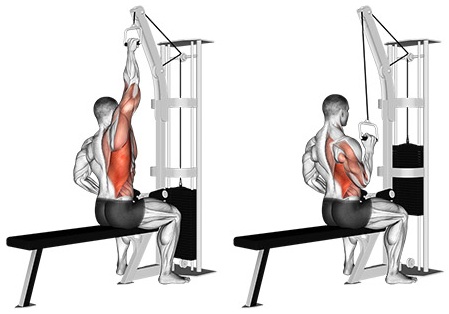
- Close-Grip Lat Pulldown. The close-grip lat pulldown trains the lats in a compound vertical pull with heavier loads.

- Vertical Traction. The vertical traction machine offers a guided pull that suits beginners.

How to Program the Lat Prayer Pulldown
Use the box below as a starting point and adjust it to your goals and training split.
Show full programming guideHide programming guide ▾
| Goal | Sets | Reps | Rest | Tempo |
|---|---|---|---|---|
| Hypertrophy | 3–4 | 10–15 | 60–90 s | 3 s return, brief pause at the top |
| Lat activation before pulling | 1–2 | 12–15 | 60 s | Light, slow, focus on the stretch |
| Muscular endurance | 2–3 | 15–20 | 45–60 s | Steady, controlled |
As an isolation exercise, the lat prayer pulldown works best with moderate to light loads and higher reps. That’s not a limitation for muscle growth: research shows hypertrophy across a broad spectrum of loads and repetition ranges, as long as sets are taken reasonably close to failure.
- Before compound pulls, as a light activation exercise to help you feel the lats
- After lat pulldowns, pull-ups, or rows, as a finisher in the stretched position
- In upper-body or back sessions when you want extra lat volume without more biceps work
- Paired with a horizontal row, such as the seated cable row, for a superset
Add reps first, then a small weight increment once you reach the top of your rep range without crunching or bending the elbows. Apply progressive overload slowly; on this exercise, form breaks down quickly when the weight goes up too fast.
Lat Prayer Pulldown vs Straight-Arm Lat Pulldown
Both exercises use the same shoulder action, but the body position changes the feel and the part of the range that’s emphasized:

| Feature | Lat Prayer Pulldown | Straight-Arm Lat Pulldown |
|---|---|---|
| Body position | Kneeling, torso inclined forward | Standing, slight forward lean |
| Range emphasized | Overhead, lengthened range | From around eye level down toward the thighs |
| Finish position | Hands near the head | Hands near the thighs |
| Main risk to technique | Crunching forward with the abs | Leaning and swinging with the body |
| Stability | High; kneeling limits leg and hip movement | Moderate; standing allows more body movement |
| Typical load | Light to moderate | Light to moderate |
| Best for | Lat training in the stretched position | Lat training through the middle and lower range |
The main difference is the part of the range each exercise emphasizes. The lat prayer pulldown starts with the arms overhead and the torso inclined, so it loads the lats in a lengthened position. The straight-arm lat pulldown is performed standing and finishes with the hands near the thighs, so it covers more of the range closer to the body.
They complement rather than compete with each other. Many lifters use one in each back session or alternate them from one training block to the next. For more ways to train the lats, see our guide to lat pulldowns vs pull-ups.
Final Thoughts
The lat prayer pulldown is a simple isolation exercise that trains the lats in the stretched position with very little help from the arms. Kneel far enough from the cable, keep the torso and elbows fixed, and let only the shoulders move.
Use it as an activation exercise or a finisher alongside compound pulls, and choose loads that let you avoid crunching. To understand the muscles behind every pulling movement, read our guide to the muscles involved in pulling movements.
Frequently Asked Questions
What muscles does the lat prayer pulldown work?
It mainly works the lats and teres major, with help from the long head of the triceps and the pectoralis major.
Is the lat prayer pulldown a compound or isolation exercise?
It’s an isolation exercise, because only the shoulder joint moves while the elbows stay fixed.
Why is it called the lat prayer?
At the end of each rep, the hands are near the head and the torso is inclined, a position that resembles praying.
Should I bend my elbows?
Keep a slight, constant bend. Bending and straightening the elbows during the rep turns it into a triceps exercise.
How far should I kneel from the cable?
Far enough that the cable pulls your arms into a stretch at the top, usually one to two steps back.
Rope or bar: which is better?
A rope is the most comfortable for most lifters; a bar can help if you struggle to keep the elbows still.
Why do I feel it in my abs?
You’re probably crunching forward. Keep the torso angle fixed and lower the weight.
Is it better than the straight-arm pulldown?
Neither is better overall. The lat prayer emphasizes the stretched position; the straight-arm pulldown covers more of the range near the body.
Can the lat prayer pulldown replace pull-ups or rows?
No. It’s an accessory exercise that complements compound pulls rather than replacing them.
