


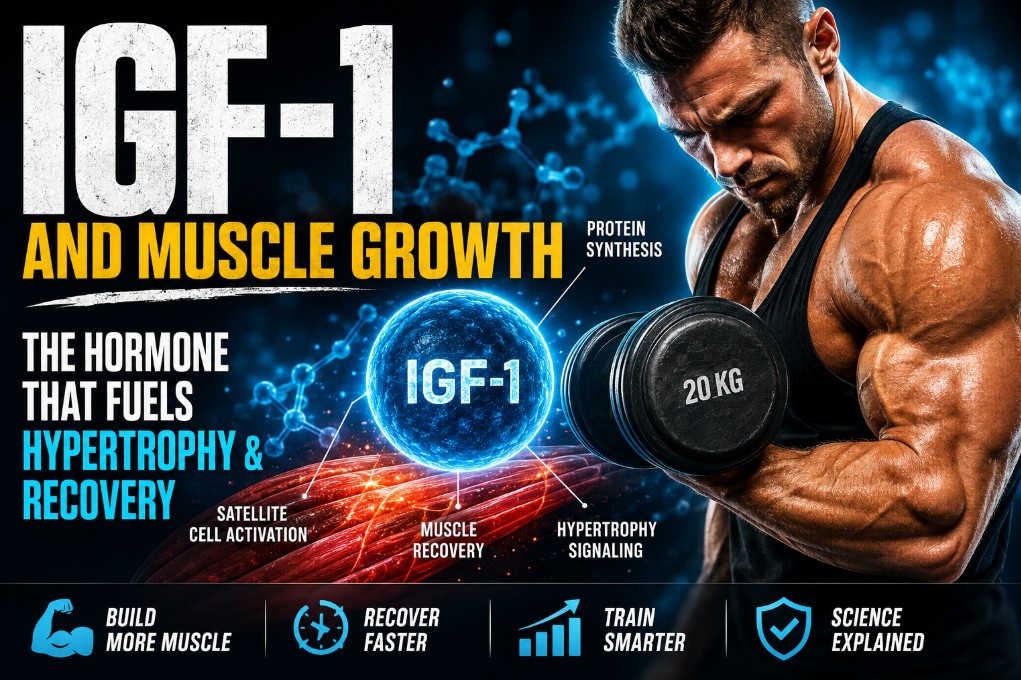
IGF-1 — short for Insulin-like Growth Factor 1 — has one of the most anabolic-sounding reputations in bodybuilding. It sits downstream of growth hormone, activates pathways associated with protein synthesis, and has been linked to satellite cells and muscle growth. So it sounds logical that higher IGF-1 should mean more hypertrophy — and that logic has fueled everything from supplement marketing claims to a persistent fascination with IGF-1 peptides in enhanced bodybuilding circles.
But that conclusion skips the most important part of the biology: where the IGF-1 signal comes from and where it acts. A hormone that sounds simple on the surface turns out to have a genuinely more interesting — and more useful — story underneath, once you separate what’s happening in your bloodstream from what’s happening inside a muscle fiber that’s actually being trained.
Here’s the thesis of this article: IGF-1 is an important regulator of muscle growth and repair, but serum IGF-1 is not a simple hypertrophy score. For lifters, local muscle IGF-1 signaling and the mechanical stimulus from resistance training matter more than trying to “boost” circulating IGF-1 with foods, supplements, or hormone hacks.
QUICK ANSWER: IGF-1 participates in muscle protein metabolism, regeneration, and hypertrophic signaling, but circulating IGF-1 is not a direct measure of muscle-building potential. Skeletal muscle also produces IGF-1 locally in response to loading, and this local autocrine/paracrine signaling may be particularly relevant to adaptation — trying to “boost” your blood IGF-1 number isn’t a meaningful training goal.
What Is IGF-1?
Where Is IGF-1 Produced?
Two genuinely distinct categories are worth separating from the start. The liver produces most circulating, systemic IGF-1—what a standard blood test measures. But skeletal muscle and several other tissues also produce their own local IGF-1, acting near where it’s made rather than traveling through the bloodstream. This distinction is the single most important concept in this entire article, and we’ll return to it repeatedly.
Why Is It Called Insulin-Like Growth Factor?
Briefly: IGF-1 shares structural and functional similarity with insulin, including overlapping receptor signaling pathways. But IGF-1 is not insulin — they’re related, distinct hormones with different primary roles, covered in more detail later in this article.
How Is IGF-1 Regulated?
IGF-1 production and activity are influenced by growth hormone, nutritional and energy status, age, tissue-level local regulation, and a family of IGF binding proteins (IGFBPs) that control how much free, active IGF-1 is available at any given time.
The GH–IGF-1 Axis
This deserves its own section because it’s commonly oversimplified into a linear chain: hypothalamus → pituitary GH → liver → IGF-1 → muscle growth. That chain is real at the systemic level — GH stimulates hepatic IGF-1 production, and this remains one of the best-characterized endocrine axes in the body. But it’s incomplete. Not all IGF-1 action depends on circulating growth hormone. Skeletal muscle can locally regulate its own IGF-1 expression, largely in response to mechanical loading, independent of what’s happening with GH and liver-derived IGF-1 at that moment.
This matters because the old bodybuilding model — workout raises GH, GH raises IGF-1, IGF-1 builds muscle — is too simple in a way that has real practical consequences. It skips local, muscle-level IGF-1 production, which may matter just as much, if not more, for the adaptation happening in trained tissue. It also implies a chain of dependency that doesn’t hold up: you don’t need a bigger acute GH response to get a meaningful local IGF-1 response in trained muscle, because the local pathway isn’t simply waiting on the systemic one. For the fuller picture of GH itself, including why chasing its acute post-workout spike is similarly unproductive, see our growth hormone and muscle growth guide.
Circulating IGF-1 vs. Local Muscle IGF-1
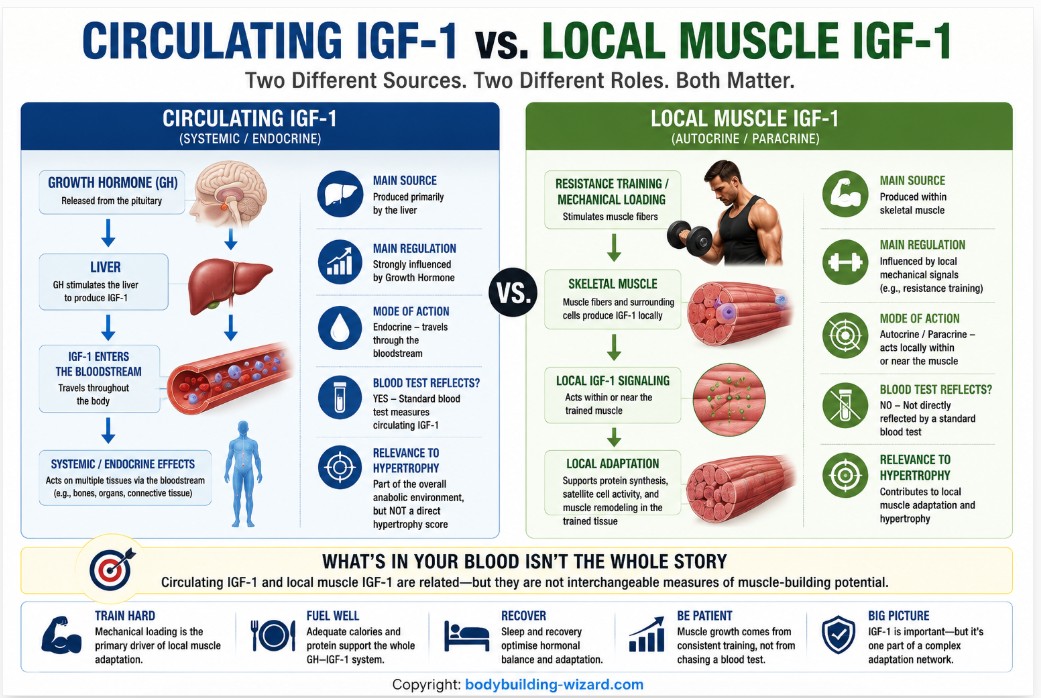
This is, by a wide margin, the most important section in this entire article.
| Circulating IGF-1 | Local Muscle IGF-1 | |
|---|---|---|
| Main source | Liver | Skeletal muscle |
| Main regulation | Strongly GH-influenced | Mechanical and local signals |
| Mode of action | Endocrine (travels through blood) | Autocrine/paracrine (acts near its source) |
| Does a blood test reflect it? | Mostly, yes | Not directly |
| Relevance to hypertrophy | Part of the systemic environment | May contribute directly to local adaptation |
A comprehensive review on IGF-1’s regulation of skeletal muscle hypertrophy and atrophy makes this distinction explicit: systemic IGF-1 is predominantly liver-derived, while locally produced IGF-1 in skeletal muscle likely acts in an autocrine or paracrine manner, driven substantially by mechanical loading rather than circulating hormone levels. This split explains a finding that surprises many lifters: earlier human research attempting to increase muscle adaptation to resistance training by raising circulating IGF-1—either through direct IGF-1 infusion or by raising GH to indirectly raise IGF-1—generally found no meaningful effect on the degree of muscle hypertrophy. The systemic number and the local, muscle-level signal are simply not the same variable.
Why would this be true? One useful way to think about it: your muscle doesn’t need a bigger delivery of IGF-1 arriving from the liver to respond to mechanical loading, because the muscle fiber itself is capable of manufacturing its own local IGF-1 supply directly at the site where loading occurred. That local signal doesn’t have to travel through the bloodstream, and it isn’t reliably reflected by a blood draw taken from your arm. This is exactly why two lifters with identical serum IGF-1 readings can have very different local hypertrophic signaling happening inside their trained muscle at any given time — the blood test simply isn’t measuring the variable that matters most for this specific question.
IGF-1 and Muscle Growth
How Does IGF-1 Signal Inside Muscle?
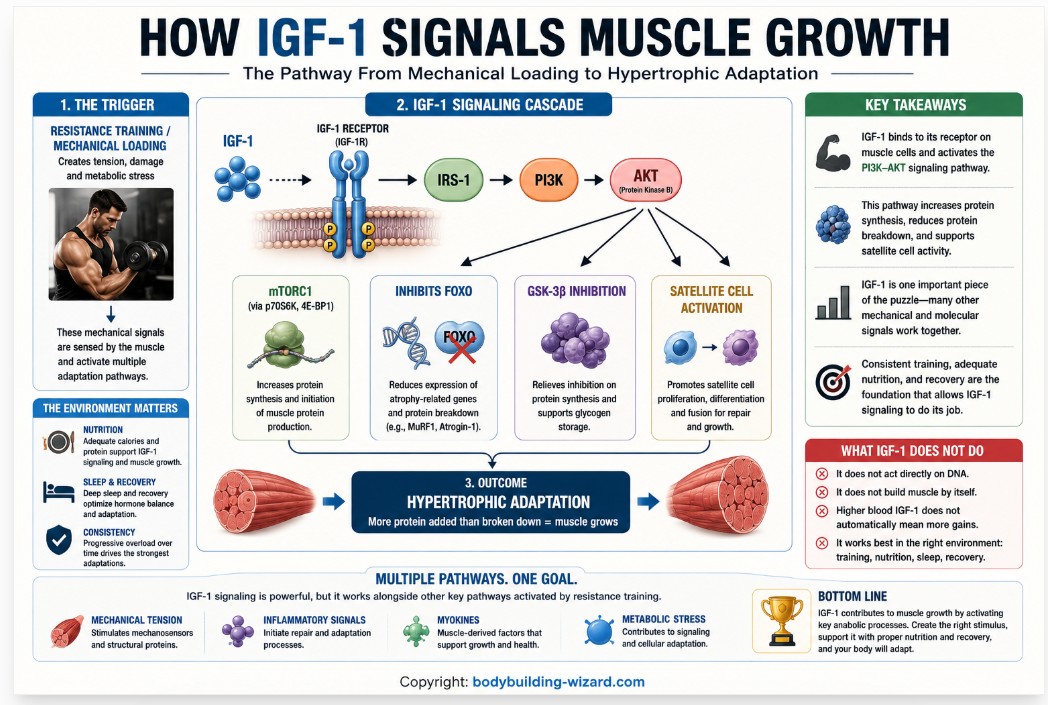
At the mechanistic level, IGF-1 binds to the IGF-1 receptor on the surface of a muscle cell, which activates a signaling cascade through IRS-1 and PI3K, leading to activation of Akt (also known as protein kinase B) — a central signaling node connected to mTOR-related anabolic signaling on one side, and to FoxO-related regulation of protein degradation on the other. In plain terms: this single pathway simultaneously supports building new muscle protein and suppresses the machinery that breaks protein down, which is exactly why IGF-1 signaling is considered genuinely anabolic at the cellular level — this isn’t in dispute. What’s disputed is only how tightly this well-documented cellular pathway translates into “more circulating IGF-1 in your bloodstream equals more of this signaling actually happening” — and as covered above, that link is much weaker than the clean mechanistic pathway itself might suggest.
IGF-1 and Muscle Protein Synthesis
IGF-1 signaling does support muscle protein synthesis through the pathway described above. What isn’t well supported is a simple linear story where more serum IGF-1 produces proportionally more muscle protein synthesis—as covered above, circulating levels and the signaling happening inside trained muscle are not the same thing.
IGF-1 and Muscle Protein Breakdown
Through the same Akt/FoxO pathway, IGF-1 signaling also helps suppress the ubiquitin-proteasome system and autophagy-related protein breakdown — an anti-catabolic effect that works alongside its support for protein synthesis, similar in spirit to what we described in our insulin and testosterone articles, though through IGF-1’s own distinct receptor pathway.
IGF-1, Satellite Cells and Muscle Regeneration
This is a genuinely strong area of the science, though it deserves a nuanced treatment rather than a simplified one. IGF-1 signaling can influence satellite cell proliferation and function, which matters because satellite cells are the source of new myonuclei in mature muscle fibers — a mechanism directly comparable to what we described in our testosterone article, where a different hormone drives a related structural outcome through a different receptor pathway.
That said, the broader literature here isn’t entirely settled — some animal-model findings on whether satellite cells are strictly necessary for hypertrophy (as opposed to simply associated with it) have produced conflicting results, with certain transgenic mouse models showing meaningful hypertrophy even under conditions of impaired satellite cell function. This is a good example of where honest nuance serves readers better than an oversimplified, fully resolved-sounding claim — IGF-1’s contribution to satellite cell biology is real and worth understanding, but it isn’t the single, indispensable switch that some fitness content implies.
What Is Mechano Growth Factor (MGF)?
This section exists specifically to correct something the older version of this content got wrong, and it’s a genuinely important myth to clear up given how much bodybuilding supplement and peptide marketing is built around it.
MGF is not simply “another name for IGF-1,” as it’s often marketed. The term refers specifically to a particular IGF-1 splice variant (IGF-1Ec) and its associated E-peptide, first identified in mechanically stretched muscle tissue. The proposed story — that this E-peptide specifically activates satellite cells in a way distinct from mature IGF-1 — comes largely from one research group’s findings. Critically, an independent replication attempt by researchers at two separate pharmaceutical companies found that synthetic MGF E-peptide, at concentrations well above what’s typically used, had no effect on the proliferation of either mouse or human skeletal muscle myoblasts or primary muscle stem cells in vitro — while mature IGF-1 itself, tested in the same experiments, did produce the expected proliferative response.
The honest summary: local muscle IGF-1 expression genuinely does change in response to mechanical loading — that part is real. But “MGF,” as marketed in bodybuilding supplement and peptide circles, is a far more complicated and contested story than “a special growth factor spikes after training and builds extra muscle.” Natural lifters don’t meaningfully track or optimize it.
Part of why this myth has persisted so long in bodybuilding content is that it sits right at the intersection of two things that sound scientifically credible on their own — real local IGF-1 splice variants exist, and mechanical loading genuinely does change muscle-level gene expression — which makes the “MGF supplement” leap feel more evidence-based than it actually is once you look at the independent replication attempt directly.
What Happens to IGF-1 During Resistance Training?
Here again, the distinction between circulating and local IGF-1 matters enormously. Exercise can change circulating IGF-1, but the effect depends heavily on the population, program, age, and other factors — this isn’t a uniform, predictable bump for everyone. A 2025 systematic review and meta-analysis examining exercise interventions in frail and/or sarcopenic older adults found that exercise significantly increased serum IGF-1 (SMD = 0.42, p<0.0001) — with combined resistance-and-aerobic training producing the largest effect, resistance training alone producing a smaller but still significant effect, and aerobic training alone showing no significant effect at all.
This is genuinely useful data — but it’s specifically about older adults with frailty or sarcopenia, a population with a very different baseline IGF-1 and muscle status than a healthy young bodybuilder. It is not evidence that a bigger circulating IGF-1 increase from training translates into more muscle gained in a healthy, already well-trained lifter — that’s a different claim entirely, and one the research doesn’t support in the same direct way. The subgroup finding that aerobic training alone showed no significant effect, while resistance training and especially combined training did, is itself a useful reminder that not all “exercise” produces the same hormonal response — but even that finding needs to stay within its own population context rather than being generalized to every training goal and every lifter.
Does a Bigger Post-Workout IGF-1 Response Mean More Muscle?
Not necessarily. This keeps the pattern established across our testosterone and growth hormone articles consistent: an acute blood hormone response is not the same thing as a reliable long-term hypertrophy score. In fact, the same large cohort study by West and Phillips referenced in those articles tracked acute IGF-1 responses alongside testosterone, GH, and cortisol in 56 young men over 12 weeks of resistance training—and found no significant correlations between acute post-exercise IGF-1 elevation and actual gains in lean body mass or strength. A transient systemic elevation poorly predicts who builds the most muscle over a training block.
Should You Train to Maximize IGF-1?
No. Structure training around mechanical tension, sufficient training volume, consistent overload, real effort, and recoverability — not around which protocol produces the biggest circulating IGF-1 reading afterward. Given everything covered above about circulating versus local IGF-1, chasing the systemic number specifically doesn’t even make mechanistic sense as a training goal — it’s optimizing for a variable the evidence suggests isn’t the one actually driving your results.
In practice, this means the exercise selection, rep ranges, and rest periods that would theoretically “maximize IGF-1” are largely irrelevant considerations. What actually determines whether your muscle produces a meaningful local IGF-1 response is simply whether you’re applying sufficient mechanical loading with enough volume and progression over time — the same training fundamentals that drive hypertrophy through every other pathway covered across this hormone category.
Coach’s Note: In coaching, I never try to raise a client’s IGF-1 as a standalone goal. If training is progressive, protein and calories are appropriate, sleep is adequate, and recovery is good, the relevant growth signaling takes care of itself. Chasing a blood hormone number is usually a distraction from the variables that actually determine whether muscle is adapting.
Does Growth Hormone Build Muscle Through IGF-1?
Partly — but the GH–IGF-1 relationship isn’t the entire explanation for muscle adaptation. As covered in our growth hormone article, there are both GH-dependent and GH-independent (local) IGF-1 mechanisms at play in adult skeletal muscle, and the regulation of muscle mass through this axis is genuinely complex — not a single clean pathway from GH to IGF-1 to guaranteed hypertrophy.
IGF-1 vs. Insulin
Briefly, since we’ve referenced this connection throughout: IGF-1 and insulin use related receptor and signaling families, sharing enough structural similarity to explain the name “insulin-like growth factor.” But they are not the same hormone, and they don’t serve the same primary physiological function — insulin is centrally about nutrient storage and glucose regulation, while IGF-1 is centrally about growth and tissue regulation, even though their signaling pathways overlap at points.
IGF-1 vs. IGF-2
Worth a brief mention for completeness, without a large dedicated section. IGF-2 is structurally related to IGF-1 but plays its most significant role in fetal and early developmental biology, and its regulation is considerably less GH-dependent than IGF-1’s. For an adult lifter’s purposes, IGF-1 is the far more relevant of the two.
IGF-1 and Body Composition / Fat Metabolism
This article focuses on muscle growth, not a complete weight-loss guide, so this section stays brief by design. IGF-1 does have genuine metabolic roles beyond skeletal muscle, interacting with broader energy metabolism and body composition. The same core lesson from the rest of this article applies here too: these are real physiological roles, not a reason to treat IGF-1 as a fat-loss lever to manipulate directly.
IGF-1 During Bulking vs. Cutting
| Bulking | Cutting | |
|---|---|---|
| Energy and protein availability | Higher | Lower |
| Effect on circulating IGF-1 | Supports the endocrine/growth environment | Can fall with prolonged restriction |
| Should you chase higher IGF-1? | No | No |
| Coaching priority | Adequate surplus + training stimulus | Sustainable deficit + adequate protein |
Bottom line: don’t chase IGF-1. Maintain the nutritional and training environment that supports adaptation, no matter which phase you’re in.
Does Fasting Lower IGF-1?
Yes, this is genuinely relevant — energy restriction and fasting can lower circulating IGF-1. But this is not, on its own, evidence that intermittent fasting “kills your gains.” Context matters considerably: total energy intake, protein intake, fasting duration, and training all shape the outcome far more than the IGF-1 number in isolation. A lower circulating IGF-1 reading during a structured fasting protocol with adequate total daily protein and calories is very different from chronic, poorly managed under-eating.
Does Protein Increase IGF-1?
Yes, adequate protein and overall energy status genuinely influence the GH-IGF-1 axis—this is well documented. But this shouldn’t become “eat more red meat specifically to boost IGF-1 for gains,” which is exactly the kind of oversimplified leap the older version of this content made. The useful takeaway is broader: adequate total protein intake supports the nutritional environment your whole endocrine system depends on—it isn’t a specific IGF-1-hacking strategy.
Can You Naturally Increase IGF-1 — and Does It Matter?
Sleep, exercise, and adequate energy and protein intake can all influence circulating IGF-1 through completely normal physiology. But here’s the more important question underneath that one: a small increase in circulating IGF-1 is not automatically a muscle-building advantage. Given everything covered in this article about the circulating-versus-local distinction, chasing a modestly higher blood IGF-1 number isn’t a meaningful training or nutrition goal in its own right.
Supplements That “Boost IGF-1”: Do They Matter?
You’ll find long lists online of supplements claimed to raise IGF-1 — zinc, DHEA, taurine, resveratrol, leucine, colostrum, carnitine, creatine, HMB, CoQ10, and more. This article isn’t going to evaluate each one against “does it raise IGF-1,” because that’s the wrong question entirely — and it’s exactly the question older versions of this kind of content spent most of their word count answering, product by product. The question that actually matters is: does raising IGF-1 through this route mediate meaningful additional hypertrophy?
For the overwhelming majority of these supplements, that link has not been established — a supplement modestly changing a blood marker is a very different claim from that supplement measurably building you more muscle. Some of these supplements (creatine and adequate leucine intake, for example) are genuinely useful for entirely different, well-established reasons — but “it might slightly raise IGF-1” isn’t the reason to take them, and shouldn’t be the headline claim on the label.
IGF-1 and Aging
Briefly: circulating IGF-1 generally declines with age, and low IGF-1 is associated with sarcopenic and frail populations — which is exactly the context behind the 2025 meta-analysis referenced earlier in this article. But low IGF-1 in an aging context is not automatically an indication for IGF-1 treatment; that’s a medical decision requiring proper clinical evaluation, not a self-directed supplementation goal. If you’re an older lifter, see our guide to strength training for older adults for training-focused guidance that doesn’t depend on chasing a hormone number.
What About IGF-1 Drugs / Peptides in Bodybuilding?
This needs to be here, briefly and safety-oriented, because search intent around this topic will inevitably arrive at it — the same pattern we followed in our insulin and growth hormone articles. IGF-1 analogs, including compounds like IGF-1 LR3 and various peptides marketed in bodybuilding and research-chemical circles, are not the same thing as normal, endogenous IGF-1 physiology described throughout this article. This article isn’t the place for doses, timing, or cycling protocols related to these compounds, and we’re not providing any.
There’s also a deeper reason to be cautious about any “more IGF-1 is better” mindset, beyond simply lacking evidence for a hypertrophy benefit — and it’s a genuinely important reason this entire article has pushed back against treating IGF-1 as something to maximize. IGF-1 is fundamentally a growth and survival signaling molecule, and a large systematic review and meta-regression analysis found that higher circulating IGF-1 concentrations are associated with increased risk of several common cancers, including prostate and premenopausal breast cancer — though the associations were described as modest and varied by cancer site, and this is not a simple “IGF-1 causes cancer” relationship. It’s a genuinely useful reason, beyond the hypertrophy evidence alone, to treat deliberately elevating circulating IGF-1 as a real trade-off rather than an unambiguous win.
Supporting Healthy IGF-1 Physiology — Without Chasing It
Pulling everything in this article together into a practical checklist, the same fundamentals that showed up across our testosterone and growth hormone articles apply here too:
- Train with progressive, sufficient mechanical loading — this is what drives local muscle IGF-1 signaling, not the systemic blood number
- Eat adequate total protein and calories, especially avoiding chronic, unmanaged energy restriction
- Prioritize consistent sleep, since it supports the broader GH-IGF-1 axis alongside nearly every other hormone covered in this category
- Treat any “IGF-1 boosting” supplement or food claim with the same question this article has applied throughout: does raising this blood marker actually translate into more muscle, or just a bigger number on a lab report?
- Skip peptide and IGF-1 analog products marketed around this hormone — the risk profile and lack of controlled human safety data make this a poor trade for natural lifters chasing a modest theoretical edge
Bodybuilder’s Take
Don’t try to maximize IGF-1. Create the mechanical and nutritional environment in which healthy IGF-1 signaling can do its job — consistent training, adequate protein and calories, and enough recovery. The hormone takes care of itself when those fundamentals are in place; chasing the blood number directly adds nothing on top of that.
Common IGF-1 Myths
❌ Myth: Higher serum IGF-1 always means more muscle growth.
✅ Reality: Circulating IGF-1 and the local muscle-level IGF-1 signaling that actually drives adaptation are not the same thing — raising the blood number hasn’t been shown to reliably increase hypertrophy on its own.
❌ Myth: IGF-1 and MGF are the same thing.
✅ Reality: MGF refers to a specific IGF-1 splice variant and its E-peptide, with a much more contested and limited evidence base than mature IGF-1 — an independent lab failed to replicate its proposed effect on muscle stem cells entirely.
❌ Myth: Resistance training builds muscle because it raises circulating IGF-1.
✅ Reality: Studies that raised circulating IGF-1 directly (via infusion or GH administration) generally found no meaningful effect on hypertrophy — local, mechanically-driven muscle IGF-1 appears far more relevant.
❌ Myth: More growth hormone automatically means more IGF-1 and more hypertrophy.
✅ Reality: GH-IGF-1 regulation of adult skeletal muscle mass is genuinely complex, involving both GH-dependent and GH-independent local mechanisms — it isn’t one clean, linear chain.
❌ Myth: You should eat specific foods to maximize IGF-1.
✅ Reality: Adequate total protein and energy intake supports normal IGF-1 physiology — there’s no evidence that specific “IGF-1-boosting” foods provide a meaningful hypertrophy advantage beyond that.
❌ Myth: Supplements that raise IGF-1 necessarily increase muscle growth.
✅ Reality: A supplement modestly changing a blood marker is a different claim entirely from that supplement measurably building more muscle — the link is rarely established for the long lists of “IGF-1 boosting” supplements marketed online.
❌ Myth: Fasting kills muscle because it lowers IGF-1.
✅ Reality: Fasting can lower circulating IGF-1, but context — total protein, energy intake, duration, and training — determines the actual outcome far more than that single number.
❌ Myth: IGF-1 is basically insulin for muscle growth.
✅ Reality: IGF-1 and insulin share related receptor and signaling families, but they’re distinct hormones with different primary physiological roles.
