
Overview (Introduction)
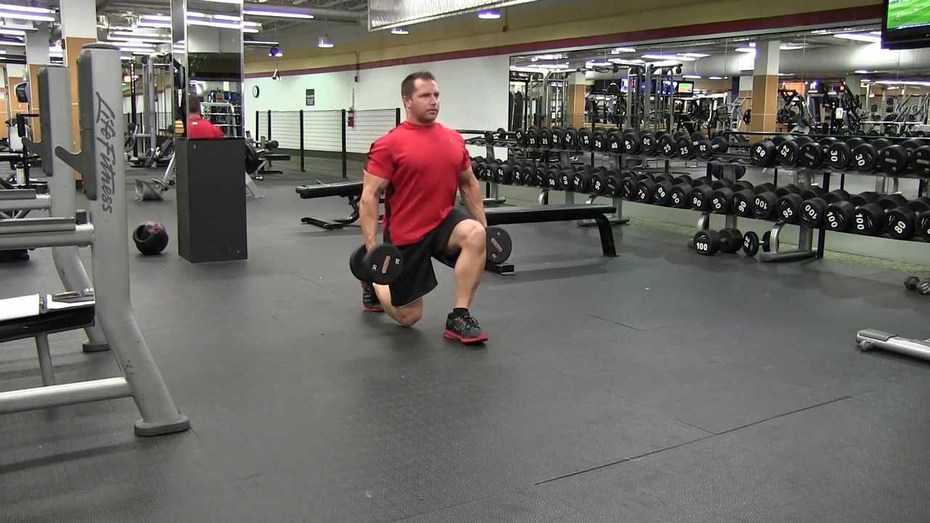
The dumbbell lunge is one of the most effective exercises for building strong, balanced, and well-developed legs. What makes this movement especially powerful is its ability to target both the quadriceps and the glutes/hamstrings, depending on how you perform it.
As a coach working with lifters and athletes, I often emphasize one key detail that most people overlook: your step length completely changes the exercise.
A shorter step places more stress on the quadriceps, while a longer step shifts the load toward the glutes and hamstrings. This makes the dumbbell lunge one of the most versatile lower-body exercises you can use.
Another major advantage is stability. Holding dumbbells at your sides lowers your center of gravity, making it easier to maintain an upright posture compared to barbell lunges. At the same time, your core muscles are heavily engaged to keep you balanced throughout the movement.
Whether you’re training for muscle growth, athletic performance, or overall lower-body strength, the dumbbell lunge is a must-have exercise—but only if you understand how to use it correctly.
Equipment Needed
The dumbbell lunge is a simple yet highly effective exercise that requires minimal equipment, making it suitable for both gym and home workouts. Despite its simplicity, proper setup plays a key role in maintaining balance, control, and correct muscle activation.
As a coach working with lifters and athletes, I often emphasize that even though lunges don’t require much equipment, stability and positioning are everything.
- Dumbbells: Held at your sides to provide resistance while maintaining a lower center of gravity.
- Flat, stable surface: Essential for balance and safe execution.
- Optional: barbell: Can be used for heavier loading, but requires more balance and control.
- Proper footwear: Helps ensure stability and effective force transfer with each step.
In practice, the most important factor isn’t the equipment—it’s how you control your body throughout the movement, especially during the descent and step length adjustment.
Step-by-Step Instructions for the Dumbbell Lunge
Executing the dumbbell lunge correctly is all about control, alignment, and step mechanics. Because this is a dynamic unilateral movement, proper setup ensures both safety and optimal muscle activation.
As a coach, I always emphasize that the lunge should feel smooth and controlled, not rushed or unstable.
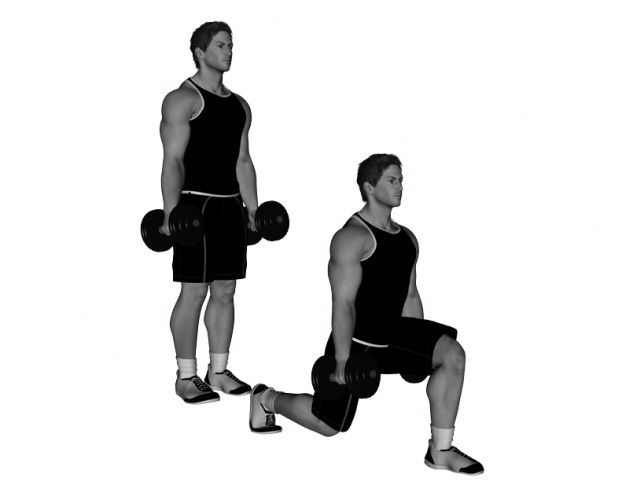
A. Starting Position (Setup)
- Stand upright with your feet about shoulder-width apart.
- Hold a dumbbell in each hand with your arms hanging naturally at your sides.
- Keep your chest up, shoulders back, and spine neutral.
- Engage your core to stabilize your torso.
- Look straight ahead with your head in a neutral position.
- Maintain a balanced stance before initiating the step.
Key coaching cue: “Tall posture, core tight, controlled step”—this sets the foundation for every rep.
B. Movement (Execution)
Once you’re set, the goal of the dumbbell lunge is to move with control and precision, using the front leg to absorb and generate force. As a coach, I always stress that lunges are not about speed—they’re about controlled stepping and proper loading of the working leg.
- Inhale and brace your core before initiating the step.
- Step forward in a controlled manner (length depends on your goal).
- Lower your body by bending both knees simultaneously.
- Keep your torso upright and avoid leaning forward.
- Descend until both knees reach roughly a 90-degree angle.
- Your back knee should be just above the floor.
- Ensure your front knee tracks in line with your toes.
- Keep your front foot flat and stable throughout the movement.
- Pause briefly at the bottom for control.
- Push through your front heel and mid-foot to return to the starting position.
- Exhale as you drive upward.
- Repeat on the same leg or alternate legs, depending on the variation.
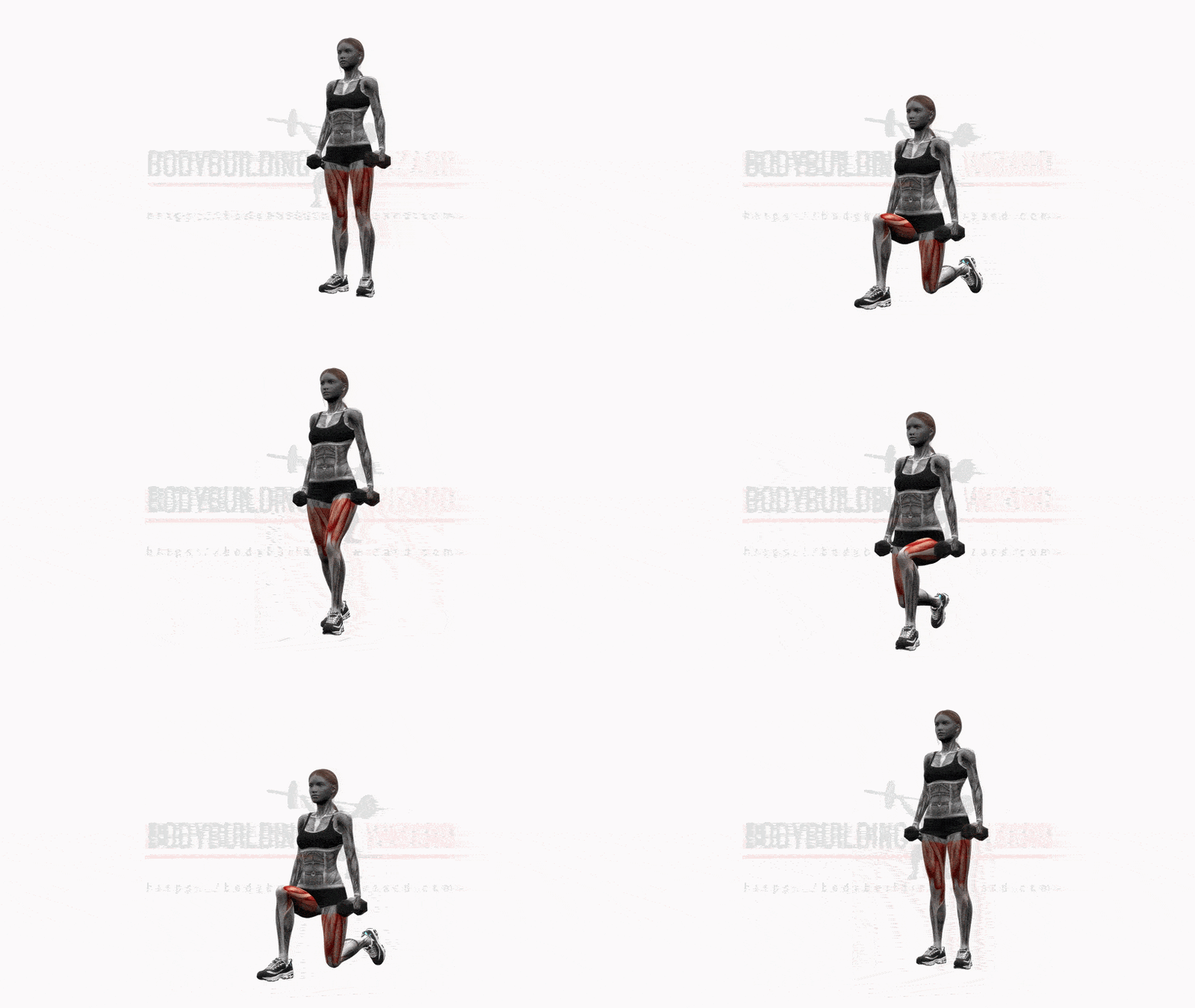
Resistance & Step Length Insight
The length of your step plays a major role in muscle activation:
- Short step: Increases knee flexion → greater emphasis on the quadriceps
- Long step: Increases hip involvement → greater emphasis on the glutes and hamstrings
This makes the dumbbell lunge one of the most adaptable exercises for targeting different lower-body muscles.
Muscles Worked in the Dumbbell Lunge
The dumbbell lunge is a dynamic unilateral exercise that targets multiple lower-body muscles while also demanding balance, coordination, and core stability. Its unique stepping motion allows you to shift emphasis between muscle groups depending on step length and execution style.
As a coach working with lifters and athletes, I often use dumbbell lunges to develop both strength and movement quality, especially because they closely mimic real-life and athletic patterns.
Primary Muscles
- Quadriceps (vastus lateralis, vastus medialis, vastus intermedius, rectus femoris): Drive knee extension and control the descent, especially with shorter steps.
- Gluteus maximus: Plays a major role in hip extension, particularly when using a longer step.
Secondary Muscles
- Hamstrings: Assist in hip extension and help stabilize the knee.
- Adductors: Contribute to hip stability and assist in controlling movement.
Stabilizers
- Core musculature: Keeps your torso upright and prevents excessive movement or rotation.
- Calves (gastrocnemius and soleus): Help stabilize the ankle during stepping and balance.
- Hip stabilizers (glute medius and minimus): Maintain alignment and prevent the knee from collapsing inward.
From my experience, the dumbbell lunge is one of the most effective exercises for building balanced leg development and functional strength. Because each step requires control and stability, it quickly exposes weaknesses and improves overall coordination.
Technical Emphasis & Targeting Adjustments
The dumbbell lunge is one of the few exercises where a simple change in step length can completely shift which muscles are doing the work. As a coach, I use this to deliberately target either the quadriceps or the glutes and hamstrings.
Step Length & Muscle Emphasis
| Step Length | Muscle Emphasis / Training Effect |
|---|---|
| Short step | More knee flexion → greater emphasis on quadriceps |
| Moderate step | Balanced activation of quads and glutes |
| Long step | More hip involvement → increased glute and hamstring activation |
Torso Position
| Position | Effect |
|---|---|
| Upright torso | Increases quadriceps activation |
| Slight forward lean | Increases glute involvement |
Movement Control
| Technique | Effect |
|---|---|
| Controlled descent | Improves muscle activation and stability |
| Explosive push-off | Increases power and athletic performance |
| Slow eccentric | Enhances time under tension and hypertrophy |
In my experience, most people use the same step length for every lunge, which limits the effectiveness of the exercise. By simply adjusting your step, you can turn the dumbbell lunge into either a quad-dominant or glute-dominant movement.
Performance Optimization Tips (Coach’s Cues)
Once your technique is solid, the dumbbell lunge becomes one of the most effective tools for building strength, muscle, and coordination—but only if you execute it with precision. As a coach, I’ve seen that the biggest improvements come from focusing on control, consistency, and intentional step mechanics.
- Be consistent with your step length: This helps ensure you’re targeting the intended muscle group (quads vs. glutes).
- Drive through the front leg: The working leg should do most of the work.
- Keep your torso upright: Helps maintain proper alignment and muscle emphasis.
- Control the descent: A slow eccentric improves stability and muscle activation.
- Keep your front foot flat: Ensures proper force transfer and balance.
- Engage your core: Prevents unnecessary movement and improves control.
- Use a full range of motion: Go deep enough to maximize muscle activation.
- Progress gradually: Increase load only after mastering form and control.
Many lifters train their glutes hard but still fail to create enough high-quality tension for real hypertrophy. Learn why your glutes aren’t growing.
Exercise Variations (Forward, Reverse, Walking, Alternating)
The dumbbell lunge can be performed in several variations, each offering a slightly different training stimulus. As a coach, I use these variations to target different aspects of strength, coordination, and muscle development, while also keeping training engaging and effective.
1) Forward Dumbbell Lunge
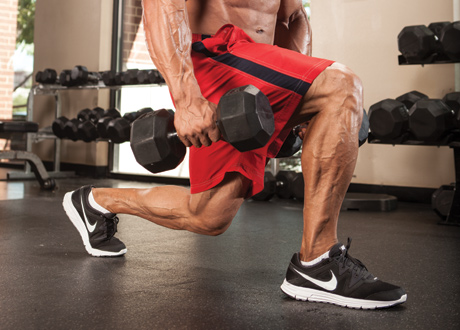
How to perform:
- Step forward into a lunge position.
- Lower your body under control, then push back to the starting position.
Why it works:
This is the most common variation and provides a balanced stimulus for both the quadriceps and glutes, depending on step length.
2) Reverse Dumbbell Lunge
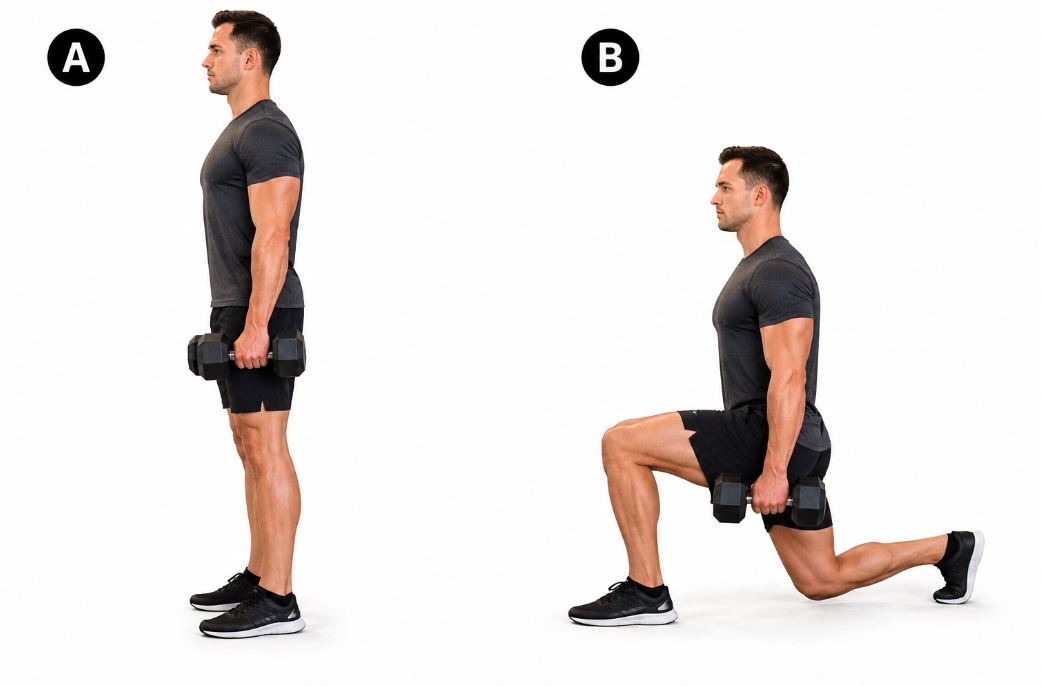
How to perform:
- Step backward instead of forward.
- Lower into a lunge, then return to the starting position.
Why it works:
Reduces stress on the knees and improves balance and control, making it a great option for beginners or those with joint concerns.
3) Walking Dumbbell Lunge
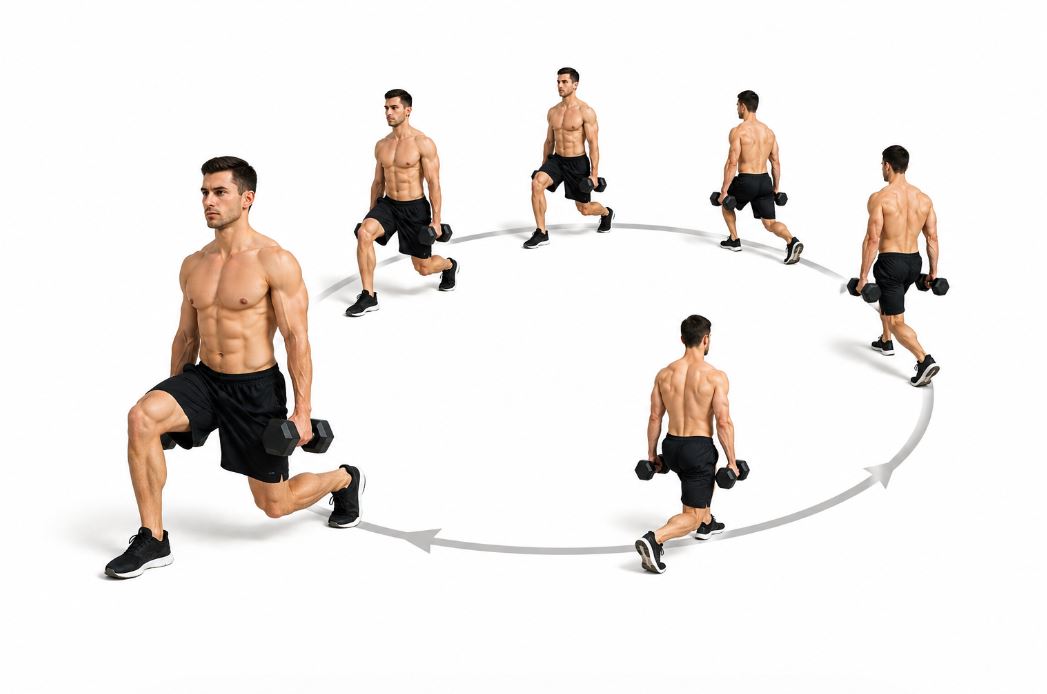
How to perform:
- Step forward continuously, alternating legs with each repetition.
- Move forward across the floor with each step.
Why it works:
Improves coordination, endurance, and athletic movement, while maintaining strong muscle activation.
4) Alternating Dumbbell Lunge
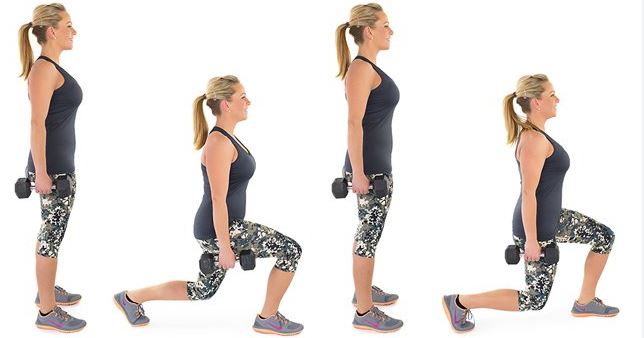
How to perform:
- Step forward with one leg, return to the start, then repeat with the other leg.
Why it works:
Provides a balanced approach, allowing you to train both legs evenly while maintaining control and rhythm.
Alternative / Replacement Exercises for the Dumbbell Lunge
While the dumbbell lunge is one of the most effective exercises for building unilateral strength and coordination, there are several excellent alternatives you can use depending on your goal, equipment, or limitations. As a coach, I often rotate these movements to maintain progress while targeting similar muscle groups. This is a great exercise, but it works best when combined with others—see our list of the best quadriceps exercises.
- Bulgarian Split Squat: A more stable unilateral exercise that allows greater focus on strength and muscle hypertrophy.
- Step-Up Exercise: A functional movement that improves balance, coordination, and single-leg strength.
- Dumbbell Squat: A bilateral exercise for overall leg strength with less balance demand.
- Barbell Back Squat: Ideal for building maximum strength and overall lower-body development.
- Hack Squat: A machine-based alternative that allows controlled quad-focused training.
In my experience, the dumbbell lunge is one of the most versatile lower-body exercises, but it can be fatiguing due to its dynamic nature. Rotating it with more stable exercises like split squats or step-ups can help maintain intensity while improving recovery.
The key is to choose exercises that match your training goal—whether it’s strength, hypertrophy, or coordination.
Key Benefits of the Dumbbell Lunge
The dumbbell lunge is one of the most versatile lower-body exercises for building strength, muscle, balance, and coordination. Its dynamic and unilateral nature makes it especially effective for improving both performance and physique.
As a coach working with lifters and athletes, I frequently use dumbbell lunges to develop functional strength and movement control, while also targeting specific muscle groups through simple technique adjustments.
- Builds unilateral leg strength: Each leg works independently, helping correct muscle imbalances.
- Targets multiple muscle groups: Effectively trains the quadriceps, glutes, and hamstrings in one movement.
- Adjustable muscle emphasis: Step length can shift focus between quads and glutes/hamstrings.
- Improves balance and coordination: Requires control and stability throughout the movement.
- Enhances core engagement: Stabilizing the torso activates core muscles.
- Highly functional movement: Mimics real-life and athletic actions like walking, running, and stepping.
- Scalable for all levels: Can be performed with body weight or progressed with added resistance.
Who Should Use This Exercise?
The dumbbell lunge is a highly adaptable exercise that can benefit a wide range of individuals, from beginners to advanced athletes. Because it combines strength, coordination, and movement control, it’s especially valuable for improving both performance and overall lower-body development.
As a coach working with lifters and athletes, I regularly use dumbbell lunges to develop balanced strength, stability, and functional movement patterns.
- Beginners: Ideal for learning basic unilateral movement and improving coordination.
- Athletes: Helps develop balance, control, and strength that transfer to sports performance.
- Individuals with muscle imbalances: Trains each leg independently to correct asymmetries.
- Bodybuilders: Effective for targeting quads, glutes, and hamstrings with adjustable emphasis.
- Home trainees: Requires minimal equipment, making it practical for home workouts.
- Intermediate and advanced lifters: Great for adding volume, improving stability, and enhancing overall leg development.
Dumbbell Lunge vs Walking Lunge: Which Is Better?
The dumbbell lunge and walking lunge are closely related variations, but they differ in movement style, coordination demands, and training effect. Both are excellent for building lower-body strength, but each has its own advantages depending on your goal.
As a coach working with lifters and athletes, I use both strategically—one for control and precision, the other for flow and athletic movement.
| Criteria | Dumbbell Lunge (Stationary) | Walking Lunge |
|---|---|---|
| Movement Pattern | Step forward and return to start | Continuous forward movement |
| Balance Requirement | Moderate to high | High |
| Coordination Demand | Moderate | Very high |
| Muscle Activation | Controlled, consistent | Dynamic, variable |
| Intensity Control | Easier to control | Harder due to movement |
| Endurance Demand | Moderate | High |
If your goal is to focus on proper form, muscle targeting, and controlled execution, the stationary dumbbell lunge is the better option. It allows you to precisely adjust your step length and emphasize specific muscle groups.
If your goal is to improve coordination, endurance, and athletic performance, walking lunges are more effective. The continuous movement increases the challenge and better mimics real-life motion.
In practice, the best results come from using both:
- Dumbbell lunges for controlled strength and muscle targeting
- Walking lunges for dynamic movement and conditioning
Where This Exercise Fits in a Workout
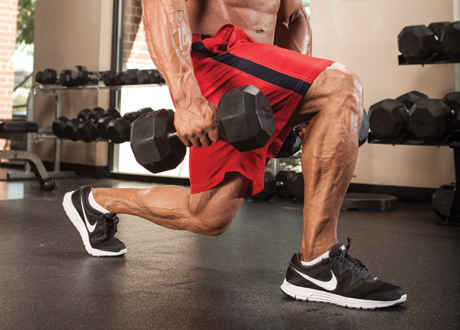
The dumbbell lunge is a highly versatile movement that can serve as a primary exercise, an accessory lift, or a conditioning tool, depending on your training goal. Because it combines strength with coordination, it’s best performed when you can focus on control and consistent execution.
As a coach working with lifters and athletes, I most often program dumbbell lunges to improve muscle balance, movement quality, and targeted muscle development, especially when adjusting step length for specific emphasis.
Recommended Placement
- As a primary unilateral exercise: Perform early in the workout to maximize strength, balance, and muscle activation.
- After squats or leg presses: Use it as an accessory movement to target each leg individually and increase training volume.
- For hypertrophy training: Ideal for moderate to high reps with controlled tempo.
- In conditioning workouts: Can be included in circuits to improve endurance and coordination.
Sets & Reps Guidelines
- Hypertrophy (muscle growth): 3–4 sets of 8–15 reps per leg
- Strength focus: 3–4 sets of 6–10 reps per leg
- Endurance/conditioning: 2–3 sets of 12–20 reps per leg
In my experience, the dumbbell lunge delivers the best results when you stay consistent with your step length and focus on controlled movement. Small variations in execution can significantly change the training effect, so precision is key.
Conclusion
The dumbbell lunge is one of the most effective exercises for building strong, balanced, and well-developed legs. Its ability to target both the quadriceps and the glutes/hamstrings—simply by adjusting step length—makes it one of the most versatile movements in any training program.
As a coach, I’ve seen this exercise consistently improve not only muscle development but also balance, coordination, and movement quality. While it may look simple, performing it with proper control and intent can significantly elevate your results.
When used correctly, the dumbbell lunge becomes a powerful tool for developing strength, symmetry, and real-world athletic performance.
What is the dumbbell lunge?
The dumbbell lunge is a unilateral lower-body exercise performed by stepping forward or backward while holding dumbbells at your sides.
What muscles does the dumbbell lunge work?
It primarily targets the quadriceps, glutes, and hamstrings, while also engaging the core and stabilizer muscles.
How does step length affect the dumbbell lunge?
A shorter step emphasizes the quadriceps, while a longer step shifts more load to the glutes and hamstrings.
Are dumbbell lunges better than squats?
Dumbbell lunges are better for balance and unilateral strength, while squats are better for maximum strength and heavier loading.
Should my knee go past my toes during a lunge?
A slight forward movement is natural, but your knee should stay aligned with your toes and under control.
Are dumbbell lunges good for beginners?
Yes, beginners can start with bodyweight lunges and progress to dumbbells as they gain strength and balance.
Can dumbbell lunges build muscle?
Yes, when performed with proper form and progressive overload, they are very effective for building lower-body muscle.
What is the difference between forward and reverse lunges?
Forward lunges are more dynamic, while reverse lunges are generally easier on the knees and offer better control.
Should I alternate legs or do one side at a time?
Both are effective—alternating improves coordination, while single-side sets improve focus and stability.
How often should I do dumbbell lunges?
Most people can include them 1–3 times per week, depending on training volume and recovery.
