


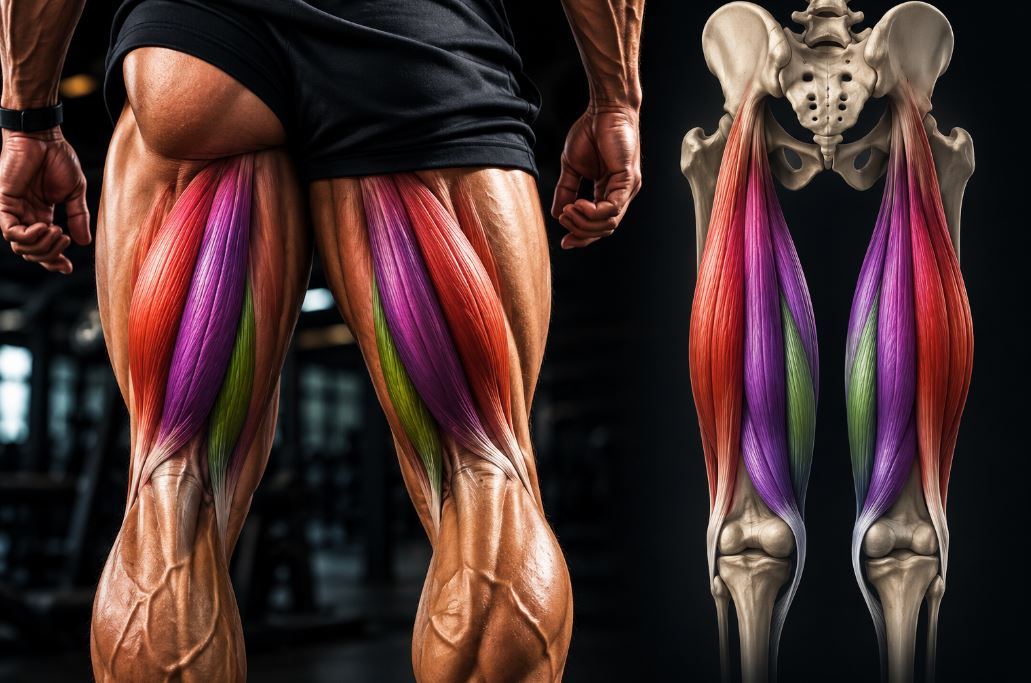
The hamstrings are three muscles doing two very different jobs at once — extending the hip and flexing the knee — which is exactly why they’re so frequently injured and so often undertrained relative to the quadriceps. Most lifters lump “hamstrings” together as one muscle, but one of the three (the short head of the biceps femoris) doesn’t even cross the hip joint, and the other two behave differently enough from each other that certain exercises can genuinely bias one over another. Understanding hamstring functional anatomy is what separates lifters who just do leg curls from those who train the posterior chain the way it actually works.
Quick Answer
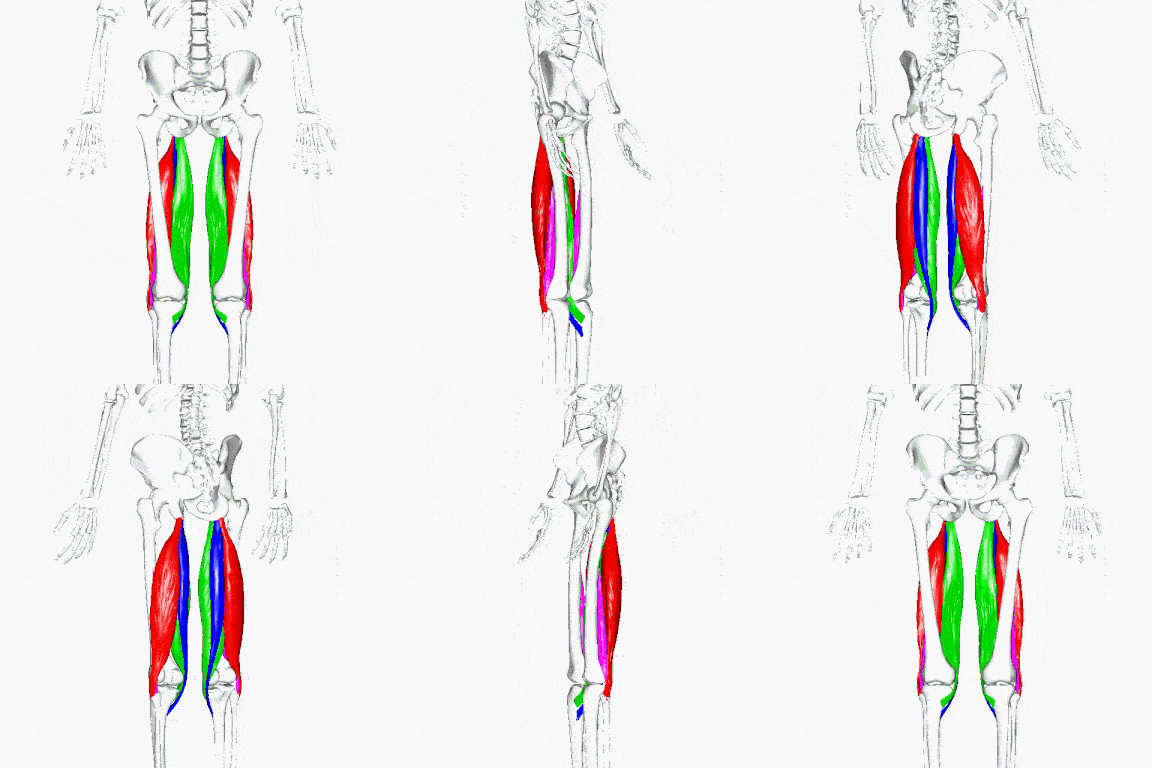
The hamstrings are a group of three muscles on the back of the thigh — the biceps femoris (long and short heads), semitendinosus, and semimembranosus — that together extend the hip and flex the knee. All three (except the short head of the biceps femoris) originate at the ischial tuberosity and cross both the hip and knee joints, making them biarticular muscles central to running, jumping, and hip-hinge movements like the deadlift.
| Muscle type | Three-muscle group of the posterior thigh |
|---|---|
| Primary functions | Hip extension, knee flexion |
| Secondary functions | Internal rotation of the tibia (semitendinosus/semimembranosus); external rotation (biceps femoris) |
| Innervation | Tibial division of the sciatic nerve (all except biceps femoris short head, which is innervated by the common fibular division) |
| Blood supply | Perforating branches of the profunda femoris artery |
| Common exercises | Romanian deadlifts, leg curls, Nordic curls, glute-ham raises |
| Main bodybuilding role | Posterior thigh shape, athletic performance, and injury resilience |
Overview
Why Are the Hamstrings Important?
The hamstrings are essential for nearly every explosive lower-body movement — sprinting, jumping, and decelerating — and they work closely with the glutes to control hip position and protect the knee joint during heavy lifting. Despite their outsized athletic importance, the hamstrings are one of the most commonly underdeveloped muscle groups in recreational lifters, largely because modern life (prolonged sitting, quad-dominant training) tends to leave them weak relative to the quadriceps. This imbalance isn’t just cosmetic — poor hamstring strength and conditioning is one of the most well-documented risk factors for lower-body strain injuries in sport. To see how the hamstrings fit into the rest of your muscular system, check out our interactive muscle anatomy tool.
Hamstring Functional Anatomy & Location
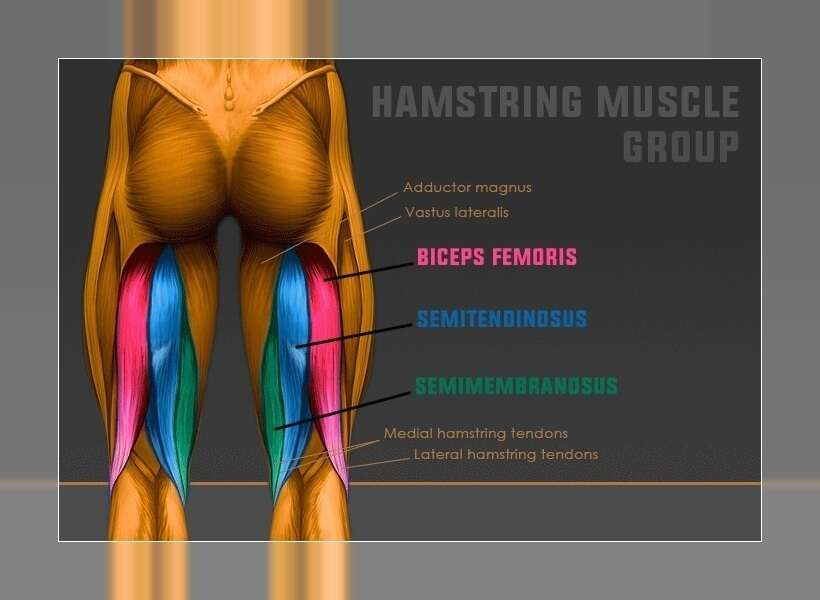
The hamstrings run down the back of the thigh, from the base of the pelvis to just below the knee, forming the rounded contour that’s visible from behind when well developed. A solid grasp of hamstring functional anatomy starts with understanding that “the hamstrings” isn’t one muscle but three: the biceps femoris on the outer thigh, and the semitendinosus and semimembranosus on the inner thigh.
The biceps femoris has two heads — a long head and a short head — similar in concept to the biceps brachii in the upper arm. It’s typically the strongest and most lateral of the three hamstring muscles. The semitendinosus is a long, slender muscle with an unusually long tendon of insertion that runs alongside the biceps femoris before crossing to the inside of the knee. The semimembranosus lies partly beneath the semitendinosus and is the broadest of the three muscles at its origin.
Finding Your Hamstrings: Surface Anatomy
Stand and bend your knee against resistance (or simply curl your heel toward your glutes), and you’ll feel the hamstrings contract along the back of your thigh. The biceps femoris is easiest to feel on the outer back of the thigh, while the semitendinosus and semimembranosus are more prominent toward the inner back of the thigh, just above the knee.
Characteristics at a Glance
| Characteristic | Value |
|---|---|
| Shape | Long, fusiform muscles with elongated tendons |
| Muscle group | Posterior compartment of the thigh |
| Number | Pair (left and right); three muscles per side (four heads counting biceps femoris separately) |
| Fiber direction | Parallel, running the length of the thigh |
| Crosses | Hip and knee joints (all except the short head of the biceps femoris, which crosses the knee only) |
Origin, Insertion, Innervation & Blood Supply
| Attribute | Detail |
|---|---|
| Origin (biceps femoris, long head) | Ischial tuberosity |
| Origin (biceps femoris, short head) | Lateral lip of the linea aspera of the femur |
| Origin (semitendinosus) | Ischial tuberosity |
| Origin (semimembranosus) | Ischial tuberosity (superolateral aspect) |
| Insertion | Biceps femoris: head of the fibula; semitendinosus: proximal medial tibia; semimembranosus: posteromedial tibial condyle |
| Innervation | Tibial division of the sciatic nerve for the long head of the biceps femoris, semitendinosus, and semimembranosus; common fibular (peroneal) division of the sciatic nerve for the short head of the biceps femoris |
| Blood supply | Perforating branches of the profunda femoris (deep femoral) artery |
Two of the three hamstring muscles — the long head of the biceps femoris and the semitendinosus — share a common tendon of origin at the ischial tuberosity, while the semimembranosus originates slightly separately on the same bony landmark. According to StatPearls’ anatomical reference on the hamstring muscle complex, the hamstrings collectively form the borders of the popliteal fossa behind the knee — the biceps femoris forming the upper-lateral border, and the semitendinosus and semimembranosus forming the upper-medial border.
Anatomical Variations
The most functionally significant “variation” within the hamstring group isn’t really a variation at all — it’s built into the muscle’s normal anatomy. The short head of the biceps femoris is the only one of the four hamstring heads that doesn’t cross the hip joint, since it originates on the femur itself rather than the pelvis. It’s also the only hamstring head innervated by the common fibular (peroneal) division of the sciatic nerve rather than the tibial division — meaning a single muscle (the biceps femoris) actually receives dual innervation from two different nerve branches to its two heads. This dual nerve supply is a genuine anatomical curiosity and is part of why the biceps femoris behaves somewhat independently even within its own two heads.

Clinical Relevance
The hamstrings are clinically significant well beyond sports medicine. The semitendinosus (often along with the gracilis) is one of the most commonly harvested tendons for ACL reconstruction surgery, since it can be removed with a relatively minor impact on overall hamstring strength. Interestingly, research using functional MRI has found that the biceps femoris tends to compensate for the reduced size and function of the semitendinosus after this type of graft harvest, showing measurably increased activation to help make up for the deficit. This is a good example of how functionally interconnected the three hamstring muscles are, even though they can be trained somewhat independently.
An Evolutionary Note
The hamstrings’ dual role in both hip extension and knee flexion is thought by some comparative anatomists to reflect the demands of bipedal walking and running, where a single muscle group crossing both joints allows for more efficient energy transfer during the gait cycle than if hip and knee movement were controlled by entirely separate muscle systems. This is more of an anatomical observation than settled science, but it may help explain why the hamstrings are so heavily involved in high-speed movements like sprinting, where this dual-joint efficiency matters most.
Actions
Primary Actions
- Hip extension — driving the thigh backward, central to running, jumping, and standing up from a hinge position
- Knee flexion — bending the knee, as in a leg curl
Secondary Functions
- Internal rotation of the tibia — performed by the semitendinosus and semimembranosus when the knee is flexed
- External rotation of the tibia — performed by the biceps femoris when the knee is flexed
- Pelvic stabilization — helping control pelvic tilt during standing and heavy hip-hinge movements
Synergists, Antagonists & Stabilizers
Synergists (muscles that assist hip extension or knee flexion alongside the hamstrings):
- Gluteus maximus — the primary synergist for hip extension, especially in hip-dominant movements
- Gastrocnemius — assists knee flexion, though its primary role is at the ankle
- Adductor magnus (posterior/hamstring portion) — assists hip extension
Antagonist (the muscle group that opposes the hamstrings’ primary actions):
- Quadriceps femoris — directly opposes knee flexion via its knee extension function
Stabilizers (muscles that support the hip and knee while the hamstrings work):
- Gluteus maximus and deep hip rotators
- Erector spinae (during hip-hinge movements)
Role During Common Exercises
| Exercise | Role of the Hamstrings |
|---|---|
| Romanian deadlift | Prime mover, hip-dominant bias |
| Nordic hamstring curl | Prime mover, knee-dominant bias |
| Lying/seated leg curl | Prime mover, knee-dominant bias |
| Glute-ham raise | Prime mover, combines hip and knee dominance |
| Good morning | Prime mover, hip-dominant bias |
| Back squat | Stabilizer |
| Sprinting | Major contributor (both hip extension and knee flexion phases) |
Bodybuilder’s Take
This is where hamstring anatomy actually changes how you train.
“Do I need both hip-dominant and knee-dominant exercises, or is one enough?” Research comparing different hamstring exercises has found that hip-dominant movements (like the Romanian deadlift, good morning, and hip extensions) and knee-dominant movements (like leg curls and Nordic curls) tend to bias the muscle group somewhat differently, and evidence increasingly suggests that a meta-analysis-level pattern exists: Nordic curls tend to bias the semitendinosus more, while prone leg curls tend to bias the biceps femoris more. Since the biceps femoris is also the most commonly strained hamstring muscle, combining both movement patterns rather than relying on just one exercise type is the more complete approach.
“Why do my hamstrings cramp during leg curls specifically?” This is an extremely common complaint, and it’s rarely about the hamstrings being “weak” in a general sense — it’s more often related to insufficient blood flow, electrolyte status, training the muscle in a shortened position repeatedly, or simply pushing too much volume too quickly in an unfamiliar range of motion. We cover the specific causes and fixes in detail in Why Do Hamstrings Cramp During Leg Curls?, which is worth reading if this happens to you regularly.
“My hamstrings feel underdeveloped compared to my quads — is that normal?” Extremely common, and usually a training imbalance rather than genetics. Most lifters do far more knee-extension-dominant work (squats, leg press, lunges) than hip-hinge work, which naturally biases development toward the quads. For a full breakdown of exercise selection to correct this, see Best Hamstring Exercises for Strength, Size & Injury Prevention.
Common beginner mistakes:
- Training only knee-dominant exercises (leg curls) while neglecting hip-dominant hinge patterns (RDLs, good mornings)
- Skipping eccentric-focused work entirely, despite eccentric strength being one of the biggest protective factors against hamstring strains
- Rounding the lower back during Romanian deadlifts instead of hinging properly at the hip, which shifts stress away from the hamstrings
Best Exercises

| Exercise | Main Function Trained | Main Benefit | Best For |
|---|---|---|---|
| Nordic hamstring curl | Knee flexion (eccentric emphasis) | Loads the hamstrings at long muscle length, where strains typically occur | Injury resilience, semitendinosus bias |
| Romanian deadlift | Hip extension | Heavy hip-hinge loading | Overall mass, biceps femoris bias |
| Glute-ham raise | Combined hip extension and knee flexion | Full posterior-chain integration | Advanced strength and coordination |
| Standing leg curl | Knee flexion | Direct, adjustable isolation | Mind-muscle connection |
| Cable leg curl | Knee flexion | Constant tension, added stabilization demand | Unilateral development and coordination |
For a complete breakdown of hamstring-specific programming, see our full guide: Best Hamstring Exercises for Strength, Size & Injury Prevention.
Stretching & Mobility
- Standing toe-touch stretch — keeping the back flat and hinging at the hips (not rounding the spine) stretches the hamstrings along their full length.
- Seated hamstring stretch — sitting with one leg extended and reaching toward the toes removes balance demands from the standing version.
- Foam rolling — light-to-moderate pressure along the back of the thigh can help address general tightness. See our full guide: Foam Roller Hamstring Roll.
For a complete set of stretching progressions, see our guide: Top 10 Hamstring Stretching Exercises.
What Does Research Say?
EMG Findings
A systematic review and meta-analysis comparing biceps femoris and semitendinosus activation across hamstring exercises found no significant overall difference between the two muscles when knee- and hip-based exercises were combined — but specific exercises showed clear biases. The Nordic hamstring curl produced significantly greater semitendinosus activation, while prone-lying leg curls produced significantly greater biceps femoris activation. This is a meaningful finding for programming, since it suggests that relying on just one exercise type leaves one of the two lateral/medial hamstring muscles relatively undertrained.
Separate research comparing hip-dominant exercises against knee-dominant exercises (Romanian deadlift, step-up, hip extension, and kickbacks versus Nordic curls and leg curls) found that the hip-dominant movements produced greater gluteus maximus activation alongside hamstring activation, reinforcing that hip-hinge patterns train the posterior chain as an integrated unit rather than isolating the hamstrings alone.
Biomechanical Findings
Where dedicated EMG comparisons are more limited — for example, comparing specific leg curl foot positions (toes pointed vs. neutral vs. flexed) — the reasoning generally comes down to line of pull and joint rotation demands, since the biceps femoris and medial hamstrings (semitendinosus/semimembranosus) have slightly different rotational actions at the knee. The Nordic curl’s emphasis on loading the hamstrings near full knee extension is particularly well supported biomechanically as an injury-prevention tool, since this lengthened position corresponds to the point at which most hamstring strains occur during high-speed running.
Common Conditions Affecting the Hamstrings
This section is educational and should not replace professional medical advice.
- Hamstring strain — the most common hamstring injury, ranging from a mild pull to a complete tear; the biceps femoris is the most frequently affected of the three muscles, likely due to its dual-joint, dual-nerve architecture.
- Proximal hamstring tendinopathy — chronic irritation of the tendon near the ischial tuberosity, often from repetitive hip-hinge loading or running volume.
- Complete hamstring tendon avulsion — a more severe injury involving the tendon tearing away from the ischial tuberosity, typically requiring surgical repair.
- Cramping during isolated knee flexion exercises—common during leg curls in particular; see our dedicated guide on why hamstrings cramp during leg curls for causes and fixes.
Risk Factors
- Poor eccentric hamstring strength — one of the most well-documented risk factors for strain injuries, which is part of why eccentric-focused exercises like the Nordic curl are widely used in injury-prevention programs.
- Muscle imbalance between the hamstrings and quadriceps—a hamstring-to-quadriceps strength ratio that’s too low — is associated with increased risk of strain.
- Insufficient warm-up before high-speed running or jumping — cold tissue is generally less tolerant of the sudden, high-force eccentric loading involved in sprinting.
- Previous hamstring injury — one of the strongest predictors of future hamstring strain, making rehabilitation and gradual return to full-intensity work especially important.
Persistent posterior thigh pain, sudden sharp pain during a sprint or lift, or bruising along the back of the thigh should be evaluated by a healthcare professional rather than trained through.
Common Myths
A clear picture of hamstring functional anatomy dispels most persistent training myths surrounding this muscle group.
Myth: All hamstring exercises train the muscle group identically. Research shows meaningful differences between exercises — Nordic curls tend to bias the semitendinosus, while prone leg curls tend to bias the biceps femoris, meaning a complete hamstring program benefits from including more than one movement pattern.
Myth: Leg curls alone are enough to build complete hamstring development. Leg curls are a knee-dominant exercise and don’t meaningfully train the hamstrings’ hip-extension function. Hip-dominant movements like Romanian deadlifts and good mornings are necessary to fully train the muscle group.
Myth: Stretching before exercise prevents hamstring strains. While mobility work has general benefits, research has not strongly supported pre-exercise static stretching alone as an effective hamstring injury prevention strategy. Eccentric strengthening (such as Nordic curls) has considerably stronger research support for this purpose.
Myth: Hamstring cramping during leg curls means the muscle is weak. Cramping during isolated knee flexion is common even in strong, well-trained lifters and is often related to factors such as training in a shortened range repeatedly, hydration, or unfamiliar volume, rather than a fundamental strength deficit.
Myth: The hamstrings are just “one muscle” on the back of the leg. The hamstrings are three distinct muscles (four counting both heads of the biceps femoris separately) with somewhat different roles, innervation, and exercise responses, not a single uniform muscle.
Complete your anatomy knowledge with the muscles of the chest, shoulders, back, arms, core, and neck.
Explore Upper Body MusclesKey Takeaways
- The hamstrings are three muscles — biceps femoris, semitendinosus, and semimembranosus — that extend the hip and flex the knee.
- The short head of the biceps femoris is the only hamstring head that doesn’t cross the hip joint.
- EMG research shows Nordic curls bias the semitendinosus while prone leg curls bias the biceps femoris.
- Poor eccentric hamstring strength is one of the strongest predictors of strain injury, making exercises like the Nordic curl valuable for prevention.
- A complete hamstring program needs both hip-dominant (RDL, good morning) and knee-dominant (leg curl, Nordic curl) exercises.
- Like any muscle, the hamstrings grow best through progressive overload, adequate range of motion, and consistent recovery.
Frequently Asked Questions
What is the main function of the hamstrings?
Their main jobs are extending the hip and flexing the knee, which makes them central to running, jumping, and hip-hinge movements like the deadlift.
Why do my hamstrings cramp during leg curls?
This is usually related to training in a shortened muscle position, hydration status, or unfamiliar training volume rather than general weakness. See our full guide on why hamstrings cramp during leg curls for a detailed breakdown.
Which hamstring exercise is best overall?
No single exercise trains the entire hamstring group optimally. Research shows Nordic curls tend to bias the semitendinosus while leg curls tend to bias the biceps femoris, so a combination of hip-dominant and knee-dominant movements is more complete.
Why are my hamstrings so much weaker than my quads?
This is usually a training imbalance rather than genetics, since most lifters do far more knee-extension-dominant work than hip-hinge work. See our guide on best hamstring exercises for exercise selection to correct this.
Does stretching prevent hamstring strains?
Research has not strongly supported static stretching alone as an effective injury-prevention strategy. Eccentric strengthening exercises, such as the Nordic curl, have considerably stronger research support.
How often should I train hamstrings for growth?
Most lifters see good results training hamstrings directly two to three times per week, combined with adequate recovery between sessions and progressive overload over time.
Sources & References
Every claim in this guide is grounded in anatomical references and published research. Explore the primary sources below.
