



Introduction
Shoulder pain, instability, and weakness are some of the most common issues I see when working with lifters, beginners, and even professional athletes. In most cases, the root cause isn’t a lack of strength in the big muscles like the deltoids or chest—it’s a weak and underdeveloped rotator cuff.
The rotator cuff is responsible for keeping your shoulder stable during nearly every upper-body movement. Whether you’re pressing, pulling, throwing, or simply raising your arm, these small but critical muscles are constantly working behind the scenes. When they’re strong and well-coordinated, your shoulders feel stable, powerful, and pain-free. When they’re weak, everything starts to break down.
The problem is that most people either ignore rotator cuff training completely or approach it incorrectly—using too much weight, poor technique, or the wrong exercises altogether.
In this guide, you’ll learn exactly how to train your rotator cuff the right way. We’ll break down the most effective exercises, explain how they work, and show you how to build strong, stable shoulders that can handle both heavy training and real-world demands.
What Are Rotator Cuff Exercises?
Rotator cuff exercises are movements designed to strengthen the muscles that stabilize the shoulder joint and control rotation, thereby improving strength, coordination, and resistance to injury.
These exercises primarily target four key muscles:
- supraspinatus
- infraspinatus
- teres minor
- subscapularis
Together, these muscles keep the head of the humerus centered in the shoulder joint, allowing for smooth, controlled movement without excessive stress on surrounding structures.
What Is the Rotator Cuff?
The rotator cuff is a group of four small but highly important muscles that surround the shoulder joint. Their primary role is not to generate large amounts of force, but to stabilize the shoulder and control movement with precision.
Unlike the deltoids or chest muscles, which are responsible for lifting and pressing, the rotator cuff works continuously to keep the head of the humerus properly positioned within the shoulder socket. This is what allows your shoulder to move freely while remaining stable under load.

The 4 Rotator Cuff Muscles Explained
Each muscle has a specific role, but they work together as a coordinated unit:
- Supraspinatus
Initiates arm elevation, especially during the first 15–30 degrees of movement. It plays a key role in starting shoulder abduction. - Infraspinatus
The primary external rotator of the shoulder. It helps rotate the arm outward and stabilize the joint during movement. - Teres Minor
Works alongside the infraspinatus to assist with external rotation and shoulder stabilization. - Subscapularis
The main internal rotator of the shoulder. It helps rotate the arm inward and contributes to overall joint stability.
Primary Functions of the Rotator Cuff
To understand why these muscles are so important, you need to look at what they actually do during movement:
- Shoulder stabilization
Keeps the humeral head centered in the socket, preventing excessive movement that can lead to injury. - External rotation
Allows the arm to rotate outward—essential for pulling movements and overhead stability. - Internal rotation
Controls inward rotation of the arm, which is heavily involved in pressing and throwing. - Initiation of arm elevation
The supraspinatus plays a crucial role in starting the lifting motion before the deltoid takes over.
Why Rotator Cuff Exercises Matter
Rotator cuff exercises are not just an optional add-on—they are essential for building strong, stable, and injury-resistant shoulders. Whether you’re a beginner or an experienced lifter, neglecting these muscles will eventually limit your performance and increase your risk of injury.
Injury Prevention and Joint Health
One of the primary roles of the rotator cuff is to stabilize the shoulder joint. When these muscles are weak, the humeral head can shift out of its optimal position, placing stress on surrounding tissues.
- Helps keep the shoulder joint properly aligned
- Reduces the risk of impingement and overuse injuries
- Supports long-term joint health
Improved Strength and Performance
Strong rotator cuff muscles allow the larger muscles—like the deltoids, chest, and back—to function more efficiently.
- Enhances pressing and pulling strength
- Improves force transfer during compound lifts
- Allows you to train heavier with better control
Better Shoulder Stability and Control
Without proper stability, strength becomes unpredictable and inefficient. The rotator cuff ensures smooth, controlled movement in every direction.
- Improves coordination during upper-body movements
- Helps maintain proper joint positioning under load
- Reduces energy leaks during lifting
Transfer to Real-World Movements
The rotator cuff is heavily involved in everyday activities and athletic movements, especially those involving overhead motion.
- Essential for throwing, swimming, and overhead sports
- Supports functional strength and mobility
- Improves movement quality outside the gym
Key insight: You don’t notice your rotator cuff when it’s strong—but you immediately feel it when it’s weak. Building these muscles is one of the best investments you can make for long-term shoulder performance and health.
Signs Your Rotator Cuff May Be Weak
A weak or underdeveloped rotator cuff often doesn’t show up as immediate pain—it usually starts with subtle signs that many people ignore. Over time, these small issues can develop into more serious problems if not addressed.
- Shoulder instability
Your shoulder feels loose, shaky, or unsupported during movements—especially when lifting weights or reaching overhead. - Pain during pressing or overhead exercises
Discomfort when performing movements like bench press, overhead press, or even push-ups. - Clicking or popping sensations
Audible or noticeable clicking during shoulder movement, often without pain at first. - Weakness at the start of movements
Struggling to initiate movements like lateral raises or arm elevation—this often points to supraspinatus weakness. - Poor control during lifting
Difficulty maintaining proper form, especially during slow or controlled movements. - Fatigue in the shoulders
Your shoulders tire quickly, even with light weights or simple exercises. - Discomfort when sleeping on your shoulder
Pain or irritation when lying on one side—common early warning sign.
Key takeaway: Most shoulder problems don’t start with injury—they start with weakness and poor control. Recognizing these signs early allows you to fix the issue before it becomes a serious limitation.
The 3 Essential Movement Patterns You Must Train
A well-designed rotator cuff program isn’t just about doing random exercises—it’s about covering the key movement patterns that keep your shoulder strong and balanced. Most people make the mistake of focusing on only one aspect, which leads to imbalances over time.
To train your rotator cuff effectively, you need to include all three of these essential functions:
External Rotation
External rotation is one of the most important—and most neglected—functions of the rotator cuff. It is primarily performed by the infraspinatus and teres minor.
- Keeps the shoulder joint stable during pulling and overhead movements
- Counteracts the strong internal rotation forces from the chest and lats
- Essential for posture and shoulder alignment
Common exercises:
- Band external rotation
- Dumbbell external rotation
- Cable external rotation
- Face pull (external rotation focus)
- Scarecrow rotation (advanced)
Internal Rotation
Internal rotation is often stronger because it is supported by larger muscles like the chest and lats. However, it still needs to be trained in a controlled, balanced manner.
- Helps control pressing and pushing movements
- Supports shoulder stability during compound lifts
- Works together with external rotation for joint balance
Common exercises:
- Resistance band internal rotation
- Cable internal rotation
- Dumbbell internal rotation
Supraspinatus Activation (Early Abduction)
The supraspinatus is responsible for initiating arm elevation—especially the first phase of lifting your arm. This function is often overlooked but critically important.
- Controls the beginning of shoulder abduction
- Helps stabilize the humeral head during lifting
- Supports smooth transition into deltoid-driven movement
Common exercises:
- Empty can exercise
- Incline lateral raise
Key insight: If you skip even one of these movement patterns, you create an imbalance in the shoulder. A complete rotator cuff program must include external rotation, internal rotation, and early-phase abduction work.
The 12 Best Rotator Cuff Exercises
Now that you understand the key movement patterns, it’s time to apply them using the most effective exercises. The goal here is not to overwhelm you with options, but to give you a complete system that covers every important function of the rotator cuff.
Below are the 12 best rotator cuff exercises—each one targeting a specific role in shoulder stability and control. For full instructions and detailed breakdowns, follow the links to each exercise guide.
1. Band External Rotation
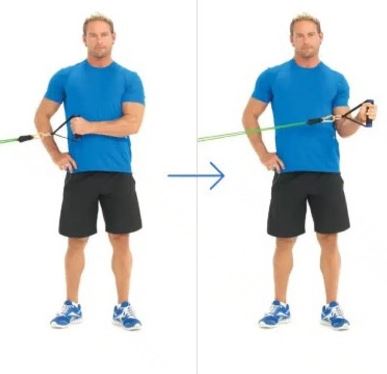
Band external rotation is the foundation of all rotator cuff training. It is simple, effective, and ideal for building strength in the external rotators without placing unnecessary stress on the shoulder joint.
Because it uses elastic resistance, the exercise becomes more challenging as you rotate outward, making it especially effective for strengthening the end range where stability is often weakest.
To perform it, attach a resistance band at elbow height and stand sideways to the anchor. Keep your elbow tucked against your torso and bent at 90 degrees. Rotate your forearm outward while keeping your upper arm fixed in place. Slowly return to the starting position under full control.
- Best for: Beginners, rehab, warm-ups
- Movement Pattern: External rotation
- Difficulty: Beginner
- Type: Band / Isolation
👉 Read full guide: Band External Rotation
2. Cable External Rotation

Cable external rotation provides smooth and consistent resistance throughout the entire movement. This makes it an excellent choice for controlled strength development and improving muscle coordination.
Compared to bands, cables allow for more precise loading and progression, making them ideal for structured gym training.
To perform it, stand next to a cable machine with the handle set at elbow height. Keep your elbow tucked to your side and bent at 90 degrees. Rotate your forearm outward while keeping your upper arm stationary. Return slowly to the starting position with control.
- Best for: Controlled progression, gym training
- Movement Pattern: External rotation
- Difficulty: Beginner to intermediate
- Type: Cable / Isolation
👉 Read full guide: Cable External Rotation
3. Dumbbell External Rotation (Bench-Supported)

Dumbbell external rotation is a simple but highly effective exercise for developing control and awareness of shoulder movement. It relies on gravity rather than constant resistance, which makes the technique even more important.
This variation is especially useful for isolating the rotator cuff and improving coordination during slower, controlled movements.
To perform it, lie across a flat bench with your upper back supported and your feet firmly planted on the floor. Hold a light dumbbell and keep your elbow in contact with the bench, bent at 90 degrees. Start with your forearm resting across your torso, then rotate it upward in a controlled arc until it reaches a vertical position. Slowly lower the dumbbell back to the starting position while maintaining full control.
- Best for: Technique, isolation, control
- Movement Pattern: External rotation
- Difficulty: Beginner
- Type: Dumbbell / Isolation
👉 Read full guide: Dumbbell External Rotation
4. Side Lying Dumbbell External Rotation

The side-lying external rotation is one of the most effective ways to isolate the rotator cuff. By using gravity and a stable position, it minimizes compensation and keeps tension on the target muscles.
This makes it particularly useful for beginners and anyone focusing on strict execution.
To perform it, lie on your side with your elbow resting against your torso. Hold a light dumbbell and bend your elbow to 90 degrees. Rotate your forearm upward while keeping your upper arm fixed. Lower the weight slowly and repeat.
- Best for: Strict form, isolation
- Movement Pattern: External rotation
- Difficulty: Beginner
- Type: Dumbbell / Isolation
👉 Read full guide: Side Lying Dumbbell External Rotation
5. Incline Dumbbell External Rotation

Incline dumbbell external rotation adds a slight variation in angle, which changes how the shoulder is loaded. This can help improve control and challenge the rotator cuff in a different position.
It’s a great progression once you’ve mastered basic external rotation movements.
To perform it, lie on an incline bench with a dumbbell in one hand. Keep your elbow bent at 90 degrees and positioned comfortably. Rotate your forearm upward while keeping your upper arm stable. Slowly return to the starting position.
- Best for: Progression and variation
- Movement Pattern: External rotation
- Difficulty: Intermediate
- Type: Dumbbell / Isolation
👉 Read full guide: Incline Dumbbell External Rotation
6. Resistance Band Internal Rotation
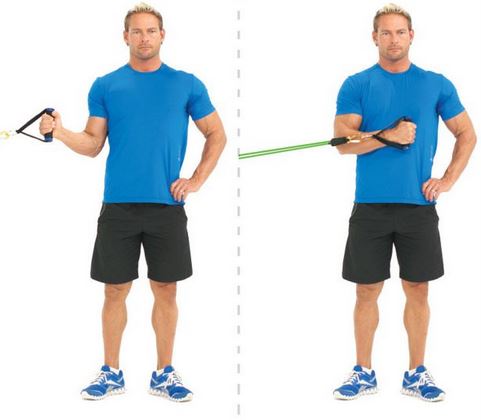
Band internal rotation is a simple and effective exercise for strengthening the shoulder’s internal rotators. While these muscles are often already strong due to pressing movements, targeted training helps improve control and balance within the joint.
This exercise is especially useful for maintaining muscular symmetry between internal and external rotation, which is essential for long-term shoulder health.
To perform it, attach a resistance band at elbow height and stand sideways to the anchor. Hold the band with the hand closest to the anchor, keeping your elbow tucked against your torso at 90 degrees. Rotate your forearm inward across your body while keeping your upper arm fixed. Slowly return to the starting position with full control.
- Best for: Balance, control, shoulder symmetry
- Movement Pattern: Internal rotation
- Difficulty: Beginner
- Type: Band / Isolation
👉 Read full guide: Band Internal Rotation (coming soon)
7. Cable Internal Rotation

Cable internal rotation is a controlled exercise to strengthen the shoulder’s internal rotators while maintaining joint stability. Although these muscles are often stronger than the external rotators, they still need proper training to maintain balance.
This exercise is especially useful for improving control during pressing and pushing movements.
To perform it, stand sideways to a cable machine with the handle set at elbow height. Hold the handle with the hand closest to the machine. Keep your elbow bent at 90 degrees and tucked against your torso. Rotate your forearm inward across your body, then slowly return to the starting position.
- Best for: Balanced shoulder strength, pressing support
- Movement Pattern: Internal rotation
- Difficulty: Beginner to intermediate
- Type: Cable / Isolation
👉 Read full guide: Cable Internal Rotation
8. Dumbbell Internal Rotation

Dumbbell internal rotation is a simple isolation exercise that targets the internal rotators using gravity. It requires strict control to ensure the correct muscles do the work.
This variation is useful for improving coordination and reinforcing controlled movement patterns.
To perform it, lie across a bench or on the floor with your elbow supported and bent at 90 degrees. Hold a light dumbbell and start with your forearm out to the side. Rotate your forearm inward toward your torso in a controlled arc. Slowly return to the starting position.
- Best for: Isolation, control, technique
- Movement Pattern: Internal rotation
- Difficulty: Beginner
- Type: Dumbbell / Isolation
👉 Read full guide: Dumbbell Internal Rotation
9. Empty Can Exercise

The empty can exercise is designed to target the supraspinatus, particularly during the initial phase of arm elevation. It mimics the motion of pouring from a can, creating internal rotation combined with abduction.
While effective, it should be performed carefully to avoid unnecessary shoulder stress.
To perform it, stand upright holding light dumbbells. Raise your arms in a slight forward angle (scapular plane) while rotating your thumbs downward. Lift until your arms reach shoulder height, then slowly lower them back down with control.
- Best for: Supraspinatus activation
- Movement Pattern: Early abduction (supraspinatus)
- Difficulty: Beginner to intermediate
- Type: Dumbbell / Isolation
👉 Read full guide: Empty Can Exercise
10. Incline Lateral Raise

The incline lateral raise shifts resistance to the beginning of the movement, making it highly effective for targeting the supraspinatus. This is a key difference compared to standard lateral raises, which are hardest at the top.
As a result, it helps strengthen the often-neglected initial phase of shoulder abduction.
To perform it, lie on your side on a bench or floor and hold a dumbbell in your top hand. Start with the weight slightly in front of your hip. Raise your arm upward in a controlled arc, keeping it slightly forward rather than directly to the side. Slowly lower the weight back down.
- Best for: Early-phase strength, control
- Movement Pattern: Early abduction (supraspinatus)
- Difficulty: Beginner to intermediate
- Type: Dumbbell / Isolation
👉 Read full guide: Incline Lateral Raise
11. Face Pull (External Rotation Focus)
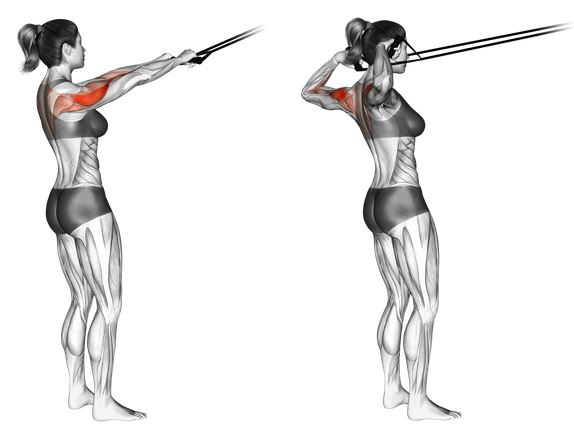
Face pull is a compound movement that combines external rotation with scapular retraction, making it one of the most effective exercises for overall shoulder health. While it is not a pure isolation exercise, it plays a key role in strengthening the rotator cuff within a functional movement pattern.
This exercise is especially valuable for improving posture, shoulder stability, and upper-back strength—all of which support proper rotator cuff function.
To perform it, set a cable or band at face height and grab the handles with both hands. Pull the handles toward your face while flaring your elbows outward and rotating your shoulders externally. Focus on squeezing your shoulder blades together at the end of the movement. Slowly return to the starting position under control.
- Best for: Posture, shoulder health, functional strength
- Movement Pattern: External rotation + scapular retraction
- Difficulty: Beginner to intermediate
- Type: Cable/Band / Compound
👉 Read full guide: Face Pull (coming soon)
12. Scarecrow Rotation

Scarecrow rotation is an advanced rotator cuff exercise that trains external rotation with the arms elevated. This position increases the demand on shoulder stability and closely mimics real-world and athletic movements.
It is particularly valuable for athletes who need strong overhead control.
To perform it, stand upright holding light dumbbells with your arms raised to shoulder height, and elbows bent at 90 degrees. Rotate your forearms upward while keeping your upper arms fixed in place. Pause briefly at the top, then slowly return to the starting position.
- Best for: Athletes, overhead stability
- Movement Pattern: External rotation (90° abduction)
- Difficulty: Intermediate to advanced
- Type: Dumbbell / Isolation
👉 Read full guide: Scarecrow Rotation
Best Rotator Cuff Exercises by Goal
Not all rotator cuff exercises serve the same purpose. Some are better for beginners, others for rehabilitation, and some are more suitable for athletes or advanced training.
Choosing the right exercise depends on your goal, experience level, and current shoulder condition.
Best for Beginners
If you’re new to rotator cuff training, the priority is learning proper movement and building basic control.
- Band External Rotation
- Side Lying Dumbbell External Rotation
- Band Internal Rotation
These exercises are simple, safe, and easy to control, making them ideal for building a strong foundation.
Best for Shoulder Rehab
When recovering from injury or dealing with discomfort, control and low resistance are key.
- Band External Rotation
- Cable External Rotation
- Side Lying Dumbbell External Rotation
- Band Internal Rotation
Focus on slow tempo, light resistance, and perfect technique.
Best for Athletes
Athletes need shoulder stability in more demanding and dynamic positions.
- Scarecrow Rotation
- Face Pull
- Cable External Rotation
These exercises improve control in positions similar to those used in throwing and overhead movement.
Best for Overhead Stability
For movements like overhead press, snatch, or throwing, stability at shoulder height is critical.
- Scarecrow Rotation
- Face Pull
- Incline Dumbbell External Rotation
These exercises train the shoulder in elevated positions where stability is most challenged.
Best for Supraspinatus Activation
If you want to target the muscle responsible for initiating arm elevation:
- Empty Can Exercise
- Incline Lateral Raise
These exercises emphasize the early phase of shoulder abduction.
Best for Home Workouts
If you train at home or want something simple and portable:
- Band External Rotation
- Band Internal Rotation
- Face Pull (with band)
Minimal equipment, maximum effectiveness.
Key takeaway: You don’t need to do all 12 exercises at once. The key is to choose the right ones based on your goal and use them consistently.
Rotator Cuff Exercises for Beginners
If you’re new to rotator cuff training, the goal is not to lift heavy weights—but to learn control, build stability, and develop proper movement patterns. Starting with the right exercises will set the foundation for long-term shoulder health and performance.
As a coach working with beginners, I always emphasize one thing: master control first, then build strength.
Beginner Routine (Simple Plan)
This routine focuses on the most important movement patterns—external rotation, internal rotation, and basic control.
- Band External Rotation – 2–3 sets of 12–15 reps
- Side Lying Dumbbell External Rotation – 2–3 sets of 10–15 reps
- Band Internal Rotation – 2–3 sets of 12–15 reps
Rest: 30–60 seconds between sets. Frequency: 2–3 times per week
How to Perform the Routine
- Use very light resistance
- Focus on slow, controlled movement
- Keep your elbow position stable
- Avoid using momentum
How to Progress Safely
Progression in rotator cuff training should be gradual and controlled.
- Increase reps before increasing resistance
- Add new exercises only after mastering basic ones
- Maintain perfect technique at all times
- Progress to cable or incline variations when ready
Key takeaway: For beginners, simplicity wins. A few well-executed exercises will do far more for your shoulders than a complex routine with poor technique.
Rotator Cuff Training for Athletes and Lifters
For athletes and experienced lifters, rotator cuff training goes beyond basic exercises—it becomes a critical part of performance, injury prevention, and long-term progression. At this level, the goal is not just to strengthen the shoulder, but to maintain stability under heavy loads and in demanding positions.
As a coach working with lifters and athletes, I often see strong individuals limited not by their prime movers, but by weak or poorly trained stabilizers. This is where targeted rotator cuff work makes a real difference.
For Weightlifters (Bench Press & Overhead Press)
Heavy pressing movements place significant stress on the shoulder joint. A strong rotator cuff helps maintain proper joint alignment and improves overall pressing efficiency.
- Include band or cable external rotations as part of your warm-up
- Use face pulls between sets to reinforce shoulder positioning
- Maintain balance between pushing and pulling volume
Focus on stability, not fatigue
For Overhead Sports (Tennis, Baseball, Swimming)
Athletes in overhead sports rely heavily on shoulder stability and control at high speeds and extreme ranges of motion.
- Use scarecrow rotations to build overhead stability
- Include external rotation work at different angles (including 90°)
- Train with light resistance and high control
Emphasize control in elevated positions
For Injury Prevention
Even if you’re not currently injured, rotator cuff training plays a major role in keeping your shoulders healthy over time.
- Train external rotation regularly to balance internal dominance
- Avoid neglecting smaller stabilizing muscles
- Use controlled tempo and proper technique
Consistency is more important than intensity
Key takeaway: For athletes and lifters, rotator cuff training is not optional—it’s essential. Strong stabilizers allow you to lift heavier, move better, and stay injury-free over the long term.
How Often Should You Train the Rotator Cuff?
One of the biggest advantages of rotator cuff training is that it can be performed frequently without excessive fatigue. Because these muscles are small and focused on stability rather than maximal force production, they respond well to regular, low-intensity work.
Weekly Frequency
For most people, training the rotator cuff 2–4 times per week is ideal.
- Beginners: 2–3 times per week
- Intermediate/advanced: 3–4 times per week
- Rehab or prehab focus: even more frequent with very light resistance
Consistency matters more than intensity
Warm-Up vs Dedicated Training
Rotator cuff exercises can be used in different ways depending on your goals.
As a warm-up:
- 1–2 light sets before upper-body workouts
- Focus on activation and control
As dedicated training:
- 2–4 sets per exercise
- More structured and focused work
Both approaches are effective when used correctly
Volume Guidelines
You don’t need a high volume to see results, but quality is essential.
- 2–4 exercises per session
- 2–4 sets per exercise
- 10–20 reps per set
Keep the resistance light and the movement controlled
Key takeaway: Rotator cuff training works best when done regularly and with proper technique. You don’t need to train hard—you need to train consistently.
Best Rep Ranges, Sets, and Resistance
When training the rotator cuff, the goal is not to lift heavy weights, but to develop control, stability, and endurance. These muscles function differently from larger muscle groups, so they require a different training approach.
Why Light Weights Work Best
The rotator cuff muscles are small stabilizers, not primary movers. Using heavy weights often leads to compensation from larger muscles, such as the deltoids and traps.
- Promotes proper muscle activation
- Reduces risk of injury
- Improves movement quality
If you feel this exercise more in your traps than your shoulders, the weight is too heavy
Ideal Rep Ranges (10–20 Reps)
Higher repetitions are more effective for rotator cuff training because they emphasize control and muscular endurance.
- 10–15 reps for general strength
- 12–20 reps for stability and endurance
- Avoid very low reps (e.g., 3–6)
Focus on how the movement feels, not just the number of reps
Sets and Volume
You don’t need high volume, but consistency is key.
- 2–4 sets per exercise
- 2–4 exercises per session
- Moderate overall workload
Quality always beats quantity
Tempo and Control
The way you perform each rep matters more than the load.
- 2 seconds lifting phase
- 2–3 seconds lowering phase
- Brief pause at the end range
Slow, controlled reps improve activation and joint stability
Key takeaway: Rotator cuff training is about precision, not intensity. Use light weights, controlled tempo, and higher reps to build strong, stable shoulders.
Common Rotator Cuff Training Mistakes
Rotator cuff exercises may look simple, but they are often performed incorrectly. These mistakes reduce effectiveness, reinforce bad movement patterns, and can even increase the risk of shoulder pain over time.
Using Too Much Weight
This is the most common mistake. Heavy resistance shifts the load away from the rotator cuff and onto larger muscles like the deltoids and traps.
- Reduces rotator cuff activation
- Encourages poor technique
- Increases the risk of compensation
If you can’t control the movement perfectly, the weight is too heavy
Ignoring External Rotation
Many people unknowingly overtrain internal rotation due to pressing exercises and neglect external rotation work.
- Creates a muscular imbalance
- Increases injury risk
- Leads to poor shoulder alignment
External rotation should be a priority in most programs
Using Momentum Instead of Control
Fast, uncontrolled reps reduce muscle engagement and defeat the purpose of the exercise.
- Decreases effectiveness
- Increases joint stress
- Limits long-term progress
Every rep should be slow, controlled, and deliberate
Poor Elbow Positioning
In many rotator cuff exercises, elbow position determines whether the correct muscles are being targeted.
- Elbow drifting away reduces isolation
- Changes the mechanics of the movement
- Leads to compensation
Keep your elbow stable and in the correct position at all times
Skipping Warm-Ups
Jumping straight into heavy upper-body training without first activating the rotator cuff increases the risk of injury.
- Reduces shoulder stability
- Limits performance
- Increases strain on joints
Even 1–2 light sets can make a big difference
Progressing Too Quickly
Moving to advanced exercises before mastering basic ones often leads to poor control and instability.
- Reduces the effectiveness of advanced movements
- Increases injury risk
- Builds bad habits
Master the basics before progressing
Key takeaway: Most shoulder issues don’t come from doing too little—they come from doing things incorrectly. Focus on technique, control, and progression to get the best results.
Rotator Cuff Exercises vs Shoulder Exercises
One of the biggest misconceptions in training is assuming that shoulder exercises and rotator cuff exercises are the same. While they both involve the shoulder joint, they serve very different purposes.
Understanding this difference is key to building strong, functional, and injury-resistant shoulders.
Deltoids vs Rotator Cuff
Most traditional shoulder exercises target the deltoids, which generate force and move the arm.
- Lateral raises
- Shoulder presses
- Front raises
These exercises build size and strength, but they do not directly train the shoulder’s stabilizing muscles.
The rotator cuff, on the other hand, is responsible for control and stability.
- External rotation
- Internal rotation
- Supraspinatus activation
Deltoids move the arm—the rotator cuff keeps it safe
Strength vs Stability
Shoulder training without rotator cuff work often leads to imbalance.
- Deltoids = strength and power
- Rotator cuff = stability and control
If you only train strength:
- The shoulder becomes powerful but unstable
If you only train stability:
- The shoulder lacks force production
You need both for optimal performance
Why Both Are Necessary
For long-term shoulder health and performance, both types of training must work together.
- The rotator cuff stabilizes the joint during heavy lifts
- Deltoids generate the force needed for movement
- Balanced training reduces injury risk
Key takeaway: Strong shoulders are not just about size and strength—they’re about control. Training both the rotator cuff and the deltoids is the key to building shoulders that are both powerful and resilient.
Sample Rotator Cuff Workout Plan
A well-structured rotator cuff routine doesn’t need to be complex—it needs to be consistent, controlled, and aligned with your level of experience. Below are three practical routines you can use depending on your goals.
Beginner Plan (Foundation & Control)
This routine focuses on learning proper movement patterns and building basic shoulder stability.
- Band External Rotation – 2–3 sets of 12–15 reps
- Side Lying Dumbbell External Rotation – 2–3 sets of 10–15 reps
- Band Internal Rotation – 2–3 sets of 12–15 reps
Frequency: 2–3 times per week
Rest: 30–60 seconds
Focus:
- Slow, controlled movement
- Light resistance
- Perfect technique
Intermediate Plan (Strength & Balance)
At this level, the goal is to improve strength across different angles and reinforce shoulder control under slightly greater demand.
- Cable External Rotation – 3 sets of 12–15 reps
- Dumbbell External Rotation (bench-supported) – 3 sets of 10–12 reps
- Cable Internal Rotation – 2–3 sets of 12–15 reps
- Incline Lateral Raise – 2–3 sets of 12–15 reps
Frequency: 2–4 times per week
Rest: 45–75 seconds
Focus:
- Controlled tempo
- Balanced development
- Clean execution
Athlete Warm-Up Routine (Performance & Stability)
This routine is designed to prepare the shoulders for demanding movements such as pressing, throwing, or overhead lifting.
- Band External Rotation – 2 sets of 12–15 reps
- Face Pull – 2 sets of 12–15 reps
- Scarecrow Rotation – 2 sets of 10–12 reps
Perform before upper-body workouts or sports activity
Focus:
- Activation, not fatigue
- Smooth, controlled movement
- Shoulder stability in elevated positions
Key takeaway: You don’t need long or complicated routines to train the rotator cuff effectively. A few well-chosen exercises performed consistently will deliver far better results than occasional, high-intensity sessions.
Coach’s Perspective (Real-World Insight)
As a coach working with lifters and athletes, one of the most common mistakes I see is that people focus almost entirely on building strength in the big muscles—chest, shoulders, and back—while completely neglecting the small stabilizers that actually keep the joint functioning properly.
The rotator cuff is rarely the limiting factor people think of, but it’s often the hidden reason behind shoulder discomfort, poor control, and stalled progress. I’ve worked with beginners who had pain just from basic pressing movements, and with strong, experienced lifters who could bench heavy weights but lacked even basic shoulder stability.
What consistently delivers results is not complexity—it’s consistency and precision.
- Beginners often improve dramatically just by adding simple band external rotations a few times per week
- Intermediate lifters benefit most from cleaning up their technique and controlling tempo
- Athletes see the biggest gains when they train the shoulder in elevated positions (like scarecrow rotations)
Another key lesson from real-world coaching is this: More weight does not necessarily yield better results in rotator cuff training.
In fact, using lighter resistance with perfect control almost always produces better outcomes. The goal is not to fatigue the muscle, but to teach it how to stabilize and control movement under load.
Conclusion
Rotator cuff training is one of the most important—but most overlooked—aspects of building strong, healthy shoulders. While these muscles are small, their role in stabilizing the joint and controlling movement is critical for both performance and long-term injury prevention.
Throughout this guide, we’ve covered the essential movement patterns, the most effective exercises, and how to structure your training for different goals and experience levels. The key takeaway is simple: you don’t need complexity—you need consistency and control.
By incorporating rotator cuff exercises into your routine, you can improve shoulder stability, enhance performance in pressing and pulling movements, and significantly reduce your risk of injury.
