


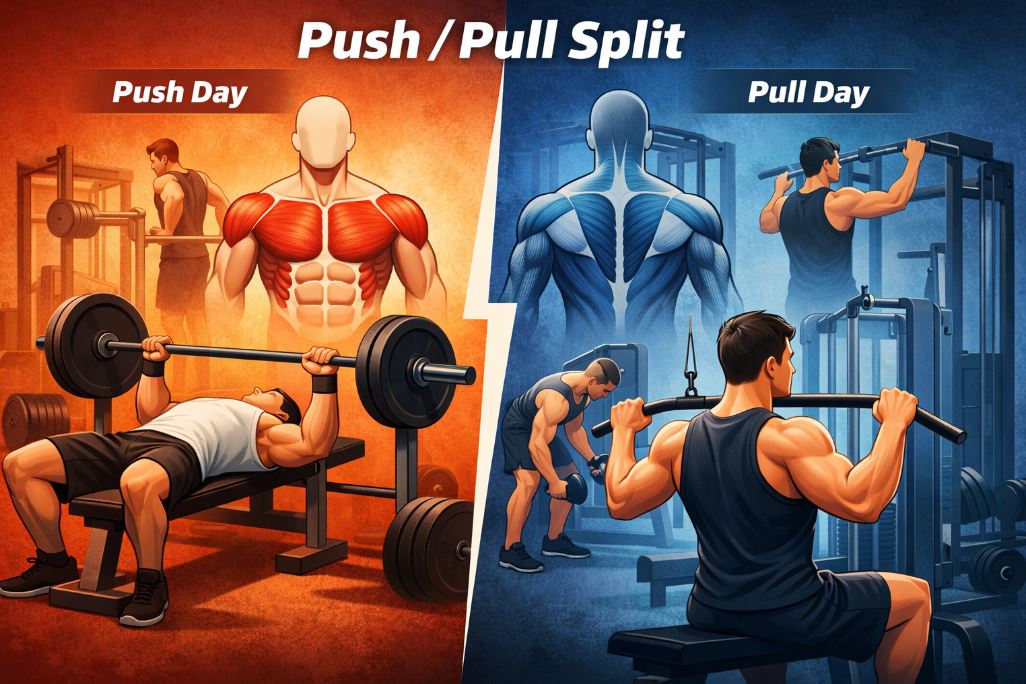
For most beginners, jumping straight into complex split routines is rarely the most brilliant move. In my coaching experience, the most effective long-term progression follows a clear hierarchy: full-body training first, then upper/lower splits, and only after that more specialized systems like push–pull routines.
This Push-Pull Workout Routine for Beginners is designed for trainees who have already completed a structured full-body or upper/lower phase and are ready for the next step. It allows you to increase training volume per muscle group, improve recovery management, and experience more focused workouts — without overwhelming your nervous system or joints.
The program is performed in a fully equipped gym and runs for 4 weeks, using a beginner-appropriate training frequency that balances stimulus and recovery. All major muscle groups are trained evenly, and exercise selection prioritizes stable, well-known movements that beginners can learn safely and progressively.
If you’ve built a solid foundation with full-body or upper/lower training, this routine is where structured split training truly begins.
What Is a Push–Pull Workout Routine?
A push–pull workout routine is a split training system that organizes exercises based on movement patterns rather than body regions.
- Push workouts train the muscles responsible for pushing movements: chest, shoulders, triceps, and, often, quadriceps (depending on structure).
- Pull workouts focus on pulling movements: back, biceps, rear delts, and posterior-chain muscles.
Unlike a full-body program, in which all major muscle groups are trained in a single session, push–pull splits allow for higher training volume per session and more focused muscle activation.
Compared with an upper/lower split, the push–pull system groups muscles by function rather than by location. Upper/lower splits separate the body anatomically, while push–pull splits separate it biomechanically. This makes push–pull training slightly more demanding and better suited for beginners who already have basic movement proficiency and recovery capacity.
Program Structure & Key Training Parameters
Before diving into the weekly workouts, it’s important to understand how this Push-Pull Workout Routine for Beginners is structured, who it’s designed for, and what training parameters it follows. This program represents a natural next step after full-body and upper/lower training, introducing beginners to higher training volume per session while still maintaining proper recovery.
The routine is performed in a fully equipped gym, using barbells, dumbbells, machines, and cables. Training is spread across four sessions per week, allowing each muscle group to be trained twice weekly — a proven sweet spot for beginner hypertrophy and strength development.
| Parameter | Details |
|---|---|
| Training Split | Push–Pull Workout Routine |
| Level | Beginners (with prior full-body or upper/lower experience) |
| Training Frequency | 4 Times per Week |
| Program Duration | 4 Weeks |
| Workout Duration | 60–75 Minutes |
| Training Location | Gym (Full Equipment Access) |
| Primary Goal | Muscle Hypertrophy, Strength Foundation, Training Volume Tolerance |
| Equipment Used | Barbells, Dumbbells, Machines, Cables |
| Muscle Group Frequency | Each muscle group trained 2× per week |
| Progression Model | Gradual increases in load, reps, and controlled RPE progression |
| Fatigue Management | Alternating push and pull days with built-in recovery |
| Rest Between Sets | 60–120 seconds (compound lifts), 45–75 seconds (isolation) |
| Warm-Up Included | Yes – general warm-up + movement-specific ramp sets |
| Beginner-Friendly | Yes – structured volume, clear movement categories |
Weekly Push–Pull Training Structure
To keep training volume manageable while allowing proper recovery, this Push–Pull Workout Routine for Beginners is structured around a weekly split. Each training day focuses on either pushing or pulling movements, grouping muscle groups by their primary function rather than by body region.
This approach reduces overlap between sessions, allows beginners to train with higher focus, and provides enough recovery time between workouts, which is critical at this stage of development.
| Day | Training Focus |
|---|---|
| Monday | Push Workout |
| Tuesday | Rest or Light Activity |
| Wednesday | Pull Workout |
| Thursday | Rest |
| Friday | Push Workout |
| Saturday | Pull Workout or Optional Active Recovery |
| Sunday | Rest |
Coach’s Note — Why This Push / Pull Schedule Works So Well for Beginners
This Push / Pull schedule is structured to train four times per week, which I consider an ideal frequency for beginners who have already completed a full-body or upper/lower phase. It allows enough weekly volume to stimulate muscle growth, without overwhelming recovery capacity.
One of the key advantages of this setup is that no major muscle group is trained on consecutive days. This gives beginners sufficient time to recover, adapt, and improve performance from session to session.
Compared to full-body training, this split allows better focus and mental engagement during each workout. Instead of trying to train everything at once, you can concentrate on fewer movement patterns and execute them with higher quality.
From a long-term coaching perspective, Push / Pull training represents a logical next step after an Upper / Lower split. It introduces more structure and specialization, while still keeping the program simple, balanced, and beginner-friendly.
For your convenience, this workout program is also available as a downloadable PDF, allowing you to save it, print it, or follow it offline anytime.
Week 1 – Learning the Push / Pull Structure
In the first week of this workout program, the main goal is to understand how exercises are grouped and how recovery works within a split system. Unlike full-body or upper/lower-body training, push–pull separates movements by function rather than body region.
This week focuses on:
- Learning which exercises belong to push vs. pull days
- Developing basic technique on compound lifts
- Keeping intensity moderate (RPE ~7)
Do not rush progression yet. Choose loads that allow clean reps and reasonable control.
Push Day (Monday & Friday) – Week 1
(Chest, Shoulders, Triceps)
| Exercise | Sets | Reps | RPE | Muscles Worked |
|---|---|---|---|---|
| Machine or Barbell Chest Press | 3 | 10–12 | 7 | Chest, triceps, anterior delts |
| Incline Dumbbell Press | 3 | 10–12 | 7 | Upper chest, shoulders |
| Seated Shoulder Press (Machine or DB) | 3 | 10–12 | 7 | Deltoids, triceps |
| Cable or Machine Chest Fly | 2–3 | 12–14 | 7 | Chest |
| Lateral Raises (Dumbbells or Machine) | 3 | 14–16 | 7 | Lateral delts |
| Triceps Pushdown (Cable) | 3 | 12–14 | 7 | Triceps |
| Overhead Triceps Extension (Cable or DB) | 2 | 12–14 | 7 | Triceps |
Pull Day (Wednesday & Saturday) – Week 1
(Back, Rear Delts, Biceps)
| Exercise | Sets | Reps | RPE | Muscles Worked |
|---|---|---|---|---|
| Lat Pulldown (Wide or Neutral Grip) | 3 | 10–12 | 7 | Lats, biceps |
| Seated Cable Row | 3 | 10–12 | 7 | Mid-back, lats |
| Chest-Supported Machine Row | 3 | 10–12 | 7 | Upper back |
| Face Pull (Cable or Machine) | 3 | 14–16 | 7 | Rear delts, upper back |
| Dumbbell or Cable Biceps Curl | 3 | 12–14 | 7 | Biceps |
| Hammer Curl (DB or Rope) | 2 | 12–14 | 7 | Biceps, forearms |
| Optional: Back Extension (Machine) | 2 | 12–15 | 7 | Lower back, glutes |
Coach’s Note — Week 1 Focus
Week 1 is about learning how push and pull movements feel and how they differ. Don’t chase heavy weights yet. Focus on clean technique, controlled tempo, and understanding which muscles are doing the work. This foundation will make every following week more effective.
Week 2 – Building Volume & Confidence
By Week 2, your body is already adapting to the push–pull structure. The exercises should feel more familiar, transitions between movements smoother, and overall confidence in the gym noticeably higher.
This week focuses on slightly increasing training volume and control, while still keeping intensity beginner-appropriate. The goal is not to lift heavier at all costs, but to perform each repetition with better technique, stability, and muscle awareness.
You may:
- Add 1–2 reps per set, or
- Slightly increase the load if form remains clean, while keeping effort around RPE 7.
Day 1 (Monday) – Push (Week 2)
| Exercise | Sets | Reps | RPE | Muscles Worked |
|---|---|---|---|---|
| Machine or Barbell Bench Press | 4 | 10–12 | 7 | Chest, triceps, anterior delts |
| Incline Dumbbell Press | 3 | 10–12 | 7 | Upper chest, shoulders |
| Seated Shoulder Press (Machine or Dumbbells) | 3 | 10–12 | 7 | Deltoids, triceps |
| Lateral Raises (Dumbbells or Machine) | 3 | 12–15 | 7 | Lateral deltoids |
| Cable Triceps Pushdown | 3 | 12–14 | 7 | Triceps |
| Overhead Dumbbell Triceps Extension | 2 | 12–14 | 7 | Triceps |
Day 2 (Wednesday) – Pull (Week 2)
| Exercise | Sets | Reps | RPE | Muscles Worked |
|---|---|---|---|---|
| Lat Pulldown (Wide or Neutral Grip) | 4 | 10–12 | 7 | Lats, biceps |
| Seated Cable Row | 3 | 10–12 | 7 | Mid-back, lats |
| Chest-Supported Dumbbell Row | 3 | 10–12 | 7 | Upper back, biceps |
| Face Pull (Cable or Bands) | 3 | 12–15 | 7 | Rear delts, upper back |
| Dumbbell Biceps Curl | 3 | 12–14 | 7 | Biceps |
| Cable Hammer Curl | 2 | 12–14 | 7 | Biceps, forearms |
Day 3 (Friday) – Push (Week 2)
| Exercise | Sets | Reps | RPE | Muscles Worked |
|---|---|---|---|---|
| Chest Press Machine | 4 | 10–12 | 7 | Chest, triceps |
| Dumbbell Bench Press | 3 | 10–12 | 7 | Chest, shoulders |
| Arnold Press | 3 | 10–12 | 7 | Deltoids |
| Cable Lateral Raise | 3 | 12–15 | 7 | Lateral delts |
| Assisted Dips or Bench Dips | 3 | 8–10 | 7 | Chest, triceps |
| Rope Triceps Pushdown | 2 | 12–14 | 7 | Triceps |
Day 4 (Saturday) – Pull (Week 2)
| Exercise | Sets | Reps | RPE | Muscles Worked |
|---|---|---|---|---|
| Assisted Pull-Ups or Lat Pulldown | 4 | 8–10 | 7 | Lats, biceps |
| One-Arm Dumbbell Row | 3 | 10–12 / arm | 7 | Lats, mid-back |
| Cable Row (Close Grip) | 3 | 10–12 | 7 | Mid-back |
| Rear Delt Fly (Machine or Dumbbells) | 3 | 12–15 | 7 | Rear delts |
| EZ-Bar Curl | 3 | 10–12 | 7 | Biceps |
| Incline Dumbbell Curl | 2 | 12–14 | 7 | Biceps |
Coach’s Note — Week 2 Progression
In Week 2, the focus shifts toward volume tolerance and consistency. You’re not chasing maximum intensity yet — you’re teaching your body how to handle slightly more work while still recovering well between sessions.
This phase is about building momentum. Solid technique, repeatable effort, and steady progression now will make the later weeks feel challenging but manageable instead of overwhelming.
Week 3 – Progressive Overload Phase
By Week 3 of this Push-Pull Workout Routine for Beginners, your body should be well-adapted to the fundamental split structure and exercise selection. Movement patterns should feel familiar, and your confidence in the gym should be noticeably higher. This is where we begin to apply progressive overload more intentionally, while still keeping the program beginner-appropriate.
The focus this week is not on adding complexity, but on increasing training demand through:
- Slightly heavier loads,
- Higher-quality repetitions,
- Better control of tempo and rest periods.
Training intensity increases to an RPE of around 7.5, meaning the last few reps of each set should feel challenging but technically solid.
Day 1 (Monday) – Push (Week 3)
| Exercise | Sets | Reps | RPE | Muscles Worked |
|---|---|---|---|---|
| Barbell or Machine Bench Press | 4 | 8–10 | 7.5 | Chest, triceps, anterior delts |
| Seated Dumbbell Shoulder Press | 3 | 10–12 | 7.5 | Deltoids, triceps |
| Incline Dumbbell Press | 3 | 10–12 | 7.5 | Upper chest, shoulders |
| Cable or Machine Lateral Raise | 3 | 12–15 | 7.5 | Lateral deltoids |
| Cable Triceps Pushdown | 3 | 10–12 | 7.5 | Triceps |
| Overhead Dumbbell Triceps Extension | 2–3 | 12–14 | 7.5 | Triceps |
Day 2 (Wednesday) – Pull (Week 3)
| Exercise | Sets | Reps | RPE | Muscles Worked |
|---|---|---|---|---|
| Lat Pulldown or Assisted Pull-Up | 4 | 8–10 | 7.5 | Lats, upper back, biceps |
| Barbell or Machine Row | 3 | 10–12 | 7.5 | Mid-back, lats |
| Seated Cable Row (Neutral Grip) | 3 | 10–12 | 7.5 | Rhomboids, biceps |
| Face Pull (Cable or Machine) | 3 | 12–15 | 7.5 | Rear delts, upper back |
| Barbell or Dumbbell Biceps Curl | 3 | 10–12 | 7.5 | Biceps |
| Hammer Curl (Dumbbells or Cable) | 2–3 | 12–14 | 7.5 | Biceps, forearms |
Day 3 (Friday) – Push (Week 3)
| Exercise | Sets | Reps | RPE | Muscles Worked |
|---|---|---|---|---|
| Machine Chest Press or Barbell Bench Press | 4 | 8–10 | 7.5 | Chest, triceps |
| Standing Barbell or Dumbbell Shoulder Press | 3 | 8–10 | 7.5 | Deltoids, triceps |
| Cable Chest Fly | 3 | 12–14 | 7.5 | Chest |
| Machine Lateral Raise | 3 | 12–15 | 7.5 | Lateral deltoids |
| Parallel Bar Dips (Assisted if needed) | 3 | 8–10 | 7.5 | Chest, triceps |
| Rope Triceps Pushdown | 2–3 | 12–14 | 7.5 | Triceps |
Day 4 (Saturday) – Pull (Week 3)
| Exercise | Sets | Reps | RPE | Muscles Worked |
|---|---|---|---|---|
| Deadlift (Trap Bar or Conventional) | 3 | 6–8 | 7.5 | Posterior chain, back |
| Pull-Ups or Lat Pulldown | 3 | 8–10 | 7.5 | Lats, biceps |
| Chest-Supported Dumbbell Row | 3 | 10–12 | 7.5 | Upper back |
| Rear Delt Fly (Machine or Dumbbells) | 3 | 12–15 | 7.5 | Rear delts |
| EZ-Bar Curl | 3 | 10–12 | 7.5 | Biceps |
| Cable Curl (Slow Tempo) | 2–3 | 12–14 | 7.5 | Biceps |
Coach’s Note — Week 3: Progressive Overload Explained
Week 3 is where structured progression becomes intentional. At this point, your body has already adapted to the movement patterns, so the stimulus must increase to keep progress moving forward.
Progressive overload in this phase doesn’t mean reckless weight jumps. It means using slightly heavier loads, pushing closer to the top of each rep range, slowing down the eccentric phase, and maintaining stronger tension throughout every set.
The goal is simple: challenge the muscles more while keeping technique clean. This balance between intensity and control is what drives sustainable strength and muscle gains for beginners.
Week 4 – Peak Intensity & Movement Mastery (RPE 8)
Week 4 represents the final and most demanding phase of this Push-Pull Workout Routine for Beginners. At this point, you should feel confident with the exercises, understand proper execution, and be comfortable navigating gym equipment.
This week intentionally pushes intensity to RPE 8 across all working sets. That means each set should feel challenging, with roughly 2 reps left in reserve, while still maintaining clean technique. The goal is not maximal effort, but controlled intensity and strong mind–muscle connection.
Push Day (Monday & Friday) – Week 4
| Exercise | Sets | Reps | RPE | Muscles Worked |
|---|---|---|---|---|
| Barbell or Machine Bench Press | 4 | 6–8 | 8 | Chest, triceps, anterior delts |
| Incline Dumbbell Press | 3 | 8–10 | 8 | Upper chest, shoulders, triceps |
| Seated Shoulder Press (Machine or Dumbbells) | 3 | 8–10 | 8 | Deltoids, triceps |
| Cable or Machine Chest Fly | 3 | 10–12 | 8 | Chest |
| Lateral Raises (Dumbbells or Machine) | 3 | 12–15 | 8 | Lateral deltoids |
| Cable Triceps Pushdown | 3 | 10–12 | 8 | Triceps |
| Overhead Triceps Extension (Cable or Dumbbell) | 2 | 12–14 | 8 | Triceps |
Pull Day (Wednesday & Saturday) – Week 4
| Exercise | Sets | Reps | RPE | Muscles Worked |
|---|---|---|---|---|
| Lat Pulldown or Assisted Pull-Ups | 4 | 6–8 | 8 | Lats, biceps, upper back |
| Seated Cable Row | 3 | 8–10 | 8 | Mid-back, lats, biceps |
| Chest-Supported Dumbbell Row | 3 | 8–10 | 8 | Upper back, lats |
| Face Pulls (Cable or Bands) | 3 | 12–15 | 8 | Rear delts, upper back |
| Barbell or Dumbbell Biceps Curl | 3 | 10–12 | 8 | Biceps |
| Incline Dumbbell Curl or Cable Curl | 2 | 12–14 | 8 | Biceps |
| Back Extension or Machine Reverse Hyper | 2 | 12–15 | 8 | Lower back, glutes |
Coach’s Note — Week 4 Intensity Check
In Week 4, the goal is not to add new exercises or complexity, but to push the same movements with higher intent. Setting all exercises at RPE 8 ensures you’re training close enough to your limits to stimulate progress, while still maintaining solid technique.
Keeping push days and pull days consistent across the week is intentional — it allows you to focus on execution, mind–muscle connection, and load progression without unnecessary variability. Finish this week strong, controlled, and confident. This is where beginners truly start to feel like lifters.
Understanding RPE: How Hard Should You Train?
Throughout this program, you’ll notice frequent references to RPE, which stands for Rate of Perceived Exertion. RPE is a simple yet powerful tool used by coaches and athletes to measure how hard a set feels, based on effort rather than exact weight.
Instead of chasing numbers on the bar, RPE teaches beginners to listen to their body and train at an intensity that promotes progress while minimizing injury risk. This is especially important in beginner programs, where technique, consistency, and recovery matter more than maximal loads.
Using RPE allows this program to stay flexible and beginner-friendly, regardless of individual strength levels, recovery capacity, or daily readiness.
| RPE | What It Feels Like | Reps Left in Reserve | What It Means for Beginners |
|---|---|---|---|
| RPE 6 | Very manageable | 4–5 reps left | Too easy for main working sets |
| RPE 7 | Challenging but controlled | 3 reps left | Ideal for learning technique and building consistency |
| RPE 7.5 | Moderately hard | 2–3 reps left | Good balance of effort and safety |
| RPE 8 | Hard but still clean | 2 reps left | Effective for muscle growth without failure |
| RPE 9 | Very hard | 1 rep left | Not recommended for beginners |
| RPE 10 | Maximum effort | 0 reps left | Training to failure — avoid at this stage |
Evaluating the Push–Pull Workout Split: Strengths and Limitations
| Pros | Cons |
|---|---|
| Clear structure that separates pushing and pulling movements, making workouts easy to follow. | Slightly higher complexity than full-body or upper/lower splits for complete beginners. |
| Allows higher training volume per muscle group compared to full-body routines. | Requires good exercise selection to avoid imbalances between push and pull muscles. |
| Improves recovery by grouping muscles with similar movement patterns. | Less frequent stimulation per muscle group compared to full-body training. |
| Prepares beginners for more advanced split routines such as Push–Pull–Legs. | Not ideal for absolute beginners without prior resistance training experience. |
| Works exceptionally well in a gym environment with access to various machines and free weights. | Can feel demanding if recovery, sleep, or nutrition are not well managed. |
| Helps beginners develop a strong mind–muscle connection for upper-body movements. | Lower-body training is less emphasized unless combined later with a legs-focused phase. |
Where This Program Fits in Your Beginner Training Journey
While the Push–Pull Workout Routine for Beginners is an excellent step forward, it’s essential to understand that it works best when placed at the right moment in your training progression. For most true beginners, the ideal starting point is a full-body training program performed three times per week, which allows frequent practice of fundamental movement patterns while keeping overall volume manageable.
Once basic technique, consistency, and recovery habits are established, the next logical phase is an Upper / Lower split. This increases training volume per muscle group while maintaining balanced frequency and sufficient recovery. Only after completing one or both of these phases does a Push–Pull routine truly shine, as it demands better exercise execution, higher session volume, and improved recovery capacity.
After finishing this 4-week Push–Pull program, trainees are typically well prepared to move toward:
- a Push–Pull–Legs (PPL) split,
- a more advanced Push–Pull structure with higher volume, or
- specialized muscle-group-focused splits, depending on individual goals.
In short, this program is not the beginning of the journey — it’s the bridge between beginner fundamentals and more advanced split-based training.
This program is part of a larger beginner system — learn where it fits in the full progression inside our beginner workout roadmap .
Conclusion: Push–Pull Workout Routine for Beginners
The 4-Week Push–Pull Workout Routine for Beginners represents an essential milestone in a beginner’s training journey. By the time someone reaches this program, they are no longer just learning how to move — they are learning how to train with purpose, manage volume, and recover correctly between sessions.
Compared to full-body and upper/lower-body routines, the push–pull split allows beginners to achieve higher training volume per muscle group while keeping the structure logical and straightforward. Each workout has a clear focus, fatigue is easier to manage, and progression becomes more measurable. This makes the program both motivating and sustainable.
That said, this routine works best when it’s used at the right time. Beginners who have already built a basic foundation through full-body or upper/lower training will get the most out of it. Those foundations ensure proper technique, joint readiness, and the ability to handle increased workload without unnecessary risk.
If you complete these four weeks with consistent effort and good form, you’ll be well prepared for the next step — whether that’s a push–pull–legs split, a more advanced upper/lower program, or a goal-specific routine focused on hypertrophy, strength, or physique development.
Progress in training is not about rushing into complexity. It’s about choosing the right tool at the right moment. Used correctly, this push–pull routine is precisely that — a smart, structured step forward.
Is a push-pull workout routine good for beginners?
Yes, a push-pull workout routine can work for beginners who already have basic gym experience and understand fundamental movement patterns.
Should beginners start with push-pull training?
Beginners are usually better off starting with full-body or upper/lower splits before progressing to push-pull routines.
How many days per week should beginners train push-pull?
For beginners, 3–4 training days per week is optimal when using a push-pull split.
What muscles are trained on push day?
Push day trains the chest, shoulders, and triceps using pressing and extension movements.
What muscles are trained on pull day?
Pull day focuses on the back, biceps, rear delts, and grip muscles through pulling motions.
Is push-pull better than upper/lower for beginners?
Upper/lower splits are usually better for beginners; push-pull works best as a next step.
How long should a push-pull workout last?
A beginner push-pull workout should last around 60–75 minutes.
Can beginners build muscle with a push-pull routine?
Yes, beginners can build muscle effectively if volume, technique, and recovery are properly managed.
What is RPE in a push-pull workout?
RPE is a scale that measures how hard a set feels, helping beginners regulate intensity safely.
What RPE should beginners use for push-pull training?
Most beginner push-pull workouts should stay between RPE 6.5 and 8.
How long should beginners follow a push-pull program?
A 4–6 week phase is ideal before reassessing progress.
What equipment is needed for push-pull training?
A full gym setup with barbells, dumbbells, cables, and machines works best.
