


Introduction
The Superman exercise is one of the few common core exercises that trains spinal extension directly, rather than training the core to resist it. Where the plank and the rollout teach the abs to prevent the lower back from arching under load, the superman asks the posterior chain — glutes, hamstrings, and spinal erectors — to actively produce that extension and hold it under control. That makes it a genuinely complementary exercise to the anti-extension movements that dominate most core programs, addressing a function those exercises deliberately avoid training.
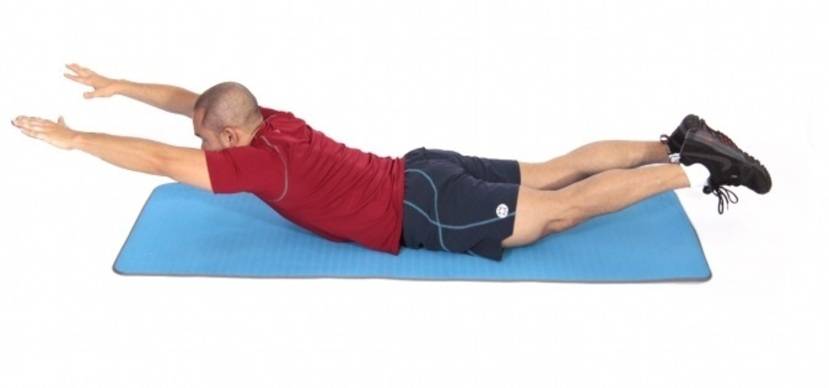
The name comes from the position itself: lying face down with the arms and legs lifted simultaneously off the floor, the body balanced on the midsection in a shape that closely resembles the character mid-flight. Getting into that position requires a dynamic contraction of the glutes, hamstrings, and shoulders; holding it requires strong static stabilization once you arrive there. Both qualities — the dynamic lift and the sustained isometric hold — are part of what this exercise trains.
A closely related exercise, the prone cobra, uses the same fundamental prone extension pattern but with the arms positioned at the sides rather than overhead. We will cover the prone cobra in detail in its own dedicated guide, but it is worth noting now that the two exercises target the same posterior chain, with slightly different arm positions and correspondingly different feels through the upper back and shoulders.
Exercise Snapshot
Muscles Worked in the Superman Exercise
Primary muscles
- Glutes (gluteus maximus) — contract powerfully throughout the hold to drive hip extension; correctly performed, the glutes should be doing significant work rather than the lower back alone
- Hamstrings — work alongside the glutes to extend the hips and contribute to lifting the legs off the floor
- Erector spinae — extend the spine to lift the chest, shoulders, and arms off the floor, working in coordination with the hip extensors rather than in isolation
Secondary muscles
- Shoulders (deltoids) — contract to lift and hold the arms extended in front of the body throughout the hold
- Rhomboids and trapezius — assist with retracting the shoulder blades and stabilizing the upper back as the arms lift
- Transverse abdominis — works to stabilize the trunk and support the spine during the extended position, even though the primary movement is extension rather than the flexion-resisting role this muscle plays in anti-extension exercises
Antagonists
The rectus abdominis and hip flexors lengthen under control throughout the hold, providing a counterbalancing tension against the hip and spinal extension being produced by the posterior chain.
A critical mechanical point that distinguishes a well-performed Superman from a poorly performed one: the hip extension contributed by the glutes and hamstrings should be doing a substantial share of the work, not just the lower back arching on its own. Targeting the glutes and hamstrings in addition to the spinal erectors — rather than relying on lumbar hyperextension alone — is what separates an effective posterior chain exercise from one that places excessive, unproductive stress on the lower back.
How to Do a Superman Exercise: Step-by-Step Form Guide
Starting position
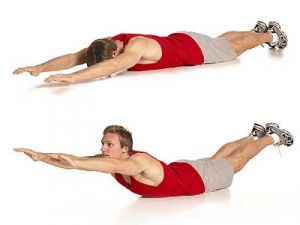
- Lie prone (face down) on the ground with the arms stretched forward in front of the body, palms down
- Knees slightly bent and shoulder-width apart
Execution
- Simultaneously contract the glutes, hamstrings, and shoulders, lifting both the arms and legs off the ground
- Hyperextend at the hips, not just the spine — actively drive the hip extension through the glutes and hamstrings rather than relying purely on lower back arching
- At the top position, you should be balanced on your midsection, with only the hips remaining in contact with the floor — the chest, arms, and legs all lifted
- Elevate the legs and torso to approximately a 20-degree angle relative to the ground, relying heavily on the glutes to achieve this position
- Hold the top position briefly
- Lower the body back to the starting position under control
The key coaching cue: Squeeze the glutes hard before and during the lift — this is the single most important cue for this exercise. Many trainees instinctively try to lift higher by arching the lower back more aggressively, which shifts load away from the glutes and hamstrings and concentrates it in the lumbar spine. Lead with a forceful glute contraction, and let the height of the lift be a consequence of that contraction rather than a goal pursued through excessive lumbar extension.
5 Common Superman Exercise Mistakes (And How to Fix Them)
1. Hyperextending the spine instead of the hips
This is the most consequential technical error in the Superman exercise. When the lift comes primarily from the lower back arching rather than the glutes and hamstrings extending the hips, the lumbar spine absorbs disproportionate stress. Consciously squeeze the glutes before initiating the lift, and think of driving the hip extension first, allowing the spinal extension to follow as a secondary, more moderate contribution.
2. Lifting too high
Reaching for maximum height by aggressively arching the back is counterproductive. The target elevation — approximately 20 degrees relative to the ground — is intentionally moderate. Beyond that range, the additional height typically comes from excessive lumbar extension rather than additional useful glute and hamstring contribution.
3. Holding the breath during the hold
As with other isometric or near-isometric holds, there is a tendency to hold the breath while contracting hard to maintain the position. Control your breathing throughout the hold, and try to relax the muscles not directly involved in the contraction — the neck and jaw, in particular, are common sites of unnecessary tension during this exercise.
4. Jerking into the top position
Snapping quickly into the lifted position relies on momentum rather than deliberate muscular contraction, and can place sudden, uncontrolled stress on the lower back. Rise into the top position with a controlled, deliberate contraction rather than a fast, jerky motion.
5. Progressing hold duration too quickly
Attempting long holds before the posterior chain has adapted to shorter durations often results in declining form as fatigue sets in — typically manifesting as the hips dropping or the lower back taking over from the glutes partway through the hold. Build duration progressively, starting with shorter intervals and extending the hold time only after the shorter duration is consistently performed with strict technique.
Benefits of the Superman Exercise
Trains the spinal and hip extension directly
Most popular core exercises train the abs to resist extension. The Superman does the opposite, directly training the posterior chain’s capacity to produce controlled extension — a function that is just as important for a balanced core program but frequently neglected.
Strengthens the glutes, hamstrings, and spinal erectors together
By requiring these three muscle groups to work in coordination to achieve and hold the extended position, the superman develops posterior chain strength and coordination in a single bodyweight exercise.
No equipment required
Like the plank, the superman requires nothing beyond floor space, making it one of the more accessible posterior chain exercises for home training.
Complements anti-extension training
Programmed alongside planks, dead bugs, and other anti-extension exercises, the superman provides balanced coverage of both sides of the spinal extension equation — resisting it in one set of exercises, producing it in another.
Scalable through hold duration
The progression from 10-second holds to 20-second, and eventually 30-second holds provides a clear, simple progression pathway that requires no equipment changes, just increasing time under tension.
Who Should Use This Exercise
- Beginners and intermediate trainees building balanced core and posterior chain strength
- Anyone whose program is dominated by anti-extension exercises — the superman provides a useful counterbalance by training the opposite function
- Trainees addressing weak glutes or hamstrings in the context of posterior chain development
- People returning to training after time off — the bodyweight, low-impact nature of this exercise makes it accessible during a return to consistent training
Who Should Be Cautious
- People with active lower back pain or lumbar disc issues — the hyperextended position places the lumbar spine in a position that can aggravate certain back conditions; physiotherapy clearance is recommended before attempting this exercise with existing back issues
- People with neck sensitivity — maintaining a neutral neck position throughout the hold is important; avoid craning the neck upward to look forward, which can create unnecessary cervical strain
- Pregnant individuals — the prone position becomes impractical in later pregnancy, and alternative exercises in supported positions are generally more appropriate
How to Make It Easier or Harder
Easier
- Shorter hold durations — starting with 10-second holds and building gradually is the appropriate progression for beginners, rather than attempting long holds immediately
- Reduced range of motion — lifting to a lower height than the full 20-degree target reduces the demand while the posterior chain develops the necessary strength and coordination
Harder
- Extended hold duration — progressing from 10 to 20 to 30-second holds, and beyond for advanced trainees, increases the time under tension demand
- Arm-Leg Extension variation — performing a contralateral version with one arm and the opposite leg extended, rather than both limbs simultaneously, increases the anti-rotation and balance demand significantly
- Added resistance — light ankle weights or holding a light weight plate behind the head can add resistance to the basic movement for advanced trainees who have mastered the bodyweight version
Superman Exercise vs. Bird Dog
Both exercises train the posterior chain and core stability in prone or quadruped positions, but they emphasize bilateral extension rather than contralateral anti-rotation control.
| Superman | Bird Dog | |
|---|---|---|
| Body position | Prone — lying face down | Quadruped — hands and knees |
| Limb pattern | Both arms + both legs simultaneously | One arm + opposite leg |
| Primary function | Bilateral hip and spinal extension | Anti-rotation, contralateral stability |
| Core demand | Posterior chain extension | Anti-rotation core stabilization |
| Balance challenge | Lower — broad base on midsection | Higher — narrow base on one hand, one knee |
| Difficulty | Beginner – Intermediate | Beginner |
| Best for | Posterior chain extension strength | Core anti-rotation stability |
The practical takeaway: The superman trains the glutes, hamstrings, and spinal erectors to produce extension together, bilaterally, with both sides of the body contributing equally and simultaneously. The bird dog trains a different, complementary skill — anti-rotation core stability — using a contralateral limb pattern that challenges the core to resist twisting rather than extension. I program both within the same posterior chain and core stability block, since the bilateral extension strength built by the superman and the anti-rotation control built by the bird dog address two distinct, equally valuable functions.
Exercise Variations
Prone Cobra
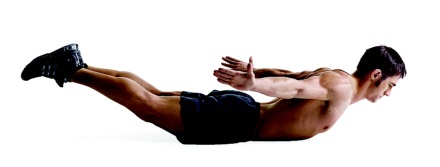
The prone cobra uses the same fundamental prone extension pattern as the superman, but with the arms positioned at the sides rather than extended overhead. Lying face down with the legs straight and the arms at the sides, palms down, the glutes and lower back muscles contract to raise the head, chest, arms, and legs off the floor, while the arms simultaneously rotate so that the thumbs point toward the ceiling. This arm position places different demands on the upper back and shoulders than the overhead-arm superman position, and it both strengthens and stretches the core through a slightly different mechanical pathway. We cover the prone cobra in full detail, including its own technique breakdown and programming guidance, in its dedicated guide.
Arm-Leg Extension
A contralateral variation performed lying flat on the ground with one arm bent, elbow on the ground, palm down, hand positioned under the chin. The other arm extends fully, thumb pointing toward the ceiling. From this position, simultaneously lift the extended arm, the torso, and the opposite leg, so the arm and leg rise to form an arc with the torso. This variation trains the same posterior chain extension pattern as the superman but with a contralateral limb pairing that adds an anti-rotation stability demand similar in spirit to the bird dog, while still emphasizing extension rather than the bird dog’s neutral spine position.

Replacement Exercises (Alternatives)
If the Superman exercise is not the right fit, these exercises develop similar posterior chain and core extension function:
- Bird Dog
- Reverse Plank
- Chinese Reverse Plank
- Dead Bug
- Forearm Plank
- The Full Plank (Straight Arm Plank)
- Hollow Body Hold Position
- Side Plank
How To Incorporate the Superman Exercise Into Your Workouts
- As a posterior chain counterbalance — program alongside anti-extension exercises like the plank and dead bug for balanced core coverage of both spinal functions
- At the end of a core or lower body session — the Superman works well as a finisher given its bodyweight nature and accessible difficulty
- Duration: Build progressively from 10-second holds, to 20-second holds, to 30-second holds as the posterior chain adapts; avoid jumping to long durations before shorter ones are consistently performed with strict technique
- Sets: 3 sets
- Frequency: 3–4 times per week, given the relatively low intensity and bodyweight nature of this exercise
- Progression trigger: When 3 sets of 30-second holds with glute-driven extension (not lumbar hyperextension) and controlled breathing become consistently easy — add light resistance or progress to the contralateral arm-leg extension variation
Conclusion
The superman exercise fills a gap that most core programs leave open: direct training of controlled spinal and hip extension, produced actively by the glutes, hamstrings, and spinal erectors working together, rather than passively resisted as in anti-extension exercises.
Lead the lift with the glutes, not the lower back. Keep the target height moderate — around 20 degrees — rather than chasing maximum elevation through excessive lumbar arching. Breathe steadily throughout the hold, and progressively build duration. Done this way, the Superman complements the anti-extension exercises that dominate most core programs and provides a genuinely balanced approach to spinal function — training the posterior chain to do its job in both directions, not just one.
Looking for more ways to train your posterior chain? See our complete core exercises guide. Check out our guides to upper ab, lower ab, and oblique exercises as well.
Frequently Asked Questions
Is the superman exercise safe for everyone?
It is generally safe for healthy individuals with no existing lower back conditions, but it is not universally appropriate. Anyone with spondylolisthesis, spinal stenosis, or other conditions that are aggravated by extension-based movements should avoid this exercise or use it only under direct guidance from a physiotherapist. The hyperextended position is precisely the type of movement that worsens certain spinal conditions, so a history of back problems warrants a conversation with a professional before adding this exercise to your routine.
Can the superman exercise replace deadlifts or hip thrusts for glute development?
No. The superman is a bodyweight, low-load exercise that trains glute and hamstring coordination and endurance, but it does not provide the progressive loading capacity of exercises like deadlifts or hip thrusts, which can be loaded with significant external weight over time. For meaningful glute hypertrophy and strength gains, loaded posterior chain exercises remain necessary; the superman is better understood as a complementary activation and endurance exercise rather than a primary glute-building movement.
Why does my neck feel strained during this exercise?
Neck strain during the superman usually happens when the head is lifted and the gaze is directed forward or upward rather than staying in a neutral position aligned with the spine. Keep the neck relaxed and the gaze directed toward the floor a short distance ahead, rather than craning upward to look forward as the limbs lift. The neck should not be a primary point of effort in this exercise.
Should I point my toes or flex my feet during the hold?
Either is acceptable, and the difference is minor. Pointing the toes slightly can help some people feel a more complete leg extension and a stronger glute contraction, while a neutral or slightly flexed foot position feels more natural to others. There is no strong technical reason to prefer one over the other; choose whichever foot position allows you to maintain the strongest glute contraction and the least lower back strain.
Is it better to do the superman as a hold or with pulsing reps?
Both approaches have value, and many programs use a combination. Static holds, building from 10 to 30 seconds, develop sustained posterior chain endurance and control. Pulsing repetitions — repeatedly lifting to the top position, briefly pausing, and lowering partway before lifting again — train more dynamic strength through a small range of motion. Beginners typically benefit more from mastering the static hold first, since it is easier to monitor and correct technique in a held position than during continuous repetitions.
