



Introduction
The one-arm push-up is the ultimate test of bodyweight pressing strength. While standard push-ups are associated with all-round fitness, lowering and pressing your body with a single arm shows a level of strength, control, and coordination that relatively few people reach.
What makes the exercise so demanding is not only the load on the working arm. Research shows that the hands together support about 64% of body weight during a standard push-up. In a one-arm push-up, a single hand must support a comparable share, while the core works hard to stop the body from twisting over one point of support. No one has measured the exact percentage directly, and it depends on your stance and body position, but the demand on the working arm is clearly much higher than in the two-arm version.
That combination makes the one-arm push-up a true full-body exercise and a popular goal in bodyweight training. It is not the most efficient way to build a bigger chest, but for relative strength, core stability, and sheer satisfaction, few bodyweight exercises can match it.
The one-arm push-up is an advanced bodyweight exercise in which the body is lowered and pressed back up using a single arm, with the feet set wide for balance and the free hand placed behind the back. It trains the pectoralis major, triceps brachii, and anterior deltoid of the working side, while the core muscles must resist the rotation created by supporting the body on one hand.
Other Names for One-Arm Push-Up
You will find this exercise under several names, depending on the training community.
- Single-arm push-up
- One-handed push-up
- Unilateral push-up
- One-arm press-up
- OAPU (in calisthenics circles)
Required Equipment
One of the biggest advantages of the one-arm push-up is that it requires no equipment. For the progressions, a few simple items are useful.
- None for the full version, just a non-slip floor
- A sturdy bench, box, or table for incline progressions
- Optional exercise mat or push-up handles for wrist comfort
How to Perform One-Arm Push-Up
The setup determines how stable you will be during the rep, so take your time finding the right stance before your first attempt.
Starting Position
Begin in a standard push-up position, then adjust your stance and hand placement for a single arm.
- Start in a high plank position with your feet wider than shoulder-width apart
- Place your working hand directly under your shoulder, fingers spread wide
- Move your free hand behind your back or rest it on your lower back
- Keep your head, torso, and legs in one straight line
- Brace your core and squeeze your glutes
- Keep your hips and shoulders as square to the floor as possible

Execution (Action Phase)
Move slowly and deliberately, focusing on control rather than speed.
- Inhale and brace before you start the descent (see our guide on breathing technique)
- Keep the elbow of the working arm close to your body as you lower yourself
- Lower until your chest is a few centimeters above the floor
- Pause briefly in the bottom position
- Exhale and press the floor away until your arm is straight, without snapping into lockout
- Keep your hips and shoulders moving together as one unit
A slight diagonal rotation toward the working arm is normal, as long as your hips and shoulders rotate together. Avoid twisting at the lower back, where the hips and shoulders move in different directions.
Video Demonstration
Watching the one-arm push-up helps you see how the stance, elbow position, and slight body rotation work together.
In the video below, notice how the lifter sets a wide stance, keeps the working elbow close to the torso, and lowers the body with control until the chest hovers just above the floor. The hips and shoulders move together, and the press back up is smooth and deliberate.

Almost every client who has seen a one-arm push-up in a movie wants to try it on day one. The first attempt usually looks like a corkscrew: the hips rise, the torso twists, the free arm flails for balance, and the person ends up somewhere on the floor next to where they started. It is a great reminder that this exercise is as much about control as it is about strength.
With my clients, the path is always the same: wide stance, hand on a sturdy bench first, and lower the bench height only when every rep looks clean. I am also honest with them. If your only goal is a bigger chest, you do not need this exercise. But if you want to own your body weight, build a rock-solid core, and have a skill that impresses everyone in the gym, it is absolutely worth the work.
Quick Form Checklist
Run through these cues before every set to keep the movement clean and controlled.
- Feet wider than shoulder width
- Working hand under the shoulder, fingers spread
- Elbow close to the body
- Hips and shoulders move together
- Chest lowered to just above the floor
Technical Emphasis & Targeting Adjustments
Small adjustments to stance, hand position, and tempo make the one-arm push-up easier or harder and shift where the difficulty comes from.
- Wider stance → more stability. Spreading your feet wider creates a larger base of support and makes it easier to control rotation. It is the best way to start, before gradually narrowing the stance.
- Narrower stance → more core demand. Bringing your feet closer together shrinks the base of support and forces the core to work much harder against rotation. Feet together is one of the hardest versions of the exercise.
- Hand slightly toward the midline → better balance for some lifters. Placing the working hand a little closer to the center of the chest can make it easier to balance over the arm. Experiment to find the position that feels most stable for you.
- Slow eccentrics → faster strength progress. Lowering yourself over 3–5 seconds builds strength in the pattern before you can complete full reps. Read more about negative repetitions and how to use them.
- Isometric holds → stronger positions. Holding the top, middle, or bottom position for 10–20 seconds builds strength and stability in each part of the movement. These isometric contractions are an excellent addition to your progression.
Common Mistakes
Most one-arm push-up mistakes come from trying the full version too early. Many are similar to typical plank mistakes, since the body must stay rigid throughout.
- Starting with the feet too close together. A narrow stance makes balance extremely difficult and leads to twisting. Start with your feet wide and narrow the stance only when your reps are clean.
- Twisting at the lower back. Letting the hips and shoulders move in different directions turns the exercise into an uncontrolled corkscrew. Keep your torso rigid and let the whole body rotate slightly as one unit.
- Sagging or piking hips. Dropping or lifting the hips greatly changes the load and makes the movement harder to control. Keep a straight line from head to heels by bracing your abs and glutes.
- Letting the elbow drift out wide. When the working elbow flares far from the body, many lifters lose control of the descent. Keeping the elbow close to the torso usually makes the movement easier to balance.
- Rushing the progression. Trying full reps before you have built enough strength leads to half reps and frustration. Follow the progressions and lower the incline gradually.
Before you start the descent, “screw” your working hand into the floor, as if you were trying to turn it outward without letting it move. At the same time, squeeze the glute on the same side as your working arm.
Many lifters find that this combination makes the whole body feel more “locked in”: the hand cue helps keep the elbow close to the body, while the glute squeeze helps keep the hips level. It takes a few sessions to coordinate, but it often makes the difference between a wobbly attempt and a clean rep.
Mechanical Considerations
Mechanically, the one-arm push-up combines shoulder horizontal adduction and elbow extension on the working side, as in a standard push-up; you can read more about this in our guide to anatomical movements. The key difference is the single point of support. With only one hand on the floor, body weight creates a rotational force that the trunk muscles must resist, turning the exercise into a demanding anti-rotation challenge for the core. A study comparing various push-up forms found that the one-arm push-up produced the highest spinal compression of all variations tested, reflecting how hard the trunk muscles must work to stabilize the spine.
For muscle growth, push-ups can be surprisingly effective, and research shows that push-ups and bench press can produce similar hypertrophy when performed at comparable loads and taken close to failure. With the one-arm version, however, balance and core stability often limit the set before the chest and triceps reach true fatigue. This is why the one-arm push-up is best viewed as a strength and skill exercise rather than a primary chest builder. As a unilateral exercise, it also trains each side independently.
Muscles Worked in One-Arm Push-Up

MAIN MUSCLES
SECONDARY MUSCLES
STABILIZERS
ANTAGONISTS
One-Arm Push-Up Pros and Cons
The one-arm push-up is an impressive and useful exercise, but it has clear limitations.
Advantages
- High demand on the working arm. Supporting your body with one hand puts much more load on the pressing muscles than a standard push-up. It is one of the hardest ways to train pressing strength without equipment.
- Exceptional core training. The core must resist rotation throughout the movement. This makes the one-arm push-up both a pressing exercise and an anti-rotation core exercise.
- No equipment needed. You can train it anywhere, anytime. The progressions require nothing more than a bench or a sturdy box.
- Trains each side independently. Working one arm at a time exposes strength differences between the left and right sides. This makes imbalances easier to notice and address.
Potential Drawbacks
- Very high skill requirement. Most lifters need weeks or months of progressions before they can perform clean reps. It is not suitable for beginners.
- Not the most efficient chest builder. Balance and core stability often limit the set before the chest is fully fatigued. For chest growth, presses and standard push-up variations are easier to overload.
- Higher spinal load. The one-arm push-up produces more spinal compression than other push-up variations. Lifters with low back problems should progress cautiously.
- Hard to scale precisely. Unlike weights, bodyweight exercises can’t be adjusted in small increments. Progress depends on stance, incline height, and tempo rather than simply adding load.
Safety Considerations
A review of resistance-training injuries reported that the shoulder complex accounted for up to 36% of documented injuries and disorders, although much of the available evidence was retrospective. Because the one-arm push-up places all the pressing load on one shoulder, keep these precautions in mind.
- Low back pain. The high spinal compression of this exercise can be problematic for lifters with low back issues. Master the progressions first, keep your torso rigid, and learn more about the spine’s role in strength training.
- Shoulder problems. The single working shoulder handles a large share of body weight while also stabilizing against rotation. Lifters with shoulder pain should stop, consult a professional, and read more about shoulder joint anatomy.
- Wrist discomfort. The full load passes through one wrist in an extended position. If this is uncomfortable, try push-up handles or a closed fist, and consider strengthening the forearm muscles.
- Progressing too fast. Connective tissues may need time to adapt to much higher loads than in regular push-ups. Increase the difficulty gradually, as explained in our guide to the muscle-tendon unit.
One-Arm Push-Up Variations and Progressions
Incline one-arm push-up
Difficulty: Easier than the standard version

Placing your working hand on a sturdy bench, box, or table reduces the load on the arm, just as incline push-ups make the two-arm version easier. It is the best starting point for most lifters. Lower the height of the surface gradually as you get stronger, until you can perform the movement from the floor.
One-arm negative push-up
Difficulty: Easier than the standard version

Lower yourself on one arm as slowly as possible, taking 3–5 seconds, then use both hands to push back up. Negatives build strength in the exact movement pattern and are one of the fastest ways to progress toward full reps.
Assisted one-arm push-up
Difficulty: Easier than the standard version

Place the fingertips of your free hand on a basketball or medicine ball placed to the side. The ball provides a little support and balance, while most of the work still falls on the working arm. Gradually reduce how much you rely on the assisting hand.
Feet-together one-arm push-up
Difficulty: Harder than the standard version

Bringing your feet together removes most of the lateral support from your base. The core must work much harder to prevent rotation. This is a good goal once you can perform clean reps with a wide stance.
One-arm, one-leg push-up
Difficulty: Harder than the standard version

Lifting the leg on the same side as your working arm leaves only two points of contact with the floor. This dramatically increases the core’s anti-rotation demand and requires exceptional balance.
Feet-elevated one-arm push-up
Difficulty: Harder than the standard version

Placing your feet on a bench or box shifts more of your body weight onto the working arm. It is one of the most demanding variations and should only be attempted once you can perform multiple clean reps from the floor.
Replacement Exercises (Substitutes) for the One-Arm Push-Up
If the one-arm push-up is still out of reach or you want to train the chest more efficiently, these exercises train the horizontal pressing pattern in a more accessible way. For more options, see our list of the most effective middle chest exercises.
- Deficit push-ups. Deficit push-ups increase range of motion and load by elevating the hands. They are a great way to make two-arm push-ups more challenging.
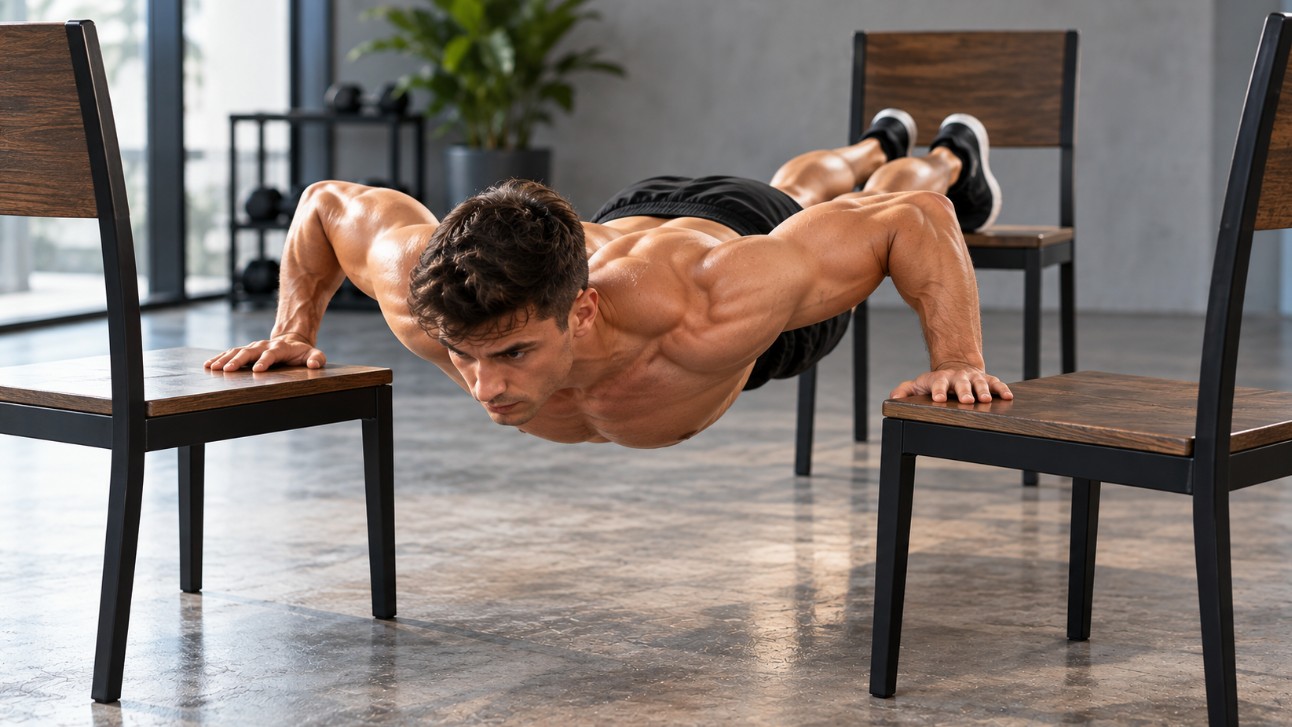
- Decline push-ups. Decline push-ups place the feet on an elevated surface, increasing the load on the arms. They are a useful step between standard and one-arm push-ups.

- Resistance band push-ups. Band push-ups add resistance that increases toward the top of the movement. They are a simple way to overload the push-up at home.

- Swiss ball push-ups. Swiss ball push-ups add an instability challenge that increases core involvement. They are a good way to build stability before attempting one-arm variations.

- Flat bench dumbbell press. The dumbbell bench press trains each arm independently and makes it easy to add load. It is more efficient than one-arm push-ups for building chest size.

- Standard push-ups. Classic push-ups remain the foundation of bodyweight pressing. Higher-rep sets taken close to failure are an effective way to build the base for one-arm progressions.

How to Program the One-Arm Push-Up
How you program the one-arm push-up depends mainly on your current stage, from early progressions to full reps.
Show full programming guideHide programming guide ▾
| Stage | Sets | Reps | Rest | Tempo |
|---|---|---|---|---|
| Building up (incline or negatives) | 3–4 | 5–8 / side | 90–120 s | 3–5 s lowering |
| Strength & skill (full version) | 3–5 | 1–5 / side | 2–3 min | Controlled, brief pause at bottom |
| Advanced volume | 2–3 | 6–10 / side | 90–120 s | Steady, controlled |
Muscle growth can occur across a wide range of repetitions when sets are taken close to failure, so treat these numbers as guidelines rather than strict rules. Adjust your rest periods between sets based on how recovered you feel.
- At the start of a workout, when you are fresh enough to practice clean reps
- In calisthenics programs as a long-term strength goal
- As a combined pressing and core exercise in bodyweight-only workouts
- As a periodic strength test for lifters who train mainly with push-up variations
Apply progressive overload by moving through the progression ladder: incline one-arm push-ups, lowering the hand height every one to two weeks, slow negatives, and then full reps from the floor. Once you can perform clean reps, bring your feet closer together, elevate your feet, or add a weighted backpack.
One-Arm Push-Up vs Standard Push-Up (Comparison Table)

| Criteria | One-Arm Push-Up | Standard Push-Up |
|---|---|---|
| Points of Support | One hand, two feet | Two hands, two feet |
| Load per Arm | Much higher (estimated) | About half of ~64% of body weight |
| Anti-Rotation Core Demand | Very high | Moderate |
| Stance | Feet wider than shoulders | Feet hip-width or closer |
| Skill Requirement | High | Low |
| Spinal Compression | Highest among push-up variations tested | Lower |
| Best For | Relative strength, core stability, skill | Beginners, volume, chest hypertrophy |
The standard push-up remains the more practical exercise for most goals. It is easier to learn, easier to perform for higher reps, and better suited for building chest muscle with bodyweight. If you can’t do it yet, our guide on your first push-up will help you get there.
The one-arm push-up is a strength and skill goal, not a replacement. It trains pressing strength and core stability in a way the two-arm version can’t. If you’re curious how push-ups compare with free-weight pressing, read our analysis of push-ups vs. bench press.
Final Thoughts
The one-arm push-up is one of the most impressive bodyweight exercises you can master. It challenges the chest, shoulders, and triceps of the working arm while demanding a strong, stable core that resists rotation throughout the movement.
If you want a bigger chest, more efficient options exist, and that’s perfectly fine. The one-arm push-up is about strength, control, and the satisfaction of owning your body weight. Follow the progressions patiently, and combine them with anti-rotation core work such as the side plank or Pallof press to speed up your progress.
How hard is a one-arm push-up?
The one-arm push-up is one of the most demanding bodyweight pressing exercises. It requires not only strong chest, shoulders, and triceps, but also the core strength and coordination to prevent the body from twisting over a single point of support.
How much weight do you lift in a one-arm push-up?
Research shows that the hands together support about 64% of body weight in a standard push-up. In a one-arm push-up, a single hand must support a comparable share, although the exact percentage depends on body position and stance width and has not been measured directly.
What muscles does the one-arm push-up work?
It primarily works the pectoralis major, triceps brachii, and anterior deltoid of the working arm. The obliques, abdominals, and serratus anterior work hard to stabilize the body and prevent rotation.
How many regular push-ups should I be able to do before trying one-arm push-ups?
There is no strict rule. As a practical benchmark, I recommend being able to perform around 25–30 clean standard push-ups before starting one-arm progressions. Solid core stability is just as important.
How long does it take to learn a one-arm push-up?
It depends on your starting strength, body weight, and consistency. For many trained lifters, it takes several weeks to a few months of regular practice with progressions such as incline one-arm push-ups and negatives.
Is it OK to rotate the body during a one-arm push-up?
A slight diagonal rotation is normal, as long as your hips and shoulders move together as one unit. What you want to avoid is twisting at the lower back, with the hips and shoulders moving in different directions.
Should my feet be wide or close together?
Start with your feet wider than shoulder width for a more stable base. Bringing them closer together makes the exercise significantly harder and is a good way to progress once you can perform clean reps.
Are one-arm push-ups good for building chest muscle?
They can contribute to chest development, but they are not the most efficient chest builder. Balance and core stability often limit the set before the chest is fully fatigued. For muscle growth, presses and standard push-up variations are easier to overload.
What is the easiest way to start training for a one-arm push-up?
The most accessible starting point is the incline one-arm push-up, with your hand on a sturdy bench or box. Lower the height gradually as you get stronger.
Are one-arm push-ups bad for your back?
Not inherently, but research shows that they produce higher spinal compression than other push-up variations. Lifters with low back pain should master easier progressions first and keep the torso rigid throughout the movement.
