



Introduction
The Hammer Strength bench press is one of the most popular plate-loaded chest machines in commercial gyms. You lie on a flat bench and press two handles upward, much like a barbell bench press, but the handles attach to lever arms that guide the movement along a fixed, slightly converging arc.
What makes the machine special is its iso-lateral design. Each lever arm moves independently, so your left and right sides have to do their own work, just as they would with dumbbells. At the same time, you get the stability of a guided path and the ability to load the machine with weight plates, which allows small increments and heavy training without a spotter.
This combination makes the Hammer Strength bench press useful for beginners and advanced lifters alike. It is not a magic upgrade over free weights, but research shows machine-based training can build muscle as effectively as free weights when effort and volume match, making it a valuable tool in any chest program.
The Hammer Strength bench press is a lying chest press performed on a plate-loaded Hammer Strength machine, in which two independent lever arms are pressed upward along a slightly converging arc. Because each arm moves on its own (iso-lateral design), the exercise trains the pectoralis major, anterior deltoids, and triceps brachii of each side independently, with the stability of a guided path and the loading flexibility of weight plates.
Other Names for Hammer Strength Bench Press
Depending on the gym, you may hear this machine and exercise called by several names.
- Hammer Strength iso-lateral bench press
- Plate-loaded bench press machine
- Iso-lateral chest press (lying)
- Lever bench press
- Hammer bench press
Required Equipment
This exercise requires a specific plate-loaded machine, one of the most common chest machines in well-equipped gyms. You can read more about different machine types in our article on exercise machines.
- Hammer Strength (or similar) plate-loaded isolateral bench press machine
- Weight plates, loaded onto the horns of each lever arm
- An adjustable seat or bench pad, depending on the model
How to Perform Hammer Strength Bench Press
The setup is quick, but a correct seat height and even loading make a big difference in how the exercise feels.

Starting Position
Load the machine and adjust the seat before you lie down.
- Load the same amount of weight on both lever arms
- Adjust the seat so the handles line up with your mid-chest at the bottom of the movement
- Lie back with your head, upper back, and glutes on the pad and your feet flat on the floor
- Grip the handles with a pronated (overhand) grip, slightly wider than shoulder width
- Wrap your thumbs around the handles for a secure grip
- Pull your shoulder blades back and down into the pad

Execution (Action Phase)
Press both handles evenly and keep the movement smooth from the first rep to the last.
- Take a breath and brace your core (see our guide on breathing technique)
- Exhale and press both handles upward along the machine’s arc
- Stop just short of locking out your elbows
- Inhale and lower the handles slowly toward your chest
- Stop when the handles reach chest level, or you feel a comfortable stretch
- Keep both arms moving at the same speed throughout the set
At the end of the set, lower the handles under control to the starting position before you sit up.
Video Demonstration
Watching the Hammer Strength bench press helps you see how the handles follow the machine’s arc and how the shoulder blades stay pinned to the pad.
In the video below, notice how the lifter presses both handles evenly, stops just short of lockout, and lowers them slowly to chest level. The back stays flat on the pad, and the feet remain planted throughout the set.

The Hammer Strength bench press is famous for producing impressive numbers. Every gym has someone proudly reporting that they pressed “four plates a side” on it. Here is the catch: because of the lever design, the resistance you feel is not the same as the weight of the plates, so four plates on the Hammer Strength machine is not a four-plate bench press. The number is real, but it only means something on that specific machine.
With my clients, I care much more about setup than plate count. Adjust the seat so the handles line up with your mid-chest at the bottom, keep your shoulder blades pulled back, and watch whether one arm finishes the rep before the other. Because the levers move independently, the machine will show you any strength difference between your sides, and that is information worth using.
Quick Form Checklist
Run through these cues before every set to make sure your setup and technique are correct.
- Equal weight on both lever arms
- Handles at mid-chest level at the bottom
- Shoulder blades pulled back and down
- Both arms moving at the same speed
- Controlled lowering, no bouncing
Technical Emphasis & Targeting Adjustments
Small adjustments to grip width, seat height, and tempo can shift the emphasis of the Hammer Strength bench press.
- Wider grip → more chest stretch. Holding the handles slightly wider increases the stretch on the pectoralis major at the bottom. Avoid going excessively wide, as our comparison of wide-grip vs close-grip bench press explains.
- Closer grip → more triceps involvement. Holding the handles closer together increases elbow flexion and extension. This shifts more work to the triceps while still training the chest.
- Seat height adjustments → a better pressing path. Raising or lowering the seat changes where the handles meet your chest. Find the position where the press feels smooth and the shoulders stay comfortable.
- Single-arm sets → independent side training. Pressing one arm at a time lets you focus fully on each side of the chest. It is a practical way to apply the benefits of unilateral training.
- Slower eccentric → more time under load. Lowering the handles over 2–3 seconds keeps the chest working throughout the rep. Learn more about eccentric training and why the lowering phase matters.
Common Mistakes
The machine guides the movement, but several mistakes can still reduce the exercise’s effectiveness. Many of them overlap with typical bench press mistakes.
- Wrong seat height. If the handles line up with your neck or upper abdomen, the pressing angle becomes awkward, and the chest works through a shorter range. Adjust the seat so the handles meet your mid-chest.
- Uneven pressing. Letting one arm lead or finish the rep early lets the stronger side compensate. Press both handles at the same speed, or use single-arm sets to address the difference.
- Letting the elbows drift far out to the sides. Extreme elbow flare makes the movement harder to control, and many lifters then feel their shoulders more than their chest. A moderately tucked position is a practical starting point.
- Bouncing at the bottom. Letting the handles drop quickly and rebound removes tension from the chest. Lower them with control and reverse the movement smoothly.
- Lifting the hips off the pad. Arching excessively to move more weight shortens the range of motion and stresses the lower back. Keep your glutes on the pad and reduce the load if necessary.
Take advantage of the independent lever arms with alternating iso-hold presses. Press both handles up, then hold one arm just short of lockout while the other arm performs a full rep. Switch sides and repeat, alternating for the entire set.
The holding arm stays under constant tension, while the working arm moves through the full range of motion. This makes each set noticeably harder with the same weight, and it quickly shows you whether one side of your chest is stronger than the other.
Mechanical Considerations
The Hammer Strength bench press combines shoulder horizontal adduction and elbow extension, the same joint actions as any bench press, which you can read more about in our guide to anatomical movements. The main difference lies in the machine’s design. The lever arms move along a slightly converging arc, bringing the hands somewhat closer together as you press. Because the plates load onto levers, the resistance you feel isn’t the same as the weight of the plates and can change across the range of motion, depending on the machine’s geometry.
The guided path removes the need to balance the load, letting you focus on pressing. Research comparing chest presses with different stability demands found similar chest and front delt activity across stable and less stable variations, with more triceps activity in the stable presses. No study has examined the Hammer Strength bench press directly, so its benefits are based on research on related machine and free-weight presses. As a compound exercise, it trains the chest, front delts, and triceps together.
Muscles Worked in Hammer Strength Bench Press
MAIN MUSCLES
SECONDARY MUSCLES
STABILIZERS
ANTAGONISTS
Hammer Strength Bench Press Pros and Cons
The Hammer Strength bench press is a versatile machine, but it is important to understand both its strengths and its limitations.
Advantages
- Independent lever arms. Each side must do its own work, which prevents the stronger side from compensating. It also allows single-arm training and helps you notice strength differences between sides.
- Train safely without a spotter. The guided path lets you stop at any point without getting pinned under a bar. You can take sets close to failure even without a spotter.
- Plate-loaded flexibility. Weight plates allow small increments and heavy loading. Quick plate changes also make the machine well suited for drop sets.
- Beginner-friendly. The stable path makes it easy to learn the pressing pattern. Advanced lifters can still train heavy and with high effort.
Potential Drawbacks
- Fixed movement arc. The machine’s path may not suit every body type. A poor fit can make the movement uncomfortable for the shoulders.
- Loads aren’t comparable to free weights. Because of the lever design, the plates on the machine don’t translate directly to barbell numbers. You can only compare progress on the same machine.
- Less transfer to barbell strength. Strength gains are partly specific to the exercise you train. If your goal is a bigger barbell bench press, the machine should complement it, not replace it.
- Availability. Plate-loaded Hammer Strength machines are common in well-equipped gyms but are missing from many smaller facilities.
Safety Considerations
A review of resistance-training injuries reported that the shoulder complex accounted for up to 36% of documented injuries and disorders, although much of the available evidence was retrospective. The Hammer Strength bench press is one of the safer ways to press, but a few precautions apply.
- History of shoulder pain. Adjust the seat carefully, use a moderate grip width, and keep your shoulder blades retracted. Stop if you feel pinching or sharp pain, and learn more about shoulder joint anatomy.
- Previous pectoral strain. Lifters recovering from a pectoral strain should start with light loads and a reduced range of motion. Return to full depth gradually and only after medical clearance.
- Wrist discomfort. Letting the wrists bend back under heavy loads can aggravate wrist injuries. Keep the wrists straight, with the handles in the base of your palms.
- High blood pressure. Holding your breath during heavy efforts temporarily raises blood pressure. Lifters with hypertension should avoid maximal efforts and consult their doctor about weight training and blood pressure.
Hammer Strength Bench Press Variations
Single-arm Hammer Strength bench press
Difficulty: Similar to the standard version

Pressing one lever arm at a time lets you focus fully on each side of the chest. Hold the other handle or the machine frame for stability. This variation helps address side-to-side differences, as explained in our guide to symmetrical muscular development.
Alternating iso-hold press
Difficulty: Harder than the standard version
Hold one arm just short of lockout while the other arm performs a full rep, then switch. The holding arm stays under constant tension, making each set much more demanding with the same load.
Incline Hammer Strength press
Difficulty: Similar to the standard version

Hammer Strength also makes incline press machines, which shift more emphasis onto the upper chest and front delts. If your gym doesn’t have one, the machine incline chest press is a similar option.
Paused Hammer Strength bench press
Difficulty: Harder than the standard version
Holding the handles just above chest level for 1–2 seconds before each press removes the stretch reflex. This variation builds strength in the bottom position and reinforces strict control.
Close-grip Hammer Strength bench press
Difficulty: Similar to the standard version
Gripping the handles at their innermost position shifts more work onto the triceps. It is the machine version of the close-grip barbell bench press and a good option for lockout strength.
Replacement Exercises (Substitutes) for the Hammer Strength Bench Press
If the machine is busy or unavailable, these exercises train the same horizontal pressing pattern and target the pectoralis major, anterior deltoids, and triceps. For more options, see our list of the most effective middle chest exercises.
- Flat bench dumbbell press. The dumbbell bench press also lets each arm move independently while requiring more stabilization. It allows a deeper stretch at the bottom.

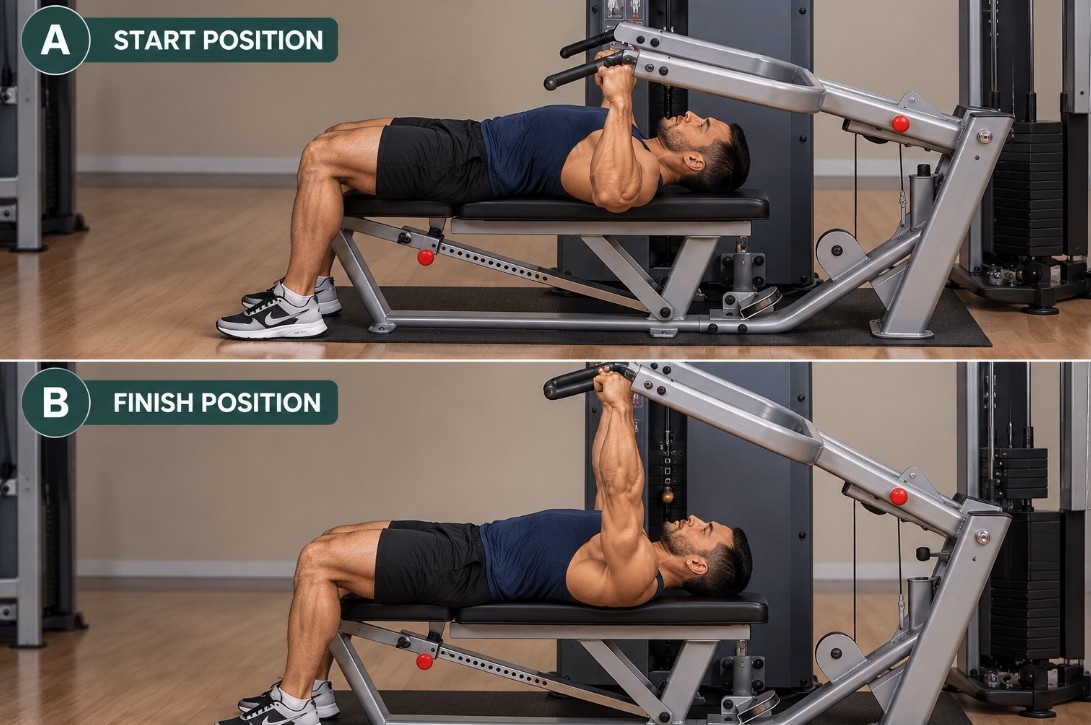
- Machine bench press. The machine bench press uses a guided lying press, usually with a weight stack. It is another stable option for training close to failure.
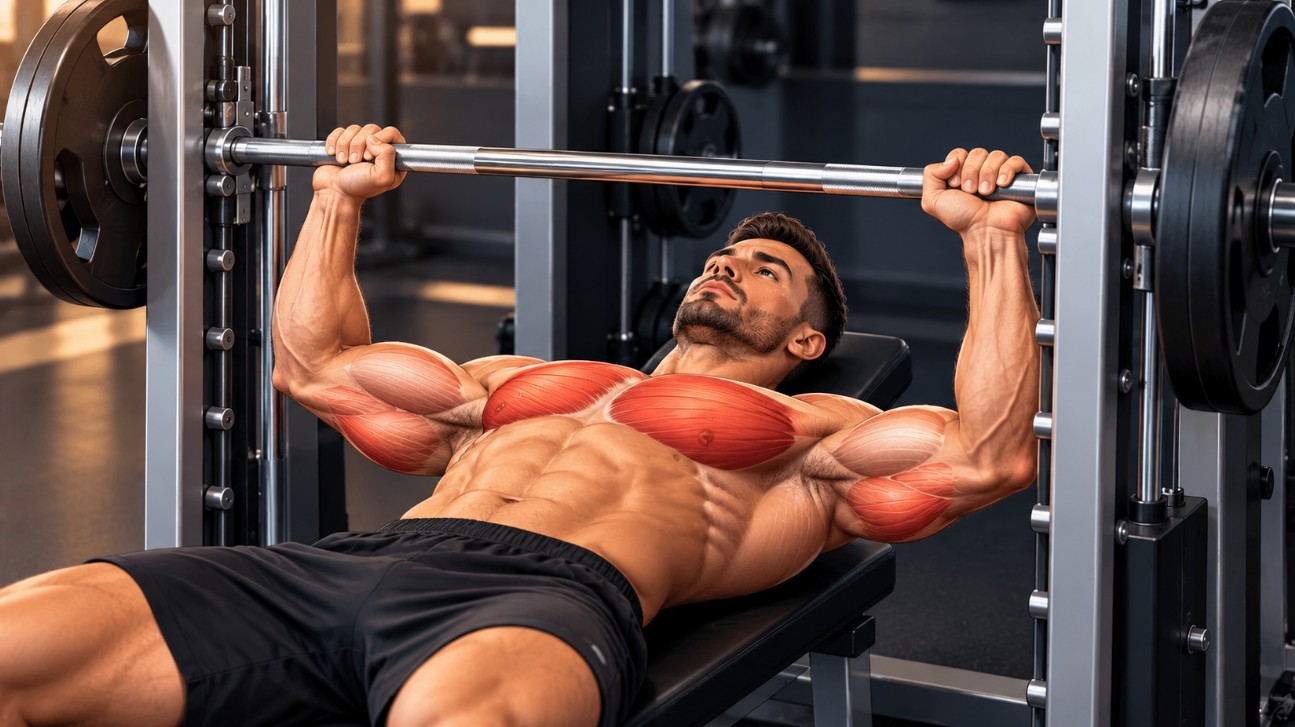
- Smith machine bench press. The Smith machine bench press combines a barbell with a guided vertical path and safety stops.
- Seated machine chest press. The seated machine chest press trains the same muscles in an upright position and is common in most gyms.

- Barbell floor press. The barbell floor press limits the range of motion and builds lockout strength.

- Flat barbell bench press. The free-weight classic remains the foundation of most pressing programs and the best choice for building barbell strength.

How to Program the Hammer Strength Bench Press
How you program the Hammer Strength bench press depends on your training goal, experience level, and where it fits in your chest workout.
Show full programming guideHide programming guide ▾
| Goal | Sets | Reps | Rest | Tempo |
|---|---|---|---|---|
| Hypertrophy | 3–4 | 6–12 | 90–120 s | 2–3 s lowering |
| Strength | 4–5 | 4–6 | 2–3 min | Controlled lowering, forceful press |
| Muscular endurance | 2–3 | 15–20 | 45–60 s | Steady, continuous |
Muscle growth can occur across a wide range of repetitions when sets are taken close to failure, so treat these numbers as guidelines rather than strict rules. Adjust your rest periods between sets based on how recovered you feel.
- As the main chest press for lifters who train without a spotter
- After barbell or dumbbell presses as a second, high-effort pressing exercise
- As a finisher with drop sets, thanks to quick plate changes
- With single-arm sets to address strength differences between sides
Apply progressive overload by adding small plates (1.25–2.5 kg per side) once you complete all sets at the top of your rep range with good form. Track your numbers on the same machine, since the resistance produced by a given load varies between machine models.
Hammer Strength Bench Press vs Barbell Bench Press (Comparison Table)

| Criteria | Hammer Strength Bench Press | Barbell Bench Press |
|---|---|---|
| Movement Path | Guided, slightly converging arc | Free, chosen by the lifter |
| Arm Independence | Each lever moves independently | Both arms on one bar |
| Stability Demand | Low | High |
| Spotter Needed | No | Recommended for heavy sets |
| Load Comparability | Specific to the machine | Standardized barbell loads |
| Transfer to Barbell Strength | Moderate | High |
| Best For | Safe high-effort sets, side-to-side work | Maximal strength, powerlifting |
The barbell bench press remains the better choice for building maximal pressing strength and for powerlifters. Controlling the bar in every direction trains coordination and stability that a machine cannot fully replicate.
The Hammer Strength bench press, however, offers a safe, stable way to train hard, with independent arms and easy loading. For most lifters, the best approach is to use both. For a broader discussion, read our article on free weights vs. machines.
Final Thoughts
The Hammer Strength bench press combines the stability of a machine with the independent arm movement of dumbbells and the loading flexibility of weight plates. It is a practical tool for building chest size, training safely without a spotter, and noticing strength differences between your left and right sides.
Set the seat correctly, press both arms evenly, and don’t get too attached to the plate count, since the numbers only mean something on the same machine. Used alongside free-weight pressing, the Hammer Strength bench press can be a valuable part of a well-rounded chest program.
Frequently Asked Questions
What is the Hammer Strength bench press?
It is a lying chest press on a plate-loaded Hammer Strength machine. Two independent lever arms move along a slightly converging arc, combining the stability of a machine with the loading flexibility of weight plates.
Is the Hammer Strength bench press as good as the barbell bench press?
For muscle growth, machine-based training can be as effective as free weights when effort and volume are matched. For building barbell strength, however, you still need to practice the barbell bench press, because strength gains are specific to the exercise you train.
What muscles does the Hammer Strength bench press work?
It primarily works the pectoralis major, with help from the anterior deltoids and triceps brachii. The rotator cuff and serratus anterior help stabilize the shoulders.
Is the Hammer Strength bench press plate-loaded or stack-loaded?
The classic Hammer Strength bench press is plate-loaded: you load weight plates onto the horns of each lever arm. Some gyms also have selectorized machines from the same brand, but the original design uses plates.
Can I lift more on the Hammer Strength machine than on a barbell?
You may see bigger numbers, but the loads are not directly comparable. The lever design changes how much resistance a given plate creates, so compare your progress only on the same machine.
Can I do the Hammer Strength bench press with one arm?
Yes. Because the lever arms move independently, you can press one arm at a time. This is a useful way to focus on each side of the chest and identify strength imbalances.
How should I set the seat on the Hammer Strength bench press?
Adjust the seat so the handles line up with your mid-chest at the bottom of the movement. If the handles sit too high or too low, the pressing angle becomes awkward for the shoulders.
Should I use a thumbless grip on the Hammer Strength bench press?
A full grip with the thumbs wrapped is the safest default. On a machine, a thumbless grip is less risky than on a barbell, but there is no evidence that it reduces wrist strain, so use it only if it feels clearly more comfortable.
Is the Hammer Strength bench press good for beginners?
Yes. The guided path and the ability to stop at any point make it beginner-friendly, while the plate-loaded design allows advanced lifters to train heavy.
How often should I do the Hammer Strength bench press?
Most lifters do well training the chest 1–2 times per week. The Hammer Strength bench press can be your main chest press or a secondary exercise after free-weight pressing.
