



Introduction
Visible abs are one of the most desired fitness goals — and also one of the most misunderstood.
Many people train their abs consistently. They do crunches, planks, leg raises, cable crunches, and countless “six-pack” routines. The workout burns. The muscles feel tired. But when they look in the mirror, nothing really changes.
If your abs aren’t showing even though you train them, you’re not alone. As a coach working with lifters, athletes, and everyday fitness enthusiasts, I see this frustration all the time. People often think they need more ab exercises, harder circuits, or some special core routine.
But in most cases, the real problem is not that your abs are missing.
They are simply hidden.
Visible abs depend on more than ab training. Body fat level, nutrition, water retention, muscle development, genetics, consistency, and time all play a role. That is why someone can train abs every day and still not see definition, while another person trains them only a few times per week and has a visible six-pack.
In this article, I’ll break down the real reasons your abs may not be showing and explain exactly how to fix them. The goal is not to sell you another “magic ab workout,” but to help you understand what actually reveals abdominal definition — and what keeps it hidden.
Why Your Abs Aren’t Showing (Quick Answer)
Spot Reduction: The Biggest Myth About Visible Abs
One of the biggest myths in fitness is that doing more ab exercises automatically leads to visible abs.
Unfortunately, that’s not how the body works.
Many people believe that if they perform hundreds of crunches, planks, leg raises, or other core exercises every week, their six-pack will eventually appear. As a result, they spend more and more time training their abs, only to become increasingly frustrated by the lack of visible results.
The problem is that abdominal exercises (upper abs, lower abs, obliques) strengthen and develop the abdominal muscles—but they do not directly burn the fat covering them.

This concept is known as spot reduction, and despite its popularity, scientific research has repeatedly shown that you cannot selectively burn fat from a specific area of the body simply by exercising that area.
In other words, doing more crunches will not magically remove the layer of fat covering your abs.
As a coach working with lifters and athletes, I’ve seen many people train their abs harder than ever while completely ignoring the factors that actually determine abdominal visibility—nutrition, calorie balance, overall body fat percentage, sleep, and long-term consistency.
Think of it this way:
Your abs are like a sculpture hidden under a blanket.
Ab training helps improve the sculpture.
Fat loss removes the blanket.
If the blanket remains too thick, no amount of additional ab exercises will reveal what’s underneath.
That’s why some people can train abs only two or three times per week and have a clearly visible six-pack, while others perform daily ab workouts and still struggle to see definition.
Before worrying about whether you’re doing ab exercises enough, it’s important to understand the real reasons your abs may not be showing.
10 Reasons Your Abs Aren’t Showing
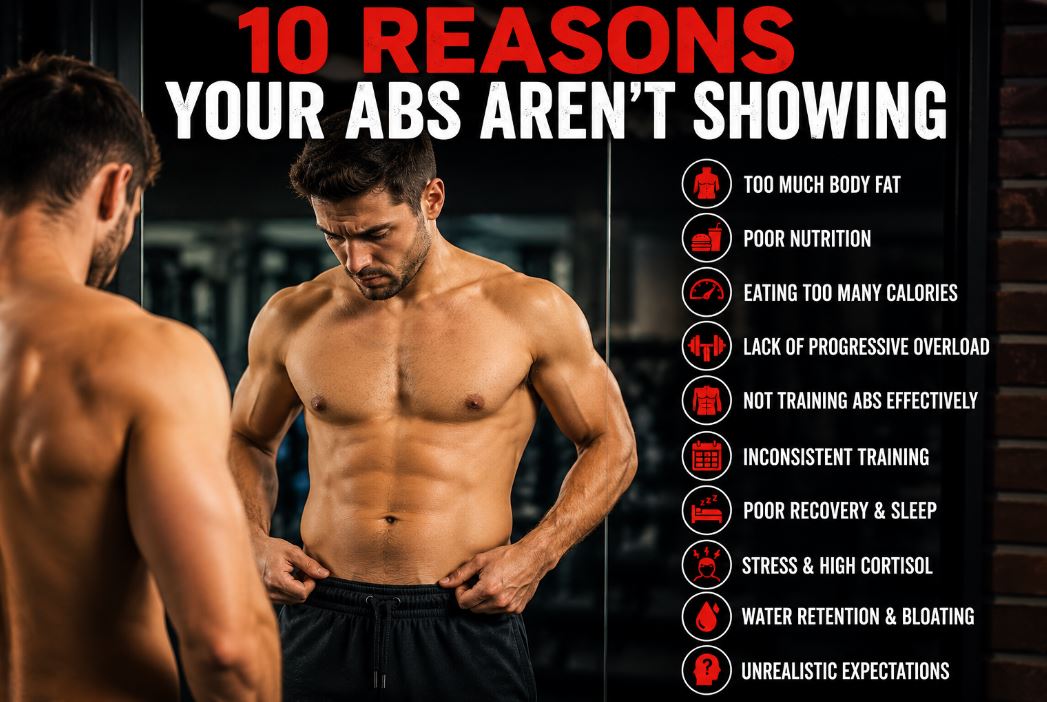
Reason #1: Your Body Fat Percentage Is Still Too High
The most common reason your abs aren’t showing has nothing to do with your ab workouts.
It’s your body fat percentage.
Many people assume that if they train their abs hard enough, a six-pack will eventually appear. They add more crunches, more planks, and more core exercises, yet the definition they want never shows up.
The problem is that abdominal muscles can be strong and well-developed yet remain hidden beneath a layer of body fat.
Visible abs are largely a body-composition issue.
While individual differences exist, most men begin to see noticeable abdominal definition around 10–15% body fat, while most women typically see visible abs around 18–24% body fat. If you’re above those ranges, your abs may simply be covered, regardless of how often you train them.
Another challenge is that the body doesn’t lose fat evenly. Many people become leaner in their face, arms, and shoulders long before enough fat disappears from their midsection to reveal their abs. This often creates the false impression that they’re already lean enough.
As a coach working with lifters and athletes, I’ve seen countless people blame their ab routine when the real issue was body fat. In most cases, they didn’t need more crunches—they needed a better fat-loss strategy.
How To Fix It
To reveal your abs, focus on reducing body fat while maintaining muscle mass.
- Create a sustainable calorie deficit.
- Prioritize protein intake to preserve muscle.
- Continue strength training during fat loss.
- Keep training your abs, but don’t rely on ab exercises alone.
- Track progress with photos, measurements, and body weight trends.
When body fat starts to decrease, the abdominal muscles you’ve already built become easier to see. And for most people, that’s when their abs finally begin to appear.
Reason #2: You’re Overestimating How Lean You Really Are
Another common reason your abs aren’t showing is that you’re simply not as lean as you think you are.
This isn’t a criticism—it’s an extremely common mistake. Most people are surprisingly poor at estimating their own body fat percentage. Social media, favorable lighting, and fitness influencers have distorted how different body-fat levels actually look.
As a result, many people believe they’re sitting at 10–12% body fat when they’re actually closer to 16–20%.
The problem is that the difference between “lean” and “abs visible” is often much smaller than people realize. You may look fit, have some muscle definition in your arms and shoulders, and still carry enough fat around your midsection to hide your abs.
This is especially frustrating because you can be making excellent progress without seeing much change in your abdominal definition. The closer you get to visible abs, the more patience becomes necessary.
As a coach working with lifters and athletes, I’ve often seen people completely change their strategy because they believed they were already lean enough. In reality, they simply needed to continue the fat-loss phase for a few more weeks or months.
The good news is that if you’re already relatively lean, you may be closer than you think.
How To Fix It
Instead of guessing your body fat percentage, use more objective methods to track your progress.
- Take progress photos under consistent lighting conditions.
- Measure your waist circumference regularly.
- Compare your physique against reputable body fat percentage charts.
- Consider a professional body composition assessment if available.
- Focus on trends over time rather than daily mirror checks.
The more accurately you assess your body composition, the easier it becomes to set realistic expectations and make the right adjustments. Sometimes the issue isn’t that your abs won’t show—it’s that you’re not quite as lean as you thought.
Reason #3: Your Diet Doesn’t Support Fat Loss
If your abs aren’t showing, your diet may be the biggest obstacle standing in your way.
Many people put tremendous effort into their training but pay far less attention to what happens outside the gym. They complete every workout, train their abs several times per week, and still wonder why their midsection never seems to change.
The reality is that visible abs require low enough body fat levels, and reducing body fat requires a calorie deficit over time.
No amount of crunches, leg raises, or planks can compensate for a diet that consistently provides more calories than your body needs.
This doesn’t mean your diet has to be extreme or restrictive. In fact, most successful fat-loss phases are built on simple habits performed consistently rather than short-term crash diets.
As a coach working with lifters and athletes, I’ve seen many people spend months searching for the perfect ab workout when the real issue was nutrition. Once their diet was aligned with their goal, abdominal definition started to appear without changing a single ab exercise.
The truth is simple: abs are revealed by lowering body fat, and diet plays the largest role in that process.
How To Fix It
To support fat loss and improve abdominal visibility:
- Maintain a consistent calorie deficit.
- Prioritize high-protein meals to preserve muscle mass.
- Base most of your diet on minimally processed foods.
- Monitor portion sizes instead of relying on guesswork.
- Focus on long-term consistency rather than short-term perfection.
When your nutrition supports fat loss, the abdominal muscles you’ve been training finally have an opportunity to become visible.
Reason #4: You’re Consuming More Calories Than You Think
Many people believe they’re eating in a calorie deficit when they’re actually eating at maintenance—or even in a surplus.
This is one of the most common reasons fat loss stalls.
The problem is that calories can add up quickly without you realizing it. A few extra snacks, larger portions, sugary coffee drinks, cooking oils, weekend meals, or frequent “healthy treats” can easily erase the deficit you’re trying to create.
The frustrating part is that these calories often don’t feel significant. Individually, they seem harmless, but together they can make a huge difference.
This is why someone can feel like they’re dieting, train consistently, and still fail to reveal their abs.
As a coach, I’ve seen many cases where people were convinced their metabolism was the problem. Once they started tracking their intake honestly for a couple of weeks, the real issue became obvious—calorie intake was much higher than expected.
The goal isn’t to obsess over every calorie forever. The goal is to become aware of where extra calories may be sneaking into your diet.
How To Fix It
If fat loss has stalled, improve your calorie awareness.
- Track your food intake for 1–2 weeks.
- Measure portions instead of estimating them.
- Be mindful of liquid calories.
- Pay attention to weekend eating habits.
- Monitor progress and adjust intake when necessary.
Many people don’t need a new diet plan—they simply need a more accurate understanding of how much they’re actually eating.
Reason #5: You’re Relying on Ab Exercises Alone
One of the biggest misconceptions in fitness is that more ab exercises automatically lead to visible abs.
Because of this belief, many people spend countless hours doing crunches, sit-ups, leg raises, ab circuits, and plank variations. They train their abs multiple times per week and assume that eventually the fat covering them will disappear.
Unfortunately, that’s not how the body works.
Ab exercises strengthen and develop the abdominal muscles, but they do not directly burn fat from your stomach. This concept is known as spot reduction, and despite being one of the most persistent fitness myths, research has repeatedly shown that you cannot selectively burn fat from a specific area simply by exercising that area.
In other words, doing hundreds of crunches won’t magically remove the layer of fat covering your abs.
This is why many people have strong abdominal muscles but still can’t see them. They’re focusing all their effort on training the muscle while ignoring the factors that actually determine whether those muscles become visible.
As a coach working with lifters and athletes, I’ve seen people perform more direct ab work than ever while making almost no progress toward a visible six-pack. The issue wasn’t their exercise selection—it was that they were relying on ab exercises to solve a body-fat problem.
Visible abs usually result from a comprehensive strategy that includes proper nutrition, strength training, overall activity levels, and long-term consistency—not just more abdominal exercises.
How To Fix It
Instead of relying solely on ab workouts, focus on the bigger picture.
- Continue training your abs 2–4 times per week.
- Prioritize fat loss if body fat is currently hiding your abs.
- Follow a structured strength-training program.
- Increase daily activity levels when appropriate.
- View ab training as one piece of the puzzle—not the entire solution.
Strong abs are important, but visible abs require more than a strong core. They require the right overall approach to body composition.
Reason #6: Your Abs Are Actually Underdeveloped
While excess body fat is the most common reason abs aren’t showing, it’s not always the only reason.
In some cases, people are lean enough to see their abs—but the abdominal muscles themselves simply aren’t developed enough to create a strong visual appearance.
This is particularly common among individuals who rarely train their abs directly. They assume that squats, deadlifts, and other compound exercises provide all the abdominal stimulation they’ll ever need.
While those exercises certainly engage the core, they may not provide enough direct hypertrophy stimulus to maximize abdominal development.
Think about other muscle groups.
If you wanted bigger biceps, you wouldn’t rely solely on pull-ups. If you wanted bigger calves, you wouldn’t expect walking to be enough. Yet many people expect their abs to become highly visible without ever training them with the same intent they apply to other muscles.
The abdominal muscles can grow just like the chest, shoulders, arms, or legs. When they become thicker and more developed, they often create greater definition and may even become visible at slightly higher body-fat percentages.
As a coach working with lifters and athletes, I’ve seen people become significantly leaner without achieving the abdominal definition they expected. In many of those cases, the issue wasn’t body fat alone—it was that the abs themselves lacked size and thickness.
This is especially common among individuals who spend months focusing exclusively on fat loss while neglecting direct abdominal training.
The goal isn’t simply to have abs.
The goal is to have abs that are developed enough to stand out once body fat is reduced.
How To Fix It
Treat your abs like any other muscle group that you want to develop.
- Train them directly 2–4 times per week.
- Include weighted exercises such as cable crunches and machine crunches.
- Apply progressive overload over time.
- Focus on quality contractions rather than simply counting reps.
- Train through a full range of motion whenever possible.
Building thicker abdominal muscles won’t replace fat loss, but it can dramatically improve how your abs look once they become visible.
Reason #7: Water Retention Is Hiding Definition
Sometimes the problem isn’t body fat at all.
You may actually be lean enough to see your abs, but temporary water retention can blur definition and make your midsection appear softer than it really is.
This is one reason why abdominal visibility can seem inconsistent. Some days your abs look sharper and more defined, while on other days they appear almost completely hidden—even though your body fat hasn’t changed.
The reason is that water balance can fluctuate significantly from day to day.
Factors such as high sodium intake, poor sleep, elevated stress levels, dehydration, hormonal fluctuations, and even intense training sessions can cause your body to retain additional water. This extra fluid often accumulates beneath the skin, reducing muscle definition and making the abdomen appear smoother.
The effect can be surprisingly dramatic.
Many people assume they’ve gained fat overnight after a salty meal, a stressful week, or a poor night’s sleep. In reality, gaining a meaningful amount of body fat in a day or two is extremely unlikely. Water retention is usually the more realistic explanation.
As a coach working with lifters and athletes, I’ve seen people become discouraged because they believed their fat-loss progress had stalled. However, once sleep improved, stress levels decreased, and their nutrition became more consistent, abdominal definition often returned without any significant change in body fat.
This is why it’s important not to judge your progress based on a single day or a single look in the mirror.
Visible abs are influenced by both body fat and fluid balance.
How To Fix It
If water retention is hiding your abs, focus on improving the habits that influence fluid balance.
- Prioritize 7–9 hours of quality sleep each night.
- Manage stress through recovery, exercise, and healthy routines.
- Stay properly hydrated throughout the day.
- Keep sodium intake relatively consistent rather than swinging between extremes.
- Avoid judging your progress based on daily fluctuations.
When water retention decreases, muscle definition often becomes more visible. In some cases, your abs may already be there—you just need to reduce the factors that are temporarily hiding them.
Reason #8: You’re Not Consistent Long Enough
One of the most frustrating truths about visible abs is that they often appear much later than people expect.
Many individuals start a new training program, clean up their diet, increase their cardio, and stay highly motivated for a few weeks. When they don’t immediately see a six-pack, they become discouraged and start to question whether their plan is working.
In reality, the plan may be working perfectly.
The problem is that fat loss takes time, and abdominal fat is often one of the last places the body releases stored fat. This means you can make significant progress in your body composition before seeing dramatic changes in your abdominal definition.
As a result, many people quit too early.
They switch diets.
They change workout programs.
And finally. they start looking for a “better” ab routine.
Or they simply lose motivation altogether.
Unfortunately, every time you restart the process, you delay the results you’re trying to achieve.
As a coach working with lifters and athletes, I’ve seen this happen countless times. People often underestimate how long it takes to reveal visible abs and overestimate how much progress should occur in a few weeks. Ironically, many give up just before their efforts would begin to produce noticeable results.
The reality is that building a lean, defined midsection usually requires months of consistent habits—not a few weeks of intense effort.
That’s why patience is one of the most underrated tools in fitness.
How To Fix It
If consistency is your biggest challenge, focus on the long game.
- Follow a sustainable plan that you can maintain for months.
- Track progress using weekly and monthly trends rather than daily changes.
- Avoid constantly switching diets and workout programs.
- Focus on improving habits instead of chasing quick results.
- Remember that visible abs are often the result of accumulated effort over time.
The people who successfully reveal their abs are not always the most disciplined on any given day—they’re usually the ones who stay consistent long enough for their efforts to compound.
Reason #9: Genetics Affect Ab Visibility
Genetics play a role in how your abs look—but not in the way most people think.
Many people believe that if they don’t naturally have a perfect six-pack, there’s no point trying. Others look at fitness models and professional athletes and assume their own genetics are preventing them from ever achieving visible abs.
The reality is more nuanced.
Genetics can influence several aspects of abdominal appearance, including the shape of the abdominal muscles, the depth of the separations between them, the number of visible “blocks,” and where your body tends to store fat.
This is why some people have a symmetrical six-pack, while others have uneven abs, a four-pack, or a different abdominal structure altogether.
These differences are largely genetic.
However, genetics do not determine whether your abs can become visible.
In most cases, people who blame genetics are overlooking more important factors such as body fat percentage, nutrition, training consistency, and overall lifestyle habits.
It’s also important to understand that genetics affect fat distribution. Some individuals naturally store more fat around the lower abdomen than others. As a result, their upper abs may appear relatively early in a fat-loss phase, while their lower abs remain hidden for much longer.
This can be frustrating, but it’s completely normal.
As a coach working with lifters and athletes, I’ve seen people use genetics as an explanation for problems that were actually caused by inconsistent habits or unrealistic expectations. While genetics certainly influences the final appearance of your abs, it rarely prevents someone from developing visible abdominal definition altogether.
The goal shouldn’t be to build someone else’s abs.
The goal should be to maximize the abs your genetics allow you to develop.
How To Fix It
You can’t change your genetics, but you can control the factors that have the biggest impact on abdominal visibility.
- Focus on reducing body fat rather than comparing your abs to someone else’s.
- Train your abs consistently to maximize their development.
- Be patient if your lower abs are slower to appear.
- Judge progress against your own previous physique, not social media standards.
- Accept that the shape of your abs may differ from other people’s.
Genetics influence the final look of your abs, but your daily habits determine how much of that potential you actually achieve.
Reason #10: You’re Expecting Results Too Quickly
In a world of transformation photos, fitness influencers, and “30-day ab challenges,” it’s easy to develop unrealistic expectations about how quickly visible abs should appear.
Many people begin a fat-loss phase expecting dramatic changes within a few weeks. They clean up their diet, increase their training volume, and become highly motivated. When their abs aren’t fully visible after a month, they assume something isn’t working.
The reality is that revealing your abs is often a much slower process than most people expect.
Building a lean, defined midsection requires enough time to reduce body fat while preserving muscle mass. Depending on your starting point, this process can take several months—not several weeks.
This is especially true if you’re already relatively lean. The leaner you become, the slower progress often appears. Losing the final few kilograms of fat that separate a flat stomach from visible abs can require significantly more patience than losing the first few.
Another issue is that progress doesn’t always show up where you want it first.
You may notice improvements in your shoulders, chest, arms, face, and waistline long before your abs become clearly visible. This can create the illusion that nothing is happening when, in reality, your body composition is steadily improving.
As a coach working with lifters and athletes, I’ve found that unrealistic timelines are one of the biggest reasons people abandon a successful plan. They aren’t failing—they simply expected results faster than human physiology allows.
The truth is that visible abs are usually the result of hundreds of small decisions made consistently over time.
That’s not exciting.
But it’s how real results happen.
How To Fix It
If impatience is holding you back, focus on the process instead of the deadline.
- Set realistic expectations for fat loss and body composition changes.
- Measure progress monthly rather than daily.
- Celebrate improvements in strength, fitness, and body composition along the way.
- Avoid comparing your timeline to other people’s transformations.
- Commit to consistency rather than chasing rapid results.
The people who ultimately reveal their abs aren’t necessarily the most gifted. They’re often the ones who stay committed long enough for the process to work.
How to Fix It and Finally Reveal Your Abs
Although we’ve already discussed solutions for each reason your abs may not be showing, it’s helpful to review the most important principles in one place. Visible abs rarely come from fixing a single problem—they’re usually the result of getting several fundamentals right at the same time.
If your abs aren’t showing, the solution is rarely a single exercise, supplement, or secret technique.
In most cases, visible abs result from getting several fundamentals right at the same time. The good news is that once you understand the factors that actually matter, the process becomes much simpler.
As a coach working with lifters and athletes, I’ve found that people make the fastest progress when they stop searching for shortcuts and start focusing on the habits that consistently improve body composition.
Here are the most important steps.
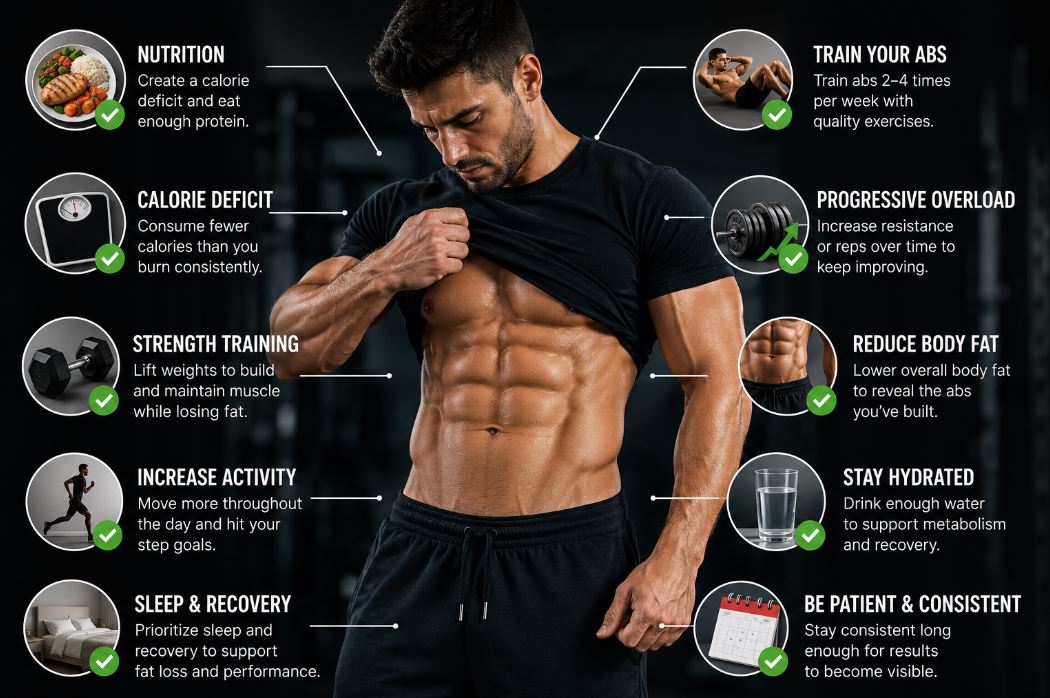
1. Prioritize Fat Loss First
For most people, body fat—not ab training—is the primary obstacle to visible abs.
If a layer of fat is covering your abdominal muscles, no amount of crunches will reveal them.
Your first priority should be creating a sustainable calorie deficit that allows you to gradually reduce body fat while maintaining muscle mass.
2. Keep Protein Intake High
Protein helps preserve muscle during a fat-loss phase and supports recovery from training.
Without adequate protein intake, you increase the risk of losing muscle along with fat, which can make it more difficult to achieve a defined physique.
Aim to include a quality protein source in most meals throughout the day.
3. Continue Strength Training
One of the biggest mistakes people make when trying to reveal their abs is replacing strength training with endless cardio.
Strength training helps maintain muscle mass, supports metabolism, and improves overall body composition.
The goal is not just to become lighter.
The goal is to become leaner.
4. Train Your Abs Like Any Other Muscle
Although body fat is the biggest factor, direct ab training still matters.
Treat your abs the same way you would treat your chest, shoulders, or arms.
Focus on:
- Progressive overload
- Controlled repetitions
- Full range of motion
- Consistent training
Stronger, thicker abs are often easier to see once body fat decreases.
5. Improve Your Daily Activity Level
Many people focus exclusively on gym workouts while ignoring how active they are during the rest of the day.
Walking more, taking the stairs, and increasing overall physical activity can significantly increase calorie expenditure without causing excessive fatigue.
Sometimes the difference between visible and hidden abs is simply a more active lifestyle.
6. Prioritize Sleep and Recovery
Sleep affects hunger, recovery, stress hormones, and overall body composition.
Poor sleep can increase cravings, reduce training performance, and contribute to water retention—all of which can make abdominal definition harder to achieve.
Aim for consistent, high-quality sleep whenever possible.
7. Stay Consistent for Long Enough
This may be the most important step of all.
Most people already know what they should be doing. The challenge is doing it consistently for months rather than days.
Visible abs rarely come from extreme effort applied briefly.
They usually come from moderate effort applied consistently over a long period of time.
8. Focus on Progress, Not Perfection
You don’t need a perfect diet. You don’t need perfect workouts. Finally, you don’t need perfect genetics. What you need is consistent progress.
Small improvements repeated week after week eventually produce dramatic results.
The people who reveal their abs aren’t always the most disciplined every day—they’re often the ones who stay on track most of the time.
9. Be Patient and Trust the Process
Fat loss and abdominal definition take time.
There will be weeks when progress feels slow and days when your abs look less defined than usual. That’s normal.
The key is to focus on long-term trends rather than short-term fluctuations.
If you’re training intelligently, eating appropriately, and staying consistent, your body composition will improve.
And when it does, your abs will eventually become visible.
As a coach, I’ve seen many people search for the perfect ab routine when the real formula is much simpler: lower body fat, maintain muscle, train consistently, and give the process enough time to work.
Most people don’t need a secret ab workout. They need patience, consistency, and a strategy they can actually sustain.
When those fundamentals are in place, the abs you’ve been training finally have a chance to become visible.
Coach’s Note — Most People Don’t Have an Ab Problem
As a coach working with lifters and athletes, I’ve found that most people who can’t see their abs don’t actually have an ab-training problem.
In many cases, they’re already training their abs often enough. The real issue is that they focus on adding more crunches and planks while ignoring the factors that have the greatest impact on abdominal visibility—body fat percentage, nutrition, recovery, and consistency.
One pattern I’ve repeatedly noticed is that people tend to underestimate how lean they need to be for their abs to be clearly visible. They assume another ab workout will solve the problem when, in reality, they may simply need more time, a better nutrition strategy, or greater consistency with the fundamentals.
The good news is that visible abs are achievable for far more people than most realize. You don’t need perfect genetics, a fancy supplement stack, or a secret workout routine. You need a sustainable approach that improves body composition over time.
In my experience, the people who successfully reveal their abs are rarely the ones searching for shortcuts. They’re usually the ones who stay patient and consistent long enough for the process to work.
Final Thoughts
If your abs aren’t showing, the solution is rarely more ab exercises.
In most cases, the issue lies elsewhere—body fat percentage, nutrition, calorie intake, consistency, recovery, or simply unrealistic expectations about how quickly visible abs should appear.
That’s why so many people spend months chasing the perfect ab workout while overlooking the factors that have the greatest impact on abdominal definition.
The good news is that visible abs are not reserved for fitness models, professional athletes, or people with perfect genetics.
For most individuals, the process is surprisingly straightforward: reduce body fat, maintain muscle mass, train consistently, and stay patient long enough for the results to appear.
As a coach working with lifters and athletes, I’ve found that the people who successfully reveal their abs are rarely the ones searching for shortcuts. They’re usually the ones who master the fundamentals and continue applying them even when progress feels slow.
Remember, abs are built through training—but they’re revealed through body composition.
Focus on the habits that improve both.
Stay consistent, trust the process, and give your efforts enough time to compound. If you do that, the abdominal muscles you’ve been working so hard to build will eventually have the opportunity to show.
Barakat C, Pearson J, Escalante G, Campbell B, De Souza EO.
Kim JY.
Stokes T, Hector AJ, Morton RW, McGlory C, Phillips SM.
Calatayud J, Escriche-Escuder A, Cruz-Montecinos C, Andersen LL, Pérez-Alenda S, Aiguadé R, Colado JC.
Carbone JW, Pasiakos SM.
Willis LH, Slentz CA, Bateman LA, Shields AT, Piner LW, Bales CW, Houmard JA, Kraus WE.
