



Introduction
After the age of 40, your body does not “break down” — it changes how it responds to stress, recovery, and hormones. Testosterone slowly declines, muscle protein synthesis becomes less efficient, joints become less forgiving, and stress tolerance drops. But the most powerful way to reverse those changes is not cardio, supplements, or gimmicks.
It is intelligent, progressive strength training.
This guide was written specifically for men over 40 who want to regain strength, rebuild muscle, lose fat, and feel physically dominant again — without wrecking their joints or burning out. You will find not just a training plan here, but the logic behind why it works for the 40+ body.
This program and the training principles behind it are the result of years of hands-on work with men over 40, combined with ongoing collaboration and knowledge exchange with fellow kinesiologists and strength coaches who specialize in aging performance.
Can Men Over 40 Build Muscle?
Yes — and often better than younger men, when training is done correctly.
While testosterone is lower than in your 20s, your nervous system, discipline, and movement awareness are far more developed. Research shows that resistance training in men over 40 still produces strong increases in muscle protein synthesis, lean mass, and strength when progressive overload and recovery are properly managed.
The real problem is not age. The real problem is training like you are still 25.
Coach’s Note
Too often I see men walk into the gym in their forties already convinced that their best years are behind them. That belief, more than age itself, is what truly limits their progress. In reality, many of the strongest, leanest, and most consistent physiques I have helped build came from men in their 40s and 50s — men who finally started training with purpose, patience, and intelligent programming.
When experience meets the right training structure, results after 40 are not just possible — they are often more impressive than what I see in much younger lifters.
The Importance of Strength Training for Men Over 40
After 40, strength training becomes medicine.
It directly improves:
- Testosterone and androgen sensitivity
- Insulin sensitivity and fat loss
- Bone mineral density
- Joint stability
- Posture and back health
- Cognitive performance and stress tolerance
No supplement, hormone, or diet has this level of systemic impact. This is why men who lift weights consistently into their 40s, 50s, and 60s look and move decades younger than their peers.
What Are the Benefits of Strength Training After Age 40?
When done correctly, strength training creates a cascade of positive adaptations:
- Muscle mass increases, which raises your resting metabolic rate
- Fat loss improves because muscle is metabolically active
- Testosterone remains higher due to heavy compound loading
- Joints become more stable, not weaker
- Bone density increases, reducing fracture risk
- Mental clarity improves due to dopamine and growth hormone release
- Posture improves, eliminating many chronic aches
In other words, strength training is anti-aging in motion.
Coach’s Note
Over the years, I have seen this pattern repeat itself countless times: men who stay physically active and continue to train with resistance simply age differently. Their posture stays upright, their movements remain confident, and their energy levels rarely resemble what most people associate with getting older.
Strength training does not just preserve muscle — it preserves independence, vitality, and self-image. In many cases, it is the single most powerful tool a man has to slow biological aging and remain capable, athletic, and resilient well into his later decades.
Essential Workout Tips for Building Muscle After 40
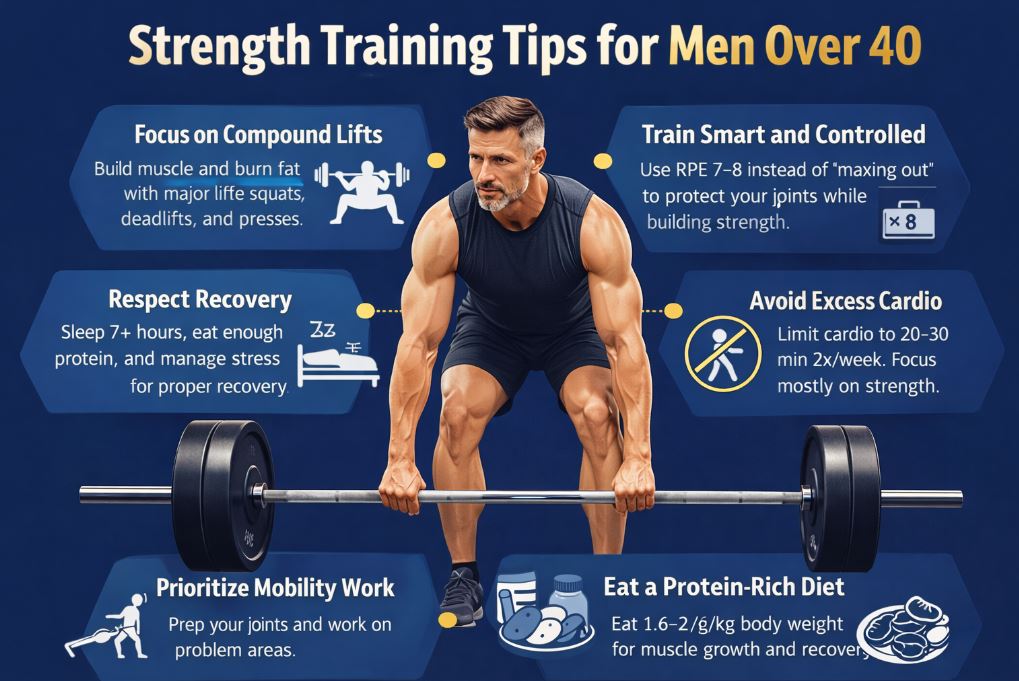
Training after 40 requires precision, not punishment. Your body can still grow, but it no longer tolerates random volume, sloppy form, or endless fatigue the way it once did. The goal now is to apply the right amount of stress, in the right way, and then allow the body to fully recover and adapt.
Key principles:
Progressive overload still matters, but volume must be controlled
Your muscles still need increasing tension to grow, but piling on excessive sets quickly leads to joint irritation and nervous system fatigue. After 40, fewer high-quality sets taken close to technical failure will outperform high-volume “junk” training.
You need longer recovery windows between hard sessions
Hormonal output, connective tissue repair, and nervous system recovery are all slower than in your 20s. Giving a muscle group 48–72 hours before training it again is no longer optional if you want consistent progress and pain-free joints.
Exercise selection must respect joint health
Barbells and machines should be chosen for how well they load the muscle without grinding the joints. Neutral grips, supported rows, leg presses, and dumbbells often outperform straight-bar work for older lifters because they reduce unnecessary stress while still allowing heavy loading.
Technique matters more than load
At this stage of life, momentum and sloppy reps are not shortcuts — they are injury invitations. Controlled eccentrics, stable positions, and clean movement patterns create more muscle tension with less joint wear, which is exactly what a 40+ body needs.
Warm-ups and mobility are no longer optional
A few focused minutes preparing your hips, shoulders, and spine can add years to your lifting career. Warm muscles produce more force, move better, and are far less likely to get injured, especially as connective tissue becomes stiffer with age.
Auto-regulation beats ego lifting
Using tools like RPE (Rate of Perceived Exertion) allows you to push hard on good days and back off when recovery is lower. This keeps progress moving forward without turning every session into a battle against fatigue.
Coach’s Note
One of the biggest shifts I see in men after 40 is that progress no longer comes from pushing harder — it comes from training smarter. When volume is controlled, exercises are chosen to suit the body, and recovery is respected, the results are often faster and more sustainable than in younger lifters who rely purely on intensity.
Many of my clients are surprised to discover that their best gains arrive when they stop chasing exhaustion and start chasing quality. That is when strength, muscle, and joint health begin to rise together instead of competing with each other.
Your body will still grow — but only if you give it the right stimulus, intelligent exercise selection, and enough recovery to actually adapt. This is why many of my clients see their best results when they stop chasing exhaustion and start focusing on quality, consistency, and long-term progress.
How Strength Training Changes After 40
In your 20s, you can survive chaos. In your 40s, you need structure.
When you train in your twenties, you can lift heavy five or six days in a row and still show up strong. Sore joints, poor sleep, and bad food choices do not stop you. Your hormones and nervous system cover your mistakes.
After 40, they do not.
- You now need fewer total sets, but each set must count. Ten sloppy sets do less for your muscles than five focused, controlled sets taken close to failure. For example, five hard sets of leg presses with perfect form will build more muscle than endless high-rep squats done while exhausted.
- You also need more rest days. Your muscles recover fast, but your joints and nervous system do not. Training chest again after 48 hours might feel fine, but your shoulders and elbows still need time. This is why upper-lower splits work so well for men over 40.
- You need smarter exercise choices. A straight-bar bench press, for example, might hurt your shoulders now. A neutral-grip dumbbell press or a machine press will load your chest just as well with far less joint stress. The goal stays the same. The tool changes.
- You also need auto-regulation instead of forced progression. Some days you feel strong. Some days you do not. RPE (Rate of Perceived Exertion) lets you push when your body feels ready and pull back when it does not. That keeps you training hard without burning out.
This is not a weakness. This is efficiency.
Common Training Mistakes Men Over 40 Make
The biggest mistakes I see:
- Training like a 25-year-old
- Too much cardio and not enough strength
- Ignoring sleep and stress
- Constant calorie deficits
- Skipping legs
- Chasing soreness instead of progression
These habits suppress testosterone, destroy joints, and stall muscle growth.
Program Overview – Strength Training for Men Over 40
This program uses a simple upper / lower split to maximize muscle growth while protecting joints and promoting recovery. Every parameter below reflects how the male body changes after 40 and how it responds best to strength training.
| Parameter | Value |
|---|---|
| Training level | Intermediate (suitable for beginners with gym experience) |
| Goal | Build muscle, strength, and hormonal health |
| Split | Upper / Lower |
| Frequency | 4 days per week |
| Program length | 4 weeks |
| Workout duration | 60–75 minutes |
| Equipment | Full gym |
| Progression model | RPE-based progressive overload |
| Rest between sets | 90–150 seconds |
| Cardio | Optional low-intensity |
| Recovery days | Built into the schedule |
Weekly Training Schedule
This weekly layout balances training stress with recovery so you can grow muscle without burning out. Each session targets the body when it feels most ready to perform and recover.
| Day | Workout |
|---|---|
| Monday | Upper Body A |
| Tuesday | Lower Body A |
| Wednesday | Rest or light cardio |
| Thursday | Upper Body B |
| Friday | Lower Body B |
| Saturday | Optional walking or mobility |
| Sunday | Full rest |
This layout maximizes anabolic signaling while allowing the nervous system and joints to recover.
4-Week Strength Training Plan for Men Over 40
This four-week program builds strength and muscle in a structured, joint-friendly way. Each week increases the training stimulus (intensity) while giving your body enough time to fully recover and adapt.
Week 1 – Foundation & Technique
This week builds movement quality and joint tolerance. We keep RPE moderate and focus on clean reps. You prepare your body for heavier loading in Week 2.
Upper Body A
| Exercise | Sets | Reps | RPE | Target Muscle |
|---|---|---|---|---|
| Barbell Bench Press | 3 | 8 | 7 | Chest, triceps |
| Lat Pulldown | 3 | 10 | 7 | Lats |
| Seated DB Shoulder Press | 3 | 10 | 7 | Shoulders |
| Cable Row | 3 | 10 | 7 | Upper back |
| Rope Triceps Pushdown | 2 | 12 | 7 | Triceps |
| DB Curl | 2 | 12 | 7 | Biceps |
Lower Body A
| Exercise | Sets | Reps | RPE | Target Muscle |
|---|---|---|---|---|
| Leg Press | 3 | 10 | 7 | Quads |
| Romanian Deadlift | 3 | 8 | 7 | Hamstrings |
| Walking Lunges | 2 | 10 | 7 | Glutes |
| Seated Leg Curl | 2 | 12 | 7 | Hamstrings |
| Standing Calf Raise | 3 | 12 | 7 | Calves |
Upper Body B
| Exercise | Sets | Reps | RPE | Target Muscle |
|---|---|---|---|---|
| Incline DB Press | 3 | 8 | 7 | Upper chest |
| Chest-Supported Row | 3 | 10 | 7 | Mid-back |
| Lateral Raise | 3 | 12 | 7 | Delts |
| Face Pull | 3 | 12 | 7 | Rear delts |
| EZ-Bar Curl | 2 | 10 | 7 | Biceps |
| Overhead Triceps Extension | 2 | 10 | 7 | Triceps |
Lower Body B
| Exercise | Sets | Reps | RPE | Target Muscle |
|---|---|---|---|---|
| Hack Squat | 3 | 8 | 7 | Quads |
| Hip Thrust | 3 | 10 | 7 | Glutes |
| Split Squat | 2 | 10 | 7 | Legs |
| Lying Leg Curl | 2 | 12 | 7 | Hamstrings |
| Seated Calf Raise | 3 | 12 | 7 | Calves |
Week 2 – Progressive Overload
You increase the load by 2–5%. RPE rises slightly. The goal is more tension with the same form. All exercises stay the same as Week 1, so you can apply progressive overload to the exact same movement patterns, which lets your muscles produce more force while your joints stay safe and well-adapted. Increase weight so that most main lifts reach RPE 8.
Upper Body A
| Exercise | Sets | Reps | RPE | Target Muscle |
|---|---|---|---|---|
| Barbell Bench Press | 4 | 8 | 8 | Chest, triceps |
| Lat Pulldown | 4 | 10 | 8 | Lats |
| Seated DB Shoulder Press | 3 | 10 | 8 | Shoulders |
| Cable Row | 3 | 10 | 8 | Upper back |
| Rope Triceps Pushdown | 2 | 12 | 8 | Triceps |
| DB Curl | 2 | 12 | 8 | Biceps |
Lower Body A
| Exercise | Sets | Reps | RPE | Target Muscle |
|---|---|---|---|---|
| Leg Press | 4 | 10 | 8 | Quads |
| Romanian Deadlift | 4 | 8 | 8 | Hamstrings |
| Walking Lunges | 3 | 10 | 8 | Glutes |
| Seated Leg Curl | 2 | 12 | 8 | Hamstrings |
| Standing Calf Raise | 3 | 12 | 8 | Calves |
Upper Body B
| Exercise | Sets | Reps | RPE | Target Muscle |
|---|---|---|---|---|
| Incline DB Press | 4 | 8 | 8 | Upper chest |
| Chest-Supported Row | 4 | 10 | 8 | Mid-back |
| Lateral Raise | 3 | 12 | 8 | Delts |
| Face Pull | 3 | 12 | 8 | Rear delts |
| EZ-Bar Curl | 2 | 10 | 8 | Biceps |
| Overhead Triceps Extension | 2 | 10 | 8 | Triceps |
Lower Body B
| Exercise | Sets | Reps | RPE | Target Muscle |
|---|---|---|---|---|
| Hack Squat | 4 | 8 | 8 | Quads |
| Hip Thrust | 4 | 10 | 8 | Glutes |
| Split Squat | 3 | 10 | 8 | Legs |
| Lying Leg Curl | 2 | 12 | 8 | Hamstrings |
| Seated Calf Raise | 3 | 12 | 8 | Calves |
Week 3 – Strength Emphasis
This week increases intensity. You lift heavier. Reps drop on the main lifts. Accessory work stays joint-friendly.
What changes from Week 2:
- We reduce reps on big lifts and push RPE to 8–9.
- You now train closer to your strength limit.
Upper Body A
| Exercise | Sets | Reps | RPE | Target Muscle |
|---|---|---|---|---|
| Barbell Bench Press | 4 | 6 | 8–9 | Chest, triceps |
| Lat Pulldown | 4 | 8 | 8 | Lats |
| Seated DB Shoulder Press | 3 | 8 | 8 | Shoulders |
| Cable Row | 3 | 8 | 8 | Upper back |
| Rope Triceps Pushdown | 2 | 10 | 7–8 | Triceps |
| DB Curl | 2 | 10 | 7–8 | Biceps |
Lower Body A
| Exercise | Sets | Reps | RPE | Target Muscle |
|---|---|---|---|---|
| Leg Press | 4 | 8 | 8–9 | Quads |
| Romanian Deadlift | 4 | 6 | 8–9 | Hamstrings |
| Walking Lunges | 3 | 8 | 8 | Glutes |
| Seated Leg Curl | 2 | 10 | 7–8 | Hamstrings |
| Standing Calf Raise | 3 | 10 | 8 | Calves |
Upper Body B
| Exercise | Sets | Reps | RPE | Target Muscle |
|---|---|---|---|---|
| Incline DB Press | 4 | 6 | 8–9 | Upper chest |
| Chest-Supported Row | 4 | 8 | 8 | Mid-back |
| Lateral Raise | 3 | 12 | 8 | Delts |
| Face Pull | 3 | 12 | 8 | Rear delts |
| EZ-Bar Curl | 2 | 8 | 8 | Biceps |
| Overhead Triceps Extension | 2 | 8 | 8 | Triceps |
Lower Body B
| Exercise | Sets | Reps | RPE | Target Muscle |
|---|---|---|---|---|
| Hack Squat | 4 | 6 | 8–9 | Quads |
| Hip Thrust | 4 | 8 | 8 | Glutes |
| Split Squat | 3 | 8 | 8 | Legs |
| Lying Leg Curl | 2 | 10 | 7–8 | Hamstrings |
| Seated Calf Raise | 3 | 10 | 8 | Calves |
Week 4 – Deload & Supercompensation
This week removes accumulated fatigue. Your body repairs joints, muscles, and the nervous system. This sets up faster progress in the next training cycle.
What changes from Week 3:
- We keep the same exercises.
- We cut the total volume (reps & sets).
- We lower the load so RPE drops to 6–7.
- This allows full recovery without losing strength or muscle.
Upper Body A
| Exercise | Sets | Reps | RPE | Target Muscle |
|---|---|---|---|---|
| Barbell Bench Press | 2 | 6 | 6–7 | Chest, triceps |
| Lat Pulldown | 2 | 8 | 6–7 | Lats |
| Seated DB Shoulder Press | 2 | 8 | 6–7 | Shoulders |
| Cable Row | 2 | 8 | 6–7 | Upper back |
| Triceps Pushdown | 1 | 12 | 6 | Triceps |
| DB Curl | 1 | 12 | 6 | Biceps |
Lower Body A
| Exercise | Sets | Reps | RPE | Target Muscle |
|---|---|---|---|---|
| Leg Press | 2 | 8 | 6–7 | Quads |
| Romanian Deadlift | 2 | 6 | 6–7 | Hamstrings |
| Walking Lunges | 1 | 8 | 6 | Glutes |
| Seated Leg Curl | 1 | 12 | 6 | Hamstrings |
| Standing Calf Raise | 2 | 10 | 6–7 | Calves |
Upper Body B
| Exercise | Sets | Reps | RPE | Target Muscle |
|---|---|---|---|---|
| Incline DB Press | 2 | 6 | 6–7 | Upper chest |
| Chest-Supported Row | 2 | 8 | 6–7 | Mid-back |
| Lateral Raise | 2 | 12 | 6–7 | Delts |
| Face Pull | 2 | 12 | 6–7 | Rear delts |
| EZ-Bar Curl | 1 | 10 | 6 | Biceps |
| Overhead Triceps Extension | 1 | 10 | 6 | Triceps |
Lower Body B
| Exercise | Sets | Reps | RPE | Target Muscle |
|---|---|---|---|---|
| Hack Squat | 2 | 6 | 6–7 | Quads |
| Hip Thrust | 2 | 8 | 6–7 | Glutes |
| Split Squat | 1 | 8 | 6 | Legs |
| Lying Leg Curl | 1 | 10 | 6 | Hamstrings |
| Seated Calf Raise | 2 | 10 | 6–7 | Calves |
Pros & Cons of This Training Style
| Pros | Cons |
|---|---|
| Builds muscle and strength at the same time | Requires access to a full gym |
| Protects joints with controlled volume and RPE | Not designed for daily training |
| Supports testosterone and metabolic health | Progress depends on honest effort |
| Uses simple, proven movement patterns | Not ideal for complete beginners |
| Allows full recovery between sessions | Requires consistency to see results |
| Scales well as you get stronger | No “quick fix” shortcuts |
This balance makes the program powerful and sustainable for men over 40.
RPE System Explained for Men Over 40
The RPE system helps you train with intensity without letting ego decide the weight. Instead of chasing numbers, you focus on how many clean reps you have left at the end of each set. This keeps the muscle under high tension while protecting your joints and nervous system. For men over 40, this matters because recovery slows and fatigue builds more quickly. RPE allows you to push hard on good days and back off on bad ones, helping prevent overtraining and reduce injury risk.
An RPE 8 means you finish the set knowing you could perform about two more clean reps with good form. That level of effort sits in the sweet spot for muscle growth. You work close enough to failure to stimulate the muscle, but not so close that you overload your joints or nervous system.
| RPE | What It Means | Reps Left in the Tank |
|---|---|---|
| 6 | Light effort | 4+ reps |
| 7 | Moderate effort | 3 reps |
| 8 | Hard but controlled | 2 reps |
| 9 | Very hard | 1 rep |
| 10 | Max effort | 0 reps |
This system replaces “ego lifting” with controlled intensity. That keeps progress steady and injuries rare.
Exercise Instructions & Coaching Cues
Use the same execution standards for all four weeks. Good form keeps joints safe and tension on the target muscle.
| Exercise | How to Perform It Correctly | Key Coaching Cues |
|---|---|---|
| Barbell Bench Press | Lie with eyes under the bar. Plant feet flat. Lower the bar to mid-chest. Press up in a slight arc. Keep wrists stacked over elbows. | Pull the bar apart. Keep shoulder blades tight. Drive feet into the floor. |
| Incline Dumbbell Press | Set the bench to 30–45°. Lower dumbbells to upper chest. Press up and slightly inward. | Keep elbows at 45°. Control the bottom. Do not bounce. |
| Seated DB Shoulder Press | Sit upright. Start with dumbbells at shoulder level. Press overhead until arms lock. Lower under control. | Keep ribs down. Do not arch the lower back. |
| Lateral Raise | Raise dumbbells to shoulder height with a slight elbow bend. Lower slowly. | Lead with elbows. Do not swing. Keep tension on delts. |
| Lat Pulldown | Pull bar to upper chest. Keep torso tall. Control the return. | Pull elbows to ribs. Do not lean back. |
| Chest-Supported Row | Lie on an incline bench. Pull handles toward lower ribs. Lower under control. | Squeeze shoulder blades. Do not jerk the weight. |
| Cable Row | Sit tall. Pull the handle toward your waist. Pause, then return. | Keep chest proud. Do not round the back. |
| Face Pull | Pull the rope toward your face. Separate hands at the end. | Elbows high. Squeeze rear delts. |
| EZ-Bar Curl | Curl bar up without swinging. Lower slowly. | Keep elbows close. Control every rep. |
| Dumbbell Curl | Curl one or both dumbbells. Rotate palm up as you lift. | Full range. No momentum. |
| Rope Triceps Pushdown | Push the rope down and spread your hands at the bottom. | Lock elbows. Squeeze triceps. |
| Overhead Triceps Extension | Hold the weight overhead. Lower behind the head. Extend arms. | Keep elbows narrow. Do not flare. |
| Leg Press | Place feet shoulder-width apart. Lower until knees reach 90°. Press up. | Do not lock knees. Keep your lower back flat. |
| Hack Squat | Keep feet mid-platform. Lower under control. Drive through heels. | Keep knees in line with toes. |
| Romanian Deadlift | Push hips back. Lower bar to mid-shin. Stand tall. | Keep spine neutral. Feel a stretch in the hamstrings. |
| Hip Thrust | Upper back on the bench. Drive hips up. Squeeze glutes at the top. | Keep ribs down. Pause at the top. |
| Walking Lunges | Step forward. Drop back knee. Push through the front heel. | Stay tall. Do not rush reps. |
| Split Squat | Rear foot elevated. Lower straight down. Push through the front leg. | Keep the knee stable. Control the descent. |
| Seated Leg Curl | Curl the pad toward the glutes. Lower slowly. | Squeeze at the top. No hip lift. |
| Lying Leg Curl | Curl weight up. Control back down. | Keep your hips on the bench. No jerking. |
| Standing Calf Raise | Rise on toes. Lower fully. | Pause at top. Use the full range. |
| Seated Calf Raise | Lift heels up. Lower slowly. | Control both directions. No bouncing. |
Recovery, Sleep & Hormones After 40
After 40, recovery drives results. You do not grow in the gym. You grow when you rest.
Strength training triggers testosterone, growth hormone, and muscle protein synthesis. Sleep controls how much of that signal your body can use. When you sleep less than six hours, testosterone drops, and cortisol rises. That slows muscle growth and increases fat storage.
Men over 40 also need more time to repair joints, tendons, and the nervous system. Hard training without proper sleep builds fatigue instead of strength. This is why rest days sit between upper and lower sessions in this program. They protect your hormones and keep your lifts strong.
If you want this plan to work, aim for seven to eight hours of sleep, eat enough protein and carbs, and respect the deload in Week 4. That is how you keep getting stronger instead of breaking down.
Nutrition for Strength Training After 40
- Eat enough protein every day. Aim for 1.6–2.2 g per kg of body weight to support muscle repair and growth.
- Do not fear carbohydrates. They fuel hard training and keep testosterone and thyroid hormones stable.
- Avoid chronic calorie deficits. Long-term dieting lowers testosterone and slows recovery.
- Include healthy fats from eggs, olive oil, nuts, and fatty fish to support hormone production.
- Spread protein across 3–4 meals to keep muscle protein synthesis active.
- Drink enough water to support joint health and maintain training performance.
- Limit alcohol, as it lowers testosterone and disrupts sleep.
- Eat a protein-rich meal within two hours after training to speed up recovery.
Who This Program Is Best For
- Men aged 40 to 60
- Former athletes returning to training
- Men with stubborn belly fat
- Men with low energy or low testosterone
- Busy professionals who need structure
- Lifters who want muscle without joint pain
Alternative Programs for Men Over 40
If you want a different training focus, here are smart options that fit various goals for men over 40:
- Gym-Based Full-Body 3×/Week – Less frequent, balanced workload, easy recovery
- Dumbbell-Only Upper/Lower Split – Ideal for travelers or minimalist training
- Machine-Only Strength Program – Joint-friendly and perfect for busy schedules
- Home-Based Bodyweight Strength Plan – No equipment needed, great for beginners
- Band-Focused Strength & Mobility Program – Improves movement quality and joint health
- Lean Muscle + Fat Loss Hybrid Plan – Strength plus strategic conditioning
- Power & Athleticism for 40+ – Adds plyometrics and speed work safely
- Mobility-First Strength Routine – Prioritizes joint range before load progression
Final Thoughts – Train Smart, Stay Strong
Getting older does not mean getting weaker. It means you need a smarter plan.
When you train with structure, control, and purpose, your body still responds. You build muscle, regain strength, protect your joints, and keep your confidence.
This program gives you the tools to do exactly that. Stay consistent. Respect recovery. Push when your body feels strong.
Train smart. Stay strong.
How long does it take for men over 40 to see results from strength training?
Most men notice better energy and strength within 2–3 weeks. Visible muscle and fat loss usually appear after 6–8 weeks when training and nutrition stay consistent.
Can strength training help reduce belly fat after 40?
Yes. Lifting weights improves insulin sensitivity and increases muscle mass, which makes fat loss easier even without extreme dieting.
Should men over 40 train to failure?
No. Training one or two reps short of failure builds muscle just as well and protects joints and recovery.
Is it normal to feel more sore after lifting at this age?
Yes. Connective tissue recovers more slowly. That is why rest days and deload weeks matter more now than in your 20s.
Can strength training improve testosterone naturally?
Heavy compound lifting increases androgen sensitivity and supports healthy testosterone levels over time.
What if I have old injuries or joint pain?
You can still train. Use machines, dumbbells, and neutral grips to load muscles without stressing injured joints.
Should men over 40 use supplements to build muscle?
Protein and creatine help. Most other supplements give little return compared to sleep, food, and training.
How much cardio should men over 40 do?
Two or three light sessions per week support heart health without interfering with muscle growth.
Is it better to train in the morning or evening at this age?
Train when you feel strongest and least rushed. Consistency matters more than the time of day.
What should I do after finishing this 4-week program?
Repeat it with slightly heavier weights or move to a new cycle with different exercises while keeping the same structure.
