


Introduction
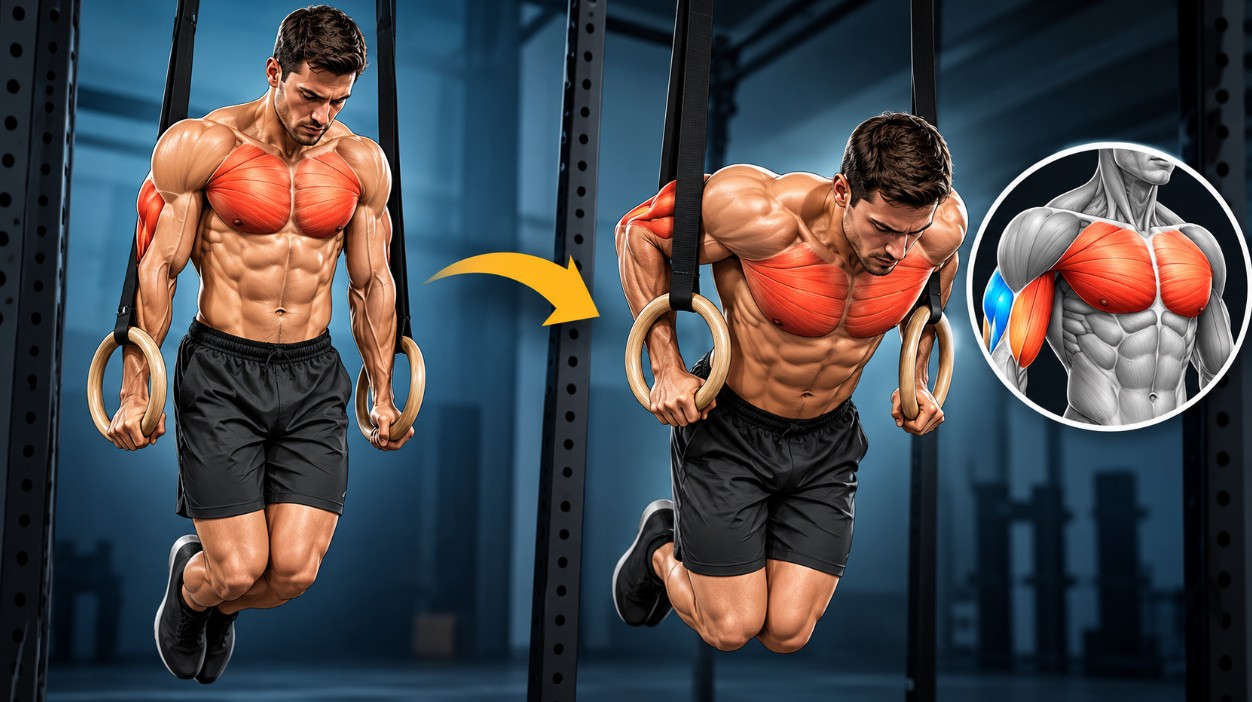
Ring dips are one of the most demanding bodyweight exercises for the chest and triceps. Instead of pressing yourself up on fixed parallel bars, as in regular chest dips, you perform the movement on a pair of gymnastic rings that hang freely and move in every direction.
That freedom is exactly what makes ring dips so challenging. On bars, the bars stay still, and your only job is to lower and press your body. On rings, you also have to keep them from drifting apart, swinging, or rotating, which forces your chest, triceps, shoulders, and core to work together to stay stable.
Research comparing dip variations found that ring dips produced muscle activation similar to, or higher than, bar dips, making them a natural next step once bar dips become easy. They are a staple in gymnastics and calisthenics, and with a sensible progression, they can become a powerful addition to any upper-body program.
Ring dips are an advanced bodyweight exercise performed on a pair of gymnastic rings, in which the body is lowered from a straight-arm support position until the upper arms are about parallel to the floor and then pressed back up. Because the rings move freely, the lifter must stabilize them throughout the movement, which trains the pectoralis major and triceps brachii while placing high demands on the shoulder stabilizers and core.
Other Names for Ring Dips
The exercise is known under several names, mainly in gymnastics and calisthenics circles.
- Gymnastic ring dips
- Ring chest dips
- Rings dips
- Suspended dips
- RD (in calisthenics programs)
Required Equipment
You only need a pair of gymnastic rings and a secure place to hang them. Rings are among the most versatile pieces of calisthenics equipment.
- A pair of gymnastic rings with adjustable straps
- A sturdy anchor point, such as a pull-up bar, beam, or power rack
- Optional resistance band or dip belt for assisted or weighted variations
How to Perform Ring Dips
Start in a stable support position. If you can’t hold the top position steadily, you are not yet ready for full reps.
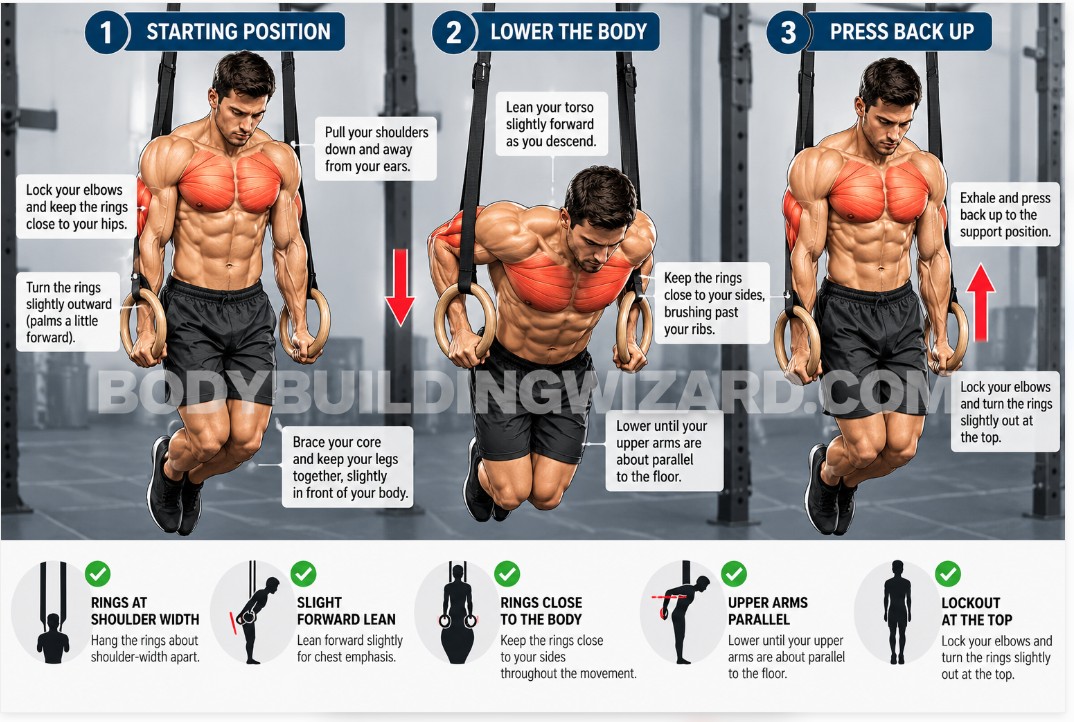
Starting Position
Set the rings at a height that allows your feet to hang freely at the bottom of the dip.
- Hang the rings about shoulder-width apart, high enough that your feet clear the floor at the bottom
- Grip the rings and jump or press up into the top support position
- Lock your elbows and keep the rings close to your hips
- Turn the rings slightly outward so your palms face a little forward
- Pull your shoulders down and away from your ears
- Brace your core and keep your legs together, slightly in front of your body
Execution (Action Phase)
Lower and press your body in a slow, controlled movement, keeping the rings close to your body throughout.
- Inhale and bend your elbows to lower your body (see our guide on breathing technique)
- Lean your torso slightly forward as you descend
- Keep the rings close to your sides, brushing past your ribs
- Lower until your upper arms are about parallel to the floor
- Exhale and press back up to the support position
- Lock your elbows and turn the rings slightly out at the top
If the rings start to shake or drift away from your body, slow down or return to an easier progression. Control matters more than depth or reps.
Video Demonstration
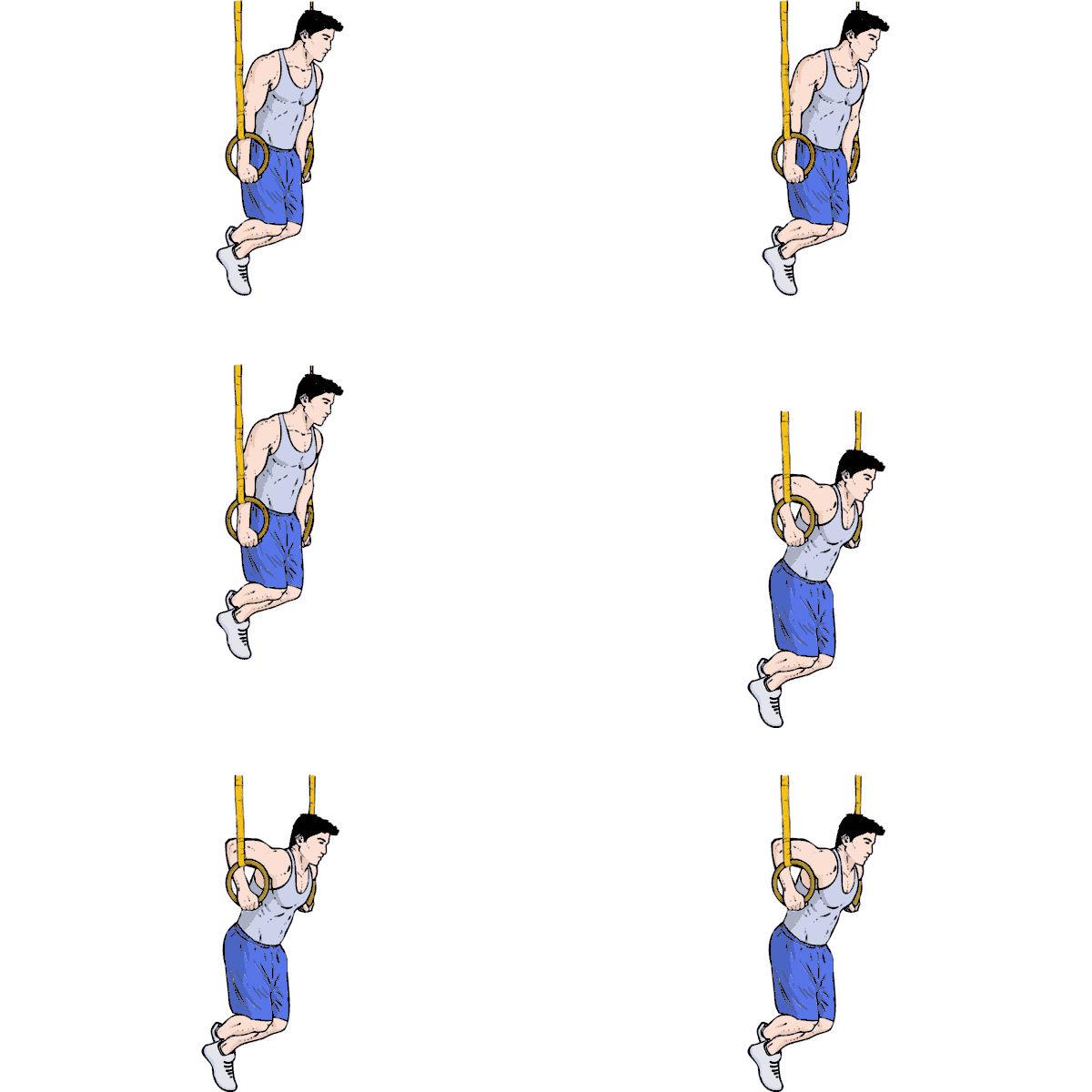
Watching ring dips helps you see how the rings stay close to your body and how the top position stays stable.
In the video below, notice how the lifter starts in a steady support position, lowers the body slowly with a slight forward lean, and keeps the rings close to the ribs throughout the descent. At the top, the elbows lock, and the rings turn slightly outward before the next rep.

The first time a strong lifter jumps into a ring support, it usually looks like a newborn giraffe trying to stand. The arms shake, the rings wobble and drift away from the body, and someone who can do ten bar dips without blinking suddenly struggles to hold the top position for five seconds. Rings have a way of humbling everyone.
With my clients, we don’t start with dips at all. We start with the ring support hold: arms locked, rings close to the hips, body still. Once they can hold that steadily for about 30 seconds, we add feet-assisted or band-assisted ring dips, and only then full reps. It is slower than jumping straight in, but it builds the shoulder control that makes ring dips both effective and safe.
Quick Form Checklist
Run through these cues before every set to keep the exercise controlled and safe.
- Steady support position before the first rep
- Rings close to the body throughout
- Slight forward lean for chest emphasis
- Upper arms about parallel at the bottom
- Elbows locked and rings turned out at the top
Technical Emphasis & Targeting Adjustments
Small adjustments to torso angle, ring position, and tempo change how ring dips load your muscles.
- Forward lean → more chest involvement. Leaning the torso slightly forward changes the direction of the press relative to the body and brings more of the chest into the movement. Direct research comparing lean angles is limited, but this is a widely used coaching cue.
- Upright torso → more triceps involvement. Keeping the torso vertical shifts more of the work onto the triceps.
- Rings close to the body → better control. Keeping the rings near your ribs and hips reduces the leverage that pulls your arms outward.
- Slower eccentric → more strength and control. Lowering yourself over 3 seconds increases time under load and builds control. Learn more about eccentric training.
- Rings turned out at the top → more stable lockout. Rotating the rings slightly outward at the top helps many lifters stabilize the support position.
Common Mistakes
Most ring dip mistakes come from progressing too quickly or losing control of the rings.
- Skipping the progressions. Jumping straight to full ring dips without a solid support hold leads to shaky, uncontrolled reps. Build up through support holds and assisted variations first.
- Letting the rings drift away. When the rings move away from your body, they pull your arms outward and destabilize your shoulders. Keep them close to your sides throughout.
- Going too deep. Going too deep. Sinking far below parallel puts the front of the shoulder under heavy stretch. Stop when your upper arms are about parallel to the floor.
- Shrugging the shoulders. Letting the shoulders rise toward the ears reduces stability and stresses the shoulder joint. Keep your shoulders down and back.
- Kipping or bouncing. Leg swings or bouncing out of the bottom remove control and stress the joints. Move slowly and deliberately.
At the top of each rep, with your elbows locked, rotate the rings slightly outward so your palms face a little forward. Gymnastics coaches call this “rings turned out,” and many lifters find it makes the top position noticeably more stable.
At the same time, keep the rings close to your body throughout the rep, brushing past your ribs and hips. When the rings drift away from your body, especially at the bottom, they become much harder to control. Close rings and a firm turned-out lockout are two of the simplest ways to make ring dips feel steady instead of shaky.
Mechanical Considerations
During ring dips, the shoulders extend as the body lowers, then flex and adduct as the body presses back up, while the elbows extend. You can read more about these joint actions in our guide to anatomical movements. Research on bar dips shows that the movement effectively targets the pectoralis major and triceps brachii, and that muscle activation increases further as fatigue builds during a set.
The key difference with rings is stability. Because the rings can move in any direction, the shoulder stabilizers, chest, and core must continuously control them. In the study comparing bench, bar, and ring dips, the ring dip produced peak activations similar to the bar dip, with several muscles reaching even higher activation levels. The same study noted that dips have been criticized as a potentially high-risk shoulder exercise, making careful progression especially important. As a compound exercise, ring dips train the chest, triceps, and front delts together.
Muscles Worked in Ring Dips
MAIN MUSCLES
- Pectoralis major (with emphasis on the lower fibers)
- Triceps brachii
SECONDARY MUSCLES
STABILIZERS
ANTAGONISTS
Ring Dips Pros and Cons
Ring dips are highly effective, but they aren’t suitable for everyone.
Advantages
- High muscle activation. Research shows ring dips activate muscles as much as, or more than, bar dips.
- Builds shoulder stability. Controlling the rings trains the shoulder stabilizers and the scapular muscles in a way fixed bars cannot.
- Minimal, portable equipment. You can hang a pair of rings almost anywhere, making them ideal for home and outdoor training.
- Natural hand path. Because the rings rotate freely, the hands can find a comfortable path, which many lifters find easier on the wrists and elbows.
Potential Drawbacks
- Very high skill requirement. Most lifters need weeks of support holds and assisted variations before performing clean reps.
- Shoulder demands. The combination of instability and a deep stretched position can be risky for lifters with shoulder issues.
- Hard to scale precisely. Unlike machines, rings can’t be adjusted in small load increments without bands or a dip belt.
- Setup required. The rings need a secure anchor point and careful height adjustment before training.
Safety Considerations
A review of resistance-training injuries reported that the shoulder complex accounted for up to 36% of documented injuries and disorders, although much of the available evidence was retrospective. Because ring dips combine instability with a deep shoulder position, keep these precautions in mind.
- Shoulder problems. Lifters with a history of shoulder instability or pain should progress very gradually or choose a more stable dip variation. Learn more about shoulder joint anatomy.
- Previous pectoral strain. Lifters recovering from pectoral strain should avoid deep ring dips until a medical professional clears them.
- Elbow and tendon stress. Dips place high demands on the triceps and elbows, and connective tissues may need time to adapt, as our guide to the muscle-tendon unit explains. Watch for signs of triceps tendonitis.
- Secure setup. Always check that the straps and anchor point are secure before every session, and set the rings high enough that you can stand up safely if you lose control.
Ring Dips Variations and Progressions
Ring support hold
Difficulty: Easier than the standard version
Holding the top position with locked arms and the rings close to the hips is the foundation of all ring dip training. Aim for 30 seconds of steady holding before moving on to dips.
Feet-assisted ring dips
Difficulty: Easier than the standard version
Lower the rings so your feet stay on the floor or a box, using your legs for assistance. Use as little leg help as possible and gradually reduce it.
Band-assisted ring dips
Difficulty: Easier than the standard version
Loop a resistance band between the rings and place your knees on it for assistance, especially at the bottom of the movement. It is a practical way to perform full-range reps while building strength.
Negative ring dips
Difficulty: Easier than the standard version
Starting in the support position and lowering yourself as slowly as possible builds strength and control in the exact movement pattern. Read more about negative repetitions and how to use them.
Weighted ring dips
Difficulty: Harder than the standard version
Once you can perform 10–12 clean reps, adding weight with a dip belt keeps the exercise challenging. Increase the load gradually and keep the same controlled technique.
Ring Dip Progression: From First Support to Full Reps
| Stage | Exercise | Practical progression target |
|---|---|---|
| 1 | Feet-Assisted Ring Support Hold | 3 × 20–30 s |
| 2 | Ring Support Hold | 3 × 15–30 s |
| 3 | Feet-Assisted Ring Dips | 3 × 6–10 |
| 4 | Controlled Negative Ring Dips | 3 × 3–5, 3–5 s lowering |
| 5 | Full Ring Dips | 3 × 3–6 |
| 6 | Weighted Ring Dips | After consistent controlled bodyweight reps |
Replacement Exercises (Substitutes) for Ring Dips
If you don’t have rings or aren’t ready for them yet, these exercises train the chest and triceps similarly. For more options, see our guide to the best lower chest exercises.
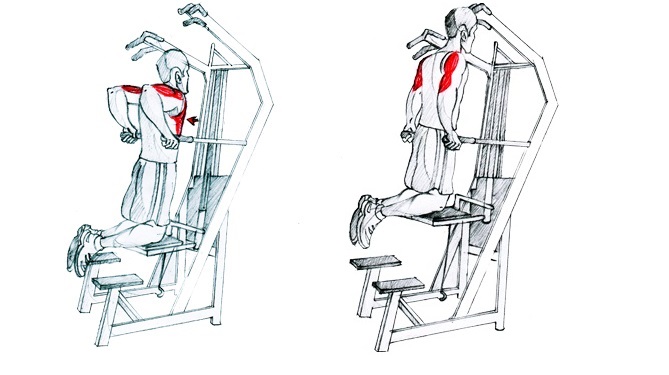
- Assisted chest dip. The assisted chest dip uses a machine to reduce the load, making it ideal for building up to dips.
- Decline barbell bench press. The decline barbell bench press allows heavy loading of the lower chest.

- Decline dumbbell bench press. The decline dumbbell bench press lets each arm move independently.

- Cable crossover. The high-to-low cable crossover isolates the lower chest with constant cable tension.

- Deficit push-ups. Deficit push-ups are a challenging bodyweight alternative with an extended range of motion.

- One-arm push-ups. One-arm push-ups are another advanced bodyweight exercise that builds pressing strength and core stability.

How to Program Ring Dips
How you program ring dips depends mainly on your current stage, from support holds to full and weighted reps.
Show full programming guideHide programming guide ▾
| Stage | Sets | Reps | Rest | Tempo |
|---|---|---|---|---|
| Building up (support holds, assisted dips) | 3–4 | 20–30 s holds or 5–8 reps | 90–120 s | Slow, controlled |
| Strength & skill (full ring dips) | 3–5 | 5–8 | 2–3 min | Controlled lowering, brief pause at bottom |
| Hypertrophy (advanced) | 3–4 | 8–12 | 2 min | 2–3 s lowering |
Muscle growth can occur across a wide range of repetitions when sets are taken close to failure, so treat these numbers as guidelines rather than strict rules. Adjust your rest periods between sets based on how recovered you feel.
- Early in a workout, when you are fresh enough to control the rings
- In calisthenics programs as a main pressing exercise
- As a progression after you can perform 10 or more clean bar dips
- As a pressing and stability exercise for athletes and gymnasts
Apply progressive overload by moving through the progression: ring support holds, feet-assisted or band-assisted ring dips, slow negatives, and then full reps. Once you can perform 10–12 clean reps, add a pause at the bottom or wear a dip belt with extra weight.
Ring Dips vs Bar Dips (Comparison Table)
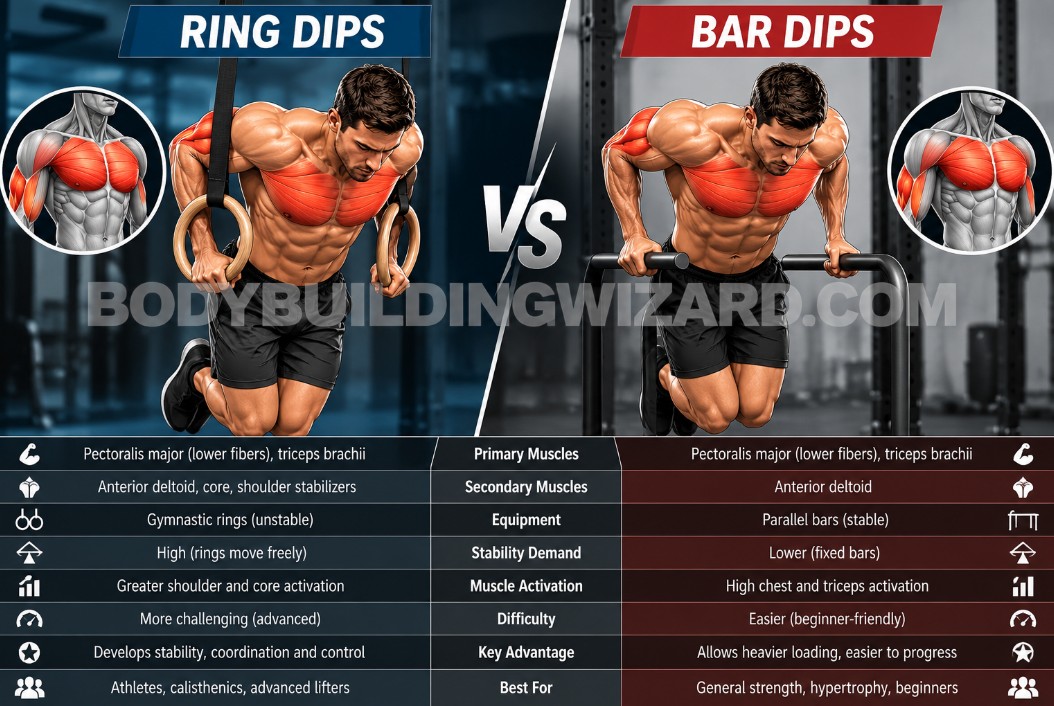
| Criteria | Ring Dips | Bar Dips |
|---|---|---|
| Support | Free-moving rings | Fixed parallel bars |
| Stability Demand | Very high | Moderate |
| Muscle Activation | Similar to or higher than bar dips | High |
| Hand Path | Free to rotate | Fixed |
| Skill Requirement | High | Moderate |
| Portability | Rings can be hung almost anywhere | Requires dip bars or a station |
| Best For | Advanced strength and stability | General chest and triceps strength |
Bar dips remain the more accessible choice and the natural starting point for most lifters. Fixed bars let you focus on pressing strength without the added challenge of stabilizing the rings. If you can’t do bar dips yet, our guide to your first dip will help you get there.
Ring dips are the natural progression once bar dips become easy, adding a major stability challenge and slightly higher muscle activation. Many lifters use both, with bar dips for heavier strength work and ring dips for control and variety.
Final Thoughts
Ring dips are one of the most effective and demanding bodyweight exercises for building the chest, triceps, and shoulder stability. Because the rings move freely, every rep becomes a test of strength and control.
Build up patiently through support holds and assisted variations, keep the rings close to your body, and control your depth. With a sensible progression, ring dips can become a cornerstone of your bodyweight training. If you want to learn more about the bone where the chest attaches, read our guide to the sternum.
Frequently Asked Questions
Are ring dips harder than bar dips?
Yes. Because the rings move freely, you must stabilize them throughout the movement, which places higher demands on the shoulders and core. Most lifters can perform noticeably fewer ring dips than bar dips at first.
What muscles do ring dips work?
Ring dips primarily work the pectoralis major and triceps brachii, with help from the anterior deltoids. The rotator cuff, serratus anterior, and core work hard to stabilize the body and the rings.
How many bar dips should I be able to do before trying ring dips?
As a practical benchmark, I recommend being able to perform around 10 clean bar dips and hold a ring support position for about 30 seconds before attempting full ring dips.
What is the ring support hold?
The ring support hold is the top position of a ring dip, held with locked arms, the rings close to your hips, and the body still. It is the first and most important step toward ring dips.
What does “rings turned out” mean?
It means rotating the rings slightly outward at the top of the movement, so the palms face a little forward. Many coaches use it to make the top position more stable.
How deep should I go on ring dips?
Lower until your upper arms are about parallel to the floor or slightly below, as long as your shoulders feel comfortable. Going much deeper increases stress on the front of the shoulder.
How high should the rings be?
Set the rings high enough that your feet don’t touch the floor at the bottom of the dip, or lower if you want to use your feet for assistance while learning.
Can ring dips build the chest?
Yes. Research shows that ring dips produce muscle activation similar to or higher than bar dips, so they can contribute to chest and triceps development, especially with a slight forward lean.
Are ring dips bad for your shoulders?
Dips in general have been described as a potentially higher-risk exercise for the shoulders. Building up gradually, controlling the depth, and keeping the rings close to your body make them much safer.
How can I make ring dips easier?
Use feet-assisted or band-assisted ring dips, or practice slow negatives. Lowering the rings so your feet can help is one of the simplest ways to build up to full reps.
