



Rock climber pull-ups are a wide-grip pull-up variation in which you pull your body up and toward one hand, then lower and pull toward the other hand on the next rep. Because your body shifts to one side, the arm closer to your chin takes a larger share of the load, while the other arm assists. That makes the exercise a useful step between regular pull-ups and more demanding one-sided variations such as archer pull-ups.
Despite the name, rock climber pull-ups aren’t a climbing-specific exercise. In a study of more than 200 sport climbers, climbing performance was best explained by hand-arm strength and endurance tests, such as grip strength and finger and bent-arm hangs, together with body fat and climbing experience. General pulling strength helps climbers, but the exercise doesn’t replicate the demands of climbing a wall.
In this guide, you’ll learn how to perform rock climber pull-ups with proper form, which muscles they work, how to program them, and how they compare with archer pull-ups.
Rock climber pull-ups are a bodyweight vertical pulling exercise performed with a wide overhand grip, in which the body is pulled up and toward one hand, so that one arm bends more and carries a larger share of the load, while the other arm assists. The direction alternates from rep to rep. The exercise mainly trains the latissimus dorsi, teres major, and elbow flexors, while the trunk works to keep the body from swinging.
Climbers sometimes come to me expecting rock climber pull-ups to be their secret weapon on the wall. I understand the appeal, because the name promises exactly that. My honest answer is that they’re a good general pulling exercise, not a climbing-specific one. On a real route, your fingers, forearms, footwork, and technique usually decide how far you get, long before your lats give up.
That’s why I use rock climber pull-ups with climbers the same way I use them with everyone else: to build one-sided pulling strength and to prepare for harder variations. For the climbing-specific part, they need finger and grip training and, above all, time on the wall. Pull-ups support climbing; they don’t replace it.
— Krunoslav, Ph.D. in Kinesiology
Other Names for Rock Climber Pull-Ups
You’ll come across this exercise under several names:
- Rock-climber pull-ups – the hyphenated spelling of the same name.
- Side-to-side pull-ups – a common descriptive name.
- Alternating side pull-ups – used in some programs.
- Offset pull-ups – an informal name highlighting the uneven load.
Archer pull-ups and typewriter pull-ups are related but different exercises; you’ll find both described in the variations section below.
Required Equipment
You only need a bar, but it has to be long enough for a wide grip:
- Straight pull-up bar. It should allow a grip about 1.5 times shoulder width; see the different types of pull-up bars for home options.
- Resistance band (optional). A band reduces the load, as in resistance band-assisted pull-ups.
- Chalk (optional). Helps keep a secure grip, especially on the side carrying more of the load.
How to Do Rock Climber Pull-Ups
The key to rock climber pull-ups is a controlled shift toward one hand, without swinging or twisting. Set your grip first, then pull in a smooth diagonal path.
Starting Position
Hang from the bar and set your body position:
- Grab the bar with an overhand grip about 1.5 times shoulder width, as in a wide-grip pull-up.
- Hang with your elbows fully or nearly fully extended, using the deepest comfortable overhead position your shoulders allow, without excessive shrugging.
- Keep your legs together, your glutes lightly squeezed, and your trunk braced, similar to a gentle hollow body position.
- Keep your head and neck neutral, with your chest facing the bar.


Execution
From the hang, pull with control toward one side:
- Drive your elbows down and pull your body up and toward one hand, so your chin finishes close to that hand.
- Let the arm on that side bend more, while the other arm bends less and assists the pull; it doesn’t need to stay straight.
- Keep your chest facing the bar and avoid twisting or swinging your hips to the opposite side.
- Pull until your chin clears the bar near your working hand, then pause briefly.
- Lower yourself under control back to the center, until your elbows are fully or nearly fully extended, avoiding dropping abruptly into a passive hang.
- Pull toward the other hand on the next rep. Exhale during the pull and inhale as you lower.
Count each pull to one side as one rep, keep the number equal on both sides, and start each set with the side you find harder.
Video Demonstration
The video below shows rock climber pull-ups with alternating sides. Notice how the lifter moves up and to the side in one smooth diagonal path rather than pulling straight up and then sliding over.
Watch the hips and legs as well. In a controlled set, the lower body stays quiet, and the chest keeps facing the bar. Filming yourself from the front makes it easy to see whether you swing or twist toward one side.

The most common mistake I see on rock climber pull-ups is what I call the “pendulum.” To get the body over to one side, the lifter swings the hips in the opposite direction, like the pendulum of an old wall clock. The chin reaches the hand, but the legs did half the work, and by the end of the set the whole body is ticking from side to side.
With clients, I set two rules: legs together and a short pause in the center at the bottom of every rep. The pause stops the swing before it starts. The first sets usually look slower and shorter, but the clients quickly feel how much harder the working arm and lat have to work when the legs can’t help. That’s exactly what the exercise is supposed to train.
Quick Form Checklist
Check these points before and during every set:
- Overhand grip about 1.5 times shoulder width
- Legs together, trunk braced, chest facing the bar
- Diagonal pull toward one hand, chin finishes near that hand
- Short pause in the center at the bottom
- Equal reps on both sides
On rock climber pull-ups, grip width mainly decides how far your body can shift and how much of the load the working arm takes. This is the overview I give my clients:
| Grip | Elbow Path | Typical Characteristics |
|---|---|---|
| Moderately wide (just outside the shoulders) | Mostly down, with a small side shift | Closest to a regular pull-up; good for learning the pattern |
| Wide (about 1.5× shoulder width) | Down and toward the working side | The standard version; a clear shift of load to one arm |
| Very wide (about 2× shoulder width) | Mostly toward the working side | Larger side shift and higher demand on the working arm; for advanced lifters |
I usually start clients with a moderately wide grip and a small side shift, so they learn to move diagonally without swinging. Once that feels smooth, we move to the standard wide grip. A very wide grip makes the exercise much closer to an archer pull-up, so I only use it with clients who already handle the standard version well.
A review of pull-up and lat pulldown research found no difference in latissimus dorsi activity between grip widths. In practice, that means grip width on this exercise changes how much of your body weight shifts onto one arm, not whether you train the lats. That’s how I think about it with clients.
— Krunoslav, Ph.D. in Kinesiology
Technical Emphasis & Targeting Adjustments
Small changes in how you move toward each side change the difficulty and the feel. Use these cues as practical adjustments:
- Elbow of the working arm toward the ribs → more lat emphasis. Driving the working elbow down toward your side emphasizes the latissimus dorsi’s main action on that side.
- Larger side shift → more load on the working arm. Moving the chin closer to the hand increases the work on the working side; a smaller shift keeps the exercise closer to a regular pull-up.
- Assisting arm less bent → harder variation. Keeping the assisting arm straighter moves the exercise toward an archer pull-up.
- Chest facing the bar → more trunk control. Resisting the urge to twist keeps the work on the back and arms and challenges the obliques.
- Lower for about 3–5 seconds → more eccentric control. A slower descent makes it easier to return to the center without swinging.
Common Rock Climber Pull-Up Mistakes
Most mistakes on this exercise come from using momentum to reach the side. Watch for these:
- Swinging the hips to reach the side. A pendulum-like swing adds momentum and reduces the work for the back. Keep the legs together and pause in the center at the bottom.
- Pulling straight up, then sliding sideways. Splitting the rep into two movements changes the exercise. Move up and to the side in one diagonal path.
- Twisting the torso. Rotating toward the working hand makes the reps uneven. Keep your chest facing the bar.
- Favoring the stronger side. Doing more or better reps on one side creates uneven training. Start each set with the weaker side and match the reps.
- Dropping into the bottom. Falling back to the center loads the shoulders abruptly. Lower under control to fully or nearly fully extended elbows.
Let your weaker side set the pace for the whole set. Most people have one side that feels noticeably harder on rock climber pull-ups. Start every set with that side, and end the set as soon as the weaker side can no longer complete a clean rep, even if the stronger side still has a few left.
Log the reps for each side in your training diary. Over a few weeks, you’ll see whether the gap between the sides is shrinking. It’s a simple way to use the exercise for more balanced strength instead of letting your stronger side do the talking.
Mechanical Considerations
What makes rock climber pull-ups different is how the load is shared between the arms. When you shift your body toward one hand, that hand ends up closer to your center of mass, so that arm supports a larger share of your body weight, while the other carries less. The further you shift, the more the exercise resembles one-arm pulling. At the same time, the trunk has to resist swinging and twisting, because the load is no longer symmetrical. This is biomechanical reasoning, not a measured result.
No study appears to have examined rock climber pull-ups directly. Research on standard pull-up variations gives some context: in an EMG study, pull-ups performed with different hand positions produced broadly similar muscle activation. Rock climber pull-ups use the same overhand grip as the wide-grip pull-up, so the main difference likely comes from the uneven loading between the arms rather than from different muscles being involved.
Muscles Worked by Rock Climber Pull-Ups
Rock climber pull-ups are a compound exercise with a greater demand on the working side:
MAIN
- Latissimus dorsi – pulls the body up, with the working side doing more of the work.
- Teres major – assists the lats.
- Biceps brachii and brachialis – flex the elbows, especially on the working arm.
SECONDARY
- Brachioradialis – assists elbow flexion, along with other forearm muscles.
- Middle and lower trapezius and rhomboids – control the shoulder blades. Learn more about the trapezius muscle.
- Posterior deltoid – assists shoulder extension.
STABILIZERS
- Obliques and other core muscles – resist swinging and twisting.
- Rotator cuff – stabilizes the shoulder joint.
- Forearm flexors – maintain the grip, especially on the side carrying more load; see why grip strength matters.
Pros and Cons
Rock climber pull-ups are a practical intermediate variation, with a few limitations:
Advantages
- More load on each arm. Shifting toward one side increases the demand on the working arm without external weight.
- A progression toward harder variations. The exercise naturally bridges to archer and assisted one-arm pull-ups.
- Reveals side-to-side differences. It’s easy to notice which side is weaker, which supports symmetrical muscular development.
- Minimal equipment. A straight bar is all you need.
Potential Drawbacks
- Requires solid pull-ups. You need several strict pull-ups first; our guide to your first pull-up is a better starting point for beginners.
- Uneven loading within each rep. Balance depends on alternating sides carefully.
- Harder to load. Adding external weight is possible but rarely necessary, since the side shift already increases the difficulty.
- Easy to cheat. Without control, the hips swing, and momentum takes over.
Safety Considerations
Because one arm carries more of the load on each rep, the main risks come from doing too much too soon rather than from the exercise itself:
- Build volume gradually. The working arm handles more load than in a regular pull-up, so increase sets and reps slowly over several weeks.
- Listen to your elbows. Discomfort around the elbow of the working arm is a sign to reduce the volume or the side shift.
- Avoid swinging. A swinging body is harder to control and can lead to an awkward pull or a lost grip.
- Control the descent. Returning to the center under control protects the shoulders, especially on the side that just worked harder.
Variations of Rock Climber Pull-Ups
These variations let you make the exercise easier or progress toward one-arm pulling:
Band-Assisted Rock Climber Pull-Up
Difficulty: Intermediate
A band looped over the bar supports part of your body weight, letting you practice the diagonal path before doing full reps. The assisted pull-up machine can serve the same purpose.
Negative Rock Climber Pull-Up
Difficulty: A progression exercise, not necessarily harder
Start at the top beside one hand and lower yourself to the center for approximately 3–5 seconds. Like negative chin-ups, it’s a useful way to build strength before full reps.
Typewriter Pull-Up
Difficulty: Advanced
Pull up to the center, move horizontally toward one hand while staying at the top, then move across to the other hand before lowering. Holding the top position makes it much more demanding.
Archer Pull-Up
Difficulty: Advanced
Keep the assisting arm nearly straight while pulling toward the other hand. The working arm takes most of the load, which makes this the next step after rock climber pull-ups.
Towel-Assisted One-Arm Pull-Up
Difficulty: Advanced
Hold the bar with one hand and a towel hanging from the bar with the other, gripping it lower to reduce the assistance. It’s a common bridge toward the one-arm pull-up.
Replacement Exercises
If you want a similar training effect without the side shift, these exercises are good substitutes:
- Wide-Grip Pull-Up. The standard version with the same grip trains the same muscles symmetrically and is easier to progress.

- Commando Pull-Up. The commando pull-up is another alternating-side variation, with a close neutral grip.

- L-Sit Pull-Up. L-sit pull-ups add a strict, demanding variation with a strong trunk component.

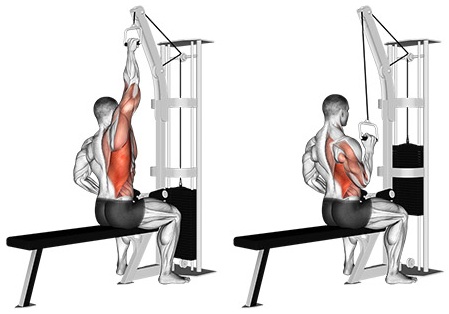
- Single-Arm Lat Pulldown. The single-arm lat pulldown trains each side separately with an adjustable load.
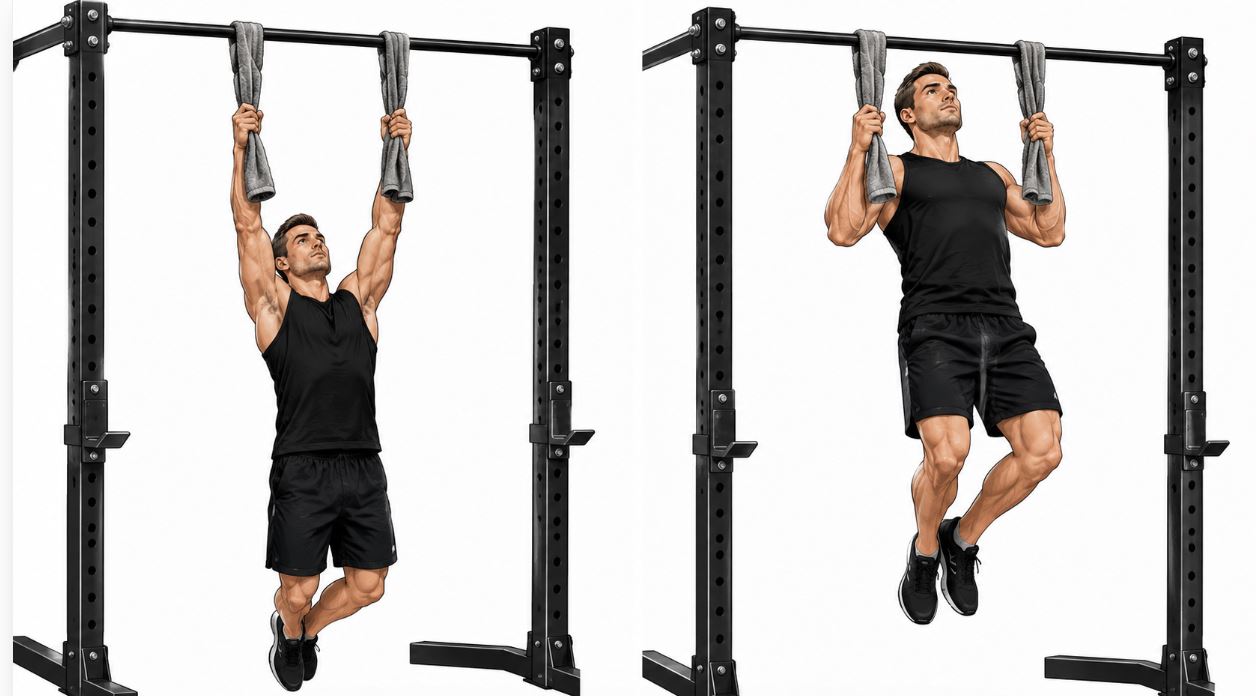
- Towel Pull-Up. The towel pull-up increases the grip demand, which is useful for climbers.
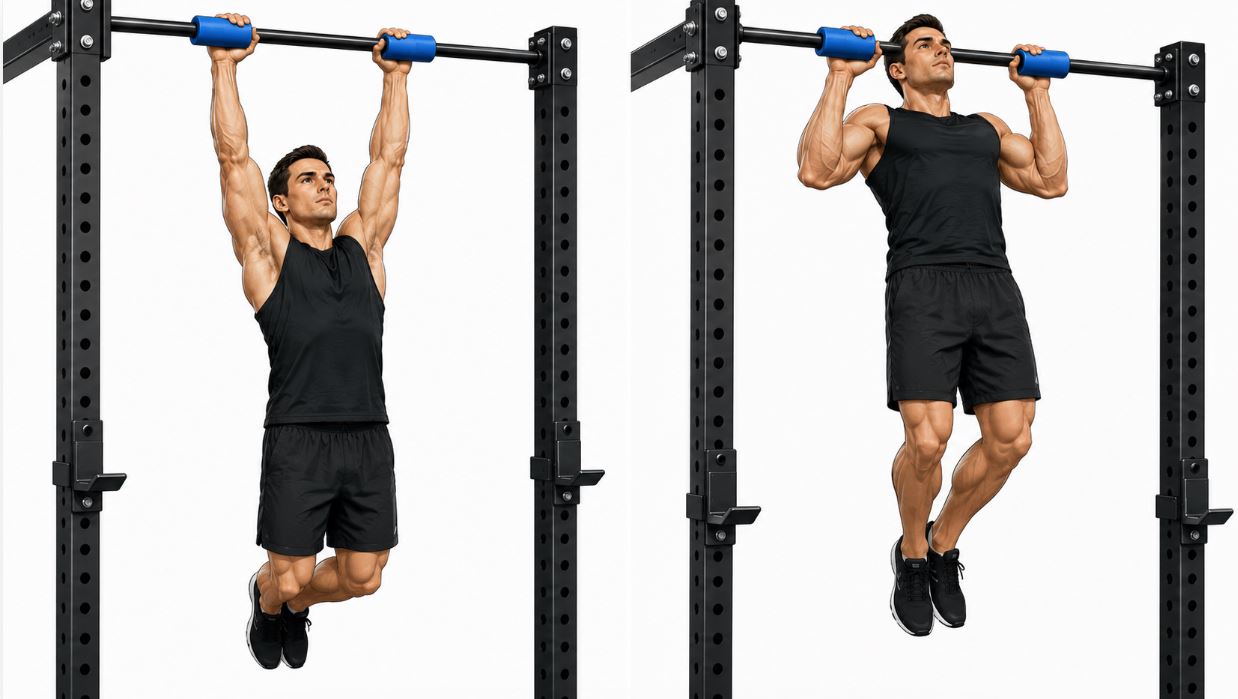
- Fat Grip Pull-Up. The fat grip pull-up is another way to make the hands work harder during vertical pulling.
How to Program Rock Climber Pull-Ups
Use the box below as a starting point and adjust it to your experience and training split.
Show full programming guideHide programming guide ▾
| Goal | Sets | Reps | Rest | Tempo |
|---|---|---|---|---|
| Learning the pattern (small side shift) | 2–3 | 6–8 total | 90–120 s | Controlled, pause in the center |
| Hypertrophy | 3–4 | 6–10 total | 90–120 s | Controlled, 3 s lowering |
| Strength | 3–5 | 4–6 total | 2–3 min | Brief pause at the top |
Use an even number of reps so both sides get the same work. Muscle growth occurs across a broad spectrum of loading ranges, so you don’t need very low reps here; a controlled set that ends close to failure on your weaker side is enough.
- As the main or second vertical pull on back or pull days
- In place of wide-grip pull-ups for a few weeks of variety
- As a progression block before archer or assisted one-arm pull-ups
- Combined with grip work such as the best grip-strengthening exercises, especially for climbers
First, add reps until you reach the top of your range on both sides. Then increase the side shift or keep the assisting arm straighter. Progressive overload on this exercise comes mainly from position, not from extra weight. Our tips to improve your pull-ups apply at every stage.
Rock Climber Pull-Ups vs Archer Pull-Ups
Both exercises shift the load toward one arm, but they differ in how much the other arm helps:
| Feature | Rock Climber Pull-Ups | Archer Pull-Ups |
|---|---|---|
| Assisting arm | Bends and helps actively | Stays nearly straight |
| Load on the working arm | Moderately increased | Substantially increased |
| Grip width | About 1.5× shoulder width | Very wide |
| Path | Diagonal toward one hand | Strongly toward one hand |
| Trunk demand | Moderate | High |
| Experience level | Intermediate to advanced | Advanced |
| Best for | Building one-sided strength | Preparing for one-arm pull-ups |
The main difference is how much the assisting arm contributes. In rock climber pull-ups, the assisting arm bends and shares the work; in archer pull-ups, it stays nearly straight, so the working arm carries much more of the load.
Neither is better overall; they’re stages of the same progression. Most lifters should be comfortable with rock climber pull-ups before trying archer pull-ups. For a broader overview of grip options, see our chin-up vs pull-up comparison.
Final Thoughts
Rock climber pull-ups are a practical way to increase the demand on each arm without adding weight. Pull up and toward one hand in a smooth diagonal path, keep your legs quiet, and match the reps on both sides.
Use them as a progression toward archer pull-ups, and remember that climbers still need finger and grip training and time on the wall. To understand the main muscle behind every pull-up variation, read our guide to the muscles involved in pulling movements.
Frequently Asked Questions
What muscles do rock climber pull-ups work?
They mainly work the lats, teres major, and elbow flexors, with more demand on the arm you pull toward.
Are rock climber pull-ups good for climbing?
They build general pulling strength, but climbing performance depends more on finger and grip strength, technique, and climbing experience.
What’s the difference between rock climber and archer pull-ups?
In rock climber pull-ups, the assisting arm bends and helps; in archer pull-ups, it stays nearly straight, so the working arm does more.
How do I count reps?
Count each pull to one side as one rep and use an even number so both sides get equal work.
How many pull-ups should I do before trying them?
A good guideline is being able to do several strict pull-ups with good control.
Are rock climber pull-ups the same as typewriter pull-ups?
No. In typewriter pull-ups, you move side to side at the top before lowering; rock climber pull-ups go up and down to one side.
Which side should I start with?
Start with your weaker side and end the set when it can no longer complete a clean rep.
Can rock climber pull-ups help me get a one-arm pull-up?
They’re a useful early step, usually followed by archer and assisted one-arm pull-ups.
Should I add weight to rock climber pull-ups?
Usually not. Increasing the side shift is a simpler way to make them harder.
