

Overview (Introduction)
The barbell lunge is a powerful lower-body exercise for building strength, muscle mass, and stability. By placing the barbell across your upper back, this variation allows you to use heavier loads compared to dumbbell lunges, making it highly effective for progressive overload and hypertrophy.
As a coach working with lifters and athletes, I often use barbell lunges to develop strong, well-balanced legs, while also challenging core stability and coordination. Because the load is positioned on your back, your body must work harder to maintain balance and proper posture throughout the movement.
One key factor that dramatically changes the effectiveness of this exercise is step length. A shorter step increases emphasis on the quadriceps, while a longer step shifts more load to the glutes and hamstrings. This makes the barbell lunge not just a strength exercise, but also a highly targetable movement.
Although it allows heavier loading, the barbell lunge requires greater control and stability than most lower-body exercises. When performed correctly, it becomes one of the most effective tools for building strong, athletic, and well-developed legs.
Equipment Needed
The barbell lunge requires slightly more setup than dumbbell lunges, but it allows for greater loading and strength development. Because the barbell is placed on your upper back, proper positioning and stability are essential for safe and effective execution.
As a coach working with lifters and athletes, I always emphasize that the barbell lunge should feel controlled and stable, not heavy and unstable.
- Barbell: Placed across your upper back (trapezius), similar to a back squat position.
- Squat rack (optional): Useful for safely loading and unloading the barbell.
- Open space: Needed if performing walking lunges.
- Flat, stable footwear: Helps maintain balance and proper force transfer.
In practice, the biggest difference compared to dumbbell lunges is the increased demand on your core and stabilizers, since the load is positioned higher on your body.
Step-by-Step Instructions for the Barbell Lunge
Executing the barbell lunge correctly requires balance, control, and proper alignment, especially because the load is placed on your upper back. This increases the demand on your core and stabilizer muscles, making technique even more important than with dumbbells.
As a coach, I always emphasize that you should feel in control of the barbell at all times—never let the weight dictate your movement.
A. Starting Position (Setup)
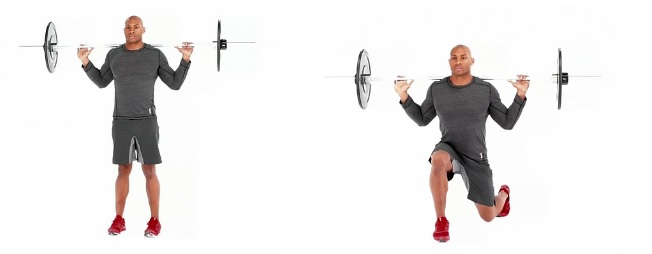
- Stand upright with your feet about hip-width apart.
- Place the barbell across your upper back (trapezius), as you would in a back squat.
- Grip the bar with an overhand grip slightly wider than shoulder-width.
- Keep your chest up, shoulders back, and spine neutral.
- Engage your core to stabilize your torso.
- Keep your head neutral, looking forward.
- Ensure you feel balanced before initiating the movement.
Key coaching cue: “Stable bar, tall posture, tight core”—this sets the foundation for safe and effective reps.
B. Movement (Execution)
Once you’re stable, the goal of the barbell lunge is to move with control and precision, using the front leg to absorb and generate force while keeping the barbell balanced on your back.
As a coach, I always stress that this is a controlled strength movement, not a rushed or momentum-based step.
- Inhale and brace your core before initiating the step.
- Take a controlled step forward (or backward, depending on variation).
- Lower your body by bending both knees simultaneously.
- Keep your torso upright and your back neutral throughout the movement.
- Descend until both knees reach approximately a 90-degree angle.
- Your rear knee should be just above the floor.
- Ensure your front knee tracks in line with your toes.
- Keep your front foot flat and stable.
- Pause briefly at the bottom for control.
- Drive upward through your front heel and mid-foot.
- Return to the starting position while maintaining balance.
- Exhale as you rise.
- Repeat on the same leg or alternate legs.
Resistance & Step Length Insight
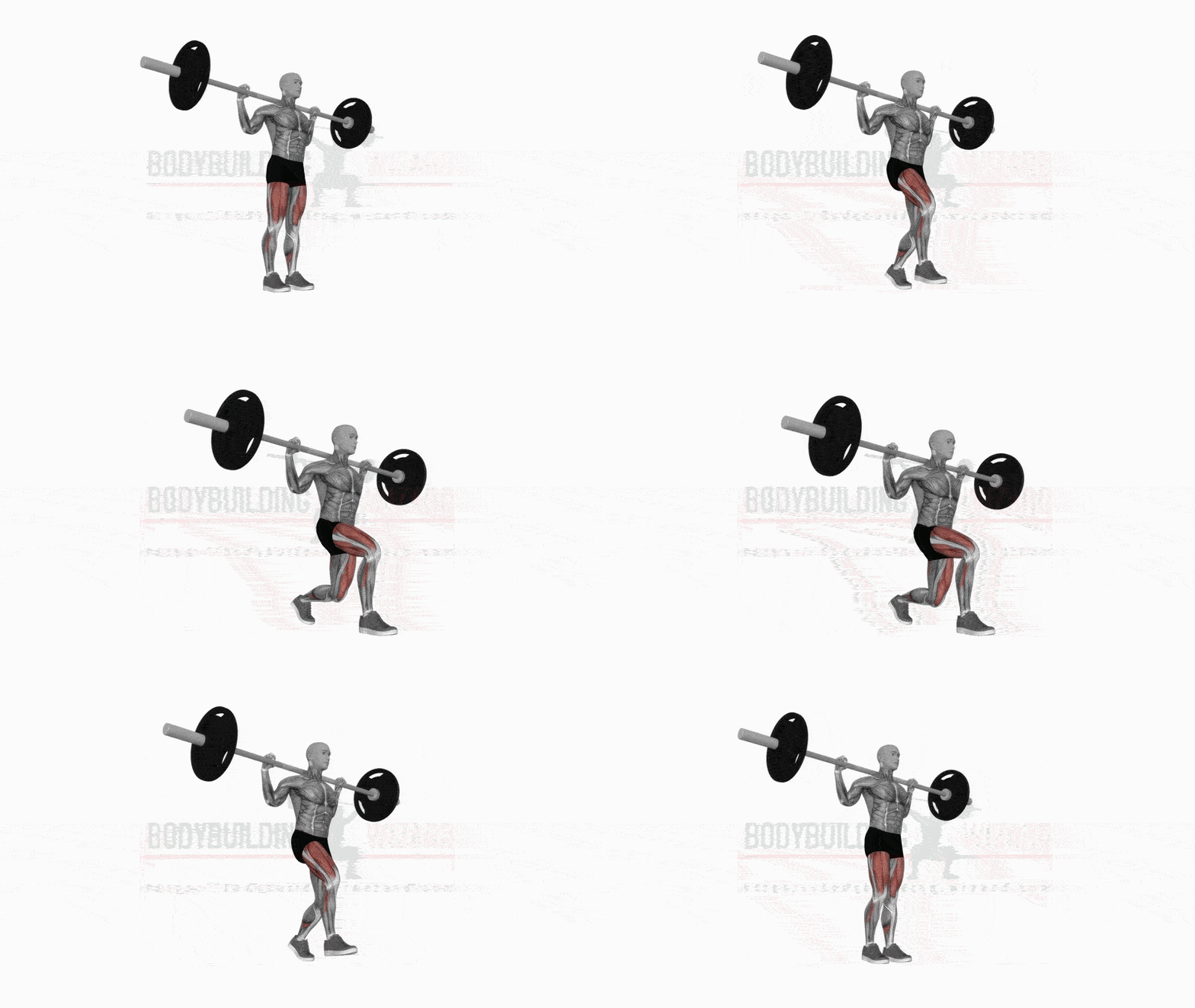
The length of your step determines muscle emphasis:
- Short step: More knee flexion → greater quadriceps activation
- Long step: More hip involvement → greater glute and hamstring activation
Combined with heavier loading, the barbell lunge is one of the most effective exercises for targeted lower-body development.
Muscles Worked in the Barbell Lunge
The barbell lunge is a powerful unilateral compound exercise that targets multiple lower-body muscles while also demanding significant core stability and balance. Because the load is placed on your upper back, your body must work harder to maintain alignment throughout the movement.
As a coach working with lifters and athletes, I often use barbell lunges to build strength, muscle mass, and coordination, especially when heavier loading is required.
Primary Muscles
- Quadriceps (vastus lateralis, vastus medialis, vastus intermedius, rectus femoris): Drive knee extension and control the descent, especially with shorter steps.
- Gluteus maximus: Plays a key role in hip extension, particularly with longer steps.
Secondary Muscles
- Hamstrings: Assist with hip extension and stabilize the knee joint.
- Adductors: Contribute to hip stability and assist in force production.
Stabilizers
- Core musculature: Works to stabilize the torso and keep the barbell balanced.
- Spinal stabilizers (erector spinae): Help maintain an upright posture under load.
- Calves (gastrocnemius and soleus): Assist with balance and ankle stability.
- Hip stabilizers (glute medius and minimus): Prevent knee collapse and maintain alignment.
From my experience, the barbell lunge is one of the most effective exercises for building strength and muscle under load, while also improving stability. It combines the benefits of heavy resistance with unilateral training, making it highly effective for both performance and physique.
Technical Emphasis & Targeting Adjustments
The barbell lunge allows you to precisely control which muscles are emphasized by adjusting step length, torso position, and execution style. Because you can use heavier loads than with dumbbells, these adjustments become even more important for both performance and safety.
As a coach, I often use these variables to shift focus between quadriceps and glutes/hamstrings, depending on the training goal.
Step Length & Muscle Emphasis
| Step Length | Muscle Emphasis / Training Effect |
|---|---|
| Short step | More knee flexion → greater emphasis on quadriceps |
| Moderate step | Balanced activation of quads and glutes |
| Long step | More hip involvement → increased glute and hamstring activation |
Torso Position
| Position | Effect |
|---|---|
| Upright torso | Increases quadriceps activation |
| Slight forward lean | Increases glute involvement |
Movement Control
| Technique | Effect |
|---|---|
| Controlled descent | Improves muscle activation and stability |
| Explosive drive | Enhances power and athletic performance |
| Slow eccentric | Increases time under tension for hypertrophy |
As a coach, one of the biggest mistakes I see with the barbell lunge is lifters treating every rep the same. The truth is, step length is your main tool for targeting muscles. When combined with heavier loading, even small adjustments can dramatically shift the focus between the quadriceps and glutes.
Performance Optimization Tips (Coach’s Cues)
Once your technique is solid, the barbell lunge becomes one of the most effective exercises for building strength, muscle, and stability under load—but only if you execute it with precision. Because of the heavier loading, small technical details make a huge difference.
- Stay consistent with your step length: This ensures you’re targeting the intended muscle group.
- Control the descent: A slow eccentric improves stability and muscle activation.
- Keep your torso stable: Avoid excessive forward lean to maintain proper alignment.
- Drive through the front leg: The working leg should handle most of the load.
- Keep the barbell stable: Maintain tight upper back and core engagement.
- Use a full range of motion: Go deep enough to maximize muscle activation.
- Progress gradually: Increase weight only after mastering balance and control.
- Stay balanced throughout: Avoid wobbling or shifting weight unevenly.
If your glute workouts feel exhausting but your lower body never noticeably changes, the problem may involve poor programming rather than a lack of effort. Learn the real reasons why your glutes aren’t growing.
Barbell Lunge Variations (Forward, Reverse, Walking, Alternating)
The barbell lunge can be performed in several variations, each offering a slightly different stimulus for strength, coordination, and muscle activation. As a coach, I rotate these variations to target different training goals while keeping workouts effective and engaging.
1) Forward Barbell Lunge
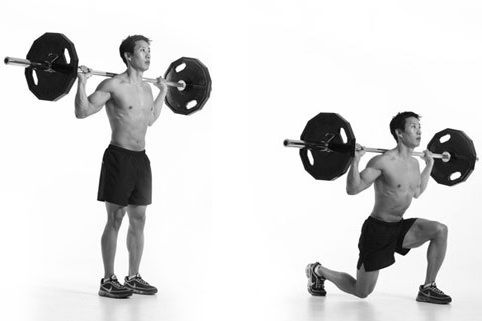
How to perform:
- Step forward into a lunge position.
- Lower under control, then push back to the starting position.
Why it works:
Provides a balanced stimulus for the quadriceps and glutes, depending on step length.
2) Reverse Barbell Lunge
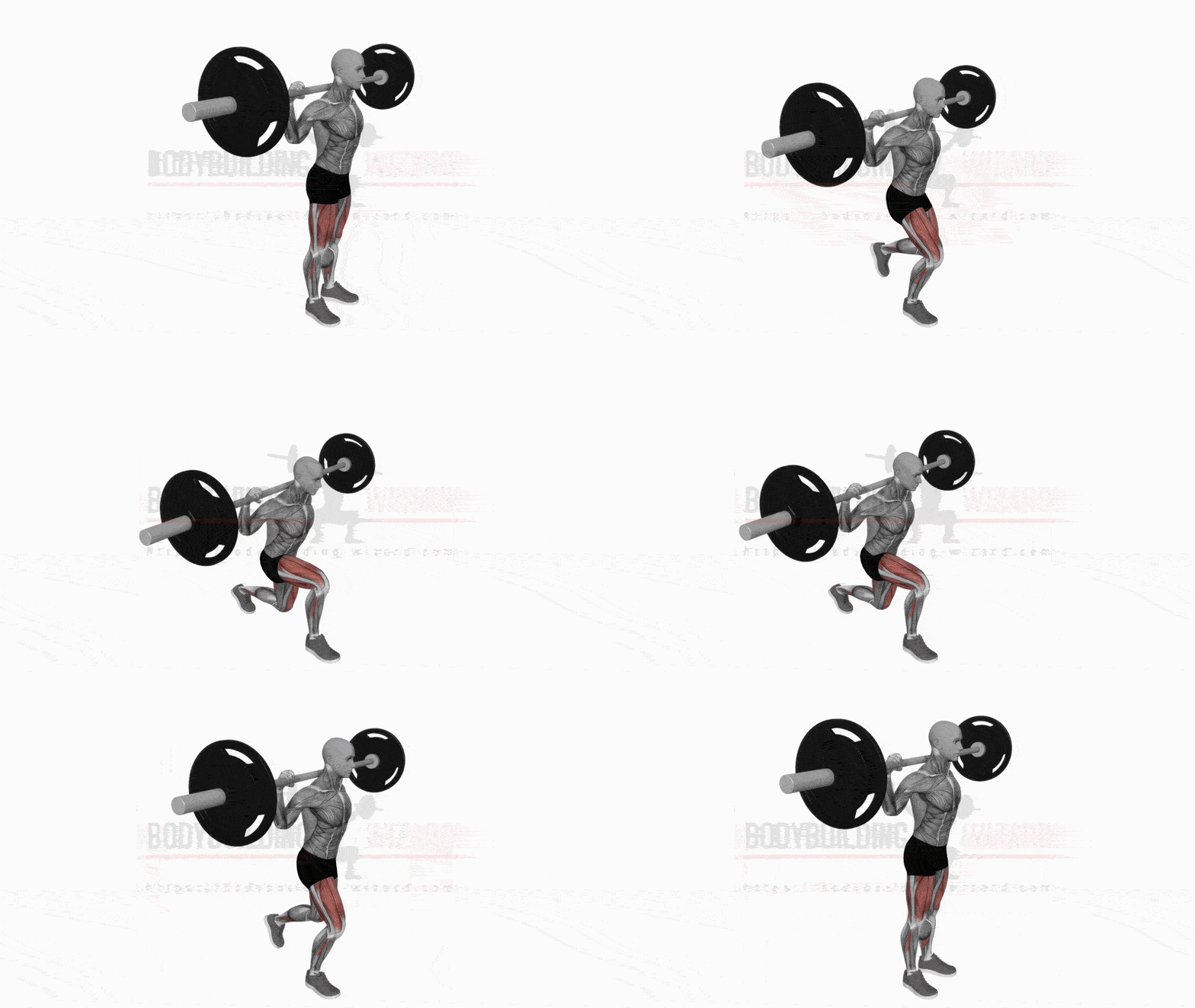
How to perform:
- Step backward instead of forward.
- Lower into a lunge, then return to the starting position.
Why it works:
Reverse lunge reduces stress on the knees and improves control and stability, making it a safer option for many lifters.
3) Walking Barbell Lunge
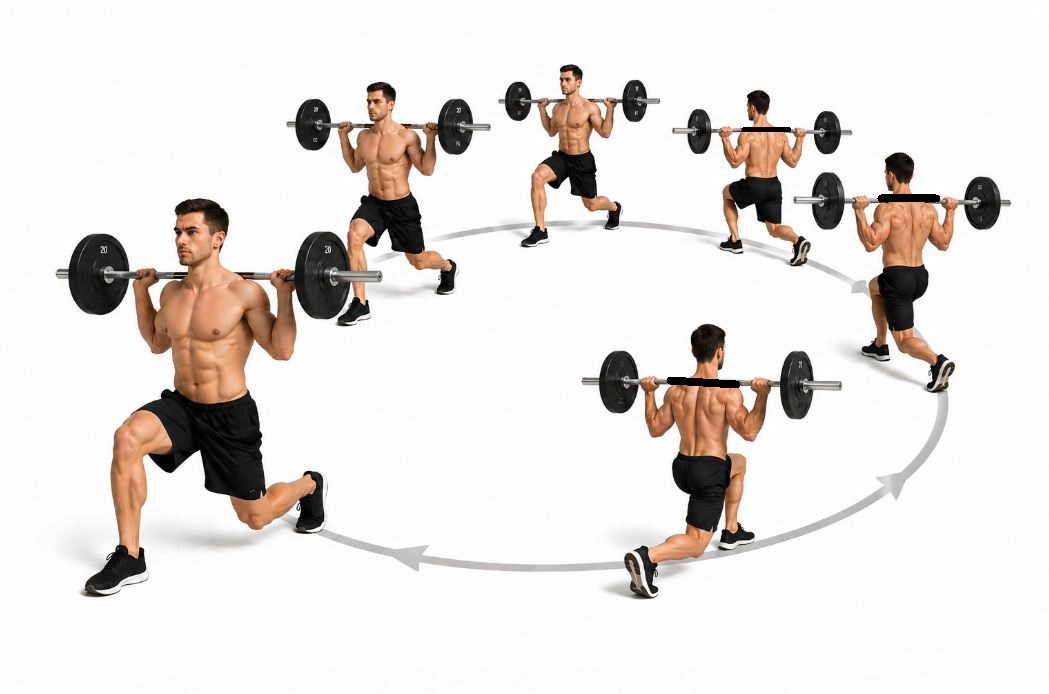
How to perform:
- Step forward continuously, alternating legs.
- Move forward with each repetition.
Why it works:
Improves coordination, endurance, and athletic movement, while maintaining strong muscle activation.
4) Alternating Barbell Lunge
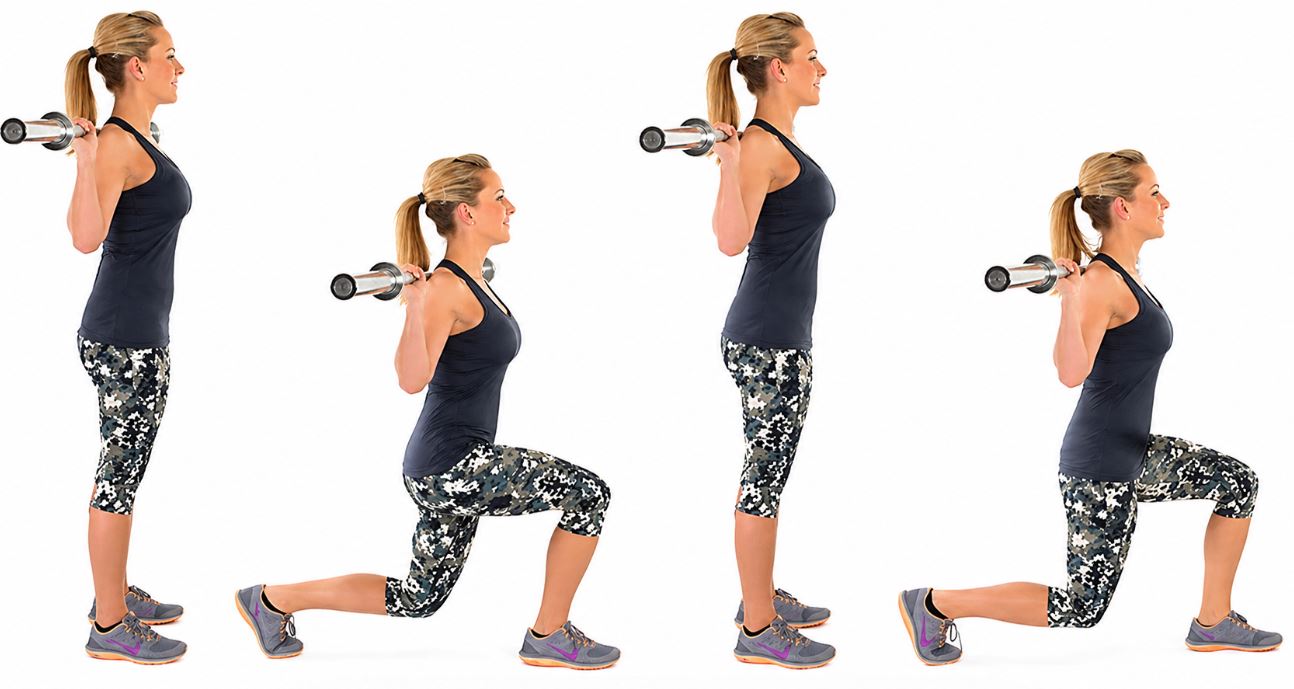
How to perform:
- Perform one rep per leg, alternating sides.
Why it works:
Provides a balanced approach, allowing equal development while maintaining rhythm and control.
Alternative / Replacement Exercises for the Barbell Lunge
While the barbell lunge is an excellent exercise for building strength, muscle, and coordination, there are several effective alternatives you can use depending on your goals, experience level, or equipment availability. As a coach, I often rotate these exercises to maintain progress while targeting similar muscle groups.
- Dumbbell Lunge: A more stable variation that is easier to control, especially for beginners.
- Bulgarian Split Squat: A highly effective unilateral exercise that allows greater focus on strength and hypertrophy.
- Step-Up Exercise: A functional movement that improves balance, coordination, and single-leg strength.
- Walking Lunges: A dynamic variation that enhances coordination and endurance.
- Dumbbell Squat: A bilateral movement for building overall lower-body strength.
- Barbell Back Squat: Ideal for maximum strength and heavy loading.
- Hack Squat: A machine-based option for controlled, quad-focused training.
From a coaching perspective, the barbell lunge is extremely effective but also demanding because of the added load and balance requirement. Rotating it with more stable exercises like dumbbell lunges or split squats can help maintain training intensity while improving recovery.
The key is to match the exercise to your goal—whether that’s strength, hypertrophy, or movement quality.
Key Benefits of the Barbell Lunge
The barbell lunge is one of the most effective exercises for building strength, muscle mass, and lower-body stability under load. Combining unilateral movement with heavier resistance provides a powerful stimulus for both hypertrophy and performance.
As a coach working with lifters and athletes, I often use the barbell lunge to develop strong, balanced legs, while also improving coordination and control under heavier weights.
- Allows greater overload: The barbell position enables heavier loads than dumbbell lunges.
- Builds unilateral strength: Each leg works independently, helping correct muscle imbalances.
- Targets multiple muscle groups: Effectively trains the quadriceps, glutes, and hamstrings.
- Adjustable muscle emphasis: Step length can shift focus between quads and glutes/hamstrings.
- Improves balance and coordination: Requires control and stability throughout the movement.
- Enhances core and upper-body stability: The barbell position increases demand on stabilizers.
- Supports athletic performance: Transfers to movements like sprinting, jumping, and directional changes.
Who Should Use This Exercise?
The barbell lunge is best suited for individuals who want to build serious lower-body strength, muscle mass, and stability under load. Because it combines unilateral movement with heavier resistance, it’s especially valuable for those looking to take their training beyond basic exercises.
As a coach working with lifters and athletes, I typically recommend the barbell lunge to those who already have a solid foundation in lower-body training and are ready to handle more demanding movements.
- Intermediate and advanced lifters: Ideal for building strength and hypertrophy with heavier loads.
- Athletes: Helps develop balance, coordination, and unilateral strength that transfers to sports performance.
- Lifters aiming for muscle growth: Provides a strong hypertrophy stimulus for the quads and glutes.
- Individuals correcting imbalances: Trains each leg independently to improve symmetry.
- Strength-focused trainees: Complements squats and deadlifts with unilateral loading.
- Not ideal for complete beginners: Requires good balance, coordination, and technique before adding a barbell.
Want to build stronger legs faster? Check out our complete guide to the best quad exercises for strength and size.
Barbell Lunge vs Dumbbell Lunge: Which Is Better?
The barbell lunge and dumbbell lunge are both excellent unilateral exercises, but they differ in loading potential, stability, and overall training effect. Choosing between them depends on your experience level and primary goal.
As a coach working with lifters and athletes, I use both variations—but for different purposes.
| Criteria | Barbell Lunge | Dumbbell Lunge |
|---|---|---|
| Loading Potential | Higher (heavier weights possible) | Moderate |
| Stability Requirement | Very high | High |
| Balance Demand | Very high | Moderate to high |
| Core Activation | Very high | High |
| Ease of Learning | More difficult | Easier |
| Control & Precision | Harder to control | Easier to manage |
If your goal is to build maximum strength and muscle under heavy load, the barbell lunge is the better choice. It allows for greater overload and places more demand on your core and stabilizers.
If your goal is to improve control, technique, and balance, the dumbbell lunge is often the better starting point. It provides more stability and is easier to learn and execute.
In practice, the best results come from using both:
- Barbell lunges for strength and hypertrophy under load
- Dumbbell lunges for control, technique, and stability
Where This Exercise Fits in a Workout
The barbell lunge is a demanding lower-body exercise that works best when used as a primary strength movement or a high-intensity accessory lift. Because it requires both balance and control under load, it should be placed in your workout where you can perform it with maximum focus and stability.
As a coach working with lifters and athletes, I typically program barbell lunges to develop unilateral strength, muscle mass, and coordination, especially after foundational lifts like squats.
Recommended Placement
- After squats or leg presses: Use it as a heavy accessory to target each leg individually.
- As a primary unilateral lift: Perform early in the workout to maximize strength and control.
- For hypertrophy training: Ideal for moderate reps with controlled tempo and strict form.
- In advanced programs: Can be used to increase intensity and training complexity.
Sets & Reps Guidelines
- Hypertrophy (muscle growth): 3–4 sets of 8–12 reps per leg
- Strength focus: 3–4 sets of 6–10 reps per leg
- Control and stability: 2–3 sets of 8–12 reps per leg with lighter weight
When programming the barbell lunge, I focus on quality over quantity. This exercise is most effective when performed with full control, consistent step length, and proper alignment, rather than simply trying to lift heavier weights.
Conclusion
The barbell lunge is one of the most effective exercises for building strong, muscular, and well-balanced legs under load. By combining unilateral movement with heavier resistance, it delivers a powerful stimulus for both strength and hypertrophy, while also improving balance and coordination.
What makes this exercise especially valuable is its versatility. By simply adjusting your step length and execution, you can shift the emphasis between the quadriceps and the glutes/hamstrings, making it a highly adaptable tool for lower-body development.
As a coach, I’ve found that the barbell lunge consistently produces results when performed with control, precision, and proper progression. While it may be more demanding than other variations, mastering it can significantly elevate your training and overall performance.
What is the barbell lunge?
The barbell lunge is a unilateral lower-body exercise performed by stepping forward, backward, or walking while holding a barbell across your upper back.
What muscles does the barbell lunge work?
It primarily targets the quadriceps, glutes, and hamstrings, while also engaging the core, adductors, and stabilizer muscles.
Is the barbell lunge better than the dumbbell lunge?
The barbell lunge allows heavier loading and greater strength development, while the dumbbell lunge is easier to control and better for beginners.
How does step length affect the barbell lunge?
A short step emphasizes the quadriceps, while a long step shifts more load to the glutes and hamstrings.
Is the barbell lunge good for building muscle?
Yes, it is highly effective for building muscle mass and strength, especially when performed with progressive overload.
Should my knee go past my toes during a barbell lunge?
A slight forward movement is normal, but your knee should remain aligned with your toes and under control.
Are barbell lunges safe for beginners?
They are better suited for intermediate and advanced lifters due to the balance and stability required.
What is better: forward or reverse barbell lunge?
Forward lunges are more dynamic, while reverse lunges are generally easier on the knees and more controlled.
How heavy should I go on barbell lunges?
Use a weight that allows full control and proper technique—never sacrifice balance for heavier loading.
How often should I do barbell lunges?
Most lifters can include them 1–2 times per week, depending on overall training volume and recovery.
