



Introduction
Swiss ball push-ups are a variation of the classic push-up performed with your hands on a large stability ball instead of the floor. The movement looks familiar, but the ball changes the experience completely: besides pressing your body up and down, you now have to stop the ball from rolling, wobbling, or slipping out from under your hands.
That added challenge is the main reason lifters use the exercise. You have to press your palms into the sides of the ball, keep your shoulders stable, and hold your body in a rigid line, so the triceps and core work noticeably harder than they would on a stable surface. It is a simple way to add variety to bodyweight training with a single piece of balance training equipment.
Still, it’s worth knowing what the exercise does and doesn’t do. Because your hands are elevated, Swiss ball push-ups put less of your body weight on your arms than floor push-ups. They are an excellent stability-focused variation, but not a way to overload the chest more than regular push-ups.
Swiss ball push-ups are a push-up variation performed with the hands placed on a large stability (Swiss) ball and the feet on the floor. In addition to pressing the body up and down, the lifter must stabilize the ball throughout the movement, which increases the demand on the triceps brachii and abdominal muscles, while the pectoralis major and anterior deltoids drive the press.
Other Names for Swiss Ball Push-Ups
Depending on the gym or equipment manufacturer, the exercise goes by several names.
- Stability ball push-ups
- Exercise ball push-ups
- Physio ball push-ups
- Hands-on-ball push-ups
- Unstable surface push-ups
Required Equipment
You only need one piece of equipment, but its quality matters for both safety and performance.
- A burst-resistant Swiss (stability) ball, usually 55–65 cm in diameter
- A non-slip floor or exercise mat
- Optional bench or box for the feet-elevated variation
How to Perform Swiss Ball Push-Ups
A stable setup is the key to this exercise, so take a moment to position the ball and your body before the first rep.
Starting Position
Make sure the ball is fully inflated, and your hands are dry before you start.
- Place your hands on the sides of the ball, about shoulder-width apart, fingers angled slightly outward
- Walk your feet back into a high plank position, toes on the floor and feet about hip-width apart
- Keep your arms straight and your shoulders directly above the ball
- Press your palms firmly inward against the sides of the ball
- Form a straight line from your head to your heels
- Brace your abs and squeeze your glutes

Execution (Action Phase)
Move slowly and keep the ball as still as possible throughout the set.
- Inhale and lower your chest toward the ball (see our guide on breathing technique)
- Keep your elbows at a moderate angle from your torso as you descend
- Lower until your chest lightly touches the ball, or as far as you can while staying in control
- Exhale and press back up to the starting position
- Keep the ball still by maintaining inward pressure with your hands
- Keep your hips in line with your torso throughout the movement
If the ball starts to wobble or roll, slow down, widen your stance, or place the ball against a wall until you can control it.
Video Demonstration
Watching Swiss ball push-ups helps you see how the hands grip the ball and how the body stays rigid throughout the movement.
In the video below, notice how the lifter presses the palms into the sides of the ball, keeps a straight line from head to heels, and lowers the chest slowly until it lightly touches the ball. The press back up is smooth, and the ball barely moves during the set.

The Swiss ball push-up has produced some of the most entertaining moments I have seen in a gym. The ball is half-inflated, the hands are a little sweaty, the first rep starts, and suddenly the ball shoots out sideways like a bar of soap in the shower, leaving its owner face to face with the floor mat. Nobody gets hurt in the funny version of this story, but it is a good reminder to respect the setup.
With my clients, I always start the same way: a fully inflated, burst-resistant ball, dry hands, and the ball placed against a wall for the first few sessions so it cannot roll away. Once the movement looks smooth and controlled, we move the ball away from the wall. It is a small detail, but it lets you focus on the push-up instead of chasing the ball.
Quick Form Checklist
Run through these cues before every set to stay safe and in control.
- Fully inflated, burst-resistant ball
- Palms pressing inward on the sides of the ball
- Straight line from head to heels
- Chest lowered to the ball with control
- Ball kept as still as possible
Technical Emphasis & Targeting Adjustments
Adjusting your stance, hand position, ball size, and tempo changes how difficult Swiss ball push-ups feel and where the challenge comes from.
- Wider stance → more stability. Spreading your feet wider creates a larger base of support and reduces wobbling. It is the best option while you are learning the exercise.
- Hand position matched to ball size → better control. A larger ball requires a slightly wider hand position, while a smaller ball allows a narrower one. Place your hands where you can press inward most firmly.
- Smaller ball → more load on the arms. A smaller ball lowers your hands closer to the floor, which shifts more of your body weight onto your arms. It is a simple way to make the exercise harder.
- Slower eccentric → more control and tension. Lowering yourself over 3 seconds increases the stability challenge and keeps the muscles working throughout the rep. Learn more about eccentric training.
- Push-up plus at the top → more serratus anterior involvement. At the top of each rep, push slightly further to spread your shoulder blades apart. This extra protraction trains the serratus anterior and supports healthy scapular function.
Common Mistakes
Most Swiss ball push-up mistakes involve losing control of the ball or the body. Many of them are similar to typical plank mistakes.
- Sagging hips. Because the upper body sits higher than in a regular push-up, the hips tend to drop toward the floor. Brace your abs and squeeze your glutes to keep a straight line.
- Hands slipping down the ball. Resting your hands on top of the ball without inward pressure lets them slide down the sides. Press your palms firmly into the ball and keep your hands dry.
- Using an underinflated or low-quality ball. A soft or worn ball is less predictable and more likely to slip or fail. Use a fully inflated, burst-resistant ball.
- Moving too fast. Fast reps make the ball harder to control and increase the risk of losing balance. Lower yourself slowly and press up with control.
- Progressing too quickly. Jumping straight to the feet-elevated or one-leg variations before mastering the basic version leads to poor form. Build control first, then increase the difficulty.
Instead of simply resting your hands on top of the ball, “hug” it with your palms by pressing them firmly inward and slightly down against the sides. Think of trying to squeeze the ball between your hands throughout the set.
This inward pressure locks the ball in place, reduces wobbling, and helps prevent your hands from sliding down the sides toward the floor. Many lifters find that the whole movement becomes noticeably more controlled once they stop “balancing” on the ball and start actively gripping it.
Mechanical Considerations
Swiss ball push-ups combine shoulder horizontal adduction and elbow extension, just like regular push-ups, which you can read more about in our guide to anatomical movements. The load and stability demands change. Placing the hands on an elevated surface reduces the share of body weight the arms must press. Research shows that hands elevated on a 61 cm box reduced the load to roughly 41% of body weight, compared with about 64% for standard floor push-ups. A typical Swiss ball places the hands at a similar height, although the exact load will vary with ball size and body position.
The instability, on the other hand, increases the work of certain muscles. A study comparing push-ups with the hands on a Swiss ball and on a stable bench found that triceps and rectus abdominis activation increased significantly on the ball, while pectoralis major activation did not change significantly. Higher muscle activation does not automatically mean greater muscle growth, so Swiss ball push-ups are best viewed as a stability-, triceps-, and core-focused variation rather than a superior chest builder. As a compound exercise, they train the chest, triceps, and front delts together.
Muscles Worked in Swiss Ball Push-Ups
MAIN MUSCLES
SECONDARY MUSCLES
STABILIZERS
ANTAGONISTS
Swiss Ball Push-Ups Pros and Cons
Swiss ball push-ups are a useful, versatile variation, but it is important to understand both their strengths and limitations.
Advantages
- Higher triceps and core activation. Compared with push-ups on a stable surface of the same height, the ball increases the work of the triceps and abdominal muscles. It is a simple way to make push-ups more demanding for these areas.
- Trains control on an unstable surface. Keeping the ball still while pressing requires coordination between the shoulders, arms, and core. This adds a new challenge for lifters who find standard push-ups too routine.
- Minimal equipment. A single stability ball is all you need. It is a practical option for home training and small gyms.
- Easy to scale. Moving the ball against a wall, changing the ball size, or elevating your feet lets you adjust the difficulty for different levels.
Potential Drawbacks
- Less load on the arms than floor push-ups. Because the hands are elevated, the arms press a smaller share of body weight. Swiss ball push-ups do not overload the chest more than regular push-ups.
- No added chest activation in research. In the study comparing a Swiss ball with a stable bench, chest activation did not increase significantly. The main changes were in the triceps and abdominals.
- Requires a quality ball. Cheap, worn, or underinflated balls can slip or fail. A burst-resistant ball is a must for this exercise.
- Harder to overload over time. Like most bodyweight exercises, it is difficult to add load in small, precise increments.
Safety Considerations
Swiss ball push-ups are generally safe, but the unstable surface creates a few specific risks worth keeping in mind.
- Ball slipping or bursting. A ball that rolls away or bursts under load can cause a fall. Use a burst-resistant ball, keep it fully inflated, and start with the ball against a wall.
- Wrist discomfort. The ball’s curved surface puts your wrists in a slightly unusual position. If you feel discomfort, adjust your hand position and learn how to protect your wrists in our guide on wrist injuries.
- Shoulder problems. Stabilizing the ball requires constant control at the shoulders. Lifters with shoulder pain should stop if they feel pinching or sharp pain, and can read more about shoulder joint anatomy.
- Lower back strain. Letting the hips sag places stress on the lower back. Keep your core braced, and read more about the role of the spine in strength training.
Exercise Variations
Swiss ball push-ups against a wall
Difficulty: Easier than the standard version
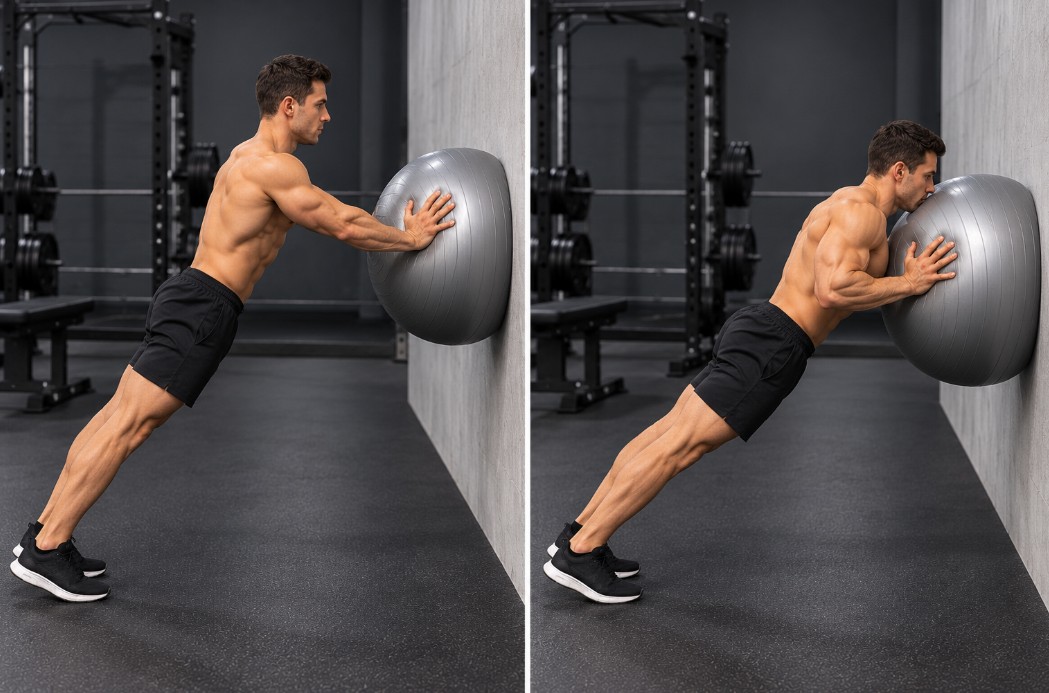
Placing the ball against a wall prevents it from rolling forward, which makes the exercise much easier to control. It is an ideal starting point for lifters new to unstable-surface training.
BOSU ball push-ups
Difficulty: Easier than the standard version

With a BOSU balance trainer flipped dome-side down, you can grip the edges of the platform and perform push-ups with your hands closer to the floor. The platform is more stable than a Swiss ball, which many lifters find easier to control.
Swiss ball push-up plus
Difficulty: Similar to the standard version

At the top of each push-up, push slightly further to spread your shoulder blades apart before lowering again. This extra movement targets the serratus anterior and helps develop better control of the shoulder blades.
Feet-on-ball push-ups
Difficulty: Harder than the standard version

Placing your feet on the ball and your hands on the floor turns the exercise into a decline push-up with added instability. The higher foot position increases the load on your arms, while the ball challenges your core.
Feet-elevated Swiss ball push-ups
Difficulty: Harder than the standard version

With your hands on the ball and your feet on a bench of about the same height, more of your body weight shifts onto your arms. Start with a few clean reps and add one or two reps per week as long as your form stays perfect.
One-leg feet-elevated Swiss ball push-ups
Difficulty: Harder than the standard version

Once you have mastered the feet-elevated version, lift one foot off the bench (or a Swiss ball) while keeping the leg straight. This reduces your base of support and makes the exercise very demanding for the core and shoulders.
Replacement Exercises (Substitutes) for Swiss Ball Push-Ups
If you don’t have a stability ball or want to vary your training, these exercises train the same horizontal pressing pattern in different ways. You can find more options in our list of the most effective middle chest exercises.
- Deficit push-ups. Deficit push-ups increase range of motion by elevating your hands on stable surfaces. They place more stretch on the chest than Swiss ball push-ups.
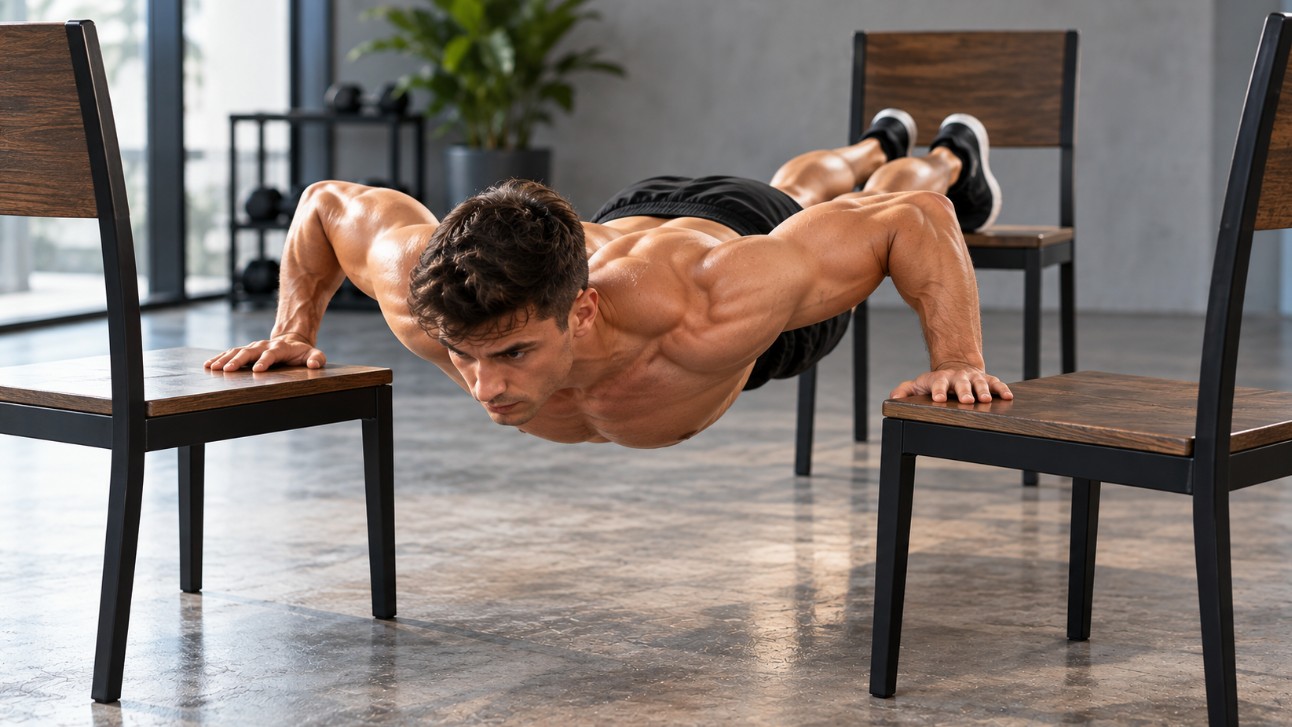
- One-arm push-ups. One-arm push-ups combine a high load on the working arm with a strong anti-rotation challenge for the core. They are an advanced alternative for building stability and strength.

- Resistance band push-ups. Band push-ups add resistance that increases toward the top of the movement. They are a simple way to overload the push-up at home.

- Incline push-ups. Incline push-ups place the hands on a stable elevated surface. They offer a similar hand height without the stability challenge, making them a good regression.

- Stability ball dumbbell fly. The stability ball dumbbell fly trains the chest through horizontal adduction while the ball supports your upper back. It combines chest isolation with a core challenge.

- Flat bench dumbbell press. The dumbbell bench press allows you to load the chest progressively and is more effective than Swiss ball push-ups for building chest size.

How to Program Swiss Ball Push-Ups
How you program Swiss ball push-ups depends on whether your main focus is stability, strength, or muscular endurance.
Show full programming guideHide programming guide ▾
| Goal | Sets | Reps | Rest | Tempo |
|---|---|---|---|---|
| Stability & control | 2–3 | 6–10 | 60–90 s | Slow, 3 s lowering |
| Strength & hypertrophy | 3–4 | 8–15 | 60–90 s | 2–3 s lowering, controlled press |
| Muscular endurance | 2–3 | 15–25 | 30–60 s | Steady, continuous |
Muscle growth can occur across a wide range of repetitions when sets are taken close to failure, so treat these numbers as guidelines rather than strict rules. Adjust your rest periods between sets based on how recovered you feel.
- In home workouts and bodyweight programs as a more challenging push-up variation
- Early in a session as a combined pressing and core stability exercise
- After heavy pressing as a lighter, stability-focused finisher
- In circuits alongside other balance training exercises
Apply progressive overload by gradually making the setup harder: move the ball away from the wall, narrow your stance, slow the lowering phase, and then elevate your feet on a bench. Once that becomes easy, try lifting one foot off the bench for part of each set.
Swiss Ball Push-Ups vs Standard Push-Ups (Comparison Table)
| Criteria | Swiss Ball Push-Ups | Standard Push-Ups |
|---|---|---|
| Hand Surface | Unstable ball | Stable floor |
| Hand Height | Elevated | Floor level |
| Load on the Arms | Lower (hands elevated) | About 64% of body weight |
| Stability Demand | High | Moderate |
| Triceps and Core Activation | Higher than on a stable surface | Moderate |
| Equipment | Swiss ball | None |
| Best For | Stability, triceps, and core training | Chest strength, volume, all levels |
Standard push-ups remain the more effective choice for building chest strength with body weight. They put more body weight on the arms and require no equipment. If you can’t yet perform them with good form, our guide to your first push-up will help you get there.
Swiss ball push-ups add a stability challenge that increases triceps and core involvement, which makes them a useful variation once standard push-ups become routine. Many lifters include both in their training, using standard push-ups for strength and Swiss ball push-ups for variety and control.
Final Thoughts
Swiss ball push-ups are a simple way to make push-ups more challenging and more interesting. The unstable surface forces your triceps and core to work harder, while teaching you to control your body on a moving base.
Just remember what they are and what they aren’t: a stability-focused push-up variation, not a superior chest builder. Use a quality ball, start against a wall, keep your body in a straight line, and progress gradually to the more advanced variations.
Frequently Asked Questions
What do Swiss ball push-ups work?
Swiss ball push-ups work the pectoralis major, triceps brachii, and anterior deltoids. Compared with push-ups on a stable surface of the same height, research has shown noticeably higher activation of the triceps and rectus abdominis.
Are Swiss ball push-ups harder than regular push-ups?
They are harder in terms of balance and stability, but the elevated hand position actually reduces the share of body weight your arms must press compared with floor push-ups. The difficulty comes mainly from controlling the ball.
Do Swiss ball push-ups build more chest than regular push-ups?
Not necessarily. In one study, chest activation did not change significantly when the hands were placed on a Swiss ball instead of a stable bench. Swiss ball push-ups are better viewed as a stability and triceps-focused variation.
What size Swiss ball should I use for push-ups?
Most lifters start with a 55–65 cm ball, fully inflated. A smaller ball lowers your hands and increases the load on your arms, while a larger ball makes the push-up easier.
How do I stop the ball from rolling?
Place the ball against a wall while you learn the movement, use a fully inflated ball, and press your palms firmly inward against its sides. Dry hands also help prevent slipping.
How low should I go on Swiss ball push-ups?
Lower yourself until your chest lightly touches the ball, or as far as you can while staying in control. Keep your body in a straight line throughout.
Are Swiss ball push-ups good for beginners?
They are better suited to lifters who can already perform 10–15 good floor push-ups. Beginners can start with the ball against a wall or try BOSU push-ups first.
What is the difference between Swiss ball and BOSU push-ups?
On a BOSU ball, the hands are closer to the floor and the platform is more stable, which many lifters find easier to control. The Swiss ball is less stable and places the hands higher.
Can I do Swiss ball push-ups with my feet on the ball instead?
Yes. Placing your feet on the ball and hands on the floor creates a decline push-up with added instability. It increases the load on your arms and challenges your core in a different way.
Are Swiss ball push-ups safe?
Yes, when performed with a quality, burst-resistant ball and good control. Avoid underinflated or damaged balls, and stop if your hands begin to slip.
