


Introduction
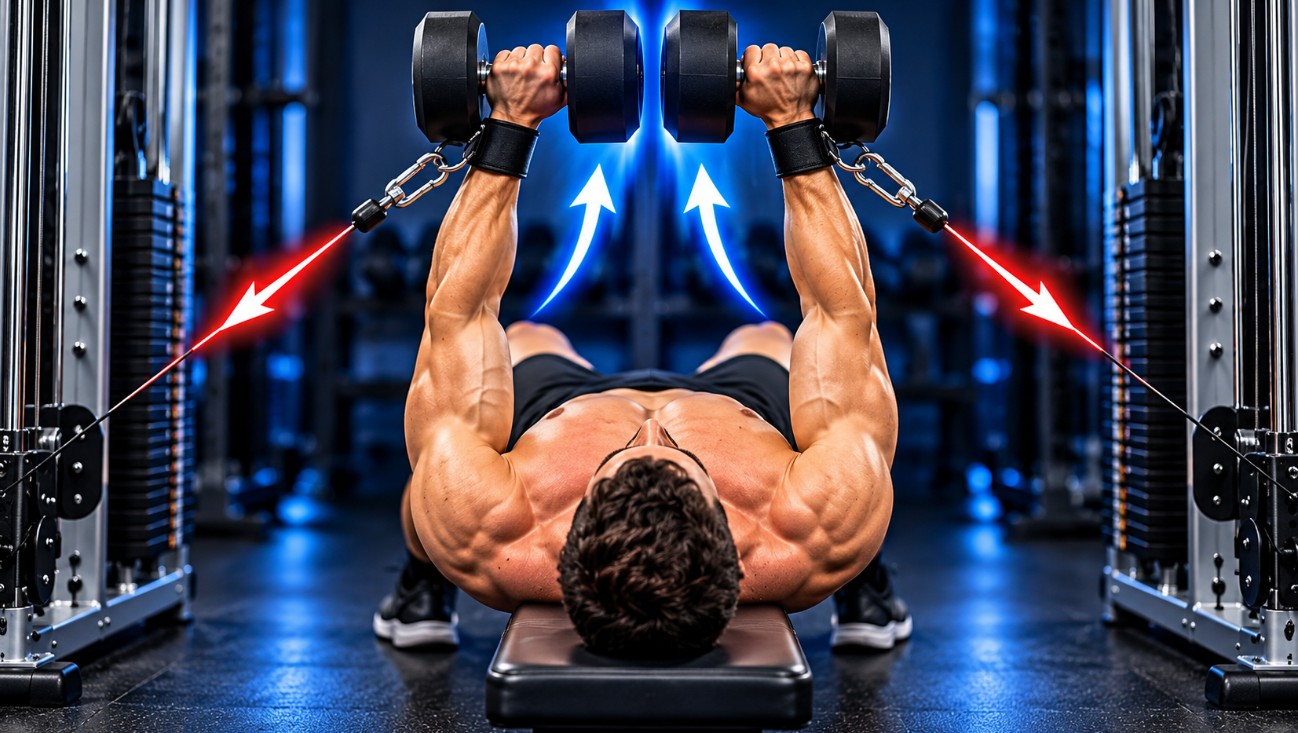
The dumbbell cable press is a hybrid chest exercise that combines two forms of resistance, cables and free weights, in a single movement. You perform a regular flat bench dumbbell press between the columns of a cable crossover machine, but with the low pulleys attached to your wrists by straps.
The idea is simple. During a conventional dumbbell press, the external moment arm at the shoulder generally decreases as the dumbbells move toward a position above the shoulder joints. As a result, the mechanical demand on the pectorals from the dumbbells becomes relatively low near the top. The cables change that by pulling your arms outward throughout the set, so the chest must keep resisting that pull, much like in a flat bench cable fly.
The result is a press and a fly blended into one movement, with the cables helping to maintain chest tension near the top. It is not the same as the standing cable chest press, which uses only cable handles. The setup takes a little patience, but for intermediate and advanced lifters, the dumbbell cable press is a great way to add variety and extra top-end tension.
The dumbbell cable press is a hybrid chest exercise in which a flat dumbbell bench press is performed between the columns of a cable crossover machine, with the low pulleys attached to the wrists via straps. The dumbbells provide vertical resistance, while the cables pull the arms outward, so the pectoralis major must press the weights up and pull the arms toward the midline at the same time, with the anterior deltoids and triceps brachii assisting.
Other Names for Dumbbell Cable Press
Because it is a less common exercise, the dumbbell cable press appears under several descriptive names.
- Cable-resisted dumbbell press
- Dumbbell press with cables
- Hybrid dumbbell cable press
- Dumbbell press-fly hybrid
- Band-resisted dumbbell press (home version)
Required Equipment
This exercise requires more equipment than most chest movements, so make sure everything is available before you start. Make sure the two straps fit securely around your wrists before adding any weight.
- Cable crossover machine with two low pulleys
- Two ankle straps or wrist cuffs to attach the cables to your wrists
- A pair of light to moderate dumbbells
- A flat bench placed in the center between the pulleys
How to Perform Dumbbell Cable Press
The dumbbell cable press requires more setup than a regular dumbbell press, so follow a consistent routine every time.
Starting Position
Prepare everything before you pick up the dumbbells, so you don’t have to fight the cables while getting into position.
- Set both pulleys to the lowest position and select a light weight on each stack
- Place a flat bench in the center, with your chest in line with the pulleys
- Sit on the bench, fasten the straps to your wrists, and clip them to the cables
- Pick up the dumbbells and lie back on the bench
- Hold the dumbbells at the sides of your chest with a pronated or neutral grip
- Plant your feet, squeeze your shoulder blades together, and keep your forearms vertical

Execution (Action Phase)
Perform the press like a standard dumbbell press, but finish each rep with an inward movement against the pull of the cables.
- Take a breath and brace your core (see our guide on breathing technique)
- Press the dumbbells up and slightly in, finishing with them close together over your mid-chest
- Exhale as you press and squeeze your chest at the top
- Lower the dumbbells slowly to the sides of your chest while resisting the pull of the cables
- Keep your elbows at about 45–60 degrees from your torso
- Stop when you feel a comfortable stretch in your chest, then press again
At the end of the set, bring the dumbbells to your chest, sit up, and set them down before unclipping the straps.
Video Demonstration
Watching the dumbbell cable press helps you understand how the press and inward pull combine into one smooth movement.
In the video below, notice how the lifter presses the dumbbells up and slightly inward, finishing with the weights close together over the chest. On the way down, the arms lower under control, resisting the cables pulling them outward, and the forearms stay vertical throughout the set.

The first attempt at the dumbbell cable press rarely looks like an exercise. It looks more like an octopus trying to get dressed: straps on the wrists, cables in the way, a dumbbell in each hand, and a bench that somehow always ends up in the wrong place. I have seen clients spend longer setting it up than actually performing the set.
My advice is to follow the same routine every time. Set both pulleys to the lowest position with a light weight, place the dumbbells at the end of the bench, sit down, fasten the straps to your wrists, and clip them to the cables. Only then pick up the dumbbells and lie back. At the end of the set, reverse the order. If you have a training partner, let them hand you the dumbbells. It turns a juggling act into a calm, controlled setup.
Quick Form Checklist
Run through these cues before every set to keep the exercise safe and effective.
- Pulleys at the lowest position with light weight
- Bench centered between the pulleys
- Forearms vertical under the dumbbells
- Elbows moderately tucked (about 45–60 degrees)
- Press up and in, lower under control
Technical Emphasis & Targeting Adjustments
Adjusting the balance between cable and dumbbell resistance, the grip, and the tempo changes how the exercise loads the chest.
- Heavier cables → greater horizontal-adduction demand. Increasing the cable load increases the outward resistance acting on the arms, requiring greater horizontal-adduction force from the chest. The movement therefore takes on more of the loading characteristics associated with a cable fly while remaining a pressing exercise.
- Lighter cables → more press-dominant loading. With only light cable tension, the exercise behaves more like a regular dumbbell press with a small inward challenge. This is the best starting point while learning the movement.
- Neutral grip → may feel more comfortable for some lifters. A neutral grip often allows the elbows to stay somewhat closer to the torso and may feel more comfortable for some lifters, particularly when resisting the outward cable pull.
- Slower eccentric → more control and tension. Lowering the dumbbells over 2–3 seconds while resisting the cables keeps the chest under tension throughout the rep. Learn more about eccentric training and why the lowering phase matters.
- Squeeze at the top → emphasizes the shortened position. Briefly bringing the dumbbells together at the top while resisting the outward cable pull emphasizes active horizontal adduction in the shortened position.
Common Mistakes
Most mistakes with this exercise come from too much cable weight or a rushed setup. Several of them also apply to regular pressing, as our list of bench press mistakes shows.
- Using too much cable weight. Heavy cables yank the arms outward at the bottom and turn the exercise into an unstable fly. Start with the lightest plate or two and increase the load only when you can fully control the movement.
- Forcing the elbows into an extreme flare. Letting the cables drag the elbows far out to the sides makes the movement harder to control, and many lifters then feel their shoulders more than their chest. A moderately tucked position around 45–60 degrees from the torso is a practical starting point, but the most comfortable angle depends on your grip, anatomy, and cable setup.
- Letting the cables pull the arms down. Losing control on the way down allows the cables to drag the arms into an overstretched position. Lower the dumbbells slowly and stop at a comfortable stretch.
- Dumbbells drifting toward the head. Letting the weights travel back over the face shifts the load onto the shoulders. Keep the dumbbells moving over your mid-chest.
- Getting into position in the wrong order. Lying down first and then trying to attach the cables or pick up the dumbbells puts the shoulders in awkward positions. Always strap in while seated, then pick up the dumbbells and lie back.
Think of every rep as “press up and in”, not just “press up.” The cables are constantly trying to pull your arms apart, so finish each rep by bringing the dumbbells together over the middle of your chest, as if a dumbbell press and a fly were blended into one movement.
If you press the dumbbells straight up and stop there, the cables do little more than make the weights feel awkward. The inward finish is what forces the chest to fight the cables, and it is the part of the rep where this exercise gives you something a regular dumbbell press cannot.
Mechanical Considerations
Research shows substantial pectoralis major involvement during dumbbell pressing, comparable to barbell pressing. From a mechanical standpoint, however, the external shoulder moment created by the dumbbells decreases as they move closer to a position directly above the shoulder joints. A similar mechanical limitation exists in the dumbbell fly: as the dumbbells move above the shoulders, the external moment arm decreases. Research comparing dumbbell flyes with the barbell bench press has also reported lower overall pectoralis activation during the fly, although this study did not establish the changing moment arm as the cause.
The cables solve this by adding a horizontal force that pulls the arms outward. To resist it, the chest must perform horizontal adduction throughout the rep, including at the top, which you can read more about in our guide to anatomical movements. Research on combined free-weight and elastic resistance shows that hybrid resistance can be used successfully in strength training. However, those studies applied the additional resistance along a different force vector and therefore cannot be used as direct evidence for the dumbbell cable press. No study has yet examined the dumbbell cable press directly, so its benefits rest on biomechanical reasoning rather than direct evidence. As a compound exercise, it trains the chest, front delts, and triceps together.
Muscles Worked in Dumbbell Cable Press
MAIN MUSCLES
SECONDARY MUSCLES
STABILIZERS
ANTAGONISTS
Dumbbell Cable Press Pros and Cons
The dumbbell cable press is a creative and effective exercise, but its complexity means it is not for everyone.
Advantages
- Maintained chest tension near the top. The cables add an outward force the chest must resist near the top of the press, where the mechanical demand from the dumbbells alone becomes relatively small. This makes each rep more demanding with lighter weights.
- Press and fly in one movement. The exercise combines pressing and horizontal adduction, two of the chest’s main functions. It is a time-efficient option when you can’t fit both a press and a fly into your workout.
- Effective with moderate loads. The combined resistance makes moderate dumbbells feel much heavier. This allows you to create a challenging chest exercise without relying on very heavy dumbbells.
- Adds variety. For experienced lifters, the novel resistance profile is a great way to break up long periods of standard pressing.
Potential Drawbacks
- Complex setup. Straps, cables, dumbbells, and a bench must all be arranged correctly. In a busy gym, this can be impractical.
- High stability demand. The combination of vertical and horizontal resistance makes the dumbbells harder to control. Beginners should master the regular dumbbell press first.
- Harder to track progress. With two sources of resistance, it is less obvious how to increase the load. Changing only one variable at a time is essential.
- Limited research. The exercise has not been studied directly. Its benefits are based on biomechanics and practical experience rather than specific scientific data.
Safety Considerations
A review of resistance-training injuries reported that the shoulder complex accounted for up to 36% of documented injuries and disorders, although much of the available evidence was retrospective. Because the cables pull the arms outward, a few extra precautions apply.
- Shoulder instability or pain. The outward cable pull adds an additional demand that must be controlled at the shoulder, particularly in the bottom position. Keep cable resistance modest, use only a comfortable depth, and learn more about shoulder joint anatomy.
- Previous pectoral strain. Lifters recovering from a pectoral strain should avoid this exercise until a medical professional clears them, as the combined resistance loads the chest in a stretched position.
- Wrist straps and wrist comfort. Straps that are too loose can slip, while straps that are too tight can pinch the skin or restrict circulation. Keep the wrists straight to avoid aggravating wrist injuries.
- Getting into and out of position. Never lie down or sit up while the cables are pulling your arms back. Follow the same setup routine every time and bring the dumbbells to your chest before moving.
Dumbbell Cable Press Variations
Band-resisted dumbbell press
Difficulty: Similar to the standard version
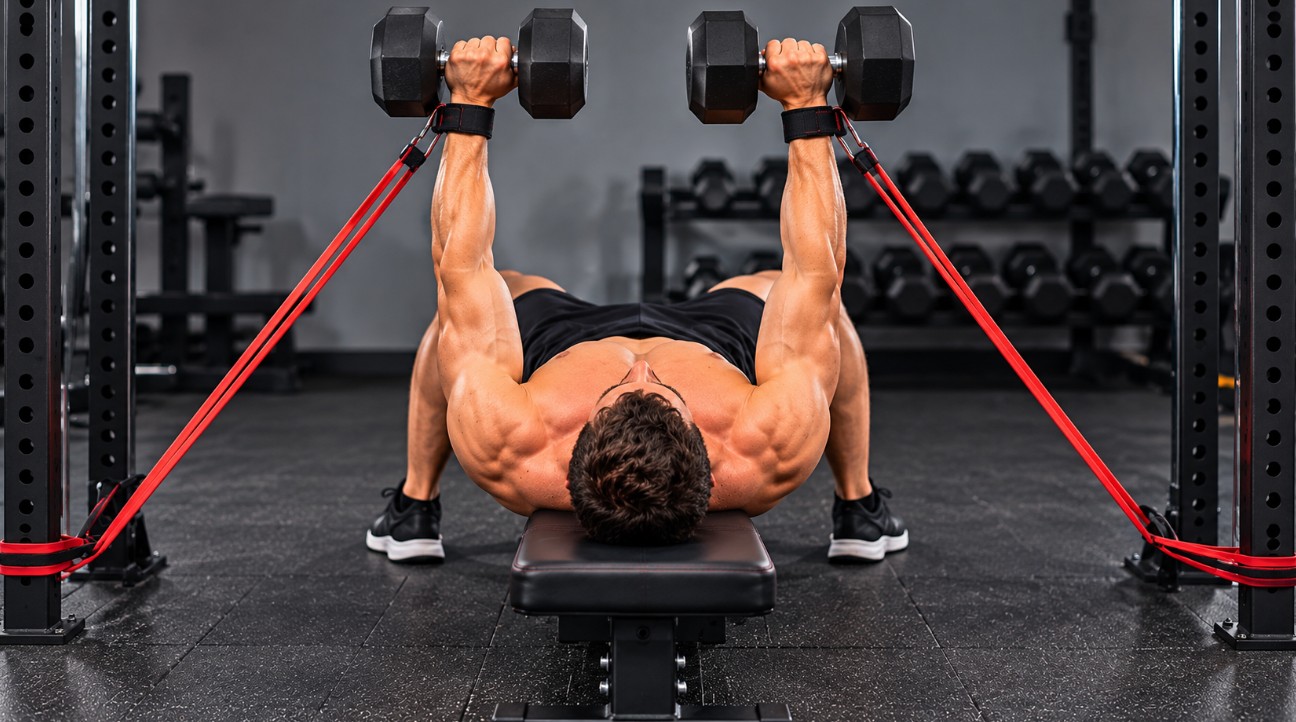
Instead of cables, anchor two resistance bands low on either side of the bench and loop them around your wrists. The bands can create a similar outward resistance component, although the resistance profile differs because band tension increases as the bands stretch. It is a practical version for home gyms.
Incline dumbbell cable press
Difficulty: Similar to the standard version

Performing the exercise on a bench set to about 30 degrees shifts more emphasis onto the upper chest. It combines the benefits of the hybrid resistance with the upper chest focus of the incline dumbbell bench press. Start with slightly lighter cable resistance while learning the altered pressing angle and cable line of pull.
Neutral-grip dumbbell cable press
Difficulty: Easier than the standard version

Holding the dumbbells with your palms facing each other usually keeps your elbows closer to your body. This may feel more comfortable at the shoulders for some lifters and can make the outward cable pull easier to control, which is useful while learning the exercise.
Single-arm dumbbell cable press
Difficulty: Harder than the standard version

Pressing one dumbbell at a time with a single cable attached to the working arm lets you focus fully on each side of the chest. The asymmetrical load also challenges the core to keep the body stable on the bench.
Paused dumbbell cable press
Difficulty: Harder than the standard version
Holding the dumbbells together over your chest for 2–3 seconds at the top of each rep, while the cables pull outward, creates a long isometric contraction of the chest. Use slightly lighter weights and focus on keeping the dumbbells completely still.
Replacement Exercises (Substitutes) for the Dumbbell Cable Press
If you don’t have access to a cable crossover or want a simpler option, these exercises also provide tension near the top or combine pressing with horizontal adduction. You can find more options in our list of the most effective middle chest exercises.
- Flat bench dumbbell press. The regular dumbbell press is simpler to set up and allows heavier loads. Combined with a fly in the same workout, it covers both parts of the hybrid movement.

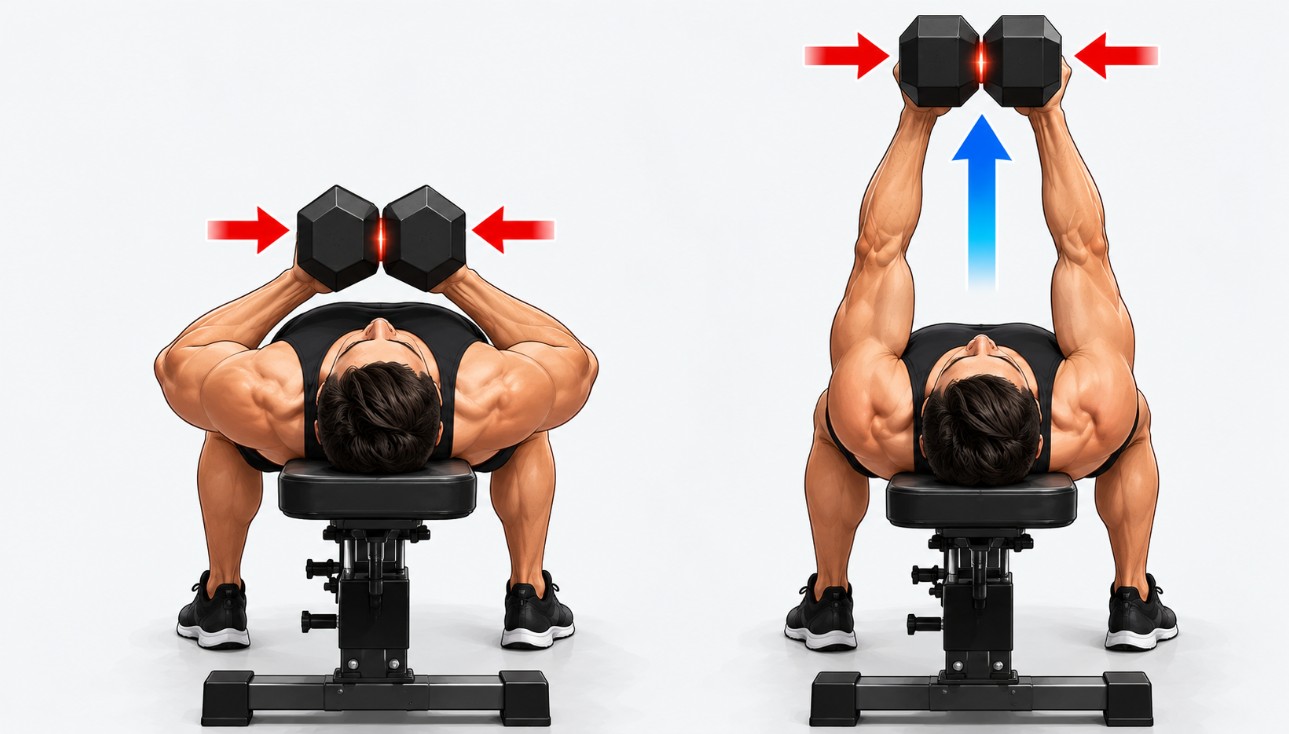
- Dumbbell squeeze press. The dumbbell squeeze press keeps tension on the chest by squeezing the dumbbells together throughout the set. It requires no cables or straps.
- Flat bench cable fly. The flat bench cable fly trains the chest through horizontal adduction with constant cable tension. It pairs well with a regular dumbbell press as a superset.

- Resistance band push-ups. Band push-ups add resistance that increases toward the top of the movement. They are a simple way to overload the lockout at home.

- Seated machine chest press. The seated machine chest press provides guided, consistent resistance and is easy to set up. It is a good option for high-effort sets without stability demands.
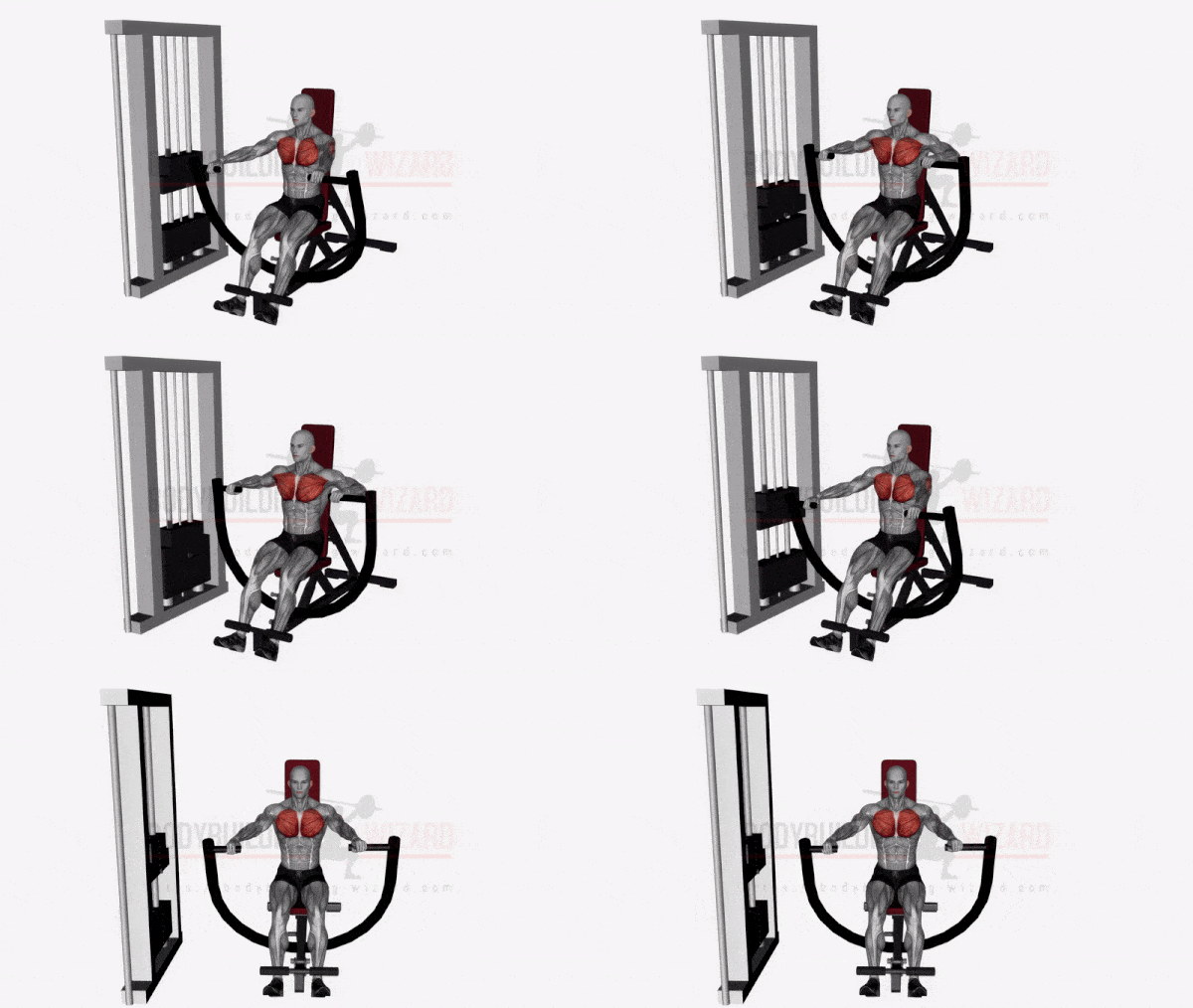
- Hammer Strength bench press. The Hammer Strength bench press follows a converging arc, combining pressing with some inward movement. It lets you load heavy while following a guided path.

How to Program the Dumbbell Cable Press
How you program the dumbbell cable press depends on your training goal, experience level, and where it fits in your chest workout.
Show full programming guideHide programming guide ▾
| Goal | Sets | Reps | Rest | Tempo |
|---|---|---|---|---|
| Hypertrophy | 3–4 | 8–12 | 60–90 s | 2–3 s lowering, press up and in |
| Strength-focused | 3–4 | 6–8 | 90–120 s | Controlled lowering, forceful press |
| Muscular endurance | 2–3 | 15–20 | 30–60 s | Steady, continuous tension |
Muscle growth can occur across a wide range of repetitions when sets are taken close to failure, so treat these numbers as guidelines rather than strict rules. Adjust your rest periods between sets based on how recovered you feel.
- As a second chest exercise after heavy barbell or dumbbell presses
- As a way to add variety to chest training once standard presses become stale
- In place of separate press and fly exercises when training time is limited
- In home workouts with resistance bands replacing the cables
Apply progressive overload by changing only one variable at a time: first increase the dumbbell weight while keeping the cable load constant, then add a plate to the cable stacks once you reach the top of your rep range again. Keep the cable load light enough that you can always control the arms at the bottom of the movement.
Dumbbell Cable Press vs Dumbbell Bench Press (Comparison Table)

| Criteria | Dumbbell Cable Press | Dumbbell Bench Press |
|---|---|---|
| Resistance Sources | Dumbbells + cables | Dumbbells |
| Vertical Resistance | Yes | Yes |
| Additional Outward Resistance | Yes | No |
| Chest Demand Near the Top | Maintained by cable component | Reduced as dumbbells approach shoulders |
| Horizontal-Adduction Challenge | Additional cable-resisted component | Produced against dumbbell loading |
| Typical Dumbbell Load | Lighter | Heavier |
| Stability Demand | Higher | Moderate |
| Setup | Complex | Simple |
| Progression Tracking | More complex | Simple |
| Best Use | Secondary hypertrophy/variation | Primary dumbbell press |
The regular dumbbell bench press remains the foundation of dumbbell chest training. For most lifters, I would use the regular dumbbell bench press as the primary dumbbell chest exercise because it is easier to set up, load progressively, and standardize from workout to workout.
The dumbbell cable press adds something the regular version lacks: an outward cable force that maintains an additional horizontal-adduction challenge near the top of the press. It works best as a secondary exercise for experienced lifters who want more variety. For a broader discussion of combining equipment types, see our article on free weights vs. machines.
Final Thoughts
The dumbbell cable press is a creative way to modify the resistance profile of the traditional dumbbell press. By adding an outward cable force at the wrists, the exercise adds a horizontal-adduction challenge near the top of the press, where the mechanical demand from the dumbbells alone becomes relatively small.
It takes some patience to set up, and it is not the right choice for beginners, but for experienced lifters it can bring new life to chest training. Keep the cable load light, keep your elbows tucked, and press up and in on every rep. If you prefer a simpler way to train the chest with cables, the standing cable crossover is an excellent alternative.
What is the dumbbell cable press?
The dumbbell cable press is a hybrid chest exercise that combines a flat dumbbell bench press with cables attached to the wrists. The dumbbells provide vertical resistance, while the low cables pull the arms outward, turning the press into a combination of a press and a fly.
Is the dumbbell cable press the same as the standing cable chest press?
No. The standing cable chest press is performed standing, using only cable handles. The dumbbell cable press is performed lying on a bench with dumbbells, with the cables attached to the wrists as an additional source of resistance.
What muscles does the dumbbell cable press work?
The exercise primarily targets the pectoralis major, with the anterior deltoids and triceps assisting the press. The rotator cuff and serratus anterior work hard to stabilize the shoulders against the combined resistance.
What equipment do I need for the dumbbell cable press?
You need a cable crossover machine, a flat bench, a pair of dumbbells, and two ankle or wrist straps to attach the cables to your wrists. At home, resistance bands anchored low on both sides can replace the cables.
How heavy should the cables be?
Start with the lightest plate or two on each stack. The cables should add noticeable inward tension without pulling your arms out of position at the bottom of the rep.
Is the dumbbell cable press better than the regular dumbbell press?
It is not strictly better. It maintains an additional chest-loading demand near the top, where the dumbbells alone provide relatively little. The regular dumbbell press is simpler, easier to load progressively, and remains a better primary exercise for most lifters.
Should I flare my elbows during the dumbbell cable press?
Avoid forcing the elbows into an extreme flare. A moderately tucked position around 45–60 degrees from the torso is a practical starting point, but the most comfortable angle depends on your grip, anatomy, and cable setup.
Can I do the dumbbell cable press at home?
Yes. Anchor two resistance bands low on either side of the bench and loop them around your wrists. The bands create a similar outward pull, although their resistance increases as they stretch, so the loading profile differs from cables.
Where should I place the bench?
Place the bench in the center between the two pulleys, so your chest lines up with the line connecting them. This ensures the cables pull straight out to the sides.
Is the dumbbell cable press good for beginners?
It is better suited for intermediate and advanced lifters. The complex setup and high stability demands make it difficult to perform safely before you have mastered the regular dumbbell bench press.

