



Introduction
The stability ball dumbbell fly is a variation of the classic flat bench dumbbell fly performed with your upper back and head resting on a stability (Swiss) ball instead of a bench. Your hips are lifted into a bridge position, your feet are planted on the floor, and the fly itself follows the same wide, hugging arc as the bench version.
The ball changes the exercise in one important way: the bench no longer holds your body in place. Your glutes have to keep your hips up, and your trunk has to stop the ball from rolling while your arms move. That makes the stability ball fly a useful option for home workouts without a bench and an interesting variation for lifters who want to combine chest isolation with some hip and trunk control.
It is often promoted as a “balance exercise disguised as a strength exercise,” but research on similar exercises shows that the ball doesn’t automatically make the chest work harder or turn the movement into a core workout. Understanding what the ball actually adds will help you use the exercise for the right reasons.
The stability ball dumbbell fly is a chest isolation exercise performed lying with the upper back and head supported on a stability (Swiss) ball, with the hips lifted into a bridge position and the feet on the floor. The dumbbells are lowered out to the sides in a wide arc with slightly bent elbows and brought back together over the chest, training the pectoralis major through horizontal adduction, while the glutes and trunk muscles hold the body in position.
Other Names for Stability Ball Dumbbell Fly
The exercise goes by several names, depending on what your gym calls the ball.
- Swiss ball dumbbell fly
- Exercise ball chest fly
- Stability ball chest fly
- Physio ball dumbbell fly
- Ball bridge dumbbell fly
Required Equipment
All you need are two simple pieces of equipment, which makes this a practical exercise for home training. You can read more about balls and similar tools in our overview of balance training equipment.
- A burst-resistant stability ball, usually 55–65 cm in diameter
- A pair of light to moderate dumbbells
- A non-slip floor or exercise mat
How to Perform Stability Ball Dumbbell Fly
Safe setup is the most important part of this exercise, so follow the same routine every time.
Starting Position
Start seated on the ball with the dumbbells resting on your thighs, then roll into position.
- Walk your feet forward slowly and roll down until your upper back and head rest on the ball
- Place your feet flat on the floor, about shoulder-width apart, with your knees bent at roughly 90 degrees
- Lift your hips so they form a straight line with your knees and shoulders
- Press the dumbbells up over your chest with your palms facing each other
- Bend your elbows slightly, to roughly 150 degrees between the upper arm and forearm
- Brace your abs and squeeze your glutes to keep the position stable

Execution (Action Phase)
Move the dumbbells in a smooth arc while keeping your hips and elbow angle completely fixed.
- Inhale and lower the dumbbells out to the sides in a wide arc (see our guide on breathing technique)
- Keep the elbow angle fixed throughout the movement
- Stop when your wrists are about level with your shoulders, and you feel a stretch in your chest
- Exhale and bring the dumbbells back together over your chest in the same arc
- Squeeze your chest briefly at the top without letting the dumbbells clash
- Keep your hips level and the ball still throughout the set
If you bend and straighten your elbows during the movement, the exercise turns into a press, and the triceps take over. Keep the arms locked in the same slightly bent position from start to finish.
Video Demonstration
Watching the stability ball dumbbell fly helps you see how the hips stay up, and the elbow angle stays constant throughout the set.
In the video below, notice how the lifter keeps the upper back and head supported on the ball, holds the hips level with the knees and shoulders, and lowers the dumbbells slowly until the wrists reach shoulder level. The ball barely moves, and the dumbbells return to the top in the same smooth arc.

The trickiest part of the stability ball dumbbell fly is not the fly itself, it is getting onto the ball with a dumbbell in each hand. I have watched clients sit on the ball, start rolling down, realize halfway that the dumbbells are pulling their arms in two different directions, and end up in a slow-motion slide that ends on the floor next to the ball. Graceful? Not really. Memorable? Absolutely.
My setup routine is simple: sit on the ball with the dumbbells resting on your thighs, then walk your feet forward slowly while rolling down until your upper back and head rest on the ball. Only then press the dumbbells up over your chest and start the set. At the end, reverse the process. And keep the dumbbells lighter than on the bench version, because here the ball, not the weight, is the first thing you have to control.
Quick Form Checklist
Run through these cues before every set to stay stable and in control.
- Upper back and head supported on the ball
- Hips level with knees and shoulders
- Fixed, slightly bent elbows
- Wrists lowered to about shoulder level
- Ball kept still throughout the set
Technical Emphasis & Targeting Adjustments
Small adjustments to your stance, tempo, and range of motion change how the stability ball dumbbell fly feels.
- Wider stance → more stability. Placing your feet wider apart creates a larger base of support and makes the ball easier to control. It is the best starting point for this exercise.
- Narrower stance → more balance demand. Bringing your feet closer together reduces your base of support and makes it harder to keep the ball still. Use lighter dumbbells when you narrow your stance.
- Slower eccentric → more control and tension. Lowering the dumbbells over 2–3 seconds keeps the chest working throughout the rep and makes it easier to stay balanced. Learn more about eccentric training.
- Brief squeeze at the top → more time under tension. Holding the dumbbells together over the chest for a second increases time under tension in the shortened position, where the dumbbell fly normally provides very little resistance.
- Controlled depth → safer shoulders. Stopping when your wrists reach shoulder level keeps the chest stretched. Lowering further mainly increases stress on the front of the shoulder.
Common Mistakes
Most mistakes in this exercise come from losing the bridge position or treating the fly like a press.
- Letting the hips sag. When the hips drop, the ball shifts and the position becomes unstable. Squeeze your glutes and keep your hips level with your knees and shoulders, as in a glute bridge.
- Letting the head hang off the ball. An unsupported head places unnecessary strain on the neck. Rest your upper back and head on the ball throughout the set.
- Bending and straightening the elbows. Changing the elbow angle turns the fly into a press and shifts the work to the triceps. Keep the same slight bend in your elbows on every rep.
- Using dumbbells that are too heavy. Heavy dumbbells make the ball harder to control and increase the stress on the shoulders in the stretched position. Use lighter weights than on the flat bench fly.
- Lowering the dumbbells too far. Letting the arms drop well below shoulder level overstretches the front of the shoulder. Stop when your wrists reach shoulder level.
Before you even pick up the dumbbells, practice the bridge position on the ball for 20–30 seconds: upper back and head on the ball, hips level with your knees and shoulders, and knees bent at about 90 degrees. Squeeze your glutes and notice how stable the position feels.
If your hips start to sag or the ball drifts during this short hold, the position is not yet solid enough to add weights. Once you can hold it steadily, the fly itself becomes much easier to control, and the chest, not the ball, becomes the focus of every rep.
Mechanical Considerations
The stability ball dumbbell fly consists of shoulder horizontal adduction, the same joint action as any fly, which you can read more about in our guide to anatomical movements. As with all dumbbell flyes, the resistance depends on gravity: the load on the chest is greatest when the arms are open and decreases as the dumbbells move above the shoulders. Research comparing dumbbell flyes with the bench press has reported lower overall pectoralis activation during the fly, which reflects the limited resistance near the top of the movement.
The ball adds a stability demand, but its effect on the working muscles is smaller than many people assume. A study on the barbell chest press found no difference in maximal strength or muscle activation between a stable bench and a Swiss ball, and another study found that replacing a bench with a Swiss ball did not consistently increase trunk muscle activity during upper-body exercises. No study has directly examined the stability ball dumbbell fly. The exercise clearly requires holding a bridge position with the glutes and trunk while the arms move. As an isolation exercise, it trains the chest without significant triceps involvement.
Muscles Worked in Stability Ball Dumbbell Fly
MAIN MUSCLES
SECONDARY MUSCLES
- Anterior deltoid
- Biceps brachii (short head)
- Coracobrachialis
STABILIZERS
ANTAGONISTS
Stability Ball Dumbbell Fly Pros and Cons
The stability ball dumbbell fly is a practical and versatile exercise, but it has clear limitations as well.
Advantages
- No bench required. A stability ball and a pair of dumbbells are all you need. This makes it an easy way to train chest isolation at home.
- Adds hip and trunk control. Holding the bridge position requires the glutes and trunk to work throughout the set. The exercise combines chest work with some lower-body and trunk involvement.
- Natural range of motion. Without a bench under the shoulder blades, the shoulders can move freely. Many lifters find the movement comfortable when they control the depth.
- Adds variety. For lifters who have mastered the bench version, the ball offers a new challenge without changing the basic movement pattern.
Potential Drawbacks
- Lower loads than the bench version. The need to stay balanced limits how much weight you can use safely. This makes the exercise less suitable for heavy, progressive overload.
- No proven extra benefit for the chest. Research on chest presses has found similar chest activation on a ball and a bench. The ball does not make the chest work harder by itself.
- Not a replacement for core training. Trunk muscle activity does not increase consistently when a ball replaces a bench. Dedicated core exercises are more effective.
- Tricky setup. Rolling onto the ball with dumbbells in your hands takes practice and can be unsafe if rushed.
Safety Considerations
The stability ball dumbbell fly is safe when performed with light weights and a controlled setup, but a few precautions apply.
- Ball slipping or bursting. A ball that rolls away or fails under load can cause a fall with dumbbells in your hands. Use a burst-resistant ball, keep it fully inflated, and train on a non-slip surface.
- Neck strain. Letting the head hang off the ball strains the neck muscles. Keep your head supported, and read more about the muscles of the neck.
- Shoulder discomfort. The stretched position of the fly loads the front of the shoulder. Keep the depth controlled and learn more about shoulder joint anatomy.
- Chest and biceps tendon issues. Lifters recovering from a pectoral strain or dealing with biceps tendonitis should use very light weights and a reduced range of motion.
Stability Ball Dumbbell Fly Variations
Feet on BOSU stability ball fly
Difficulty: Harder than the standard version

Placing your feet on the soft dome of a BOSU balance trainer makes your base less stable and increases the demand on your hips and trunk. To make it even harder, flip the BOSU over and place your feet on the flat platform.
Narrow-stance stability ball fly
Difficulty: Harder than the standard version

Bringing your feet close together reduces your base of support and makes the ball harder to control. This is the simplest way to increase the balance challenge without any extra equipment.
Single-arm stability ball fly
Difficulty: Harder than the standard version

Performing the fly with one arm at a time creates an uneven load that tries to rotate your body off the ball. Your trunk must work harder to stay stable while you focus fully on one side of the chest.
Stability ball fly with a pause
Difficulty: Harder than the standard version

Holding the stretched position for 1–2 seconds at the bottom of each rep increases the time the chest spends under tension and the challenge of staying balanced. Use lighter dumbbells than usual.
Flat bench dumbbell fly
Difficulty: Easier than the standard version

The bench version fully supports your body and lets you use heavier weights. It is the best starting point before progressing to the ball, and a great alternative when maximum chest loading is the priority.
Replacement Exercises (Substitutes) for the Stability Ball Dumbbell Fly
If you don’t have a stability ball or want a different stimulus, these exercises train the chest through the same horizontal adduction movement. For more options, see our list of the most effective middle chest exercises.
- Incline dumbbell fly. The incline dumbbell fly trains the same movement on an incline bench, shifting more emphasis toward the upper chest.

- Decline bench dumbbell fly. The decline bench dumbbell fly emphasizes the lower chest fibers.

- Flat bench cable fly. The flat bench cable fly keeps tension on the chest near the top of the movement, where the dumbbell fly loses most of its resistance.
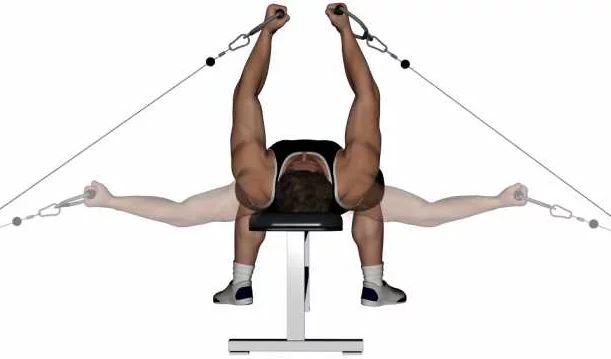
- Machine fly. The machine fly uses a guided arc and is easy to set up, making it a stable alternative for chest isolation.
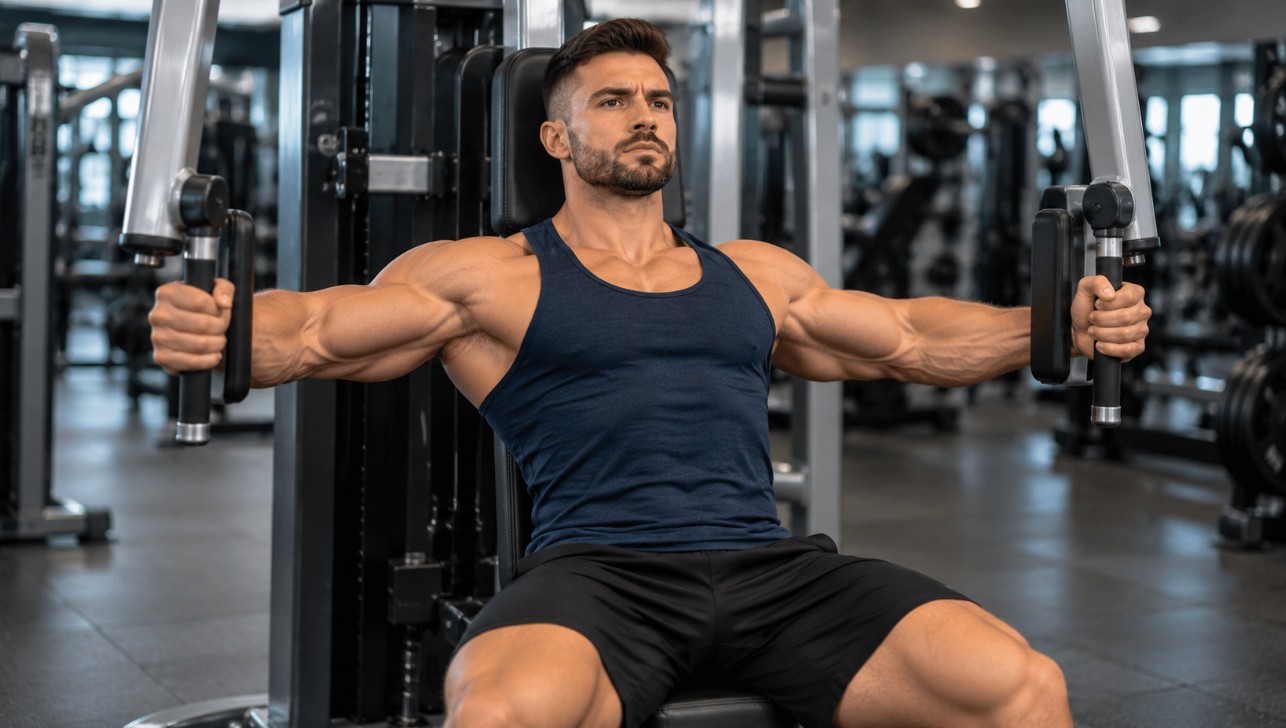
- Pec-deck fly. The pec-deck fly uses forearm pads and a short lever to isolate the chest with less stress on the elbows.

- Cable crossover. The cable crossover allows you to train the chest from different angles with constant cable tension.

How to Program the Stability Ball Dumbbell Fly
How you program the stability ball dumbbell fly depends on your training goal and where it fits in your workout.
Show full programming guideHide programming guide ▾
| Goal | Sets | Reps | Rest | Tempo |
|---|---|---|---|---|
| Hypertrophy | 3–4 | 10–15 | 60–90 s | 2–3 s lowering, controlled squeeze |
| Stability & control | 2–3 | 8–12 | 60–90 s | Slow, 3 s lowering |
| Muscular endurance | 2–3 | 15–20 | 30–60 s | Steady, continuous |
Muscle growth can occur across a wide range of repetitions when sets are taken close to failure, so treat these numbers as guidelines rather than strict rules. Adjust your rest periods between sets based on how recovered you feel.
- As a chest isolation exercise in home workouts without a bench
- After pressing exercises as a lighter chest finisher
- In full-body circuits combining chest work with glute and trunk control
- As a variation once flat bench dumbbell flyes are mastered
Apply progressive overload by adding reps and slowing the lowering phase before adding weight. Once the standard version feels stable, you can bring your feet closer together to make the position less stable, but increase the dumbbell weight only when your hips stay level throughout the set.
Stability Ball Dumbbell Fly vs Flat Bench Dumbbell Fly (Comparison Table)
| Criteria | Stability Ball Dumbbell Fly | Flat Bench Dumbbell Fly |
|---|---|---|
| Body Support | Upper back and head on a ball, hips bridged | Full support on a bench |
| Stability Demand | Moderate to high | Low |
| Hip and Trunk Involvement | Holding the bridge position | Minimal |
| Typical Load | Lighter | Heavier |
| Chest Activation | No evidence of an increase from the ball | Standard reference |
| Equipment | Stability ball and dumbbells | Bench and dumbbells |
| Best For | Home training, variety, hip and trunk control | Chest isolation with heavier loads |
The flat bench dumbbell fly remains the better choice when your main goal is to load the chest as heavily and as consistently as possible. The bench supports your body completely, so you can focus on the fly itself.
The stability ball version is a practical alternative when you don’t have a bench, and a useful variation that adds hip and trunk control. If you enjoy training on the ball, you can pair it with Swiss ball push-ups for a complete chest workout using the same equipment.
Final Thoughts
The stability ball dumbbell fly takes the classic dumbbell fly off the bench and onto a ball, adding the challenge of holding a bridge position while your arms move. It is a practical option for home workouts and a fresh variation for lifters who have mastered the bench version.
Just keep your expectations realistic: the ball doesn’t make your chest work harder by itself, and it is not a replacement for dedicated core training. Use light dumbbells, keep your head supported and your hips level, and focus on smooth, controlled reps. If you want more direct trunk training, add dedicated core exercises to your program alongside it.
Frequently Asked Questions
What muscles does the stability ball dumbbell fly work?
The exercise primarily targets the pectoralis major, with help from the anterior deltoid, the short head of the biceps, and the coracobrachialis. The glutes, hamstrings, and trunk muscles work to hold the body in the bridge position on the ball.
Is the stability ball dumbbell fly better than the flat bench fly?
Not necessarily. Research on chest presses has found similar chest activation and strength on a Swiss ball and on a bench. The ball version adds a hip and trunk control challenge, while the bench version allows heavier, more stable loading.
Does the stability ball dumbbell fly work the core?
It adds some demand on the glutes and trunk muscles to hold the bridge position. However, research shows that replacing a bench with a Swiss ball does not consistently increase trunk muscle activity during upper-body exercises, so it should not replace dedicated core training.
Should my head be on the ball?
Yes. Rest your upper back and head on the ball to keep your neck relaxed and supported. Letting the head hang off the ball can strain the neck muscles.
How heavy should the dumbbells be?
Use lighter dumbbells than on the flat bench fly. Choose a weight that allows 10–15 controlled reps with a fixed elbow angle and level hips.
How far should I lower the dumbbells?
Lower the dumbbells until your wrists are about level with your shoulders and you feel a stretch in your chest. Going much deeper increases stress on the front of the shoulders without meaningful benefit.
What size stability ball should I use?
Most lifters use a 55–65 cm ball. When you lie on it in the bridge position, your knees should be bent at roughly 90 degrees and your hips level with your shoulders.
Can beginners do the stability ball dumbbell fly?
It is better to master the flat bench dumbbell fly first. Once the basic fly is comfortable, the ball version adds a new challenge with less risk of losing control.
How do I get onto the ball safely with dumbbells?
Sit on the ball with the dumbbells resting on your thighs, then walk your feet forward slowly while rolling down until your upper back and head are supported. Press the dumbbells up only once you are stable.
Can I do the stability ball dumbbell fly at home?
Yes. A stability ball and a pair of dumbbells are all you need, which makes it a practical chest isolation exercise for home training without a bench.
