


Introduction
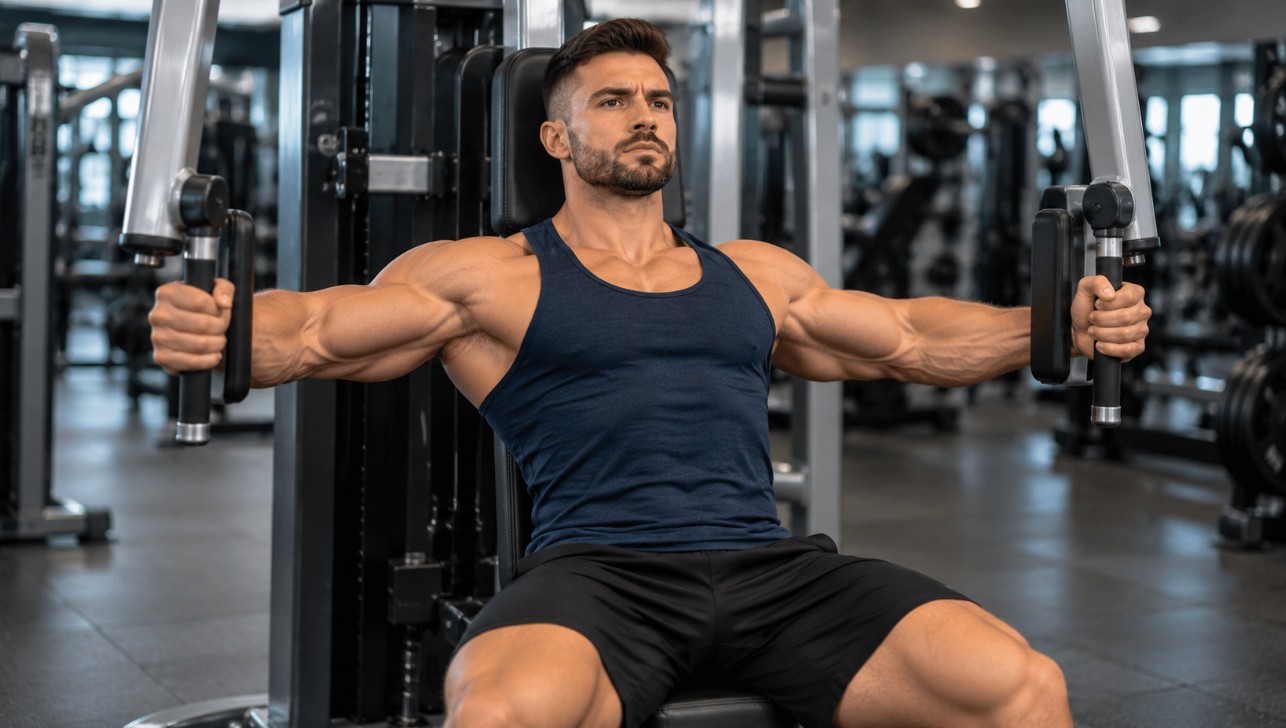
The machine fly is a seated chest exercise in which you grip two vertical handles and bring them together in front of your chest in a wide, hugging arc. It is the machine version of the dumbbell chest fly, but the guided path and adjustable resistance make it easier to control and more consistent from rep to rep.
This exercise should not be confused with the pec-deck fly, where the forearms rest against vertical pads and the elbows stay bent at roughly 90 degrees. On the machine fly, you hold the handles and keep your arms almost straight, creating a longer lever and a slightly different chest feel.
As an isolation exercise, the machine fly trains the pectoralis major without involving the triceps, making it an ideal companion to pressing exercises such as the machine bench press. Research also shows that machine-based training builds muscle as effectively as free weights when effort and training volume are matched.
The machine fly is a seated chest isolation exercise in which you bring two vertical handles together in a wide, hugging arc while keeping your elbows slightly bent. The movement consists purely of shoulder horizontal adduction, which allows the pectoralis major to work with minimal triceps involvement and a consistent resistance throughout the range of motion.
Other Names for Machine Fly
You will find this exercise under several names, and some gyms even use the term pec deck for both the handle and the pad version of the machine.
- Seated machine fly
- Machine chest fly
- Chest fly machine
- Seated fly with handles
- Vertical-handle fly machine
Required Equipment
The machine fly is performed on a dedicated chest fly station, found in most commercial gyms alongside other strength-training machines.
- Seated chest fly machine with vertical handles
- Adjustable seat and start-position setting for the handles
- Many models double as a rear delt machine for the reverse pec deck fly
How to Perform Machine Fly
Setting up the machine correctly is the most important part of the exercise, because the handle position determines both the stretch and the safety of your shoulders.
Starting Position
Before you load the machine, adjust the seat height and the handle start position to match your body.
- Adjust the seat so the handles are at chest level when you grip them
- Set the start position so you feel a comfortable stretch, not an extreme one
- Sit with your upper back, hips, and head pressed against the pad
- Place your feet flat on the floor for a stable base
- Grip the handles with a closed neutral grip, palms facing forward-inward
- Keep your elbows slightly bent, with your shoulders, elbows, and hands on the same horizontal plane

Execution (Action Phase)
Every rep should follow the same smooth arc, with the elbow angle staying fixed from start to finish.
- Brace your core and exhale as you begin the movement (see our guide on breathing technique)
- Bring the handles together in a wide arc, as if hugging a large tree
- Keep your elbows slightly bent and at the same height as your hands
- Squeeze your chest hard for one second when the handles meet in front of you
- Inhale and return the handles slowly until you feel a strong but comfortable stretch
- Stop before the weight stack touches and begin the next rep
Be careful not to pinch your fingers between the handles at peak contraction, and keep your back against the pad throughout the set.
Video Demonstration
Watching the exercise helps you see how the arms should travel in one fixed arc, without the elbows bending or straightening during the rep.
In the video below, notice how the lifter keeps the upper back against the pad, moves the handles in a smooth, wide arc, and pauses briefly with a strong squeeze when the handles meet. The return is slow and controlled, and the weight stack never touches between reps.

I like to call the machine fly the “honesty exercise” for the chest. When the weight is too heavy, lifters start bending their elbows more and more until the fly quietly turns into a half-hearted chest press, and the front delts and triceps take over. The weight stack might say 60 kg, but the pecs are handling maybe half of it.
With my clients, I use a simple test: if you can\’t hold the handles together in front of your chest for a full second with a hard squeeze, the load is too heavy. Drop the pin a notch or two, keep the same slight elbow bend from the first rep to the last, and you will feel your chest working in a way the heavier weight never allowed.
Quick Form Checklist
Use these cues before every set to make sure the machine is set up correctly, and your technique stays consistent.
- Handles at chest level
- Back and head against the pad
- Slight, fixed bend in the elbows
- Wide hugging arc, not a pressing motion
- Controlled return without touching the stack
Technical Emphasis & Targeting Adjustments
Small changes to handle height, tempo, and range of motion can shift the stimulus of the machine fly.
- Handles slightly below chest level → more lower chest emphasis. Moving the arms along a slightly downward path places more emphasis on the lower, sternocostal fibers of the pectoralis major. It pairs well with other lower chest exercises when that area is a weak point.
- Handles slightly above chest level → more upper chest and front delt involvement. Raising the path of the arms shifts some of the work toward the clavicular head of the chest and the anterior deltoids. Avoid going too high, as the shoulders tend to take over.
- Peak contraction hold → stronger mind-muscle connection. Holding the handles together for 1–2 seconds increases time under tension in the shortened position. It also makes it easier to develop a strong mind-muscle connection with the chest.
- Slower eccentric → better control of the stretch. Returning the handles over 2–3 seconds keeps the chest loaded in the lengthened position and reduces stress on the shoulder joint. Read more about eccentric training and why the lowering phase matters.
Common Mistakes
The machine fly looks simple, but a few common errors can quickly turn it into a less effective or even risky exercise.
- Bending the elbows during the rep. When the elbows bend as the handles come together, the fly turns into a press, and the triceps and front delts take over. Lock in a slight elbow bend at the start and keep that angle fixed throughout the set.
- Wrong seat height. If the handles sit too high or too low, the shoulders take more of the load and the chest works through a shorter, less effective arc. Adjust the seat so the handles line up with your chest before you start.
- Overstretching at the start. Setting the handles too far back forces the shoulders into extreme horizontal abduction, which stresses the front of the shoulder joint and the pectoral tendon. Choose a start position that gives a strong but comfortable stretch.
- Rolling the shoulders forward. Letting the shoulders round forward at the end of the rep shifts tension to the front delts and pulls the upper back off the pad. Keep your chest up and your shoulder blades gently pulled back against the pad.
- Using momentum. Jerking the handles together or letting them snap back reduces the work on the chest and places sudden stress on the shoulders. Move in a smooth arc in both directions and never let the stack slam.
Instead of thinking about bringing your hands together, focus on bringing your biceps toward each other. This simple cue keeps the movement centered on the upper arms and shoulder joint, which is exactly where the pectoralis major does its work.
Lifters who focus only on the hands tend to curl their wrists or bend their elbows to “finish” the rep. Leading with the upper arms keeps the elbow angle fixed and produces a noticeably stronger chest contraction at the end of each rep.
Mechanical Considerations
The machine fly consists of a single joint action, horizontal adduction of the shoulder, which makes the pectoralis major the prime mover. An EMG study comparing the bench press with a fly machine found similar pectoralis major and anterior deltoid activity in both exercises, while triceps activity was significantly lower on the fly machine. This is exactly why flys work so well after presses, when the triceps are already fatigued.
The key advantage of the machine over free weights is its resistance profile. During a dumbbell fly, the load is greatest when the arms are open and drops to almost nothing as the dumbbells come together, and research has shown lower overall chest activation with dumbbell flyes than with the bench press. A well-designed fly machine keeps tension on the chest through the closing phase, so the muscle keeps working all the way to peak contraction.
Muscles Worked in Machine Fly
MAIN MUSCLES
SECONDARY MUSCLES
- Anterior deltoid
- Biceps brachii (short head)
- Coracobrachialis
ANTAGONISTS
Machine Fly Pros and Cons
The machine fly is a valuable chest exercise, but it works best when you understand what it can and cannot do for your training.
Advantages
- Consistent tension through the range of motion. Unlike dumbbell flyes, the machine applies continuous tension and keeps the chest loaded even when the handles come together. This allows for a strong, deliberate squeeze at peak contraction.
- True chest isolation. Because the triceps are largely removed from the movement, the chest can be trained hard even after heavy pressing. It is also a good option when elbow or triceps issues limit your pressing.
- Safe and beginner-friendly. The guided path and adjustable start position make it easy to learn and reduce the risk of overstretching. No spotter is needed.
- Ideal for intensity techniques. Quick pin changes make the machine ideal for drop sets, rest-pause sets, and safely taking sets close to muscle failure.
Potential Drawbacks
- Fixed movement path. The machine’s arc may not suit every body type, especially very tall or very short lifters. A poor fit can shift stress onto the shoulders.
- Limited strength transfer. As an isolation exercise, the machine fly does little to improve your pressing strength. It should complement compound chest exercises rather than replace them.
- Lower loads and overall muscle activation than presses. Compound pressing exercises allow much heavier loads and involve more muscle mass. For most lifters, flys work best as a secondary chest exercise.
- Risk of overstretching with poor setup. Setting the handles too far back can place excessive stress on the front of the shoulder. Properly adjusting the starting position is essential.
Safety Considerations
The machine fly is a low-risk exercise when set up correctly, but lifters with certain conditions should take extra care.
- Shoulder instability or anterior shoulder pain. The stretched position of the fly stresses the front of the shoulder capsule. Limit the range of motion with the start-position setting, and learn more about shoulder joint anatomy to understand which positions to avoid.
- Previous pectoral strain. Lifters recovering from pectoral strain should avoid deep stretches and heavy loads until a medical professional clears them. Start with light weights and a shortened range of motion.
- Biceps tendon issues. With the arms almost straight, the biceps tendons are placed under tension in the stretched position. Lifters with biceps tendonitis should bend the elbows slightly more and reduce the stretch.
- Elbow joint stress. Locking the elbows completely straight shifts stress from the muscles to the elbow joint. Always keep a slight bend in the elbows, even with light loads.
Machine Fly Variations
Pec-deck fly
Difficulty: Similar to the standard version
The pec-deck version uses forearm pads instead of handles, with the elbows bent at roughly 90 degrees throughout the movement. The shorter lever allows heavier loads and reduces stress on the elbows and biceps tendons, while still training the chest through horizontal adduction. It is a good option for lifters who find the straight-arm position uncomfortable.
Single-arm machine fly
Difficulty: Harder than the standard version
Performing the fly one arm at a time lets you concentrate fully on each side of the chest and helps correct strength or size imbalances. Sit sideways or brace your free hand against the machine to keep your torso stable. The unilateral setup also adds a small anti-rotation challenge for the core.
Low-handle machine fly
Difficulty: Similar to the standard version
Raising the seat so that the handles sit slightly below chest level creates a subtle downward arc of the arms. This variation emphasizes the lower fibers of the pectoralis major. It is an easy way to shift the focus without changing machines.
High-handle machine fly
Difficulty: Similar to the standard version
Lowering the seat so the handles sit slightly above chest level brings the arms along a higher arc. This increases the involvement of the upper chest and the anterior deltoids. Keep the elbows below shoulder height to prevent the shoulders from taking over the movement.
Paused machine fly
Difficulty: Harder than the standard version
Holding each rep for 2–3 seconds at peak contraction dramatically increases the time the chest spends under maximal tension. This variation is excellent for building a stronger mind-muscle connection and works well as a finishing exercise. Expect to use a noticeably lighter weight than usual.
Replacement Exercises (Substitutes) for the Machine Fly
If the fly machine is occupied or unavailable, several exercises replicate the same horizontal adduction movement and target the pectoralis major similarly. You can find more chest options in our list of the most effective middle chest exercises.
- Flat bench cable fly. The flat bench cable fly keeps constant tension on the chest thanks to the cables, much like the machine. Lying on the bench also provides good stability and support.

- Cable crossover. The cable crossover is performed standing and allows you to adjust the pulley height to target different areas of the chest. It requires more core stability than the machine version.

- Flat bench dumbbell fly. The classic free-weight fly places the greatest load in the stretched position. It requires more stabilization and careful control of the stretch, especially with heavier dumbbells.

- Low-pulley cable fly. The low-pulley cable fly moves the arms along an upward arc, shifting emphasis toward the upper chest. It is a great option for lifters who want to bring up the clavicular head.

- Incline dumbbell fly. The incline dumbbell fly trains the chest through the same movement pattern on an incline bench. The angle increases the involvement of the upper chest and front delts.

- Svend press. The Svend press requires only a weight plate and trains the chest through a strong squeeze. It works well as a finisher when you don’t have machines or cables.

How to Program the Machine Fly
How you program the machine fly depends on your training goal, experience level, and whether you use it as a finisher or a main chest exercise.
Show full programming guideHide programming guide ▾
| Goal | Sets | Reps | Rest | Tempo |
|---|---|---|---|---|
| Hypertrophy | 3–4 | 10–15 | 60–90 s | 2–3 s lowering, 1 s squeeze |
| Strength-focused | 3–4 | 8–10 | 90–120 s | Controlled lowering, strong squeeze |
| Muscular endurance | 2–3 | 15–20 | 30–60 s | Steady, continuous |
Muscle growth can occur across a wide range of repetitions when sets are taken close to failure, so treat these numbers as guidelines rather than strict rules. Adjust your rest periods between sets based on how recovered you feel.
- After your main pressing exercises, when the triceps are already fatigued
- Before presses as part of a pre-exhaustion strategy
- As a chest finisher with higher reps or drop sets
- As the main chest exercise for lifters working around triceps or elbow issues
Apply progressive overload through reps first: once you reach the top of your rep range on all sets with a controlled one-second squeeze, move the pin to the next plate. Because isolation exercises respond poorly to big load jumps, you can also progress by slowing the lowering phase or adding a short pause at peak contraction before adding weight.
Machine Fly vs Dumbbell Fly (Comparison Table)

| Criteria | Machine Fly | Dumbbell Fly |
|---|---|---|
| Tension at Peak Contraction | High, maintained | Very low |
| Tension in Stretched Position | Moderate, adjustable | Highest |
| Stability Demand | Low | Moderate |
| Learning Curve | Easy | Moderate |
| Range of Motion Control | Adjustable start position | Depends on lifter control |
| Load Changes | Quick pin adjustment | Requires changing dumbbells |
| Overstretching Risk | Lower | Higher with heavy loads |
| Best For | Constant-tension isolation, drop sets | Stretch emphasis, home gyms |
The dumbbell fly remains a useful exercise because it loads the chest heavily in the stretched position and requires no special equipment. However, the resistance almost disappears as the dumbbells come together, and heavy loads in the bottom position increase the risk of overstretching the chest and shoulder.
The machine fly solves both problems by providing a gentler stretch and consistent tension through the closing phase. For most lifters, it is the safer and more practical choice for chest isolation, while the dumbbell fly remains a good alternative for home training or when you want to emphasize the stretch.
Final Thoughts
The machine fly is one of the simplest and most effective ways to isolate the chest. By removing the triceps from the movement and keeping tension on the pecs through the full arc, it lets you train the chest hard even after heavy pressing.
Set the machine up correctly, keep your elbow angle fixed, and focus on a controlled squeeze rather than heavy weights. Used this way, the machine fly is a valuable finishing exercise that complements your presses and helps you build a fuller, better-developed chest.
Frequently Asked Questions
What is the difference between the machine fly and the pec-deck fly?
The machine fly uses vertical handles that you grip with your hands while keeping your arms almost straight. The pec-deck fly uses forearm pads, with your elbows bent at roughly 90 degrees and your forearms pressing against the pads. Both train the chest through horizontal adduction, but the lever length and feel differ.
What muscles does the machine fly work?
The machine fly primarily targets the pectoralis major. The anterior deltoid, short head of the biceps, and coracobrachialis assist the movement, while the triceps are largely taken out of the exercise.
Is the machine fly better than the dumbbell fly?
Neither is strictly better. The machine fly keeps tension on the chest near the end of the movement, where the dumbbell fly loses most of its resistance. The dumbbell fly places the greatest load in the stretched position and requires more stabilization.
Does the machine fly build the inner chest?
You cannot isolate the “inner chest” as a separate muscle. The pectoralis major contracts along its entire length, so the machine fly trains the whole muscle. The strong squeeze at the end of each rep simply makes the contraction easier to feel.
Should the handles touch at the end of the rep?
You can bring the handles together or stop just short of touching. The key is to keep tension on the chest and squeeze for a moment, while making sure you don’t pinch your fingers between the handles.
How heavy should I go on the machine fly?
Choose a weight that allows 10–15 controlled reps with a one-second squeeze at peak contraction and no change in elbow angle. If your elbows bend more as the set goes on, the load is too heavy.
Should I do machine flys before or after presses?
Most lifters perform machine flys after pressing exercises to finish off the chest. Performing them first as a pre-exhaustion technique is also an option, but it will reduce the weight you can use on your presses.
How should I set the seat height on a fly machine?
Adjust the seat so the handles are at chest level when you grip them. Your shoulders, elbows, and hands should be roughly on the same horizontal plane at the start of the movement.
Is the machine fly good for beginners?
Yes. The machine guides the movement, the setup is simple, and the risk of overstretching is lower than with dumbbells, making it an excellent first chest isolation exercise.
What should I do if I feel shoulder pain during machine flys?
Reduce the starting stretch by adjusting the handle position, check that the seat is at the right height, and lower the weight. If the pain is sharp or persists, stop the exercise and consult a medical professional.
