



Introduction
This guide focuses on pilates for core strength as a practical training tool—not as a trend or lifestyle concept. The goal is to explain how Pilates develops deep core stability, movement control, and spinal support, and how you can use these principles to build a stronger, more resilient body.
I approach Pilates from a strength-and-conditioning perspective, connecting its methods to core anatomy, biomechanics, and real-world performance. Whether you train in the gym, coach others, or simply want to improve posture, stability, and injury resistance, this guide shows how Pilates fits into a well-rounded core training strategy.
Although the fitness industry often markets Pilates toward women, men, athletes, and strength trainees use Pilates just as effectively—and many male clients benefit even more because Pilates targets mobility restrictions, core control, and muscular imbalances that commonly develop through traditional gym-based training.
What Is Pilates?
When people hear “Pilates for core strength,” they often picture “ab workouts on a mat”—but Pilates is actually a full-body training method built around control, posture, breathing, and precise movement. It was developed to improve the way your body moves (and holds itself together) — not just to make you tired. Here’s the exact definition you want to remember:
What Is Pilates?
Pilates is a low-impact mind–body training system that develops core strength, posture, flexibility, and movement control through precise, controlled exercises. It emphasizes deep core engagement (often called the “powerhouse”), coordinated breathing, and smooth, flowing movement to improve spinal alignment, mobility, and overall physical function. Pilates uses primarily mat-based exercises, with optional resistance from specialized spring-loaded equipment, and adapts easily to all fitness levels.
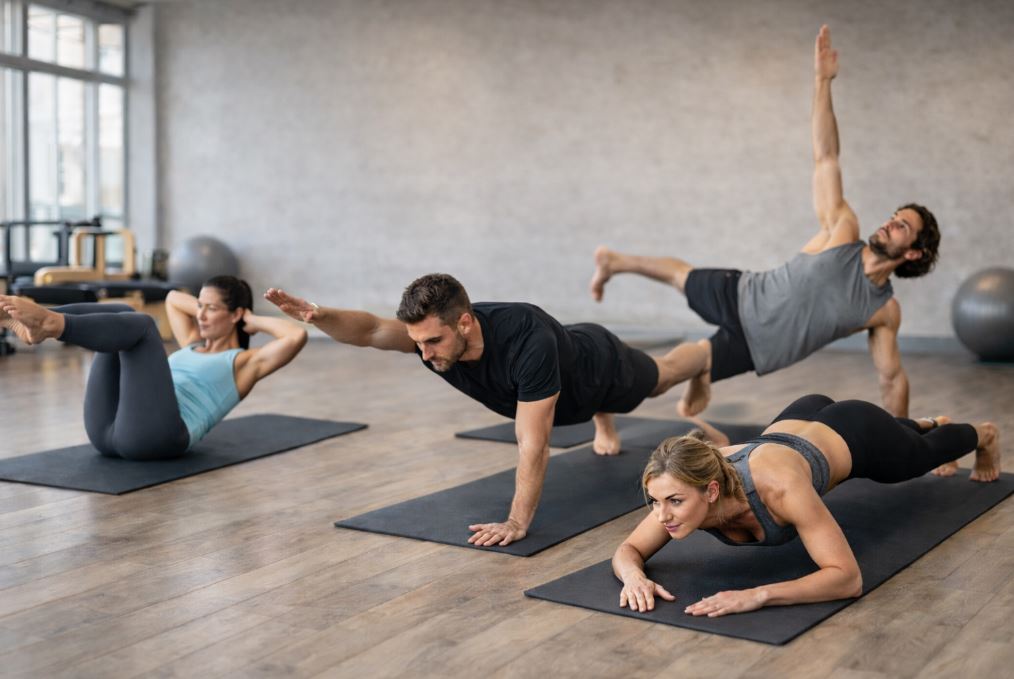
Therefore, at its core, Pilates teaches you to stabilize your spine and pelvis while your arms and legs move with intention. Instead of chasing heavy loads or high reps, you focus on quality: alignment, tension, rhythm, and smooth control through a comfortable range of motion. Most classic Pilates work is done on a mat (with just bodyweight), but it can also be performed using small props (band, ball, ring) or specialized machines (like the Reformer).
Coach’s Note
Coming from a strength-training background, I value Pilates because it develops what I call quiet strength—the kind of control that doesn’t always look impressive in the gym, but shows up when you squat, press, sprint, change direction, or move through daily life without pain. Pilates doesn’t replace progressive strength training, but it significantly improves how efficiently the body transfers force through the trunk, hips, and shoulder girdle.
What Is the Core?
In fitness and strength training, the core represents far more than visible abdominal muscles. The core—often referred to in Pilates as the powerhouse—includes all muscles that stabilize, support, and control the trunk during movement.
From an anatomical and functional perspective, the core spans from the base of the rib cage to the base of the glutes. Its role is not to create movement, but to resist unwanted movement, transfer force efficiently, and maintain spinal and pelvic stability.
A well-functioning core includes:
- the abdominal muscles (rectus abdominis, obliques, transverse abdominis)
- the muscles of the lower back
- the hips and gluteal muscles
- the inner thighs
- the pelvic floor
Together, these muscles form an integrated system that stabilizes the spine, controls posture, and allows the arms and legs to move with strength and precision.
For a deeper anatomical breakdown of these muscles and how they function together, you can explore my detailed guide to core anatomy.

Why Core Strength Matters (Who Needs a Strong Core?)
Core strength plays a central role in how the body moves, produces force, and stays injury-resistant. A strong core does not mean visible abs—it means the ability to stabilize the spine and pelvis, control posture, and maintain efficient movement under both everyday and athletic demands.
When the core works appropriately, it acts as a solid foundation for the arms and legs. When it doesn’t, other structures—especially the lower back, hips, and knees—often compensate, increasing the risk of pain, poor movement patterns, and overuse injuries.
Why Core Strength Is Essential
A well-developed core helps you:
- Maintain proper posture during standing, walking, and sitting;
- Protect the spine during lifting and dynamic movement;
- Transfer force efficiently between the upper and lower body;
- Improve balance, coordination, and movement control;
- Reduce the risk of lower-back and hip discomfort;
In strength training and sport, the core does not generate power on its own—it allows power to express itself safely and efficiently.
Who Needs to Strengthen Their Core?
The short answer: everyone. But different groups benefit in various ways.
- Strength trainees and bodybuilders need a strong core to stabilize heavy compound lifts, improve force transfer, and reduce stress on the spine during squats, deadlifts, and presses.
- Athletes rely on core stability for sprinting, jumping, throwing, and rapid changes of direction, where control and timing matter as much as raw strength.
- Recreational exercisers benefit from improved posture, balance, and movement efficiency, making everyday activities feel easier and more controlled.
- People with a history of back discomfort or movement limitations often need better core control to reduce excessive spinal motion and build confidence in movement.
- Older adults rely on core strength to maintain balance, reduce fall risk, and preserve independence in daily life.
This broad relevance explains why pilates for core strength works so well across populations. Pilates does not rely on heavy loading or aggressive movement. Instead, it develops controlled stability, coordination, and awareness—qualities that everybody needs, regardless of age, training background, or fitness level.
Common Core Exercises vs. True Core Function
Most people train their core by targeting individual muscles, usually through isolated movements like crunches, sit-ups, leg raises, or twisting exercises. While these movements can strengthen specific muscles, they often overlook the core’s primary function.
From a functional and biomechanical standpoint, the core rarely acts as a prime mover. Instead, it primarily stabilizes the spine and pelvis, controls posture, and transfers force between the upper and lower body. In real-life movement and athletic performance, the core’s job is not to bend and twist repeatedly, but to resist excessive motion while the limbs generate force.
The Limitations of Traditional Core Training
Many conventional core workouts focus on:
- Repeated spinal flexion or rotation;
- Chasing muscle fatigue or “burn”;
- Isolating the abs without integrating the hips and trunk;
This approach can improve local muscle endurance, but it often fails to:
- Enhance spinal stability;
- Improve movement efficiency;
- Carry over to compound lifts or athletic tasks;
In some cases, excessive flexion-based core work may even irritate the lower back, primarily when performed without adequate control or progression.
What “True” Core Function Looks Like
A well-trained core should allow you to:
- Keep the spine stable while the arms and legs move;
- Maintain posture under load;
- Transfer force efficiently during lifting, running, jumping, or changing direction;
- Reduce unnecessary strain on the lower back and hips;
This is where Pilates for core strength fits naturally. Instead of isolating muscles, Pilates trains the core as an integrated stabilizing system, emphasizing control, alignment, breathing, and precision. The exercises teach you how to hold the body together while movement happens around the trunk—exactly how the core functions in real-world activity.
This shift—from chasing abdominal fatigue to building controlled stability—sets the foundation for understanding why Pilates works so effectively as a core-strengthening method.
Benefits of Pilates for Core Strength
Pilates develops core strength by training the body to control movement rather than chase fatigue. Instead of isolating individual muscles, Pilates teaches the core to function as an integrated system that stabilizes the spine, supports posture, and coordinates movement between the upper and lower body.
From a strength and conditioning perspective, this approach fills a significant gap that many traditional core workouts leave behind.
1. Improved Deep Core Activation
Pilates places strong emphasis on activating the deep stabilizing muscles of the trunk, including the transverse abdominis, pelvic floor, and deep spinal stabilizers. These muscles create internal support around the spine and pelvis, improving control before larger muscles generate force.
Over time, this leads to better bracing, improved posture, and greater movement efficiency—both in daily activities and in the gym.
2. Better Spinal Stability and Postural Control
Many Pilates exercises train the core to hold the spine in a neutral, supported position while the arms and legs move independently. This directly improves spinal stability, which plays a key role in reducing unnecessary strain on the lower back.
For people who sit frequently, lift weights, or perform repetitive movements, this kind of postural control often makes a noticeable difference in comfort and movement quality.
3. Low-Impact Strength With High Control
Pilates builds strength without heavy external loading. The exercises rely on bodyweight, leverage, and controlled tempo, which allows you to train the core effectively while minimizing joint and spinal stress.
This makes Pilates especially useful for:
- Beginners building foundational strength
- Individuals returning from injury
- Strength trainees looking to improve stability without overloading the spine
4. Enhanced Movement Coordination and Control
Pilates emphasizes precision and smooth transitions rather than speed or maximal effort. This trains the nervous system to coordinate muscle activation efficiently, improving timing and control across the trunk and limbs.
Better coordination translates to cleaner technique during compound lifts, more efficient athletic movement, and reduced compensations.
5. Better Breathing Mechanics and Core Integration
Breathing plays an active role in Pilates. Controlled breathing helps regulate intra-abdominal pressure and reinforces the connection between the diaphragm, core muscles, and pelvic floor.
This integration improves trunk stability and reinforces proper breathing patterns during both static holds and dynamic movements—an often-overlooked aspect of core training.
6. Improved Body Awareness and Movement Quality
Pilates encourages awareness of alignment, tension, and movement patterns. Over time, this increased body awareness helps people recognize compensations, adjust posture, and move with greater intention.
For many clients, this alone leads to better exercise execution, fewer aches, and a stronger sense of control over their own movement.
Coach’s Note
In my coaching work, I often see clients who train hard but struggle with control, posture, or recurring lower-back discomfort. When I introduce Pilates-based core work, the biggest change doesn’t come from “stronger abs”—it comes from better awareness, cleaner movement, and improved spinal stability.
Clients learn how to stabilize their trunk while the arms and legs move, which immediately carries over to squats, deadlifts, presses, and everyday activities. I don’t use Pilates to replace strength training, but as a foundation that helps people move with more control, confidence, and resilience. When the core works the way it should, everything else tends to work better.
Key Pilates Exercises for Core Strength
The following Pilates exercises target core strength through controlled movement, spinal stability, and coordinated breathing. Instead of isolating individual muscles, these movements train the core to function as an integrated system—stabilizing the trunk while the limbs move with precision.
Each exercise below focuses on control over intensity, making them suitable for beginners while still challenging enough for advanced trainees when performed correctly.
#1 Breathing (Pilates Breathing)
How to Perform
Lie on your back with knees bent and feet flat on the floor. Place one hand on your chest and the other on your abdomen. Inhale through the nose, directing the breath into the rib cage rather than lifting the chest. Exhale slowly through the mouth while gently drawing the abdominal wall inward, maintaining a neutral spine.

Muscles Worked
- Transverse abdominis
- Diaphragm
- Pelvic floor
- Deep spinal stabilizers
Key Tips
- Keep the rib cage relaxed and avoid flaring
- Focus on controlled exhalation rather than force
- Maintain neutral spine throughout
How to Modify
Perform seated or with feet elevated on a bench for better spinal awareness.
Benefits for Core Strength
This exercise establishes the mind–core connection and teaches proper breathing mechanics, which support spinal stability and intra-abdominal pressure during movement.
Difficulty Level
Beginner
#2 Shoulder Bridge Preparation
How to Perform
Lie on your back with knees bent and feet hip-width apart. Press through your heels and lift your hips off the floor until the torso forms a straight line from shoulders to knees. Hold briefly while maintaining pelvic control, then lower slowly with control.

Muscles Worked
- Gluteus maximus
- Hamstrings
- Erector spinae
- Deep core stabilizers
Key Tips
- Avoid arching the lower back at the top
- Keep the ribs down and pelvis neutral
- Move slowly during both lifting and lowering
How to Modify
Limit the range of motion or hold a static bridge position without lifting fully.
Benefits for Core Strength
The shoulder bridge trains posterior chain engagement while teaching the core to stabilize the pelvis—an essential skill for lifting and athletic movement.
Difficulty Level
Beginner to Intermediate
#3 Toe Taps
How to Perform
Lie on your back with arms at your sides. Lift both legs into a tabletop position (hips and knees at 90 degrees). While maintaining a stable pelvis and neutral spine, slowly lower one foot to tap the floor, then return to the starting position and switch sides.

Muscles Worked
- Transverse abdominis
- Rectus abdominis
- Hip flexors
- Pelvic stabilizers
Key Tips
- Keep the lower back gently pressed into the mat
- Move one leg at a time with complete control
- Stop if the pelvis begins to tilt or arch
How to Modify
Tap one foot at a time from a single-leg tabletop position.
Benefits for Core Strength
Toe taps train anti-extension control, teaching the core to stabilize the spine while the legs move independently.
Difficulty Level
Beginner to Intermediate
#4 Single Leg Stretch
How to Perform
Lie on your back and lift your head, neck, and shoulders slightly off the mat. Bring one knee toward your chest while extending the opposite leg forward at a low angle. Switch legs in a controlled, alternating pattern while keeping the pelvis stable and the core engaged.

Muscles Worked
- Rectus abdominis
- Transverse abdominis
- Hip flexors
- Obliques (stabilizing role)
Key Tips
- Keep the rib cage down, and the core braced
- Move smoothly without rushing
- Avoid pulling aggressively on the knee
How to Modify
Keep the head on the mat or extend the moving leg higher to reduce leverage.
Benefits for Core Strength
This exercise improves dynamic core control, teaching the trunk to stay stable while the legs move rhythmically—a key requirement for running, cycling, and many athletic movements.
Difficulty Level
Beginner to Intermediate
#5 One Leg Circle
How to Perform
Lie on your back with one leg extended on the mat and the other leg lifted toward the ceiling. Draw controlled circles in the air with the raised leg while keeping the pelvis completely still. Reverse direction after several repetitions, then switch legs.

Muscles Worked
- Deep core stabilizers
- Hip flexors
- Hip adductors and abductors
- Pelvic stabilizers
Key Tips
- Anchor the pelvis and avoid rocking side to side
- Keep the movement smooth and controlled
- Use a small range of motion if control decreases
How to Modify
Bend the working leg slightly or make smaller circles to reduce difficulty.
Benefits for Core Strength
One leg circles train pelvic stability and rotational control, reinforcing the core’s role in resisting unwanted movement while the hip moves freely.
Difficulty Level
Beginner to Intermediate
#6 Side Bend Preparation
How to Perform
Sit on one hip with the supporting arm placed under the shoulder and legs bent to the side. Press through the supporting arm and lift the hips off the mat, creating a straight line from head to knees. Hold briefly, then lower with control.

Muscles Worked
- Obliques
- Quadratus lumborum
- Shoulder stabilizers
- Gluteus medius
Key Tips
- Keep the neck aligned with the spine
- Avoid collapsing into the supporting shoulder
- Engage the obliques before lifting
How to Modify
Keep both knees bent, limit the lift height, or perform short holds.
Benefits for Core Strength
This movement builds lateral core stability, which supports posture, gait, and single-leg strength during athletic and everyday activities.
Difficulty Level
Intermediate
#7 Sidekick
How to Perform
Lie on your side with the body aligned in a straight line from head to feet. Support the head with the lower arm and place the top hand lightly on the mat for balance. Lift the top leg to hip height and swing it forward and backward in a controlled motion while keeping the torso and pelvis stable.

Muscles Worked
- Gluteus medius and minimus
- Hip flexors and extensors
- Obliques (stabilizing role)
- Deep core stabilizers
Key Tips
- Keep the torso completely still
- Avoid arching the lower back during the forward swing
- Control both the forward and backward phases
How to Modify
Reduce the range of motion or bend the working leg slightly.
Benefits for Core Strength
Sidekick improves hip–core coordination, teaching the core to stabilize the trunk while the hip moves dynamically.
Difficulty Level
Intermediate
#8 Side Leg Lifts
How to Perform
Lie on your side with legs extended and stacked. Rest the head comfortably and engage the core to keep the spine aligned. Lift the top leg upward in a slow, controlled manner, then lower it without losing balance or alignment.

Muscles Worked
- Gluteus medius
- Hip abductors
- Obliques
- Pelvic stabilizers
Key Tips
- Keep the toes facing forward or slightly down
- Avoid rolling the hips backward
- Move slowly to maintain control
How to Modify
Bend the bottom leg for added stability or lift the leg only partway.
Benefits for Core Strength
This exercise strengthens lateral core stability and hip control, which are essential for posture, walking mechanics, and single-leg strength.
Difficulty Level
Beginner to Intermediate
#9 Swan Dive (Preparation)
How to Perform
Lie face down with hands placed under the shoulders and legs extended. Gently engage the core and lift the chest off the mat while keeping the pelvis grounded. Lower slowly with control, focusing on lengthening the spine rather than compressing it.

Muscles Worked
- Erector spinae
- Gluteal muscles
- Posterior shoulder stabilizers
- Deep core stabilizers
Key Tips
- Keep the movement smooth and controlled
- Avoid excessive lower-back compression
- Focus on spinal length rather than height
How to Modify
Perform a tiny lift or keep the forearms on the mat for support.
Benefits for Core Strength
Swan dive preparation strengthens the posterior chain while reinforcing spinal control and balance between flexion and extension.
Difficulty Level
Intermediate
#10 Swan Dive (Advanced)
How to Perform
Lie face down on a mat with legs extended and feet hip-width apart. Place the hands slightly in front of the shoulders with elbows softly bent and close to the body. Engage the core by gently drawing the abdominals upward to support the lower back. On an inhale, press lightly through the hands and lift the chest, lengthening the spine forward and upward. As you exhale, release the hands, extend the arms forward, and allow the body to rock gently forward as the legs lift slightly off the mat. Continue rocking smoothly between extension and dive, using breath and control rather than momentum.

Muscles Worked
- Erector spinae
- Gluteal muscles
- Hamstrings
- Deep core stabilizers
Key Tips
- Keep the neck long and avoid collapsing into the lower back
- Focus on spinal length rather than height
- Let the movement flow with controlled breathing
How to Modify
Perform only the chest-lift phase without rocking, or keep the hands on the mat throughout the movement.
Benefits for Core Strength
Swan dive challenges dynamic spinal control and posterior chain integration, training the core to stabilize the spine through controlled extension and transition.
#11 Swimming Preparation (Bird Dog)
How to Perform
Start on all fours with hands under shoulders and knees under hips. Engage the core to stabilize the spine, then extend the opposite arm and leg while keeping the pelvis level. Hold briefly, return to the starting position, and switch sides with control.

Muscles Worked
- Transverse abdominis
- Erector spinae
- Gluteus maximus
- Shoulder stabilizers
Key Tips
- Keep the spine neutral throughout the movement
- Avoid shifting weight side to side
- Move slowly and deliberately
How to Modify
Lift only the arm or only the leg until stability improves.
Benefits for Core Strength
This exercise trains cross-body stability and anti-rotation control, which are essential for gait, running mechanics, and athletic coordination.
Difficulty Level
Beginner to Intermediate
#12 Leg Pull Front Preparation (Hovers)
How to Perform
Start in a high plank position with hands under shoulders and body aligned in a straight line. Engage the core and lift one foot slightly off the floor without shifting the hips or shoulders. Lower the foot and repeat on the opposite side.

Muscles Worked
- Rectus abdominis
- Transverse abdominis
- Shoulder stabilizers
- Gluteal muscles
Key Tips
- Maintain a straight line from head to heels
- Keep the ribs down and pelvis stable
- Lift the foot only as high as control allows
How to Modify
Hold a static plank without lifting the feet or perform the exercise from the knees.
Benefits for Core Strength
Leg pull front prep builds anti-extension and anti-rotation strength, reinforcing the core’s role in maintaining alignment under load.
Difficulty Level
Intermediate
#13 Roll Down
How to Perform
Begin by sitting up tall with feet hip-width apart. Slowly roll the spine down one vertebra at a time, allowing the head and shoulders to follow. Pause briefly at the bottom, then reverse the movement to return to standing with full control.

Muscles Worked
- Rectus abdominis
- Erector spinae
- Deep spinal stabilizers
- Hip extensors (stabilizing role)
Key Tips
- Move slowly and deliberately
- Keep the knees soft, not locked
- Focus on spinal articulation rather than speed
How to Modify
Bend the knees more deeply or perform only a partial range of motion.
Benefits for Core Strength
Roll downs improve spinal mobility and segmental control, reinforcing the connection between core strength and controlled movement.
Difficulty Level
Beginner to Intermediate
#14 Crisscross
How to Perform
Lie on your back with your hands lightly supporting your head, and your legs lifted into a tabletop position. Lift the head, neck, and shoulders off the mat. Rotate the torso to bring one shoulder toward the opposite knee while extending the other leg, then switch sides in a controlled, alternating pattern.

Muscles Worked
- Obliques
- Rectus abdominis
- Transverse abdominis
- Hip flexors
Key Tips
- Rotate through the rib cage, not the elbows
- Keep the pelvis stable throughout the movement
- Focus on control rather than speed
How to Modify
Keep the head on the mat or extend the moving leg higher to reduce difficulty.
Benefits for Core Strength
Crisscross develops rotational control and diagonal strength, reinforcing the core’s ability to manage twisting forces without excessive spinal movement.
Difficulty Level
Intermediate
#15 Plank
How to Perform
Start in a forearm or high plank position with the body aligned in a straight line from head to heels. Engage the core, glutes, and shoulder stabilizers while maintaining steady breathing. Hold the position without allowing the hips to sag or lift.

Muscles Worked
- Transverse abdominis
- Rectus abdominis
- Obliques
- Shoulder stabilizers
- Gluteal muscles
Key Tips
- Keep the ribs down and pelvis neutral
- Push the floor away with the forearms or hands
- Breathe steadily without holding your breath
How to Modify
Perform the plank from the knees or reduce the hold duration.
Benefits for Core Strength
The plank trains global core stability, teaching the body to maintain alignment under sustained tension—a key requirement for strength training and athletic performance.
Difficulty Level
Beginner to Advanced (depending on variation)
#16 Forearm Side Plank With Hip Lift and Lower + Arm Extension
How to Perform
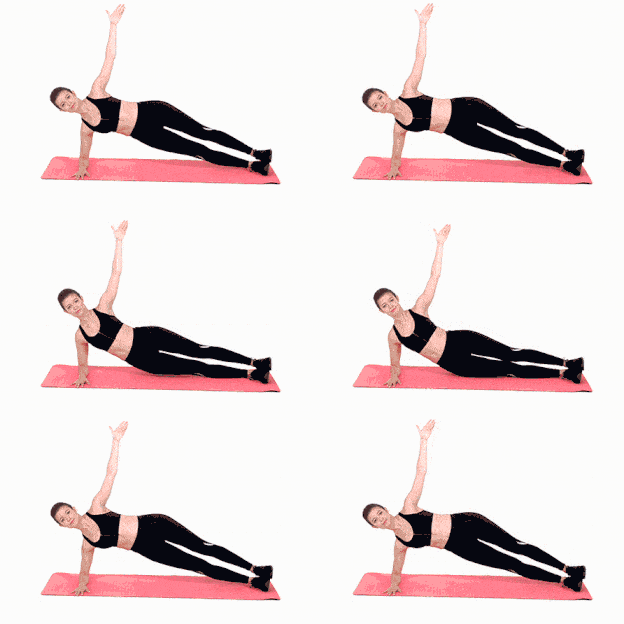
Start in a forearm side plank with the elbow under the shoulder and legs stacked. Lift the hips to form a straight line from head to feet. Slowly lower the hips a few centimeters, then lift them back up. Add an arm extension by reaching the top arm forward while maintaining balance.
Muscles Worked
- Obliques
- Quadratus lumborum
- Gluteus medius
- Shoulder stabilizers
Key Tips
- Keep the neck aligned with the spine
- Avoid rotating the torso forward or backward
- Move the hips slowly and with control
How to Modify
Bend the bottom knee for support or remove the arm extension.
Benefits for Core Strength
This exercise challenges lateral core strength and anti-rotation control, which directly support posture and single-leg stability.
Difficulty Level
Advanced
#17 Bear Plank With Toe Taps to Downward Dog
How to Perform
Start in a bear plank with hands under shoulders and knees hovering just above the floor. Keeping the spine stable, tap one foot lightly to the floor, then return to hover. Transition smoothly into a downward dog position, then return to bear plank.

Muscles Worked
- Transverse abdominis
- Shoulder stabilizers
- Hip flexors
- Gluteal muscles
Key Tips
- Keep the knees low and controlled
- Avoid rounding or arching the spine
- Move smoothly between positions
How to Modify
Hold the bear plank statically or skip the downward dog transition.
Benefits for Core Strength
This movement develops dynamic core control under changing positions, reinforcing stability during transitions.
Difficulty Level
Advanced
#18 Glute Bridge With Arm Reach and Heel Raise
How to Perform
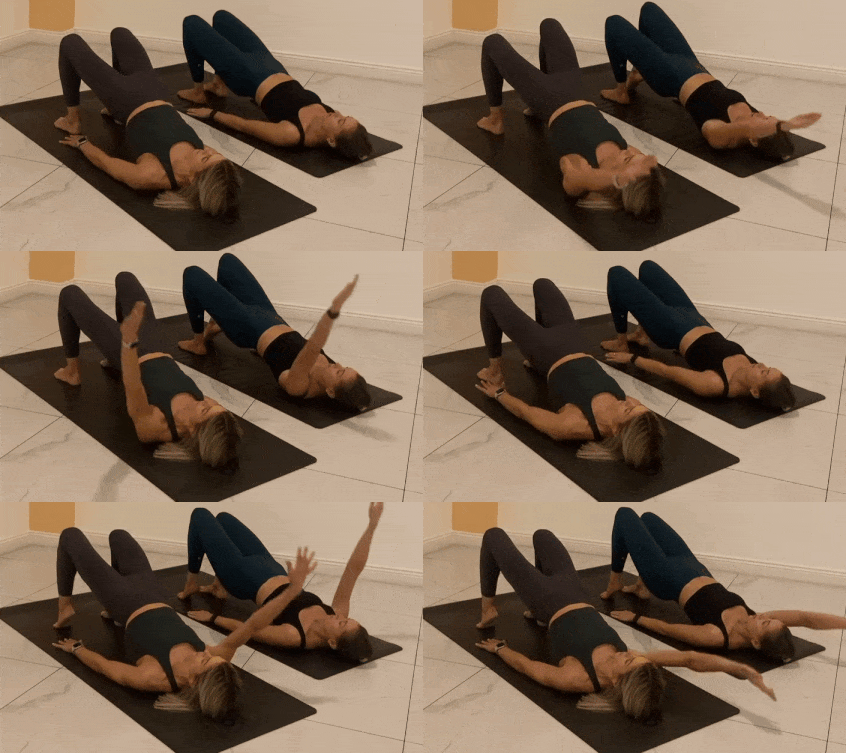
Lie on your back with knees bent and feet flat. Lift the hips into a bridge position. While holding the bridge, raise the heels off the floor and extend one or both arms overhead, maintaining pelvic stability.
Muscles Worked
- Gluteus maximus
- Hamstrings
- Deep core stabilizers
- Calves (stabilizing role)
Key Tips
- Keep the ribs down and pelvis neutral
- Avoid shifting weight side to side
- Maintain steady breathing
How to Modify
Remove the heel raise or arm reach.
Benefits for Core Strength
This exercise trains posterior chain engagement combined with core stability, improving force transfer through the hips and trunk.
Difficulty Level
Intermediate to Advanced
#19 Adductor Hold With Side-Lying Single-Leg Lift
How to Perform
Lie on your side with the bottom leg extended and the top leg bent in front for support. Lift the bottom leg off the floor and hold briefly while maintaining trunk alignment. Lower with control and repeat.

Muscles Worked
- Inner thighs (adductors)
- Obliques
- Pelvic stabilizers
- Deep core muscles
Key Tips
- Keep the torso stable
- Avoid rolling backward
- Use slow, controlled lifts
How to Modify
Lift the leg only slightly or reduce hold time.
Benefits for Core Strength
This exercise strengthens the medial chain, which supports pelvic control and lower-body alignment.
Difficulty Level
Advanced
#20 Forearm-Supported Lean Back With Double Toe Tap
How to Perform
Sit with forearms on the mat behind you and torso leaning slightly back. Lift both legs into a tabletop position. Tap both toes lightly to the floor while maintaining trunk stability, then return to the starting position.

Muscles Worked
- Rectus abdominis
- Transverse abdominis
- Hip flexors
- Spinal stabilizers
Key Tips
- Keep the chest open and spine neutral
- Avoid collapsing through the shoulders
- Control both lowering and lifting phases
How to Modify
Tap one foot at a time or reduce the lean angle.
Benefits for Core Strength
This exercise challenges anti-extension strength and hip–core coordination.
Difficulty Level
Advanced
#21 Forearm Plank to Dolphin
How to Perform
Start in a forearm plank position. Press through the forearms to lift the hips upward into a dolphin position, then return to plank with control.

Muscles Worked
- Shoulders
- Transverse abdominis
- Rectus abdominis
- Gluteal muscles
Key Tips
- Keep the elbows planted
- Move the hips, not the spine
- Maintain steady breathing
How to Modify
Limit the range of motion or hold a static plank.
Benefits for Core Strength
This movement improves core stability during shoulder-driven movements, which is useful for overhead strength and upper-body control.
Difficulty Level
Advanced
#22 Bird Dog With Sweeping Arm and Knee
How to Perform
Begin on all fours. Extend the opposite arm and leg, then sweep the arm and knee inward toward each other under the torso before extending again. Switch sides with control.

Muscles Worked
- Deep core stabilizers
- Gluteus maximus
- Shoulder stabilizers
- Obliques
Key Tips
- Keep the pelvis level
- Avoid rushing the sweep
- Maintain spinal alignment
How to Modify
Pause briefly in the extended position without the sweep.
Benefits for Core Strength
This variation reinforces cross-body coordination and anti-rotation control, essential for athletic movement patterns.
Difficulty Level
Intermediate to Advanced
Pilates vs. Other Core-Strengthening Workouts
Many training systems claim to build a strong core, but they do not all train the core in the same way or for the same purpose. Understanding how Pilates compares to other popular core-strengthening approaches helps clarify when—and why—Pilates fits into a well-rounded training plan.
Pilates vs. Traditional Ab-Based Training
Traditional core workouts often emphasize isolated abdominal exercises such as crunches, sit-ups, and leg raises. These movements primarily train spinal flexion and local muscular endurance.
Pilates takes a different approach. Instead of repeatedly bending the spine, Pilates focuses on stabilizing the trunk while the limbs move, reinforcing control, alignment, and coordination.
Key differences:
- Traditional ab training prioritizes muscle fatigue and repetition
- Pilates prioritizes control, posture, and integrated stability
- Pilates places greater emphasis on deep core muscles and spinal support
This makes Pilates especially useful for individuals who want functional core strength rather than just visible abdominal definition.
Pilates vs. Heavy Compound Lifts
Heavy compound exercises such as squats, deadlifts, and presses challenge the core indirectly by placing high demands on trunk stability under load. These lifts play a crucial role in building overall strength and power.
However, heavy lifting alone does not always address:
- asymmetries in core control
- movement compensation patterns
- spinal awareness and precision
Pilates complements compound lifting by improving core control and movement quality, which often leads to better lifting technique and reduced strain on the spine.
Pilates vs. Machine-Based Core Training
Core machines often guide movement along fixed paths, reducing the need for active stabilization. While machines can help beginners feel safer, they limit the core’s role in maintaining balance and alignment.
Pilates requires active control throughout the entire movement, challenging the core to stabilize the body in multiple planes without external support. This makes Pilates more transferable to real-world movement and sport.
Pilates vs. High-Intensity Core Circuits
High-intensity circuits and metabolic-style core workouts emphasize speed, volume, and fatigue. While they can improve conditioning, they often sacrifice precision and control—especially under fatigue.
Pilates prioritizes quality over quantity. The slower tempo and focus on technique help reinforce proper movement patterns, reducing injury risk and improving long-term progress.
Where Pilates Fits Best
Pilates does not replace traditional strength training, athletic conditioning, or high-intensity workouts. Instead, it works best as:
- a foundation for core stability
- a corrective or supportive tool alongside strength training
- a low-impact option for improving control, posture, and movement efficiency
When combined intelligently with other training methods, pilates for core strength enhances overall performance by addressing what many workouts overlook: how the body holds itself together during movement.
4-Week Pilates for Core Strength Training Program
This 4-week program builds core strength progressively through control, stability, and coordination, not through exhaustion. Each week increases either complexity, volume, or control demands while respecting Pilates principles.
- Frequency: 3 sessions per week
- Session duration: 25–40 minutes
- Rest: Minimal, focus on control and breathing
- Tempo: Slow and controlled on all movements
Week 1 – Core Awareness & Stability Foundations
Goal: Learn proper core engagement, breathing, and spinal control.
| Exercise | Sets | Reps / Time |
|---|---|---|
| Pilates Breathing | 2 | 6–8 slow breaths |
| Shoulder Bridge Prep | 2 | 8–10 reps |
| Toe Taps | 2 | 6–8 reps per side |
| One Leg Circle | 2 | 6 circles per side |
| Side Leg Lifts | 2 | 10 reps per side |
| Swimming Prep (Bird Dog) | 2 | 6–8 reps per side |
| Plank | 2 | 20–30 sec |
Coaching focus:
Neutral spine, slow tempo, no rushing.
Week 2 – Control Through Movement
Goal: Maintain spinal stability while increasing limb movement complexity.
| Exercise | Sets | Reps / Time |
|---|---|---|
| Pilates Breathing | 2 | 6 breaths |
| Single Leg Stretch | 2 | 8–10 reps per side |
| Sidekick | 2 | 8 reps per side |
| Shoulder Bridge Prep | 2 | 10 reps |
| Leg Pull Front Prep (Hovers) | 2 | 6–8 reps per side |
| Crisscross | 2 | 8 reps per side |
| Plank | 2 | 30 sec |
Coaching focus:
The pelvis stays stable while the limbs move freely.
Week 3 – Strength, Coordination & Anti-Movement
Goal: Challenge anti-extension, anti-rotation, and lateral stability.
| Exercise | Sets | Reps / Time |
|---|---|---|
| Roll Down | 2 | 6 reps |
| Side Bend Preparation | 2 | 6–8 reps per side |
| One Leg Circle | 2 | 8 circles per side |
| Swan Dive Prep | 2 | 6–8 reps |
| Forearm Side Plank w/ Hip Lift | 2 | 6 reps per side |
| Leg Pull Front Prep | 2 | 8 reps |
| Plank | 2 | 35–45 sec |
Coaching focus:
Quality over range of motion. Stop if control drops.
Week 4 – Advanced Core Integration
Goal: Integrate strength, balance, and coordination under higher demands.
| Exercise | Sets | Reps / Time |
|---|---|---|
| Pilates Breathing | 1 | 6 breaths |
| Bear Plank w/ Toe Taps → Downward Dog | 2 | 6–8 reps |
| Glute Bridge w/ Arm Reach & Heel Raise | 2 | 8 reps |
| Adductor Hold + Side-Lying Leg Lift | 2 | 6–8 reps per side |
| Forearm-Supported Lean Back + Double Toe Tap | 2 | 6–8 reps |
| Forearm Plank to Dolphin | 2 | 8 reps |
| Bird Dog w/ Sweeping Arm & Knee | 2 | 6 reps per side |
Coaching focus:
Controlled transitions, steady breathing, zero momentum.
How to Progress After Week 4
After completing this program, you can:
- Increase time under tension (slower tempo)
- Add light resistance (band or small ball)
- integrate Pilates sessions alongside gym-based strength training
- Repeat Weeks 3–4 with higher control demands
Pilates works best when you progress precision before intensity.
Conclusion
Building a strong core goes far beyond chasing visible abs or muscle fatigue. True core strength depends on stability, control, and coordination, and this is precisely where Pilates excels. By training the body to maintain spinal alignment as the limbs move with precision, Pilates develops the core strength that supports performance, posture, and long-term joint health.
When applied correctly, pilates for core strength complements traditional strength training rather than competing with it. It improves movement quality, reinforces deep core activation, and helps reduce unnecessary strain on the spine and hips. For beginners, it creates a solid foundation; for experienced lifters and athletes, it fills critical gaps that heavy training often leaves behind.
Used consistently, Pilates becomes more than a workout—it becomes a movement education tool that teaches the body how to move efficiently and stay resilient. Whether your goal is better lifting technique, improved posture, or a pain-free, stable core, Pilates offers a structured, sustainable path to stronger, smarter movement.
Key Takeaways
- Pilates for core strength focuses on spinal stability, control, and movement quality—not muscle fatigue.
- The core includes the abdominals, lower back, hips, glutes, inner thighs, and pelvic floor working as one system.
- Pilates trains the core to resist unwanted movement while the arms and legs move independently.
- Low-impact Pilates exercises improve deep core activation without overloading the spine.
- Pilates complements strength training by improving posture, control, and force transfer.
- Both beginners and advanced trainees benefit from Pilates when they prioritize precision over intensity.
- Progress in Pilates comes from better control, breathing, and coordination—not heavier resistance.
- A structured Pilates program builds a strong, stable, and injury-resistant core over time.
Is Pilates effective for core strength?
Yes. Pilates improves core strength by training spinal stability, deep core activation, and controlled movement rather than relying on muscle fatigue.
How often should you do Pilates for core strength?
Most people benefit from Pilates core training 2–3 times per week, especially when combined with strength training.
Can Pilates replace traditional core workouts?
Pilates does not replace all core training but complements it by improving control, posture, and movement quality.
Is Pilates suitable for beginners?
Yes. Pilates uses low-impact exercises that scale easily for beginners while remaining challenging for advanced trainees.
Does Pilates help with lower back pain?
Pilates often reduces lower-back discomfort by improving spinal stability, posture, and movement control.
Can men benefit from Pilates core training?
Absolutely. Men benefit from improved mobility, core control, and reduced movement compensations.
How long does it take to see results from Pilates?
Most people notice better control and posture within 3–4 weeks of consistent training.
Is Pilates good for athletes and lifters?
Yes. Pilates improves force transfer, stability, and coordination, which support lifting performance and athletic movement.
