
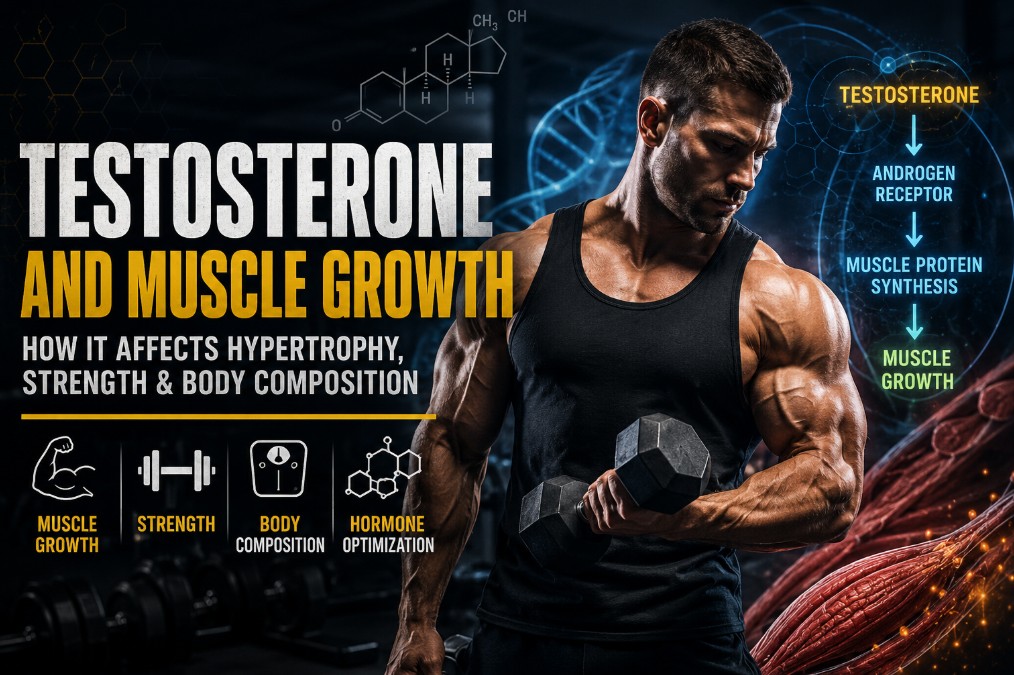
Testosterone unquestionably matters for muscle. Yet many things lifters do to “boost testosterone”—shortening rest periods, choosing certain exercises, keeping workouts under 60 minutes—may have little to do with how much muscle they ultimately build.
If testosterone builds muscle, why doesn’t every temporary increase in testosterone produce more hypertrophy?
That question is the spine of this entire article.
QUICK ANSWER: Testosterone is important for maintaining and building skeletal muscle, but context matters. Low testosterone can impair muscle maintenance and body composition, while supraphysiological testosterone can substantially increase muscle mass. Within normal physiological conditions, however, small differences or temporary post-workout spikes in testosterone do not translate directly into proportional differences in hypertrophy.
What Is Testosterone?
Where Is Testosterone Produced?
Testosterone is produced primarily by the Leydig cells of the testes in men, with smaller amounts produced by the ovaries and adrenal glands; in women, the adrenal glands and ovaries are the primary sources, but produce much less overall.
How Is Testosterone Production Controlled?
The regulatory pathway follows a clear chain: the hypothalamus releases gonadotropin-releasing hormone (GnRH), which signals the pituitary gland to release luteinizing hormone (LH), which then signals the Leydig cells to produce testosterone. Rising testosterone feeds back to the hypothalamus and pituitary to dial the signal back down — the same kind of negative feedback loop that governs most of the hormones covered in this category.
Total vs. Free Testosterone
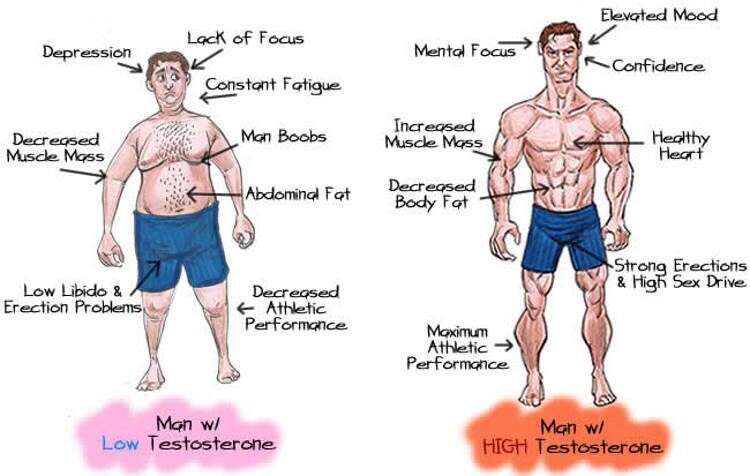
This distinction matters more than most lifters realize. Most circulating testosterone is bound to proteins in the blood — primarily sex hormone-binding globulin (SHBG) and, to a lesser extent, albumin. Only a small fraction circulates as “free” testosterone, unbound and biologically active at target tissues. A lab report showing “total testosterone” isn’t telling you the complete story on its own.
What Is SHBG?
Sex hormone-binding globulin is a protein produced mainly by the liver that binds testosterone (and other sex hormones) in the bloodstream, effectively taking it out of immediate circulation for use at tissues. SHBG levels themselves can shift with body composition, thyroid status, and other factors — which is part of why two men with identical total testosterone readings can have meaningfully different free testosterone.
Testosterone and Muscle Growth
How Does Testosterone Act on Skeletal Muscle?
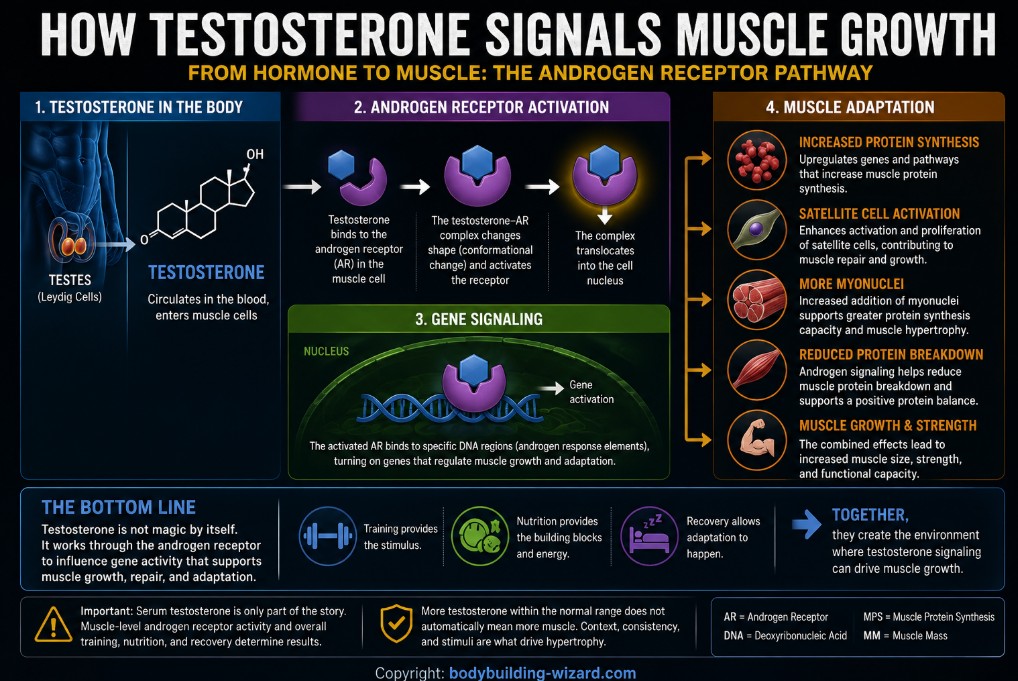
At the cellular level, testosterone binds to the androgen receptor (AR) inside muscle cells, and this receptor-hormone complex moves into the nucleus, where it influences gene expression related to muscle protein metabolism. In plain terms: testosterone isn’t acting on muscle from the outside — it’s getting inside the cell and directly influencing what genes get switched on.
Testosterone and Muscle Protein Synthesis
Testosterone does influence muscle protein synthesis, but it’s worth resisting the urge to reduce this entire hormone’s story to a single mechanism. Research on testosterone administration in men has shown measurable increases in muscle protein synthesis rates, but the magnitude and consistency of this effect vary across studies and populations—younger versus older men, and physiological versus supraphysiological dosing don’t all show identical responses. Testosterone’s effects on skeletal muscle run through several parallel pathways — protein synthesis is one of them, not the whole story.
Testosterone, Satellite Cells and Myonuclei
This is genuinely one of the more scientifically compelling parts of testosterone physiology, and it’s underused in most fitness content. A classic human study by Sinha-Hikim and colleagues found that testosterone-induced muscle fiber hypertrophy in healthy young men was associated with a dose-dependent increase in satellite cell number — the post-treatment satellite cell percentage differed significantly across dose groups, and myonuclear number increased significantly in the groups receiving the two higher testosterone doses. Satellite cells are the source of new myonuclei in mature muscle fibers, since existing muscle nuclei can’t divide — this is a genuine, well-documented structural mechanism behind testosterone’s anabolic effect, not just a vague “it helps build muscle” claim.
Testosterone and Muscle Protein Breakdown
Alongside its effects on synthesis and satellite cell activity, testosterone also has anti-catabolic properties, contributing to a more favorable net protein balance — similar in spirit to how we described insulin’s anti-catabolic role, though through a different receptor pathway.
Does More Testosterone Mean More Muscle?
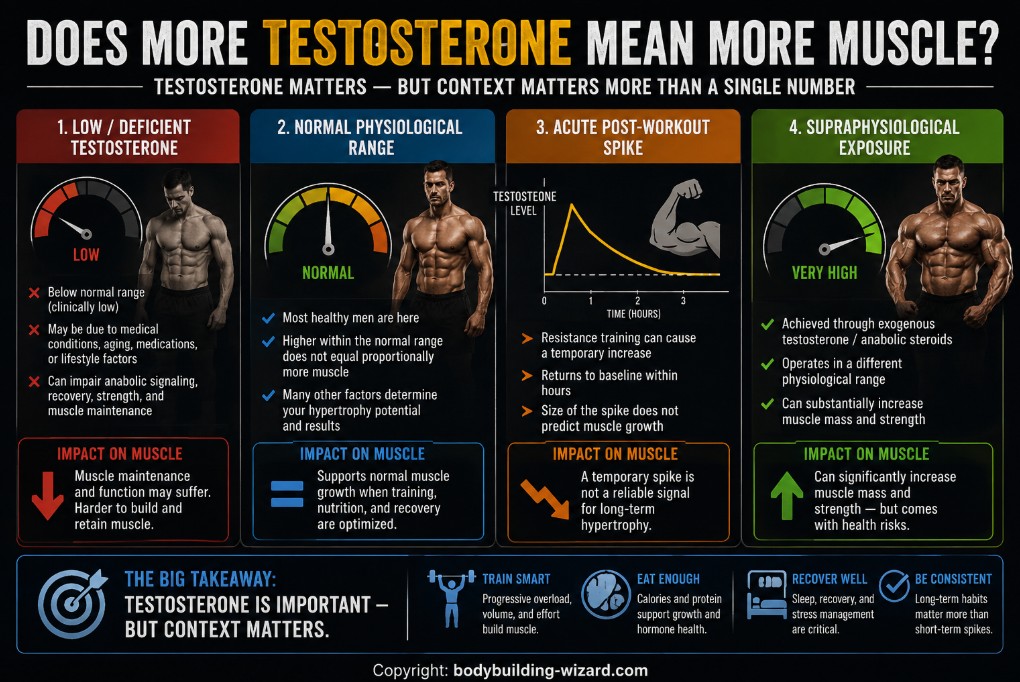
This is one of the most important questions this article answers, and the honest answer depends entirely on context.
| Testosterone Context | What It Means for Muscle |
|---|---|
| Clinically low/deficient | Can compromise muscle mass and function |
| Normal physiological range | Higher levels don’t simply produce proportionally greater gains |
| Temporary exercise-induced increase | A poor target for predicting hypertrophy |
| Supraphysiological exposure | Can substantially increase muscle mass |
This table is the heart of the article. It explains why testosterone research can seem to say contradictory things depending on which study you read — because these are four genuinely different physiological contexts, not one continuous dial where “more is always proportionally better.”
Natural Testosterone vs. Supraphysiological Testosterone
This distinction deserves its own section because bodybuilding culture often uses results from one context to justify expectations in a completely different one. The logic usually goes: “if testosterone builds muscle, naturally boosting mine by some percentage should give me noticeably more gains.” That reasoning doesn’t hold up.
The classic reference point here is a randomized, placebo-controlled trial by Bhasin and colleagues, published in the New England Journal of Medicine. Forty-three men were assigned to one of four groups: placebo without training, testosterone without training, placebo with training, or testosterone with training, and received weekly injections of 600 mg testosterone enanthate—a clearly supraphysiological dose—over 10 weeks. Both testosterone groups gained significantly more fat-free mass, muscle size (measured by MRI), and strength than the placebo groups, even the testosterone-without-training group.
This is a genuinely important, dose-dependent finding — but it’s a study of pharmacological, supraphysiological testosterone exposure, using a dose (600 mg weekly) far beyond anything produced by natural physiology or lifestyle interventions. It shows that a large enough, sustained increase in testosterone clearly increases muscle size. It does not tell us that a modest, natural increase — the kind you might get from better sleep, more consistent training, or a “testosterone-boosting” supplement — produces a proportionally scaled-down version of the same effect. Dose-response relationships in physiology are often non-linear, closer to a threshold-and-plateau pattern than a straight line, and this is a clear example. A supplement or lifestyle change that shifts your testosterone by a small, single-digit percentage within the normal range operates in an entirely different part of that curve than a tenfold pharmacological dose increase.
Testosterone and Androgen Receptors: The Missing Part of the Story
This is where this article can genuinely offer something most bodybuilding content doesn’t. Serum testosterone isn’t the only part of the story — androgen receptor signaling at the muscle level matters independently, and there’s compelling human research showing these two things don’t always move together.
A study by Cardaci and colleagues had resistance-trained men complete volume- and intensity-matched low-load and high-load full-body resistance exercise sessions. High-load exercise significantly increased androgen receptor-DNA binding in skeletal muscle three hours post-exercise — but this happened without any corresponding increase in serum or muscle testosterone, muscle dihydrotestosterone, or total androgen receptor content. In fact, serum free testosterone was significantly decreased, not increased, at the same time point. The researchers concluded that a different signaling pathway (involving β-catenin) likely facilitated this androgen receptor activation independent of circulating hormone levels.
Here’s the sentence this finding earns: the testosterone concentration in your blood is not a complete measure of the androgen signal occurring inside trained muscle. Heavy training can activate androgen-receptor signaling through mechanisms unrelated to how much testosterone is circulating in your bloodstream at that moment.
What Happens to Testosterone During Resistance Training?
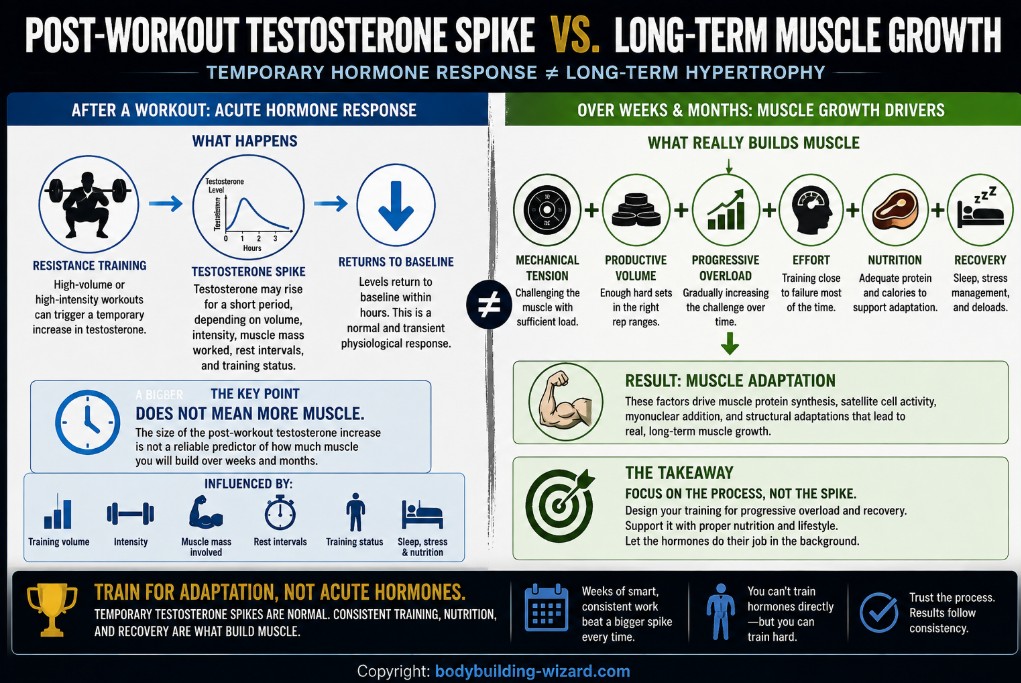
Certain resistance training sessions can acutely raise testosterone. Factors that influence the size of that response include training volume, the amount of muscle mass involved, intensity, rest interval length, and training status. This is genuine, well-documented acute exercise physiology.
Do Post-Workout Testosterone Spikes Increase Muscle Growth?
This needs an honest answer, not an overcorrection. Individual studies have found associations between the exercise-induced testosterone response and measures of muscle growth in specific contexts. But the broader body of research hasn’t shown a reliable, consistent link between transient systemic testosterone elevations and long-term hypertrophy. A large cohort study by West and Phillips, tracking 56 young men through 12 weeks of resistance training, found no significant correlations between acute post-exercise testosterone elevation and actual gains in lean body mass or strength.
The honest summary: this is exactly why the acute hormone spike isn’t a good training target, even though it isn’t accurate to claim “no study has ever found any association.” The weight of evidence points toward the acute spike being a poor predictor of your actual results.
Should You Train to Maximize Testosterone?
No — and this section can correct several specific, extremely common training myths at once.
Do Squats Boost Testosterone?
Squats and other large-muscle-mass compound exercises can produce a meaningful acute hormonal response. But that’s not why you should be squatting — you should squat because it’s an efficient, effective way to load a large amount of muscle with mechanical tension, not because of what it does to a hormone panel afterward. This applies to leg training generally, not just squats specifically — see our deep dive on leg day and testosterone for the full picture, including why a bigger hormone spike from leg training doesn’t help unrelated muscles like your arms or chest grow faster.
Are Compound Exercises Better Because They Raise Testosterone?
Not on the basis of that mechanism. Compound exercises are valuable because they load more muscle volume efficiently and generate more mechanical tension; the hormonal response is a side effect, not the reason to program them.
Do Short Rest Periods Increase Testosterone?
Shorter rest periods can influence the acute hormonal response. But if shorter rest intervals force you to reduce the weight or reps you can perform on subsequent sets, you’re trading away productive training volume for a hormone spike that, based on the evidence above, isn’t a reliable growth driver anyway. That’s a bad trade.
Should Workouts Stay Under 60 Minutes?
This deserves the same correction we gave it in our cortisol article: there’s no evidence-backed magic cutoff where a workout suddenly becomes counterproductive at the 60-minute mark. Total volume, intensity, and recovery capacity matter far more than a rigid clock.
Is There a Best Time of Day to Train for Testosterone?
Train when you can perform consistently well and fit training into your life sustainably — not according to a hormone chart. Consistency and training quality over time will outweigh any theoretical advantage from training at your daily testosterone peak.
What Actually Drives Hypertrophy If Not Testosterone Spikes?
After correcting a myth, a reader deserves a replacement model—and this one is genuinely well supported. The drivers that matter are mechanical tension, sufficient productive training volume, consistent progressive overload, effort and proximity to failure, adequate protein and energy availability, and sufficient recovery. Recent hypertrophy research has increasingly emphasized load-induced, mechanotransductive signaling — the direct mechanical and cellular response to how a muscle is loaded — over systemic acute hormone fluctuations as the primary driver of growth.
Testosterone provides part of the biological environment in which adaptation occurs. It is not the workout variable you should be optimizing session by session.
In practical terms, this reframes many common training decisions. Instead of asking “which exercise raises testosterone the most,” ask “which exercise lets me apply the most productive mechanical tension with good technique.” Instead of asking “how short should my rest periods be to spike hormones,” ask “how much rest do I need to hit my target reps and weight on the next set?” The training variables that actually predict your results over months and years are the boring, unglamorous ones — consistent overload, adequate volume, and enough recovery to keep applying both — not the ones that produce the most dramatic hormone panel immediately after a session.
Testosterone and Strength
Worth a brief, separate note: muscle growth and strength gain are not the same thing. Testosterone can influence muscle mass, but strength also depends heavily on neural adaptation, skill, technique, and joint/limb architecture — factors that have nothing to do with circulating hormone levels. Two lifters with identical testosterone and identical muscle size can have meaningfully different strength on a given lift because of technique and neural efficiency alone.
Coach’s Note: I don’t program workouts around testosterone spikes. I pick exercises because they let someone apply real mechanical tension with good technique, I structure rest periods around maintaining load and reps — not around a hormone chart — and I choose training volume based on what a person can actually recover from. Every time I’ve seen a lifter chase “T-boosting” workout tricks instead of just training hard and consistently, their actual progress has been slower, not faster.
Testosterone and Body Composition
Does Testosterone Help With Fat Loss?
Be careful with the framing here — testosterone shouldn’t be called a “fat-burning hormone.” It has genuine effects on body composition, particularly at low or supraphysiological levels, but at normal physiological ranges it isn’t a fat-loss lever to chase the way some marketing implies.
Body Fat and Testosterone
The relationship runs both ways, and it’s worth explaining without the body-shaming framing that shows up in much older content on this exact topic. Higher body fat — particularly visceral fat — is associated with lower testosterone, partly through increased conversion of testosterone to estrogen in fat tissue via the enzyme aromatase, and partly through other metabolic pathways linked to insulin resistance and inflammation. At the same time, testosterone itself influences body composition, including fat distribution and lean mass maintenance. It’s a genuinely bidirectional relationship, not a simple one-directional cause — which is exactly why the calorie-restriction research covered in the next section produces such different results depending on someone’s starting body fat level.
Testosterone During a Bodybuilding Cut
This is where this article becomes something a generic medical resource simply isn’t built to provide.
Does Calorie Restriction Lower Testosterone?
It depends heavily on starting body composition and the deficit’s severity — and the research is genuinely more nuanced than most bodybuilding content presents. A systematic review and meta-analysis on calorie restriction and testosterone in men found a striking split: in overweight or obese men, calorie restriction significantly increased total testosterone in 3 of 4 studies—likely reflecting reduced aromatization as body fat decreases. But in normal-weight, healthy men, calorie restriction significantly decreased testosterone in 2 of 3 studies. The same intervention, in other words, moves testosterone in opposite directions depending on where you’re starting from.
Does Getting Very Lean Lower Testosterone?
This is where the concept of low energy availability (LEA) becomes directly relevant, particularly for lean, drug-free bodybuilders. LEA — insufficient dietary energy relative to exercise expenditure, generally referenced around a threshold near 30 kcal per kg of fat-free mass per day in the sports science literature — is a recognized driver of hormonal disruption in athletes, including suppressed testosterone. This risk climbs specifically as deficits become large, sustained, and combined with already-low body fat — exactly the conditions of a hard contest prep, not a moderate recreational cut.
Contest Prep and Testosterone
A revealing case report tracking a natural male bodybuilder through a 7-month pre-competition period documented exactly this pattern: as energy intake dropped roughly 28% and daily activity rose substantially, testosterone declined progressively through the prep, reaching its lowest point in the week before the show, alongside rising cortisol. This is a genuinely useful reference point for what an aggressive natural contest prep looks like hormonally—a real physique-athlete data point, not a generalization borrowed from unrelated clinical populations.
It’s also worth being precise about dietary fat here specifically, since it’s commonly blamed in isolation. A review of nutritional recommendations for physique athletes notes that while dietary fat and testosterone are correlated in some populations, findings in bodybuilders specifically suggest this relationship is more about overall energy availability than fat intake in isolation — one case study documented a 72% testosterone decrease in a bodybuilder with only minimal relative changes in fat intake, implicating the broader energy deficit rather than fat grams specifically.
Testosterone During Bulking vs. Cutting
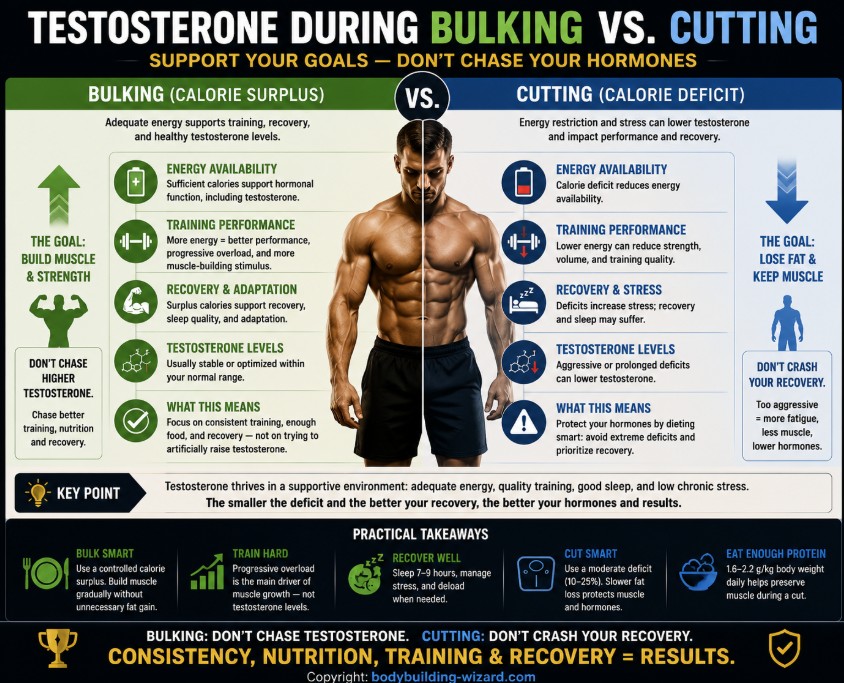
| Bulking | Cutting | |
|---|---|---|
| Energy availability | Higher | Lower |
| Primary goal | Muscle gain | Muscle retention + fat loss |
| Endocrine stress | Usually lower | Can rise as the deficit becomes aggressive |
| Testosterone concern | Don’t chase higher levels | Avoid unnecessary suppression |
| Coaching priority | Controlled surplus + training | Sustainable deficit + recovery |
Sleep and Testosterone
Sleep and testosterone are genuinely linked, but resist turning this into “sleep = testosterone hack.” Chronic inadequate sleep can negatively affect the broader endocrine and recovery environment your training depends on — testosterone is one part of that picture, not the whole reason sleep matters. See our complete guide to sleep for bodybuilders and athletes for the fuller framework — and if you’ve seen claims that sleeping without clothes affects testosterone, we’ve examined that claim elsewhere on this site.
Diet and Testosterone
Does Dietary Fat Affect Testosterone?
As covered above in the contest prep section, dietary fat’s relationship with testosterone in lifters appears to run mostly through overall energy availability rather than fat grams specifically.
Do Carbohydrates Affect Testosterone?
Carbohydrate availability interacts with overall energy status and training performance more than it independently drives testosterone up or down in a way worth optimizing for its own sake.
Does Protein Affect Testosterone?
Adequate protein supports the broader nutritional environment training and recovery depend on — it isn’t a testosterone-specific lever either.
Micronutrient Deficiencies
Correcting a genuine deficiency (in nutrients like zinc or vitamin D, when actually deficient) can normalize testosterone in someone who was deficient — that’s meaningfully different from claiming supplementation above adequate levels provides an additional testosterone boost.
The theme across this entire section: adequacy matters far more than testosterone-hacking your diet. Eating enough, consistently, of a reasonably complete diet does more for your hormonal environment than any single “T-boosting” food or supplement.
Can You Naturally Increase Testosterone?
Optimize Normal Physiology — Don’t Chase a “Boost”
The practical levers that actually matter: maintaining a healthy body composition, ensuring sufficient energy availability, consistent resistance training, adequate sleep, correcting any genuine nutrient deficiencies, and managing excessive training relative to your recovery capacity. None of this is about “hacking” a hormone — it’s about not sabotaging the normal physiology that’s already working. That includes being skeptical of viral behavioral “hacks” too — power posing is a good example of a widely repeated claim that a two-minute posture change measurably raises testosterone, which failed to hold up under independent replication.
Do Testosterone Boosters Actually Work?
This deserves a direct answer without reviewing 30 individual products. The key distinction is between correcting a genuine deficiency — which can meaningfully normalize testosterone in someone who was actually low — and raising testosterone above already-normal physiology enough to materially increase muscle growth, which is a fundamentally different claim that the vast majority of over-the-counter “testosterone booster” products have not demonstrated.
Feeling sluggish or unmotivated lately? Reignite your strength and energy with the best testosterone boosters for men — hand-picked for real performance results.
🔥 Read the Full ReviewTestosterone in Women: Can Women Build Muscle With Much Lower Levels?
This is one of the best teaching points available on this entire topic. Women have roughly a tenth of the circulating testosterone that men do — yet resistance training still produces substantial hypertrophy. A 2025 systematic review and Bayesian meta-analysis comparing muscle size changes between sexes after resistance training found that while men showed a slight advantage in absolute muscle size gains, relative (percentage) increases from baseline were similar between men and women.
This is genuinely one of the clearest demonstrations available that serum testosterone level is not a simple “muscle-building score.” If it were, the roughly ten-fold difference in baseline testosterone between men and women should produce a correspondingly enormous difference in relative training response — and it doesn’t. Something beyond the raw serum number is clearly determining a large share of the outcome. If you’re a woman specifically interested in strength training, see our guide to women and weight training and our breakdown of common myths in women’s strength training.
Low Testosterone: When It Becomes a Medical Issue
How Is Low Testosterone Diagnosed?
Proper diagnosis requires consistent, relevant symptoms and appropriately obtained blood testing—not a single number in isolation. Guidelines from the Endocrine Society recommend diagnosing hypogonadism based on consistent symptoms and signs combined with unequivocally and repeatedly low morning testosterone concentrations, measured with a reliable assay method — a single test result, especially one drawn at the wrong time of day, isn’t considered adequate for diagnosis.
Total vs. Free Testosterone in Testing
As covered earlier in this article, total testosterone alone doesn’t tell the complete story — free or bioavailable testosterone can matter clinically, particularly in men with conditions affecting SHBG levels.
When to Talk to a Doctor
If you have persistent symptoms consistent with low testosterone — and you want a proper diagnosis rather than guesswork from a symptom checklist — that conversation belongs with a physician who can order appropriately timed, repeated testing.
What About TRT and Testosterone Use in Bodybuilding?
This needs to be here because search intent around this topic will inevitably arrive at this question, the same way it did in our insulin and growth hormone articles.
TRT (testosterone replacement therapy) is a medical treatment for a properly diagnosed case of hypogonadism, following the diagnostic process described above. This is fundamentally different from supraphysiological testosterone or broader AAS use for physique enhancement, which is an entirely separate context, with its own distinct risk profile — and this article isn’t the place for doses, cycles, or stacking protocols, and we’re not providing any.
Bodybuilder’s Take
Don’t train to boost testosterone. Train to build muscle—and support the hormonal environment that lets you recover and adapt.
Common Testosterone Myths in Bodybuilding
❌ Myth: More testosterone always means more muscle.
✅ Reality: Within the normal physiological range, higher testosterone doesn’t produce proportionally greater muscle gains — context (deficient, normal, or supraphysiological) determines the relationship.
❌ Myth: Squats make your whole body grow because they boost testosterone.
✅ Reality: Squats are effective because they load a large amount of muscle with mechanical tension, not because of the acute hormonal response that happens to accompany them.
❌ Myth: Short rest periods build more muscle because they raise testosterone.
✅ Reality: Short rest periods can raise the acute hormonal response, but if they reduce the weight or reps you can lift, you lose more in productive training volume than any hormone spike could offer.
❌ Myth: Workouts over 60 minutes crash testosterone and kill gains.
✅ Reality: There’s no evidence-backed cutoff at 60 minutes — total training volume, intensity, and recovery capacity matter far more than session length alone.
❌ Myth: You need to train specifically to maximize post-workout testosterone.
✅ Reality: Acute post-workout testosterone spikes show no reliable correlation with long-term gains in muscle or strength across the broader research.
❌ Myth: Testosterone boosters produce meaningful hypertrophy.
✅ Reality: Correcting an actual deficiency can normalize testosterone, but raising already-normal levels with over-the-counter boosters hasn’t been shown to meaningfully increase muscle growth.
❌ Myth: Getting one low testosterone result means you have low T.
✅ Reality: Proper diagnosis requires consistent symptoms plus repeated, appropriately timed testing — a single low reading isn’t sufficient for diagnosis.
❌ Myth: Women can’t build much muscle because their testosterone is low.
✅ Reality: Despite roughly a tenth of the testosterone levels of men, women show similar relative muscle growth from resistance training — proof that serum testosterone alone isn’t a simple muscle-building score.

