


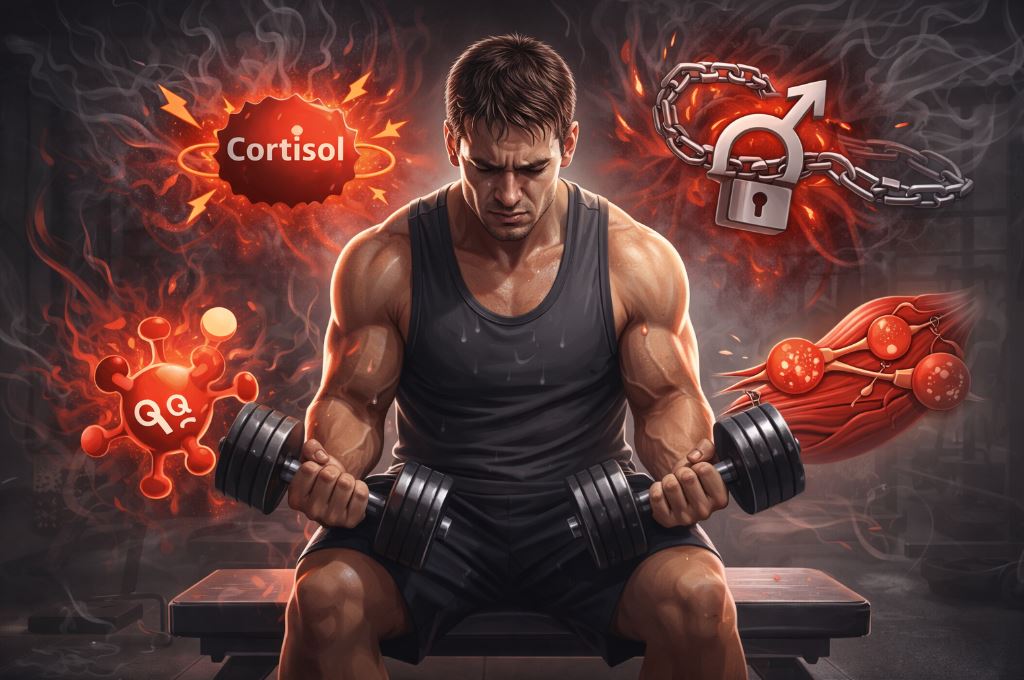
Introduction: When Effort Is Not the Problem
One of the most frustrating experiences in fitness is doing everything “right” and still not seeing results. You train consistently, follow a structured program, eat plenty of protein, and yet your muscles seem to grow slowly—or not at all. Meanwhile, others appear to make progress with far less effort.
This is where most people are told they need more discipline, better genetics, or stronger willpower. In reality, muscle growth is not a moral trait. It is a biological process governed by hormones, cellular capacity, the state of the nervous system, and energy availability.
Some people are not failing because they lack motivation—they are failing because their bodies are operating in a physiological state that does not allow efficient muscle building. Understanding that state is the first step to changing it.
This article explains the real biology behind slow muscle growth, and why “hardgainers” are often not broken—they are simply stuck behind invisible physiological roadblocks.
The main reasons why you’re not building muscle include hormonal imbalances, low satellite cell activity, chronic stress and nervous system overload, insufficient energy availability, and the way your genes are currently being expressed.
In practical terms, this means that training harder is rarely the solution. The real breakthrough happens when you restore your hormonal balance, support satellite cell function, reduce chronic stress, and give your body enough energy and recovery to allow growth.
What Determines Your Ability to Build Muscle?
Muscle growth is not triggered by training alone. It occurs only when three fundamental conditions are met at the same time:
- A growth signal
- Sufficient biological resources
- Permission from the body to build tissue
Training provides the signal. Nutrition provides the resources. Hormones and cellular mechanisms provide the permission.
When you lift weights, you create mechanical stress inside the muscle fibers. This signals that the muscle needs to become stronger. But that message must be approved at multiple biological levels before any actual growth can occur.
At the hormonal level, anabolic hormones such as testosterone, IGF-1, and insulin must outweigh catabolic signals like cortisol and myostatin. At the cellular level, satellite cells must be active and capable of donating new nuclei to muscle fibers. Finally, at the systemic level, your nervous system must be in a recovery-capable state rather than chronic fight-or-flight.
If any one of these layers is impaired, muscle growth slows—or stops completely.
This is why two people can perform the same workout and eat similar diets yet experience very different results. One body is in a growth-permissive state. The other is not.
Building muscle is not about forcing your body harder. It is about creating the internal conditions that allow biological growth.
Hormonal Roadblocks to Muscle Growth
Even the best training program cannot overcome a poor hormonal environment. Hormones are the chemical messengers that tell your body whether it should build tissue or break it down, and for muscle growth, that message must be clearly anabolic.
When this balance is disrupted, your muscles stop responding to training, no matter how hard you work.
Low Testosterone
Testosterone is one of the primary regulators of muscle growth. It increases muscle protein synthesis, enhances neuromuscular efficiency, and supports satellite cell activation. When testosterone is low, your body becomes far less responsive to resistance training.
Low testosterone can result from:
- chronic stress
- sleep deprivation
- excessive dieting
- high body fat
- aging
Even modest reductions can dramatically slow hypertrophy (muscle growth).
Low IGF-1
IGF-1 is the hormone that links training stress to cellular growth. It stimulates satellite cell activation and directs nutrients toward muscle repair and expansion. If IGF-1 is suppressed—often due to calorie restriction, poor sleep, or metabolic stress—muscle fibers receive fewer growth signals even when training is intense.
Chronically Elevated Cortisol
Cortisol is necessary in short bursts, but when it stays high, it becomes one of the strongest blockers of muscle growth. It increases muscle protein breakdown, suppresses anabolic hormones, and interferes with satellite cell function.
People who live in constant stress, under-eat, or overtrain often remain stuck in a cortisol-dominant state that quietly erodes muscle.
Insulin Resistance
Insulin is not just a blood sugar hormone—it is also a nutrient-partitioning hormone. When insulin sensitivity is poor, calories and amino acids are less likely to be directed into muscle tissue and more likely to be stored as fat or used for energy.
This makes it much harder to create a net anabolic state, even when total calorie intake is high.
Together, these hormonal roadblocks explain why many people feel like their bodies are
“fighting” their training.
Without a supportive hormonal environment, the
muscle-building machinery simply does not turn on.
If you want to learn how to naturally optimize testosterone, IGF-1, growth hormone, and other key drivers of muscle growth, explore our in-depth guide: Key Muscle-Building Hormones: How to Naturally Boost Anabolic Hormones for Maximum Muscle Growth.
And to understand how cortisol, myostatin, and chronic stress quietly sabotage your progress — and how to control them — read: Catabolic Hormones Explained: How Cortisol, Myostatin, and Stress Affect Muscle Loss.
When these two sides of the hormonal equation are addressed together, your training finally starts working the way it should.
Satellite Cells and Muscle Growth Capacity
Muscle size is not determined only by how much protein you eat or how hard you train. It is limited by a deeper biological factor: the number of nuclei in your muscle fibers. This is where satellite cells become decisive.
Every muscle fiber has a finite ability to grow. As it gets thicker, its existing nuclei can only support a certain amount of protein synthesis. When that limit is reached, further growth stalls unless new nuclei are added. Satellite cells are the only way this happens.
When satellite cells are activated by strength training and a supportive hormonal environment, they multiply and fuse with muscle fibers, donating new nuclei. Each new nucleus expands the muscle’s capacity to produce contractile proteins, allowing continued hypertrophy.
Some people naturally have:
- higher satellite cell responsiveness
- greater nuclear retention
- better fusion efficiency
These individuals build and maintain muscle more easily. Others may train just as hard but fail to add or retain muscle mass, creating the “hardgainer” phenotype.
This is also why muscle loss is not just about shrinking fibers—it is about losing the biological infrastructure that allows regrowth. When stress, poor nutrition, aging, or chronic cortisol suppression impairs satellite cell activity, muscle fibers gradually lose nuclei, and their growth capacity declines.
In practical terms, satellite cells are not just about how fast you grow—they determine how big you are capable of becoming.
Chronic Stress and the Nervous System
One of the most overlooked reasons people struggle to build muscle is chronic nervous system stress. This has nothing to do with motivation or mental toughness—it is a physiological state in which the body is locked in survival mode.
Your nervous system has two main operating modes:
- Sympathetic (fight-or-flight) – stress, alertness, emergency energy
- Parasympathetic (rest-and-repair) – recovery, digestion, tissue building
Muscle growth requires parasympathetic dominance. Chronic stress pushes the body into persistent sympathetic activation, where the priority shifts from building tissue to simply surviving.
When this happens:
- cortisol remains elevated
- testosterone and IGF-1 decline
- insulin sensitivity worsens
- satellite cell activity is suppressed
Even with perfect training, the body no longer “approves” muscle growth.
Modern life makes this state extremely common. Long work hours, emotional stress, poor sleep, caffeine dependence, and constant stimulation keep the nervous system activated long after the workout ends. The body does not distinguish between psychological stress and physical stress—they both feed into the same hormonal pathways.
This is why many people feel wired but tired, train hard but recover poorly, and slowly lose muscle despite consistent effort. Their physiology is not broken—it is simply stuck in defense mode.
Restoring a recovery-dominant nervous system is one of the most powerful yet underused tools for unlocking muscle growth.
Energy Availability and Nutrition
Muscle growth is an energy-intensive process. Your body will not invest resources into building new tissue unless it senses that enough energy is available to support it. This is why so many lifters struggle to grow even when their training is solid—their physiology is quietly operating in a conservation mode.
Energy availability is not just about calories on paper. It reflects whether the body feels safe enough to allocate fuel to long-term projects, such as muscle building, rather than short-term survival.
When energy intake is too low, several things happen:
- cortisol rises
- IGF-1 falls
- thyroid output declines
- satellite cell activity is suppressed
This creates a biological state where muscle growth is “not allowed,” even if protein intake is high.
Carbohydrates play a particularly important role here. They reduce stress hormone output, improve training performance, and support insulin-mediated nutrient delivery into muscle tissue. Lifters who chronically restrict carbohydrates often experience greater fatigue, poorer recovery, and slower hypertrophy despite adequate protein intake.
Micronutrients matter as well. Iron, zinc, magnesium, iodine, and B vitamins all support energy metabolism, hormone production, and tissue repair. Deficiencies do not cause dramatic symptoms at first—but they quietly erode your ability to build and maintain muscle.
To grow muscle, your body must feel both mechanically challenged and metabolically supported. Training provides the challenge. Nutrition provides the signal that growth is safe.
Optimizing hormones and satellite cells is only part of the equation. Without the right nutritional strategy, even a perfect training plan cannot support muscle growth. For a clear, science-based framework on fueling recovery, muscle repair, and long-term hypertrophy, explore our in-depth guide: Muscle Recovery Nutrition Explained: What to Eat, When to Eat, and Why It Matters. When training, hormones, and nutrition are aligned, the body finally shifts into a state where building muscle is not a struggle — it becomes the natural outcome.
Genetics vs Epigenetics
Genetics determines the blueprint of your body, but epigenetics determines how that blueprint is expressed. This distinction explains why some people appear naturally muscular while others struggle, even when training and nutrition are similar.
Your genes influence:
- muscle fiber type distribution
- androgen receptor density
- baseline hormone levels
- satellite cell numbers
These factors set your starting point and your theoretical upper limit. But they do not dictate your final outcome.
Epigenetics is how lifestyle, training, stress, sleep, and nutrition switch genes on or off. Resistance training, for example, changes how muscle-related genes are expressed. Over time, this can increase protein synthesis efficiency, improve insulin sensitivity, and enhance satellite cell responsiveness—even in individuals with less favorable genetic predisposition.
This is why two people with similar genetic backgrounds can end up with vastly different physiques. One creates an environment that promotes the activity of growth-related genes. The other lives in a state that keeps them suppressed.
In other words, genetics loads the gun—but epigenetics pulls the trigger.
Long-term, consistent training combined with proper recovery and nutrition can reprogram muscle tissue to behave more like that of a natural gainer. While you cannot change your DNA, you can change how your body uses it.

Why Some People Lose Muscle Faster Than Others
Not everyone loses muscle at the same rate. Some people can stop training for weeks and barely shrink, while others seem to deflate within days. This difference is not about discipline—it is about how well the body preserves its muscle-building infrastructure.
The key factors are satellite cells, hormones, and stress.
People who retain muscle more easily tend to:
- keep more myonuclei inside their muscle fibers
- maintain better insulin sensitivity
- experience smaller cortisol spikes under stress
- preserve satellite cell activity even during inactivity
In contrast, people who lose muscle quickly often live in a state of chronic stress, under-eating, or poor sleep. In these conditions, cortisol remains elevated, and satellite cells become less active. Over time, muscle fibers lose nuclei, and their ability to maintain size declines.
This is why dieting, illness, emotional stress, or overtraining can cause some individuals to lose muscle rapidly. Their bodies interpret the situation as unsafe for maintaining energetically expensive tissue.
Once muscle fibers lose their nuclei, rebuilding becomes slower and more difficult. This creates a vicious cycle: muscle loss reduces metabolic health, which increases stress, which further accelerates muscle loss.
Understanding this dynamic allows you to intervene early—before temporary setbacks become permanent declines.
How to Break Through a “Hardgainer” Physiology
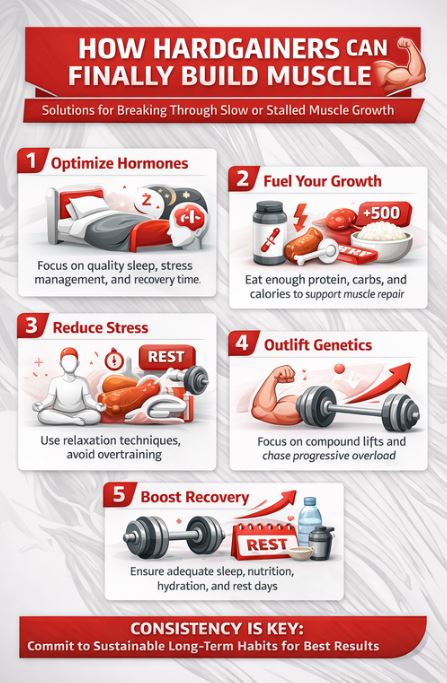
Being a “hardgainer” is not a life sentence—it is a description of a current physiological state. That state can be changed. The goal is not to train harder, but to shift your body from defense mode into growth mode.
Here is how that happens.
Train for Signal, Not Exhaustion
Your muscles need a clear growth signal, not endless fatigue. Focus on:
- heavy compound lifts
- progressive overload
- controlled tempo
- sufficient rest between sets
Avoid excessive volume that drives cortisol up without increasing mechanical tension.
Eat to Support Growth
Hardgainers almost always under-eat, even when they think they are eating enough. Prioritize:
- adequate total calories
- sufficient carbohydrates
- high-quality protein
Your body will not build tissue if it does not believe energy is abundant.
Restore Sleep and Circadian Rhythm
Sleep is where anabolic hormones and satellite cell activity peak. Chronic sleep debt keeps cortisol elevated and blocks growth. Consistent bedtimes, dark rooms, and limiting stimulants can have more impact than any supplement.
Reduce Life Stress
Psychological stress triggers the same hormonal responses as overtraining. Meditation, walking, social connection, and downtime are not luxuries—they are tools for growth.
Periodize Your Training
Long periods of nonstop intensity push the body into a catabolic state. Planned deloads and lighter phases restore hormonal balance and re-sensitize muscles to growth signals.
Hardgainer Optimization — Coach’s System
- Train most sets 1–3 reps short of failure to stimulate growth without crushing recovery.
- Use 2–4 minute rest periods on compound lifts to maximize mechanical tension.
- Eat more calories and carbohydrates on training days to lower cortisol and boost IGF-1.
- Focus on fewer exercises done with perfect form instead of high-stress volume.
- Take a planned deload every 4–6 weeks to reset hormones and nervous system fatigue.
- Prioritize sleep and low-intensity activity to restore parasympathetic recovery.
Common Myths About Hardgainers
The term “hardgainer” has become one of the most misunderstood labels in fitness. It is often invoked to explain slow progress, but in reality, it hides deeper physiological mechanisms. Clearing up these myths helps lifters stop fighting their biology and start working with it.
Myth 1: “Hardgainers just need to eat more.”
While calories matter, many hardgainers already eat more than they realize. The real issue is often energy availability and nutrient partitioning—not just total food intake. High stress, poor sleep, and insulin resistance can prevent calories from being used for muscle.
Myth 2: “You either have good genetics, or you don’t.”
Genetics influences potential, but epigenetics determines expression. Training, recovery, and nutrition can reprogram how muscle-related genes behave. Many so-called “bad genetics” are actually poor biological environments.
Myth 3: “Hardgainers should train more.”
More volume and more frequency often increase cortisol and nervous system fatigue, making growth even harder. Hardgainers usually need better recovery and higher-quality training, not more work.
Myth 4: “Supplements will fix it.”
No supplement can override stress, sleep deprivation, or chronic under-eating. Supplements support a healthy physiology—they do not replace it.
Myth 5: “Hardgainers can’t hold muscle.”
Hardgainers lose muscle quickly, not because they are weak, but because their bodies remain in a catabolic, stress-dominant state. When recovery and hormones are restored, muscle retention improves dramatically.
Understanding these myths allows lifters to move beyond frustration and toward a smarter, biology-driven approach to building muscle.
Conclusion
Being a “hardgainer” is not a flaw in character or commitment—it is a reflection of the body’s current physiological state. Muscle growth depends on far more than training effort alone. Hormonal balance, satellite cell activity, nervous system regulation, energy availability, and genetic expression all determine whether your body is willing to invest in building new muscle tissue.
When these systems are aligned, even people who once struggled to grow can make steady, visible progress. When they are not, no amount of willpower can force the body into an anabolic state. The solution is not to push harder, but to create the biological conditions that allow growth to happen.
Understanding the real reasons behind slow muscle gain gives you something far more valuable than motivation—it gives you control.
Key Takeaways
- Slow muscle growth is usually a biological issue, not a lack of effort.
- Hormones determine whether muscle building is allowed or blocked.
- Satellite cells and muscle nuclei set your true growth capacity.
- Chronic stress and poor sleep are major muscle-killing factors.
- Energy availability and carbohydrates strongly influence anabolic signaling.
- Genetics set potential, but epigenetics determines results.
- Hardgainer physiology can be changed by restoring recovery and hormonal balance.
