


Introduction
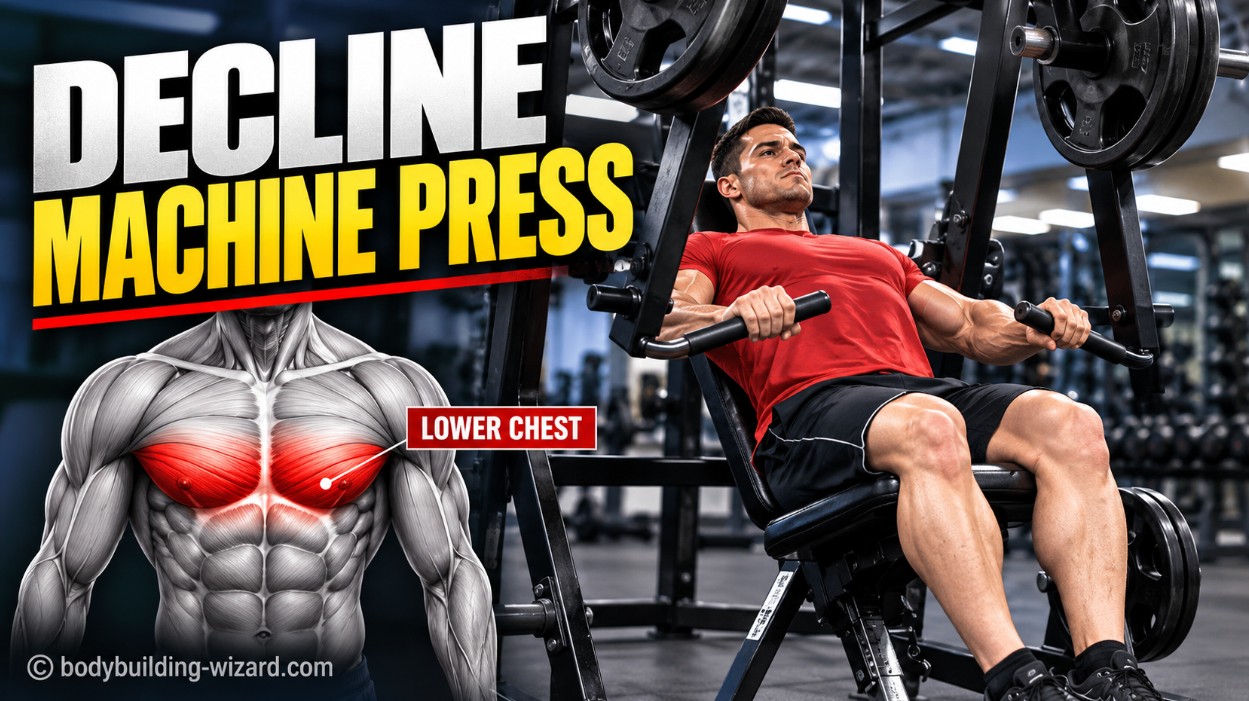
The decline machine press is a seated chest exercise performed on a decline press machine, most commonly the plate-loaded Hammer Strength iso-lateral decline press. You sit with your back against a slightly reclined pad and press two handles forward and downward along a guided arc, which shifts more of the work toward the lower fibers of the chest. Although the seated position may look like an upper-chest exercise at first, the downward direction of the press, not the seat angle, makes it a lower-chest movement.
It is the decline counterpart to the Hammer Strength bench press, and it shares the same key features: independent lever arms, a guided converging path, and plate loading that lets you add small increments and train heavy without a spotter. Unlike the Smith machine decline press or the decline barbell bench press, however, it doesn’t require lying with your head lower than your hips or hooking your feet under pads.
That makes the decline machine press a comfortable and practical option among the best lower chest exercises, especially for lifters who dislike the head-down position. Like other machine exercises, it can build muscle effectively, as research shows machine-based training can match free weights for hypertrophy when effort and volume are matched.
The decline machine press is a seated chest exercise performed on a decline press machine, most commonly the plate-loaded Hammer Strength iso-lateral decline press, in which the handles are pressed forward and downward along a guided, slightly converging arc. The downward pressing direction places more emphasis on the lower fibers of the pectoralis major, while the triceps brachii and anterior deltoids assist, without the head-down position of a decline bench.
Other Names for Decline Machine Press
Depending on the gym and manufacturer, the exercise may appear under several names.
- Hammer Strength decline press
- Iso-lateral decline press
- Decline chest press machine
- Plate-loaded decline press
- Seated decline press
Required Equipment
You need a decline press machine, which is common in well-equipped gyms. You can read more about different machine types in our article on exercise machines.
- A plate-loaded decline press machine (such as the Hammer Strength iso-lateral decline press) or a selectorized decline chest press
- Weight plates for plate-loaded models
- An adjustable seat to set the starting position of the handles
How to Perform Decline Machine Press
Seat height is the most important setting because it determines the press angle.
Starting Position
Adjust the seat and load the machine before you start.
- Load the same amount of weight on both lever arms (for plate-loaded models)
- Adjust the seat so the handles start at about your lower chest, around or slightly below the nipple line
- Sit with your back and head against the pad and your feet flat on the floor or footrests
- Grip the handles with a pronated or neutral grip, depending on the machine
- Pull your shoulder blades slightly back and down against the pad
- Keep your elbows moderately tucked below shoulder height
Execution (Action Phase)
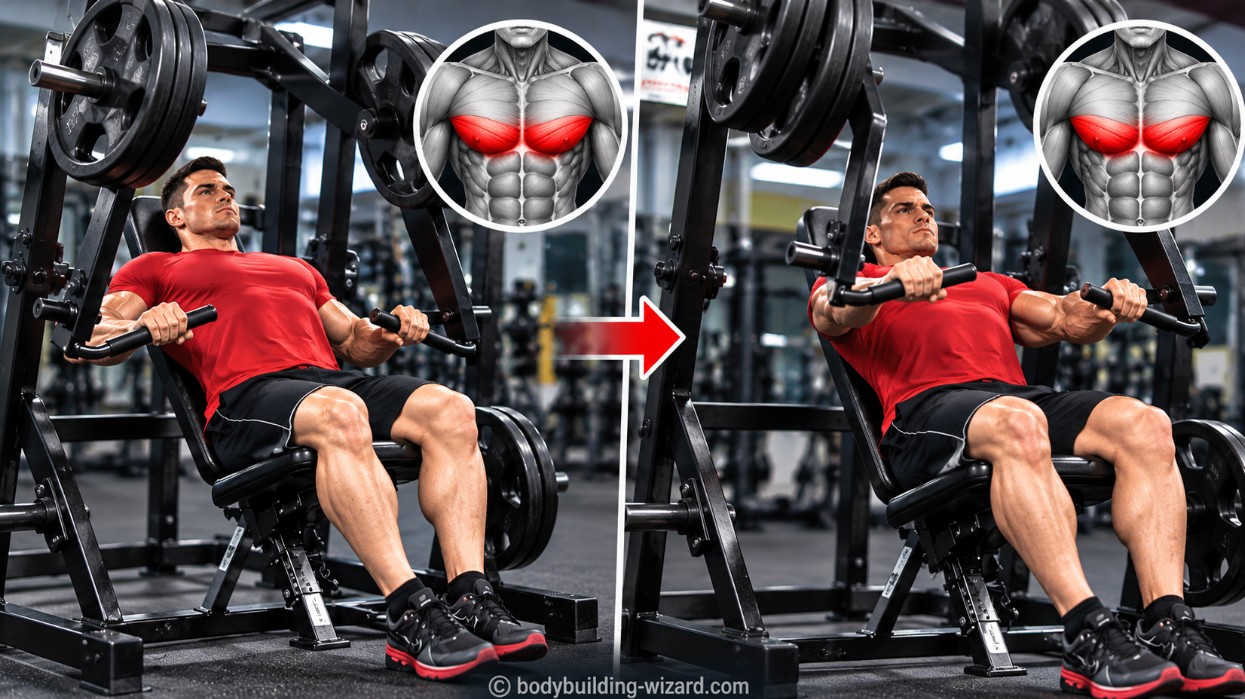
Press the handles forward and downward along the machine’s arc, keeping both arms moving at the same speed.
- Take a breath and brace your core (see our guide on breathing technique)
- Exhale and press the handles forward and down until your arms are almost straight
- Stop just short of locking out your elbows
- Squeeze your chest briefly at the end of the press
- Inhale and return the handles slowly to the starting position
- Keep your back against the pad throughout the set
At the end of the set, return the handles under control rather than letting them crash back to the starting stops.

In many gyms, the decline press machine is the mystery machine in the corner. People walk past it, glance at it, maybe sit on it once, and then go back to the flat bench because nobody is quite sure what it is for. When someone finally uses it, the seat is usually set for the previous person, and the handles start right next to their chin.
With my clients, I like this machine a lot, especially for lifters who don’t enjoy hanging upside down on a decline bench. We set the seat so the handles start at the lower chest, press forward and slightly down, and pay attention to whether one arm finishes before the other. Because the levers move independently, the machine quietly shows you which side needs more work.
Video Demonstration
Watching the decline press machine shows how the handles travel forward and down along the machine’s arc.
In the video below, notice how the lifter sits with their back against the pad, presses the handles forward and slightly down with both arms moving evenly, and slowly returns them to the lower chest. The shoulders stay back, and the movement is smooth and controlled.
At first glance, the decline press machine can look like an upper chest exercise, especially because you sit with your back against a slightly reclined pad. But the part of the chest that receives more emphasis isn’t determined by the angle of the seat. It is determined by the direction your arms move in relation to your torso.
On this machine, the lever arms are built to travel forward and downward, so your hands finish below chest level, just as they would on a decline bench. It is the same principle that makes chest dips a lower chest exercise even though your body is upright: what counts is where the arms are pushing.
Quick check: if your hands finish below the level of your chest, toward your stomach, you are performing a decline press. If they finish at chest height or higher, adjust the seat so the handles start lower on your chest.
Quick Form Checklist
Run through these cues before every set to make sure your setup and technique are correct.
- Seat set so the handles start at the lower chest
- Back and head against the pad
- Elbows moderately tucked
- Both arms moving at the same speed
- Controlled return, no crashing into the stops
Technical Emphasis & Targeting Adjustments
A few adjustments can change how the decline machine press feels and where you notice the work.
- Seat height → pressing angle. A seat height that puts the handles at the lower chest keeps the press directed downward. Starting the handles higher makes the movement more like a flat press, similar to the seated machine chest press.
- Neutral grip → comfortable elbow position. If your machine offers neutral handles, many lifters find this grip more comfortable for the wrists and shoulders.
- Single-arm sets → independent side training. Pressing one handle at a time lets you focus fully on each side of the chest, a key benefit of unilateral training.
- Slower eccentric → more time under load. Returning the handles over 2–3 seconds keeps the chest working throughout the rep. Learn more about eccentric training.
- Pause at the bottom → more strength off the start. Holding the handles briefly at the starting position removes the rebound and reinforces control.
Common Mistakes
The machine guides the movement, but a few setup and technique errors can still reduce its effectiveness. Several are also common bench press mistakes.
- Wrong seat height. If the handles start near your shoulders or down at your stomach, the pressing path becomes awkward. Adjust the seat so the handles start at your lower chest.
- Uneven pressing. Letting one arm lead allows the stronger side to compensate. Press both handles at the same speed, or use single-arm sets to address the difference.
- Letting the elbows drift far out to the sides. Extreme elbow flare makes the movement harder to control, and many lifters end up feeling their shoulders more than their chest. A moderately tucked position is a practical starting point.
- Rolling the shoulders forward. Letting the shoulders come off the pad at the end of the press shifts tension to the front delts. Keep your shoulder blades against the pad.
- Crashing into the stops. Letting the handles slam back to the starting position removes tension from the chest. Control every rep in both directions.
On a decline press machine, the seat height is your angle control. Before loading any plates, sit down and check where the handles start: they should line up roughly with your lower chest, around or slightly below the nipple line.
If the handles start up near your shoulders, the press becomes flatter and the decline effect largely disappears. If they start down at your stomach, the movement gets cramped and awkward. A seat height that puts the handles at your lower chest gives you the downward pressing path this machine is designed for.
Mechanical Considerations
The decline machine press combines shoulder adduction and extension with elbow extension, as the arms press forward and downward relative to the torso. You can read more about these joint actions in our guide to anatomical movements. This downward direction aligns the movement more closely with the lower fibers of the pectoralis major. However, the effect of the pressing angle is smaller than often claimed: a study comparing bench angles found that a flat bench activated both the upper and lower chest well, and a 15-degree decline did not clearly outperform it.
Because the machine guides the movement, it removes most of the balancing demand. Research comparing chest presses with different stability requirements found similar chest and front delt activity across stable and less stable variations, with more triceps activity in the more stable presses. The plates load onto levers, so the resistance you feel isn’t the same as the plates’ weight and can change across the range of motion. No study has examined the decline machine press directly. As a compound exercise, it trains the chest, triceps, and front delts together.
Muscles Worked in Decline Machine Press
MAIN MUSCLES
- Pectoralis major (with emphasis on the lower fibers)
SECONDARY MUSCLES
STABILIZERS
ANTAGONISTS
Decline Machine Press Pros and Cons
The decline machine press is a practical lower chest exercise, but it also has some limitations.
Advantages
- No head-down position. You sit upright or slightly reclined, so you don’t have to lie with your head below your hips or hook your feet.
- Independent lever arms. On iso-lateral models, each side works independently, revealing strength differences and supporting symmetrical muscle development.
- Safe to train without a spotter. The guided path lets you stop at any point, making it easy to safely take sets close to failure.
- Plate-loaded flexibility. Weight plates allow small increments, heavy loading, and quick drop sets.
Potential Drawbacks
- Machine availability. Decline press machines are less common than flat or incline machines, and many smaller gyms don’t have one.
- Fixed movement arc. The machine’s path may not suit every body type, and a poor seat setting can make the press uncomfortable.
- Not essential for lower chest development. Research shows that flat pressing also activates the lower chest well.
- Loads aren’t comparable to free weights. Because of the lever design, the numbers on the machine don’t translate to barbell or dumbbell lifts.
Safety Considerations
A review of resistance-training injuries reported that the shoulder complex accounted for up to 36% of documented injuries and disorders, although much of the available evidence was retrospective. The decline machine press is one of the safer ways to press, but a few precautions apply.
- Shoulder discomfort. An incorrect seat height or extreme elbow flare can make the press uncomfortable. Stop if you feel pinching or sharp pain, and learn more about shoulder joint anatomy.
- Previous pectoral strain. Lifters recovering from a pectoral strain should start with light loads and a controlled range of motion.
- Wrist discomfort. Letting the wrists bend back under heavy loads can aggravate wrist injuries. Keep the handles in the base of your palms.
- High blood pressure. Holding your breath during heavy efforts temporarily raises blood pressure. Lifters with hypertension should avoid maximal efforts and consult their doctor about weight training and blood pressure.
Decline Machine Press Variations
Single-arm decline machine press
Difficulty: Similar to the standard version
Pressing one lever arm at a time lets you focus on each side of the chest. Hold the other handle or the machine frame for stability.
Alternating iso-hold decline press
Difficulty: Harder than the standard version
Hold one arm just short of lockout while the other performs a full rep, then switch. The holding arm stays under constant tension, making each set more demanding with the same load.
Selectorized decline chest press
Difficulty: Similar to the standard version
Some gyms have decline chest press machines with a weight stack instead of plates. The movement is the same, but the weight changes more quickly and in larger increments.
Flatter-setting decline press
Difficulty: Similar to the standard version
Lowering the seat so the handles start higher makes the movement closer to a flat press. It is a useful option if the full decline angle feels uncomfortable.
Paused decline machine press
Difficulty: Harder than the standard version
Holding the handles at the starting position for 1–2 seconds before each press removes the rebound and builds strength from the bottom. Use lighter loads than usual.
Replacement Exercises (Substitutes) for the Decline Machine Press
If the machine is unavailable, these exercises also emphasize the lower chest.
- Decline dumbbell bench press. The decline dumbbell bench press lets each arm move independently and allows a deeper stretch.

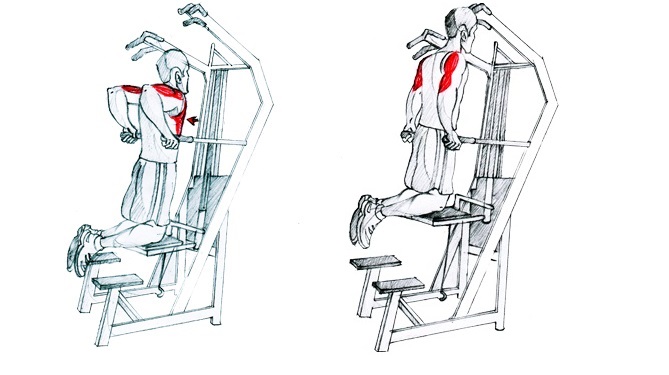
- Chest dips. Chest dips are a demanding bodyweight exercise that strongly involves the lower chest, with the body upright and the arms pressing downward.

- Assisted chest dip. The assisted chest dip uses a counterweight to make dips accessible at any strength level.
- Ring dips. Ring dips are an advanced bodyweight option that adds a major stability challenge.

- Decline bench cable fly. The decline bench cable fly isolates the lower chest with cables.

- Cable crossover. The high-to-low cable crossover trains the lower chest through a downward arc.

How to Program the Decline Machine Press
How you program the decline machine press depends on your training goal, experience level, and where it fits in your chest workout.
Show full programming guideHide programming guide ▾
| Goal | Sets | Reps | Rest | Tempo |
|---|---|---|---|---|
| Hypertrophy | 3–4 | 6–12 | 90–120 s | 2–3 s lowering |
| Strength | 4–5 | 4–6 | 2–3 min | Controlled lowering, forceful press |
| Muscular endurance | 2–3 | 15–20 | 45–60 s | Steady, continuous |
Muscle growth can occur across a wide range of repetitions when sets are taken close to failure, so treat these numbers as guidelines rather than strict rules. Adjust your rest periods between sets based on how recovered you feel.
- After flat or incline pressing as a lower chest exercise
- As a lower chest press for lifters who dislike the head-down position of a decline bench
- As a finisher with drop sets, thanks to quick plate changes
- With single-arm sets to address strength differences between sides
Apply progressive overload by adding small plates (1.25–2.5 kg per side) once you complete all sets at the top of your rep range with good form. Track your numbers on the same machine and seat setting, since the resistance produced by a given load varies between machine models.
Decline Machine Press vs Decline Barbell Bench Press (Comparison Table)
| Criteria | Decline Machine Press | Decline Barbell Bench Press |
|---|---|---|
| Body Position | Seated, slightly reclined | Lying with head below hips |
| Movement Path | Guided, downward converging arc | Free, chosen by the lifter |
| Arm Independence | Each lever moves independently (iso-lateral) | Both arms on one bar |
| Stability Demand | Low | High |
| Spotter Needed | No | Strongly recommended |
| Transfer to Free-Weight Strength | Moderate | High |
| Best For | Safe lower chest work, no head-down position | Free-weight lower chest strength |
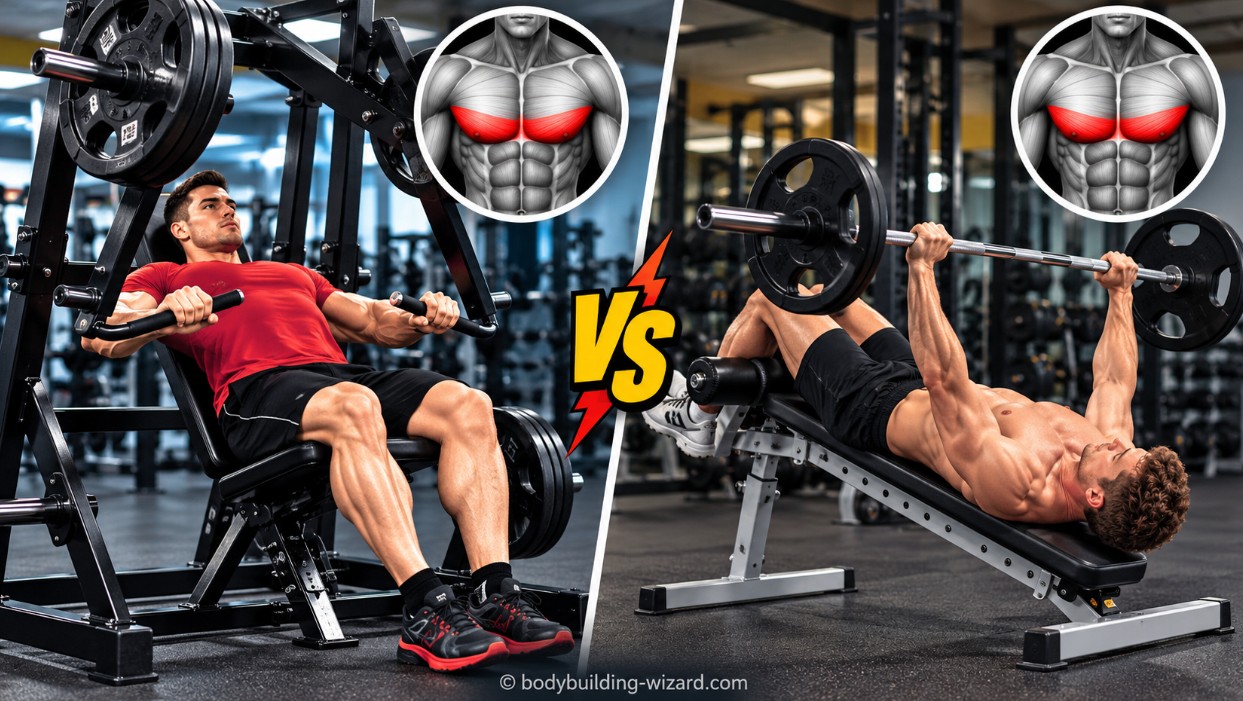
The decline barbell bench press allows a natural bar path and trains the stabilizing muscles more. However, it requires a head-down position and ideally a spotter, which makes it less practical for many lifters.
The decline machine press is a comfortable, stable alternative that avoids the head-down position entirely. Many lifters use both, rotating them to vary the stimulus. For a broader discussion, read our article on free weights vs. machines, and if you enjoy this machine family, try the machine incline chest press for the upper chest.
Final Thoughts
The decline machine press is a practical and comfortable way to train the lower chest. With a seated position, independent lever arms, and a guided path, it offers the benefits of decline pressing without the head-down position of a decline bench.
Set the seat so the handles start at your lower chest, press forward and slightly down, and keep both arms moving evenly. Remember, the flat bench also works the lower chest well, so use the decline machine as a variation, not a requirement. If you want to learn more about the bone where the chest attaches, read our guide to the sternum.
Frequently Asked Questions
What is the decline machine press?
It is a seated chest press on a decline press machine, in which the handles are pressed forward and downward. The most common version is the plate-loaded Hammer Strength iso-lateral decline press.
Does the decline machine press work the lower chest?
The downward pressing direction shifts emphasis toward the lower fibers of the pectoralis major. However, research found that a flat bench press also activates the lower chest well, so the decline machine is best seen as a useful variation rather than a must-have.
What is the difference between the decline machine press and the decline bench press?
On the decline bench press, you lie with your head lower than your hips. On the decline machine press, you sit upright or slightly reclined and press downward, which avoids the head-down position and the need to hook your feet.
How should I set the seat on the decline press machine?
Adjust the seat so the handles start at about your lower chest, around or slightly below the nipple line. This gives you the intended downward pressing path.
Is the Hammer Strength decline press plate-loaded?
The classic Hammer Strength iso-lateral decline press is plate-loaded, with plates loaded onto the horns of each lever arm. Some gyms have selectorized decline chest press machines that work in a similar way.
Can I lift more on the decline machine than on the flat bench?
You may see higher numbers, but machine loads are not directly comparable to free weights, because the lever design changes how much resistance a given plate creates.
Can I do the decline machine press with one arm?
Yes. On iso-lateral machines, the levers move independently, so you can press one arm at a time to focus on each side of the chest.
Is the decline machine press good for beginners?
Yes. The guided path, seated position, and ability to stop at any point make it beginner-friendly, while advanced lifters can still train heavy.
Is the decline machine press better than dips for the lower chest?
Neither is strictly better. Dips are a demanding bodyweight exercise with high shoulder demands, while the decline machine offers a stable, easily adjustable load that many lifters find more comfortable.
How often should I do the decline machine press?
Most lifters do well training the chest 1–2 times per week, using the decline machine press as a secondary exercise after flat or incline pressing.
