
Introduction
Every one of the 206 bones in the adult human skeleton belongs to one of five main categories based on its shape and function. Whether it’s the femur supporting your body weight, the ribs protecting your lungs, or the patella improving knee mechanics, each type of bone has evolved for a specific purpose.
Classifying bones this way matters because shape and function are directly linked. Once you know why a bone is built the way it is, you also know what job it’s actually doing in your body — which is exactly why doctors, physical therapists, and coaches all lean on the same five categories instead of describing every bone from scratch.
It’s also a topic people mix up constantly. Bones get confused across categories all the time: the ribs look long and curved, so people assume they’re “long bones,” when they’re actually classified as flat bones. The vertebrae look nothing like the other bones in the body, so people assume they don’t fit any category at all — when in fact “doesn’t fit anywhere else” is a category (irregular bones).
Understanding these five types of bones isn’t just an anatomy-class exercise, either. Once you know why a bone is shaped the way it is, coaching cues, injury patterns, and even your own training decisions start making a lot more sense. This guide breaks down each type of bone — long, short, flat, irregular, and sesamoid — with a clear look at why each one matters if you lift weights, plus quick-reference tables and examples so you can look up any specific bone in seconds. For a broader look at how these bones fit together as a complete system, see our guide to the human skeletal system, or browse the full rundown of major bones of the human skeleton.
Why Are Bones Classified into Different Types?
Bones aren’t grouped into categories because of how they look — they’re grouped by shape because shape directly reflects function. Every one of the five bone classifications developed to handle a specific mechanical job:
- Function — some bones exist purely to move (acting as rigid levers), others exist purely to protect.
- Mechanics — a bone’s shape determines how force flows through it and how well it resists bending, twisting, or compression.
- Load — bones that carry heavy compressive loads (like the femur) are built differently than bones that absorb impact (like the patella) or transmit small, precise forces (like the bones of the wrist).
- Protection — flat, curved bones like the ribs and skull exist specifically to shield delicate organs.
- Movement — long bones are essentially built-in levers, and their length and shape directly determine your range of motion and leverage during every lift you perform.
Bone shape is never accidental. It’s the direct physical answer to the mechanical demand a bone needs to meet — which is exactly why understanding the types of bones gives you a much better mental model of how your body actually moves under load.
The Five Types of Bones
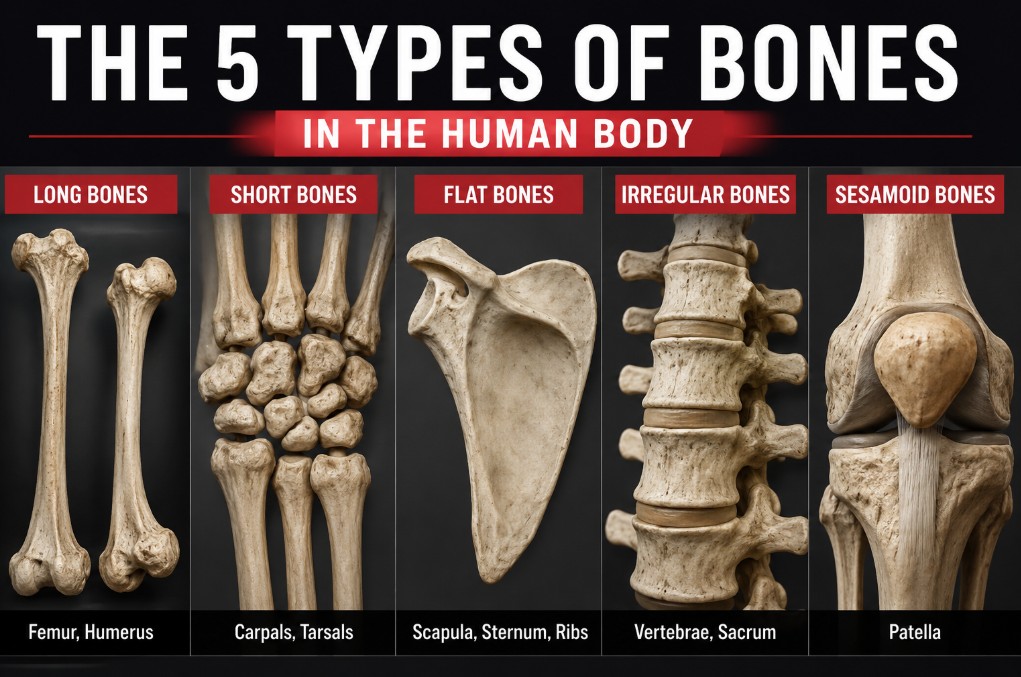
The human skeleton contains five recognized types of bones, classified by shape rather than by location. Bone tissue itself is remarkably consistent across the body — it’s the overall shape of each bone that varies to match its job.
| Bone Type | Primary Function | Examples |
|---|---|---|
| Long Bones | Movement and leverage | Femur, humerus, tibia |
| Short Bones | Stability with limited movement | Carpals, tarsals |
| Flat Bones | Protection and muscle attachment | Skull, sternum, scapula |
| Irregular Bones | Complex support and protection | Vertebrae, sacrum, pelvis |
| Sesamoid Bones | Leverage and tendon protection | Patella |
Now let’s cover each type in detail.
Long Bones

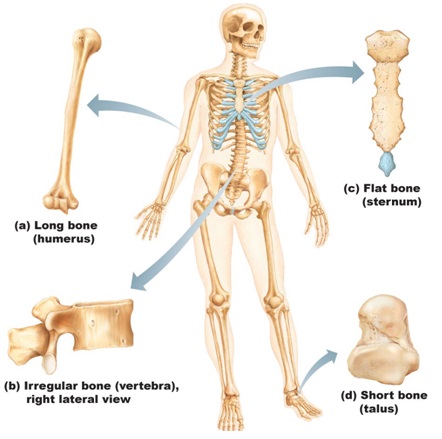
Long bones are longer than they are wide, with a shaft (diaphysis) and two ends (epiphyses). They’re the body’s primary lever bones and are among the most heavily trained bones in the human body.
Quick Facts
- Where found: Arms, legs, hands, and feet.
- Characteristics: A long shaft with a hollow marrow cavity, capped by two epiphyses; dense compact bone forms the shaft, while spongy bone fills the ends.
- Primary Functions: Support body weight, act as levers for movement, and house red and yellow bone marrow.
- Examples: Femur, tibia, fibula, humerus, radius and ulna, and the clavicle.
Why It Matters for Lifters
Long bones are the levers your muscles pull on to create every squat, press, pull, and curl. Their length directly determines your leverage: a longer femur, for example, means a longer moment arm at the hip and knee during a squat, which changes torque demands, ideal stance width, and even which lifters are naturally suited to which movements. This same lever action is also why long bones are a common site of stress fractures in overtrained athletes — the repetitive mechanical stress that makes them useful levers is the same stress that accumulates along the shaft when training volume outpaces recovery.
Short Bones
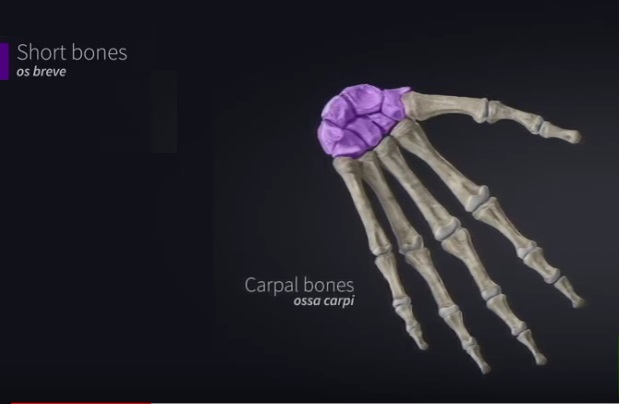
Short bones are roughly equal in length, width, and height — cube-shaped rather than elongated. They trade range of motion for stability, which is exactly why you find them where the body prioritizes control over reach.
Quick Facts
- Where found: Wrists and ankles.
- Characteristics: Composed mostly of spongy bone with a thin compact shell, giving them shock-absorbing strength without much length.
- Primary Functions: Provide stability and limited, controlled movement.
- Examples: Carpals (see hand bones), tarsals (see foot bones), including the calcaneus and talus.
Why It Matters for Lifters
Short bones are why your grip can hold a heavy barbell without your wrist collapsing, and why your ankle can stabilize hundreds of kilograms during a squat without buckling sideways. They’re built for load-bearing stability rather than range of motion — which is exactly why wrist and ankle mobility work looks so different from, say, shoulder mobility work: you’re not trying to add range to a joint that was built to prioritize control over motion in the first place.
Flat Bones

Flat bones are thin, often curved, plate-like bones that provide broad, protective coverage and generous surface area for muscle attachment.
Quick Facts
- Where found: Skull, chest, and pelvis.
- Characteristics: Two layers of compact bone sandwiching a spongy bone core; often curved rather than truly flat.
- Primary Functions: Protect internal organs and provide large surfaces for muscle attachment.
- Examples: Skull, sternum, ribs, and the scapula.
Why It Matters for Lifters
Flat bones are essentially your body’s built-in anchor plates. The scapula alone provides attachment points for more than a dozen muscles that move your shoulder — which is exactly why scapular positioning shows up in coaching cues for nearly every upper-body exercise. The broad surface of the sternum and ribs anchors your chest and core musculature, and the sheer surface area of the pelvis is part of what allows some of the largest, most powerful muscles in the body to generate the force behind a heavy hip thrust or deadlift lockout.
Irregular Bones
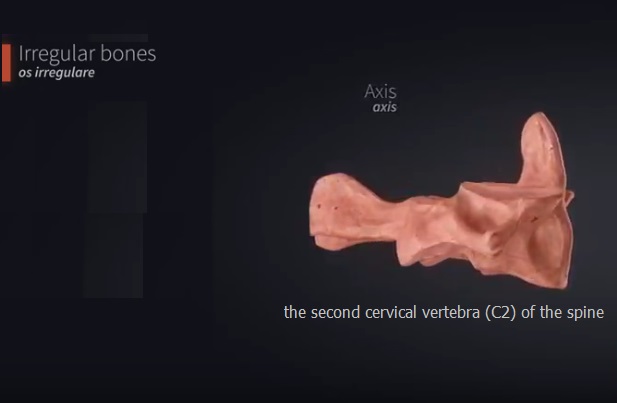
Irregular bones don’t fit neatly into any other category — their complex, asymmetrical shapes exist to solve a specific structural problem, most often protecting something delicate while allowing controlled, segmented movement.
Quick Facts
- Where found: Spine, pelvis, and face.
- Characteristics: Complex, non-uniform shapes covered by a thin layer of compact bone surrounding a spongy core.
- Primary Functions: Provide structural support while protecting delicate structures, such as the spinal cord.
- Examples: Vertebrae (see the vertebral column), the sacrum, the pelvis, and the bones of the face.
Why It Matters for Lifters
The vertebrae are the clearest example of why irregular bones matter under a loaded bar. Each vertebra is shaped to stack into a curved column that both protects the spinal cord and allows segmented, controlled movement between individual bones — which is exactly what makes a neutral spine position possible during a deadlift or squat. Lose that stacked alignment under heavy load, and you lose the structural advantage the vertebrae were literally shaped to provide.
Sesamoid Bones
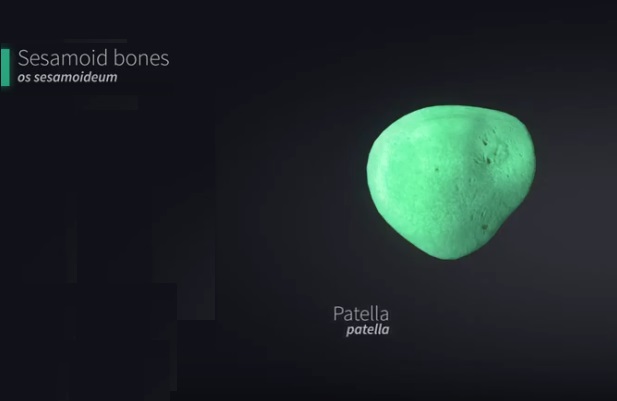
Sesamoid bones are small, rounded bones embedded entirely within a tendon rather than connected directly to other bones at a joint.
Quick Facts
- Where found: Knees, hands, and feet, wherever a tendon crosses a joint under high mechanical stress.
- Characteristics: Small and round, named for their resemblance to a sesame seed; the patella is the only sesamoid bone present in every human skeleton.
- Primary Functions: Improve muscle leverage and protect tendons from friction and excessive stress.
- Examples: Patella, the pisiform bone of the wrist, and small sesamoid bones at the base of the big toe.
Why It Matters for Lifters
The patella is a perfect illustration of what a sesamoid bone is built to do: by sitting inside the quadriceps tendon, it increases the angle — and therefore the leverage — of the quadriceps as it crosses the knee joint, making knee extension significantly more powerful than it would be without it. This is also part of why patellar tracking issues show up so often in lifters who squat or lunge with poor alignment — the sesamoid bone’s entire mechanical advantage depends on it staying correctly seated within the tendon.
Are There More Than Five Types of Bones?
Most anatomy references stop at five bone types, but there’s a lesser-known sixth category worth knowing: sutural bones, also called Wormian bones. These are small, irregular bone fragments that occasionally form within the fibrous sutures of the skull, most often along the lambdoid suture at the back of the head. They’re considered a normal anatomical variant rather than a distinct functional bone type — most people have a handful, some have none, and they don’t serve a particular mechanical purpose for training. They’re worth mentioning mainly for completeness, since a genuinely thorough answer to “how many types of bones are there” should acknowledge them.
Examples of Each Bone Type
Here’s a quick-reference list of major bones and their classification — useful for checking a specific bone at a glance.
| Bone | Classification |
|---|---|
| Femur | Long bone |
| Tibia | Long bone |
| Fibula | Long bone |
| Humerus | Long bone |
| Radius and Ulna | Long bones |
| Clavicle | Long bone |
| Carpals (see hand bones) | Short bones |
| Tarsals (see foot bones) | Short bones |
| Calcaneus | Short bone |
| Talus | Short bone |
| Skull | Flat bones |
| Sternum | Flat bone |
| Ribs | Flat bones |
| Scapula | Flat bone |
| Pelvis | Irregular bone |
| Vertebrae (see spine) | Irregular bones |
| Sacrum | Irregular bone |
| Patella | Sesamoid bone |
Bone Classification Chart
For a quick side-by-side comparison, the chart below summarizes the shapes, main functions, and representative examples of all five bone types in one place.
| Bone Type | Shape | Main Function | Examples |
|---|---|---|---|
| Long Bones | Elongated, with a shaft and two ends | Leverage and movement | Femur, humerus, tibia |
| Short Bones | Cube-like, roughly equal dimensions | Stability with limited motion | Carpals, tarsals |
| Flat Bones | Thin, broad, often curved | Protection and muscle attachment | Skull, sternum, scapula |
| Irregular Bones | Complex, non-uniform | Structural support and protection | Vertebrae, sacrum, pelvis |
| Sesamoid Bones | Small and round | Leverage and tendon protection | Patella |
Why Bone Shape Matters
None of these shapes are arbitrary. Every bone in the body is a direct physical answer to the mechanical job it must perform.
The femur isn’t flat, because a flat femur couldn’t handle the massive compressive load of standing, walking, and squatting — it needs to be a long, cylindrical lever capable of transmitting force efficiently along its length. The scapula isn’t shaped like a cylinder, because a cylindrical scapula couldn’t provide the broad, flat surface area that more than a dozen shoulder muscles need to attach to.
A vertebra looks strange and asymmetrical for good reason — it needs a solid weight-bearing body at the front, a hollow protective ring around the spinal cord, and bony processes sticking out the back and sides for muscles and ligaments to anchor to, all in one bone. And the patella exists at all only because a tendon crossing the knee joint at that particular angle needed something to improve its leverage and protect it from friction — without it, your quadriceps would be measurably weaker at extending the knee.
This is form following function in its purest sense: shape isn’t decoration, it’s mechanical necessity, worked out through millions of years of skeletal evolution.
Which Types of Bones Matter Most for Lifters?
Every bone type contributes something to lifting, but each one maps to a distinct role that’s directly useful to understand as a lifter:
- Long bones → movement. They’re your body’s lever system, and their length and shape directly determine your leverage, range of motion, and mechanical efficiency in every major lift.
- Flat bones → muscle attachment. The broad surfaces of the scapula, sternum, ribs, and pelvis anchor the muscle groups responsible for most of your training volume — chest, back, shoulders, and glutes.
- Sesamoid bones → leverage. The patella alone demonstrates how a single small bone can measurably improve the mechanical output of one of the body’s largest muscle groups.
- Irregular bones → spine. The vertebrae are what make a neutral, loaded spine possible in the first place, making them arguably the single most important bone type for injury prevention under heavy load.
Understanding which category a bone belongs to isn’t just trivia — it tells you what that bone is actually built to do, which makes coaching cues, injury patterns, and your own training decisions make a lot more sense.
Interesting Facts About Bone Types
- The femur isn’t just the longest bone in the body — it’s also the longest long bone by a wide margin, measuring roughly a quarter of a person’s total height.
- The patella is the largest sesamoid bone in the human body, and the only one present in literally every human skeleton.
- The clavicle is unique among long bones — it’s the only long bone in the human body that lies horizontally rather than vertically.
- Not all vertebrae are the same shape. Cervical, thoracic, and lumbar vertebrae each have distinct features suited to their specific job, from supporting head rotation at the top of the spine to bearing the heaviest compressive loads at the bottom.
- Sesamoid bones other than the patella vary from person to person — some people have extra sesamoid bones in their hands or feet, while others don’t develop them at all.
- The hyoid bone, a small horseshoe-shaped bone in the neck, is the only bone in the human body that doesn’t articulate with another bone at all — it’s suspended entirely by muscles and ligaments.
