


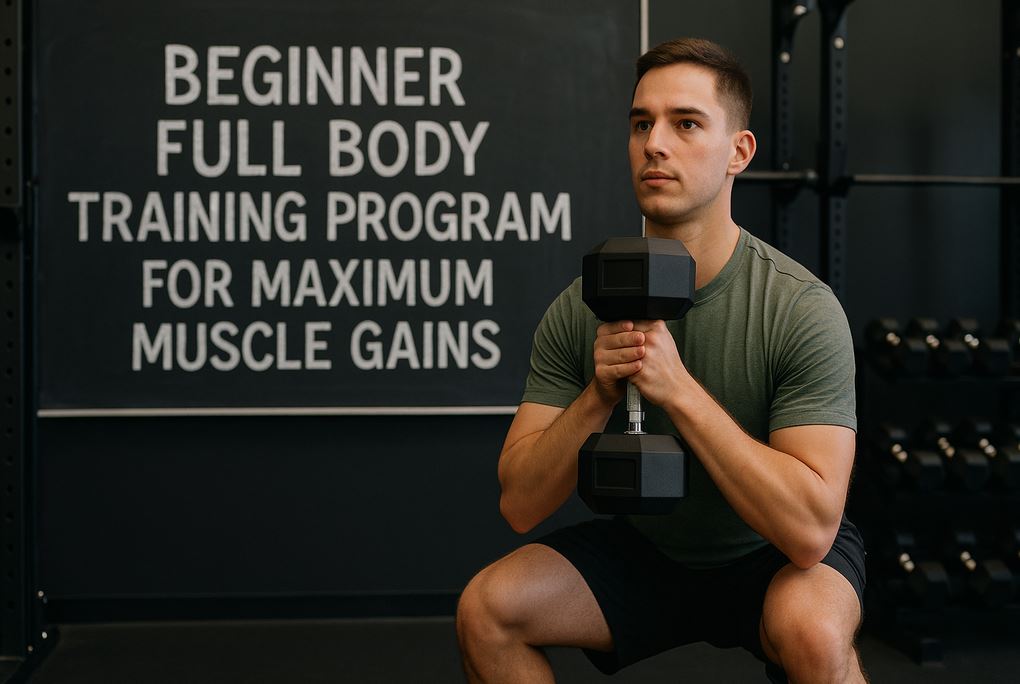
As a seasoned fitness coach with years of experience training both beginners and advanced athletes, I’ve seen first-hand what works—and what doesn’t—when it comes to building muscle from the ground up. One of the most common mistakes beginners make is jumping into complicated routines, chasing variety over consistency, and training with intensity they haven’t earned yet.
That’s why I’ve created this Beginner Full Body Training Program—a simple yet scientifically structured plan designed specifically for those just starting out. It focuses on compound movements, controlled intensity, proper recovery, and high-frequency muscle stimulation, all spread over three practical sessions per week.
This isn’t just another generic workout from the internet. It’s a professionally crafted system based on principles of hypertrophy, progressive overload, and stimulus-to-fatigue optimization. If you’re ready to build real muscle and create a solid foundation for future progress, this is where you start.
About the Program
Before we jump into the actual workouts, let’s take a look at the program’s core structure and parameters. These foundational elements will give you a clear understanding of what to expect, how to approach each session, and why this program is ideally suited for beginners looking to build serious muscle.
| Training Parameter | Details |
|---|---|
| Training Type | Full Body Training System |
| Level | Beginners |
| Frequency | 3 Times a Week (e.g. Mon/Wed/Fri) |
| Program Duration | 1 Month (4 Weeks) |
| Workout Session Duration | 90 Minutes |
| Primary Goal | Gaining Muscle (Hypertrophy Focus) |
| Equipment | Gym-Based (Full Equipment Access) |
| Types of Exercises | Compound & Isolation Movements |
| Progression Model | Progressive Overload + RPE-Based Intensity |
| RPE Range Used | RPE 7 – Controlled Effort, Not to Failure |
| Recovery Time Between Sessions | 48 Hours Between Workouts |
| Targeted Muscle Groups per Session | Full Body (Upper + Lower + Core) |
| Workout Split | Same Muscle Groups Stimulated Each Day |
This structure ensures enough frequency to stimulate muscle growth while allowing adequate recovery—especially critical for beginners still adapting to training stress.
Understanding RPE – Rate of Perceived Exertion
Throughout this program, you’ve seen references to RPE 7. But what exactly does that mean?
RPE (Rate of Perceived Exertion) is a self-assessment tool that helps you gauge how hard a particular set feels on a scale of 1 to 10. It’s a simple, subjective way to control training intensity without needing advanced tracking tools or heart rate monitors.
Instead of training to complete muscular failure, this system helps beginners develop awareness of their effort while avoiding excessive fatigue or poor form.
| RPE | Effort Description | Reps in Reserve (RIR) | What It Feels Like |
|---|---|---|---|
| 6 | Moderate | 4+ | Very easy – could’ve done many more reps |
| 7 | Challenging but comfortable | 3 | Good working set – you’re in control |
| 8 | Hard | 2 | You could push more, but form may suffer |
| 9 | Very hard | 1 | Nearly max effort – barely 1 rep left |
| 10 | Maximal effort | 0 | Full failure – no more reps possible |
Week 1 – Training Overview
| Monday | Tuesday | Wednesday | Thursday | Friday | Saturday | Sunday |
|---|---|---|---|---|---|---|
| ✅ Workout | ❌ Rest | ✅ Workout | ❌ Rest | ✅ Workout | ❌ Rest | ❌ Rest |
Below is your complete 3-day full body split for the first week. Each workout targets all major muscle groups, combines compound and isolation movements, and follows the principle of progressive overload within a safe and sustainable RPE range.
Day 1 – Monday
- Barbell Squat – 3 sets | 6–10 reps | RPE 7
🔹 Muscles worked: Quadriceps, glutes, hamstrings, core - Pull-Ups (Assisted if needed) – 3 sets | 6–10 reps | RPE 7
🔹 Muscles worked: Lats, biceps, upper back - Dumbbell Bench Press – 3 sets | 8–12 reps | RPE 7
🔹 Muscles worked: Chest, triceps, anterior deltoids - Seated Cable Row – 3 sets | 10–12 reps | RPE 7
🔹 Muscles worked: Rhomboids, mid-back, biceps - Standing Dumbbell Shoulder Press – 3 sets | 8–12 reps | RPE 7
🔹 Muscles worked: Deltoids, triceps - Barbell Curl – 2 sets | 10–12 reps | RPE 7
🔹 Muscles worked: Biceps - Rope Triceps Pushdown – 2 sets | 10–12 reps | RPE 7
🔹 Muscles worked: Triceps - Hanging Leg Raises – 3 sets | 10–15 reps | RPE 7
🔹 Muscles worked: Lower abs, hip flexors
Day 2 – Wednesday
- Romanian Deadlift – 3 sets | 8–10 reps | RPE 7
🔹 Muscles worked: Hamstrings, glutes, lower back - Lat Pulldown – 3 sets | 8–12 reps | RPE 7
🔹 Muscles worked: Lats, biceps - Incline Dumbbell Press – 3 sets | 8–12 reps | RPE 7
🔹 Muscles worked: Upper chest, front deltoids, triceps - Chest Supported Row – 3 sets | 10–12 reps | RPE 7
🔹 Muscles worked: Mid-back, rear delts, biceps - Dumbbell Lateral Raise – 3 sets | 12–15 reps | RPE 7
🔹 Muscles worked: Medial deltoid - Dumbbell Hammer Curl – 2 sets | 10–12 reps | RPE 7
🔹 Muscles worked: Brachialis, biceps - Overhead Cable Triceps Extension – 2 sets | 10–12 reps | RPE 7
🔹 Muscles worked: Long head of triceps - Cable Crunch – 3 sets | 12–15 reps | RPE 7
🔹 Muscles worked: Upper abdominals
Day 3 – Friday
- Leg Press – 3 sets | 10–15 reps | RPE 7
🔹 Muscles worked: Quads, glutes, hamstrings - Cable Chest Fly – 3 sets | 10–15 reps | RPE 7
🔹 Muscles worked: Chest (especially inner) - One-Arm Dumbbell Row – 3 sets | 10–12 reps | RPE 7
🔹 Muscles worked: Lats, rhomboids, biceps - Machine Shoulder Press – 3 sets | 8–12 reps | RPE 7
🔹 Muscles worked: Front and medial deltoids, triceps - Preacher Curl (EZ Bar or Machine) – 2 sets | 10–12 reps | RPE 7
🔹 Muscles worked: Biceps (isolated) - Triceps Dips (Assisted if needed) – 2 sets | 10–12 reps | RPE 7
🔹 Muscles worked: Triceps, lower chest - Plank – 3 sets | 30–60 seconds | RPE 7
🔹 Muscles worked: Core (abs, obliques, lower back) - Optional Cooldown: 10 minutes of light cardio (walking or cycling)
Week 2 – Training Progression
While the exercise selection remains precisely the same as in Week 1 (which is intentional and critical for motor learning and neuromuscular adaptation), Week 2 introduces subtle yet strategic progressions to continue stimulating muscle growth.
In this phase, you’ll notice:
- A slight increase in total training volume, with additional sets added to key compound lifts
- A higher rep target for many exercises within their prescribed ranges
- And all of this while maintaining the same controlled RPE 7 intensity, ensuring safe and steady overload
These adjustments may seem minor, but they significantly enhance stimulus without overwhelming the body—allowing beginners to build consistency, strength, and confidence in movement patterns.
| Monday | Tuesday | Wednesday | Thursday | Friday | Saturday | Sunday |
|---|---|---|---|---|---|---|
| ✅ Workout | ❌ Rest | ✅ Workout | ❌ Rest | ✅ Workout | ❌ Rest | ❌ Rest |
Day 1 – Monday
- Barbell Squat – 4 sets | 8–10 reps | RPE 7
🔹 Muscles worked: Quads, glutes, hamstrings, core - Pull-Ups (Assisted if needed) – 3 sets | 8–10 reps | RPE 7
🔹 Muscles worked: Lats, biceps, upper back - Dumbbell Bench Press – 3 sets | 10–12 reps | RPE 7
🔹 Muscles worked: Chest, triceps, anterior deltoids - Seated Cable Row – 3 sets | 12 reps | RPE 7
🔹 Muscles worked: Mid-back, rhomboids, biceps - Standing Dumbbell Shoulder Press – 3 sets | 10–12 reps | RPE 7
🔹 Muscles worked: Deltoids, triceps - Barbell Curl – 2 sets | 12 reps | RPE 7
🔹 Muscles worked: Biceps - Rope Triceps Pushdown – 2 sets | 12 reps | RPE 7
🔹 Muscles worked: Triceps - Hanging Leg Raises – 3 sets | 12–15 reps | RPE 7
🔹 Muscles worked: Lower abs, hip flexors
Day 2 – Wednesday
- Romanian Deadlift – 4 sets | 8–10 reps | RPE 7
🔹 Muscles worked: Hamstrings, glutes, lower back - Lat Pulldown – 3 sets | 10–12 reps | RPE 7
🔹 Muscles worked: Lats, biceps - Incline Dumbbell Press – 3 sets | 10–12 reps | RPE 7
🔹 Muscles worked: Upper chest, front delts, triceps - Chest Supported Row – 3 sets | 12 reps | RPE 7
🔹 Muscles worked: Rear delts, mid-back, biceps - Dumbbell Lateral Raise – 3 sets | 15 reps | RPE 7
🔹 Muscles worked: Medial deltoid - Dumbbell Hammer Curl – 2 sets | 12 reps | RPE 7
🔹 Muscles worked: Brachialis, biceps - Overhead Cable Triceps Extension – 2 sets | 12 reps | RPE 7
🔹 Muscles worked: Long head of triceps - Cable Crunch – 3 sets | 15 reps | RPE 7
🔹 Muscles worked: Abs (upper focus)
Day 3 – Friday
- Leg Press – 4 sets | 12–15 reps | RPE 7
🔹 Muscles worked: Quads, glutes, hamstrings - Cable Chest Fly – 3 sets | 12–15 reps | RPE 7
🔹 Muscles worked: Chest - One-Arm Dumbbell Row – 3 sets | 12 reps | RPE 7
🔹 Muscles worked: Lats, traps, biceps - Machine Shoulder Press – 3 sets | 10–12 reps | RPE 7
🔹 Muscles worked: Delts, triceps - Preacher Curl (EZ or Machine) – 2 sets | 12 reps | RPE 7
🔹 Muscles worked: Biceps - Triceps Dips (Assisted) – 2 sets | 12 reps | RPE 7
🔹 Muscles worked: Triceps, chest - Plank – 3 sets | 45–60 sec | RPE 7
🔹 Muscles worked: Core - Optional Cooldown: 10 min low-intensity cardio
Week 3 – Training Progression
In Week 3, we continue building on the foundation established in Weeks 1 and 2—keeping the same exercises for maximum neuromuscular coordination and movement proficiency, but now introducing a slight increase in overall intensity and training demand.
What changes in Week 3?
- Some reps are pushed closer to the top of the range (or even slightly beyond, if form is clean)
- Weights may now increase by ~2.5–5% on major lifts if you completed Week 2 with clean form and moderate effort
- RPE is still capped at 7, but expect to feel a bit more challenged
- You’ll continue developing movement mastery, volume tolerance, and muscle coordination—setting the stage for heavier work in Week 4
| Monday | Tuesday | Wednesday | Thursday | Friday | Saturday | Sunday |
|---|---|---|---|---|---|---|
| ✅ Workout | ❌ Rest | ✅ Workout | ❌ Rest | ✅ Workout | ❌ Rest | ❌ Rest |
Day 1 – Monday
- Barbell Squat – 4 sets | 10 reps | RPE 7
🔹 Muscles worked: Quads, glutes, hamstrings, core
📈 Progression: Increase weight slightly (2.5–5%) if 10 reps were easy in Week 2 - Pull-Ups (Assisted if needed) – 3 sets | 10 reps | RPE 7
🔹 Muscles worked: Lats, biceps, upper back - Dumbbell Bench Press – 3 sets | 12 reps | RPE 7
🔹 Muscles worked: Chest, triceps, anterior deltoids - Seated Cable Row – 3 sets | 12–14 reps | RPE 7
🔹 Muscles worked: Mid-back, rhomboids, biceps - Standing Dumbbell Shoulder Press – 3 sets | 12 reps | RPE 7
🔹 Muscles worked: Delts, triceps - Barbell Curl – 2 sets | 12–14 reps | RPE 7
🔹 Muscles worked: Biceps - Rope Triceps Pushdown – 2 sets | 12–14 reps | RPE 7
🔹 Muscles worked: Triceps - Hanging Leg Raises – 3 sets | 15 reps | RPE 7
🔹 Muscles worked: Lower abs, hip flexors
Day 2 – Wednesday
- Romanian Deadlift – 4 sets | 10 reps | RPE 7
🔹 Muscles worked: Hamstrings, glutes, lower back
📈 Progression: Add ~2.5–5% if Week 2 felt manageable - Lat Pulldown – 3 sets | 12 reps | RPE 7
🔹 Muscles worked: Lats, biceps - Incline Dumbbell Press – 3 sets | 12 reps | RPE 7
🔹 Muscles worked: Upper chest, front delts, triceps - Chest Supported Row – 3 sets | 12–14 reps | RPE 7
🔹 Muscles worked: Rear delts, mid-back, biceps - Dumbbell Lateral Raise – 3 sets | 15 reps | RPE 7
🔹 Muscles worked: Medial deltoid - Dumbbell Hammer Curl – 2 sets | 12–14 reps | RPE 7
🔹 Muscles worked: Brachialis, biceps - Overhead Cable Triceps Extension – 2 sets | 12–14 reps | RPE 7
🔹 Muscles worked: Long head of triceps - Cable Crunch – 3 sets | 15–20 reps | RPE 7
🔹 Muscles worked: Upper abs
Day 3 – Friday
- Leg Press – 4 sets | 15 reps | RPE 7
🔹 Muscles worked: Quads, glutes, hamstrings
📈 Progression: Only increase load if 15 reps were easy last week - Cable Chest Fly – 3 sets | 15 reps | RPE 7
🔹 Muscles worked: Chest - One-Arm Dumbbell Row – 3 sets | 12–14 reps | RPE 7
🔹 Muscles worked: Lats, traps, biceps - Machine Shoulder Press – 3 sets | 12 reps | RPE 7
🔹 Muscles worked: Delts, triceps - Preacher Curl (EZ or Machine) – 2 sets | 12–14 reps | RPE 7
🔹 Muscles worked: Biceps - Triceps Dips (Assisted) – 2 sets | 12–14 reps | RPE 7
🔹 Muscles worked: Triceps, chest - Plank – 3 sets | 60 sec | RPE 7
🔹 Muscles worked: Core - Optional Cooldown: 10 min light cardio (walk/bike)
Week 4 – Peak Week Progression
This is the final week of the 4-week beginner training cycle, and its goal is to consolidate all adaptations you’ve built so far—strength, endurance, movement confidence, and muscular conditioning. Week 4 gently pushes your performance to the limit while still operating within safe intensity zones.
What changes in Week 4?
- Slight intensity increase on key lifts (add 2.5–5% load if Week 3 felt manageable)
- Select isolation/accessory movements are pushed to the top of rep ranges
- Core movements were maintained or slightly progressed
- RPE remains at 7, to keep the focus on execution over exhaustion
| Monday | Tuesday | Wednesday | Thursday | Friday | Saturday | Sunday |
|---|---|---|---|---|---|---|
| ✅ Workout | ❌ Rest | ✅ Workout | ❌ Rest | ✅ Workout | ❌ Rest | ❌ Rest |
Day 1 – Monday
- Barbell Squat – 4 sets | 10–12 reps | RPE 7
🔹 Muscles worked: Quads, glutes, hamstrings, core - Pull-Ups (Assisted) – 3 sets | 10–12 reps | RPE 7
🔹 Muscles worked: Lats, biceps, upper back - Dumbbell Bench Press – 3 sets | 12–14 reps | RPE 7
🔹 Muscles worked: Chest, triceps, anterior deltoids - Seated Cable Row – 3 sets | 14 reps | RPE 7
🔹 Muscles worked: Mid-back, rhomboids, biceps - Standing Dumbbell Shoulder Press – 3 sets | 12–14 reps | RPE 7
🔹 Muscles worked: Delts, triceps - Barbell Curl – 2 sets | 14 reps | RPE 7
🔹 Muscles worked: Biceps - Rope Triceps Pushdown – 2 sets | 14 reps | RPE 7
🔹 Muscles worked: Triceps - Hanging Leg Raises – 3 sets | 15–20 reps | RPE 7
🔹 Muscles worked: Lower abs, hip flexors
Day 2 – Wednesday
- Romanian Deadlift – 4 sets | 10–12 reps | RPE 7
🔹 Muscles worked: Hamstrings, glutes, lower back - Lat Pulldown – 3 sets | 12–14 reps | RPE 7
🔹 Muscles worked: Lats, biceps - Incline Dumbbell Press – 3 sets | 12–14 reps | RPE 7
🔹 Muscles worked: Upper chest, front delts, triceps - Chest Supported Row – 3 sets | 14 reps | RPE 7
🔹 Muscles worked: Rear delts, mid-back, biceps - Dumbbell Lateral Raise – 3 sets | 15–18 reps | RPE 7
🔹 Muscles worked: Medial deltoid - Dumbbell Hammer Curl – 2 sets | 14 reps | RPE 7
🔹 Muscles worked: Brachialis, biceps - Overhead Cable Triceps Extension – 2 sets | 14 reps | RPE 7
🔹 Muscles worked: Long head of triceps - Cable Crunch – 3 sets | 20 reps | RPE 7
🔹 Muscles worked: Upper abs
Day 3 – Friday
- Leg Press – 4 sets | 15–18 reps | RPE 7
🔹 Muscles worked: Quads, glutes, hamstrings - Cable Chest Fly – 3 sets | 15–18 reps | RPE 7
🔹 Muscles worked: Chest - One-Arm Dumbbell Row – 3 sets | 14 reps | RPE 7
🔹 Muscles worked: Lats, traps, biceps - Machine Shoulder Press – 3 sets | 14 reps | RPE 7
🔹 Muscles worked: Delts, triceps - Preacher Curl (EZ or Machine) – 2 sets | 14 reps | RPE 7
🔹 Muscles worked: Biceps - Triceps Dips (Assisted) – 2 sets | 14 reps | RPE 7
🔹 Muscles worked: Triceps, chest - Plank – 3 sets | 60–75 sec | RPE 7
🔹 Muscles worked: Core (abs, obliques, lower back) - Optional Cooldown: 10 min light cardio (walk/bike)
7 Reasons Why This Program Is Ideal for Beginners
This program is built on principles that align perfectly with the needs of beginners. Rather than overwhelming new lifters with excessive complexity, high volume, or unnecessary variation, it focuses on what actually matters in the first 4–8 weeks of resistance training: movement proficiency, progressive overload, and training frequency.
| Reason | Explanation |
|---|---|
| Full Body Structure | Train the entire body 3x per week. Enhances motor learning, provides frequent muscle stimulus, and offers a better stimulus-to-fatigue ratio. |
| Ideal Frequency (3x/week) | Muscles receive growth signals multiple times a week. Rest days between sessions prevent overtraining. |
| Balanced Muscle Group Coverage | All major muscle groups are evenly targeted. Prevents muscular imbalances (e.g., only training the chest without the back). |
| RPE-Based Progression | You train smart, not to failure. RPE ensures sustainable intensity and gradual overload without burnout. |
| Smart Exercise Selection | Combines compound (e.g., squats, presses, rows) and isolation (e.g., curls, triceps, abs) movements for maximum efficiency. |
| Progressive Overload | Allows for weekly increases in reps, weight, or RPE—essential for continuous muscle growth. |
| Low Injury Risk | RPE 7 and joint-friendly exercises promote safe training, avoiding extreme methods meant for advanced lifters. |
How Much Muscle Can a Beginner Expect to Gain in 1 Month?
While results vary based on nutrition, sleep, and genetics, most beginners following a structured, progressive plan like this can expect to gain 1 to 2 kg (2 to 4.5 lbs) of lean muscle mass within their first month of training.
This is thanks to a phenomenon known as “newbie gains”—a period where the body is highly responsive to resistance training. If paired with a proper diet and recovery, this first month can yield some of the fastest muscle gains a trainee will ever experience.
However, the real value of this program lies not only in short-term growth but also in developing long-term habits and movement mastery that will pay dividends for months and years to come.
What’s Next After Week 4?
Congratulations—if you’ve made it to the end of this 4-week Beginner Full Body Training Program, you’ve done more than build muscle. You’ve established movement patterns, developed consistency, and laid down a rock-solid foundation for future gains. Where do you go from here? Here are three powerful options to consider:
Option 1: Repeat the Cycle with Heavier Loads
You can run this same program for another 4 weeks, but this time:
- Increase weights by 5–10% on major lifts
- Keep rep ranges but aim for higher RPE (8 instead of 7 in Weeks 3–4)
- Add intensity techniques (pause reps, slower eccentrics)
Option 2: Transition to a New Phase (Upper/Lower or Push/Pull/Legs)
Now that your body is adapted, you can:
- Move to a 4- or 5-day split
- Focus more on volume per muscle group
- Specialize weak points (e.g., lagging arms, chest, glutes)
Option 3: Periodize Your Training
Start using structured mesocycles:
- Weeks 1–3: Accumulation (volume & reps)
- Week 4: Deload or peak
- Adjust RPE, volume, and intensity in a cyclical way for sustainable long-term growth.
Beginner Training Alternatives Worth Exploring
While this resistance band program is an excellent entry point into strength training, it’s not the only effective option for beginners. Depending on your available equipment, training environment, and personal preferences, the following beginner-friendly programs may be a better fit for your next step:
- Beginner Machine-Only Full Body Workout Program (Gym Edition)
Designed for those who feel more confident starting with machines. Fixed movement paths reduce injury risk while helping beginners build strength, coordination, and gym confidence before progressing to free weights. - Dumbbell-Only Full Body Workout for Beginners (Home Edition)
A practical home-based option for those with adjustable dumbbells and a bench. This program introduces unilateral work, grip strength, and greater stabilizer activation compared to bands or machines. - Barbell-Only Full Body Workout for Beginners (Home Edition)
Best suited for individuals who already own a barbell setup. Focuses on foundational compound lifts and progressive overload, making it ideal for beginners aiming to build long-term strength. - Kettlebell-Only Full Body Workout for Beginners (Home Edition)
A dynamic alternative that blends strength, coordination, and conditioning. Particularly effective for those who enjoy functional, athletic-style training with minimal equipment. - 4-Week Beginner Free-Weights Workout Program (Home or Gym)
A hybrid approach combining barbells and dumbbells. This program bridges the gap between beginner routines and more advanced hypertrophy-focused training. - 4-Week Bodyweight-Only Full Body Workout Program (Home Edition)
A no-equipment solution that uses bodyweight resistance to build strength, mobility, and control. Ideal for travel, budget limitations, or complete beginners. - Full-Body Resistance Band Workout Plan for Beginners (Home Edition)
Perfect for building a strong foundation at home using minimal equipment. Resistance bands offer scalable tension, joint-friendly loading, and an excellent transition point toward more advanced training methods.
Beginners who follow a clear progression avoid common mistakes — learn the system inside our complete beginner overview .
Conclusion
As a fitness coach, I can confidently say that this beginner full-body training program offers everything a new trainee needs to build a strong foundation—physically and mentally. It’s not just about lifting weights; it’s about learning movement, developing consistency, and creating sustainable habits that lead to real results.
By training the entire body three times per week, following a structured progression model, and respecting recovery, this beginner full-body training program lays the groundwork for long-term muscle growth, strength development, and injury-free performance. Stick with it, stay consistent, and you’ll be surprised how quickly progress comes.
What results can I expect after 4 weeks on this program?
While individual results vary, beginners can gain between 1 to 2.5 kg (2–5 lbs) of lean muscle within the first month, provided they follow the program consistently and maintain a high-protein diet.
Should I train to failure on this program?
No. This program uses an RPE of 7, meaning you stop 2–3 reps before failure. This ensures effective training while minimizing the risk of injury and excessive fatigue — ideal for beginners.
Can women follow this same program?
Yes, absolutely. The exercises, structure, and progression principles apply equally to men and women. The only difference might be in exercise load and nutritional requirements.
What should I eat before and after workouts?
Consume a meal with carbs and protein 60–90 minutes before training (e.g., oats with whey protein), and a post-workout meal with protein and carbs (e.g., rice and chicken) to support muscle recovery and growth.
Can I combine this with cardio?
Yes, but limit it to light-to-moderate sessions 2–3x weekly. Prioritize strength training if muscle gain is your goal. Avoid intense cardio on the same day as lifting to prevent recovery interference.
How do I progress if I plateau?
If you’re no longer seeing strength or muscle gains, increase training volume (more reps or sets), improve nutrition (more protein/calories), or check sleep and recovery habits.
Can I extend the program beyond 4 weeks?
Yes. Simply loop back to Week 1 with slightly heavier weights, shorter rest periods, or more reps. Or, move into an intermediate split-style program for further progression.
