



Introduction
New to the gym, or an old hand looking to update your knowledge? You’ve come to the right place. This guide is about fat loss. It’s the most complete fat loss guide you’ll ever find. Here you’ll learn how to:
- Lower your body fat ratio
- Maintain and build on lean muscle mass
- Work with your body
We give you the science in plain English. We explain how best to achieve the results you’re looking for. Healthy, sustainable ways to lose fat, clearly explained. Understand how your body works. Eat right. Choose the right workout. Get fit. Get lean. Read on.

FAT LOSS: MAIN CONCEPT
What is fat loss?
When dieters lose weight they’re losing more than just fat. They lose muscle. They lose bone density. Internal organs may be impacted. The more extreme the diet, the more muscle is lost, and the more potential there is for health to be compromised.
Once their diet is over, many regain the weight they’ve shed. Lost muscle is often replaced by yet more fat. Ultimately, weight loss dieters can find themselves in a worse position than when they started.
However, fat loss is the biological process by which your body burns fat for fuel. It’s losing the fat and nothing else.
By adopting a scientific approach to fat loss, you can reduce your overall body fat percentage, while maintaining lean muscle mass. With a healthy diet and workout plan, you will shed fat to achieve optimal health, fitness, and wellbeing.
When we toss around the words “belly fat”, we’re actually talking about two different types: subcutaneous and visceral. While both types of fats store energy for your body to use, they are still very different. Subcutaneous fat is present all over the body just underneath the skin (between your skin and muscles). Subcutaneous fat is best, though perhaps not most scientifically, defined as the fat that you can see, the “inch you can pinch.” Visceral adipose tissue is the second area where fat is stored. It develops on top and around our visceral organs, like the intestine, heart, liver, kidneys, and so on. Visceral fat is nearly impossible to spot from the outside.
How much fat is healthy?
According to the American Council on Exercise, body fat ranges for adults are as follows:
| Description | Men | Women |
|---|---|---|
| Essential fat | 2-5% | 10-13% |
| Athletes | 6-13% | 14-20% |
| Fitness | 14-17% | 21-24% |
| Average | 18-24% | 25-31% |
| Obese | 25% + | 32%+ |
How much fat do I have?
Short of cutting a body open, there is no foolproof way of knowing the exact amount of subcutaneous fat it contains. Fortunately, there are some less intrusive ways of getting an indication of where you stand in the fat stakes. We have already written a detailed article about different ways of measuring body fat percentage (subcutaneous body fat).
Some methods, like hydrostatic weighing, require access to a special water tank and a team of scientists, but the following techniques for estimating body fat, can be done at home, or by your local gym or GP.
- Body mass index (BMI)
- Bioelectric scales
- Skin-fold calipers
- Measurement method
Body mass index
This is the most commonly used body fat indicator. Simply divide your weight in kilograms by the square of your height in meters. The result is your BMI. You can use the chart below to plot your BMI.
Those with a BMI over 25 are classed as overweight. Higher than 30, and you’re one of the 26% of adults in England who are obese. However, body mass index has many serious disadvantages and can lead to a false conclusion for some people (especially for people who are athletic build).

BMI is a good rule-of-thumb indicator, but it won’t tell you how much fat your body contains. BMI doesn’t take into account bone density or how much lean muscle mass you have.
A fit, muscular rugby player might have a BMI that would classify them as overweight or obese, when in fact they’re not. For most of us though, it’s a reasonable pointer to being over or underweight.
To convert BMI to estimated body fat, work through the following formula:
- For men: (1.20 x BMI) + (0.23 x Age) – 16.2
- For women: (1.20 x BMI) + (0.23 x Age) – 5.4.
Bioelectric scales
Readily available to buy, many modern electronic bathroom scales can also give you a body fat percentage.
They work by passing a small electrical current through your body. Because lean muscle mass contains more water than fat, it’s a better conductor.
The scales work by calculating total body water (TBW). TBW is used to estimate total fat-free body mass. This is compared with your overall body mass. The result is the amount of fat your body contains.
If using this method to calculate your body fat, be sure to follow the manufacturer’s directions closely. That’s because factors like dehydration, and when you last ate or exercised can affect the accuracy of the reading.

Skinfold method
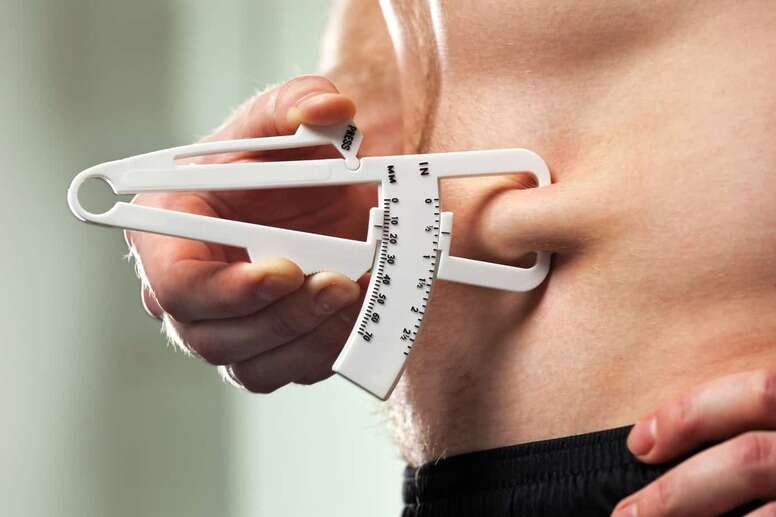
A pair of calipers is used to measure the thickness of folds of skin pinched at specific sites of your body. The thicker the fold, the more fat it contains. By extrapolating from the measurements you take, an estimated body fat figure is given.
For a full analysis of this method see here.
The skinfold method can prove inaccurate unless the measurements are taken in exactly the right place each time. The type of calipers used can also affect the outcome of the test.
Measurement method
There are several methods for estimating body fat based on measuring your body. The U.S. Navy circumference method is one example. The equation compares the circumference of your hips, waist, and neck with your height and weight.
Essentially, you’re calculating the density of your body: D = mass ÷ volume. Estimated body fat is extrapolated from this result, but it’s not a very accurate measure.
How much fat do I need to lose?

Once you’ve measured or estimated your percentage body fat, to work out the amount of fat you need to lose, work through the following formula:
Desired body weight in lbs = Lean body weight in lbs ÷ (1 – desired body fat percentage written as a decimal)
How fast should I lose the fat?
Rapid weight loss is often associated with fad diets which we know are bad for our health. Aim instead to cut your body fat by around one to two pounds per week. By monitoring your body fat level on a weekly rather than daily basis, you’re also less likely to become fat loss obsessed!
NUTRITION FOR FAT LOSS

Nutrition is of paramount importance in helping you to achieve your fat loss goal. It is next to impossible to out-train bad food habits. Here we’ll give you the tools to calculate how many calories you need to consume, in order to shed fat.
We discuss the macronutrients – protein, carbohydrate, and fat. We look at the role played by your body type in helping or hindering you as you strive towards your fat loss target. Whatever your shape or size, our nutrition guidelines will get you results.
Know your body type
Working with your body is key to constructing an effective fat-loss plan. Some people are naturally leaner than others. But while you can’t change what you’re born with, knowing your body type and eating accordingly will help you lose fat and keep it off.

Ectomorphs
Lean and slim. Long thin muscles and limbs are ideal for endurance sports where your lightweight body and slow-twitch muscle fibers help you keep going for longer.
The downside is you find it hard to put on muscle. But even ectomorphs can accumulate fat if they consistently take on more energy than they expend.
During your fat loss challenge, you’ll need to be extra careful to prevent your existing lean muscle mass from being eroded by the calorie deficit you’ll be running.
Mesomorphs
The lucky ones. You’re predisposed to gain muscle fast, and you should find it relatively easy to shed fat. Add to that your natural body shape – wide shoulders, broad chest, narrow waist – and you can see why if you stick to your fat loss regime, you’ll soon be in the form of your life.
Endomorph
Chunky, big-boned, and with a tendency to lay down fat. Training will turn you into a force to be reckoned with, but to shed fat, there’s no way around it, you need to watch what you eat.
What are calories?
A calorie is a unit of heat, equal to 4.1868 joules. That’s the amount of energy it takes to raise the temperature of 1 g of water by 1°C. Applied to the human body, a calorie is the amount of food energy it takes to generate that same amount of heat.
In terms of the calorie values you see printed on food products, these usually refer to kilocalories (Kcal) – 1000 calories is abbreviated to 1 Kcal.
In this guide, when we refer to a calorie, we mean 1 Kcal. One unit of energy that fuels your body.
Counting the calories?
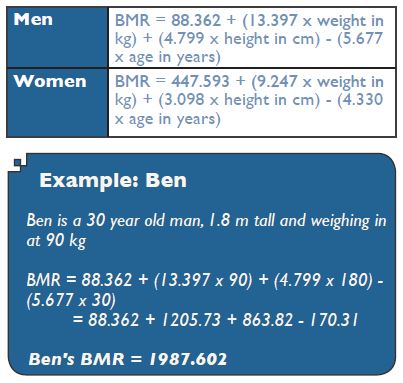
Calorie calculations begin with working out your Basal Metabolic Rate (BMR). This is the number of calories your body consumes per day when at rest. Taken into account are your height, weight, age, and sex.
The sum is based on the Harris-Benedict Equation (1910), revised in 1984 by Roza and Shizgal:
But of course, nobody remains inactive for 24 hours a day, every day. To calculate the number of calories you need to maintain your body weight, we now need to apply the activity level multiplier to the Harris-Benedict Principle:
| Amount of exercise | Activity level multiplier |
|---|---|
| Little to no exercise | Daily kilocalories needed = BMR x 1.2 |
| Light exercise (1-3 days per week) | Daily kilocalories needed = BMR x 1.35 |
| Moderate exercise (3-5 days per week) | Daily kilocalories needed = BMR x 1.55 |
| Heavy exercise (6-7 days per week) | Daily kilocalories needed = BMR x 1.725 |
| Very heavy exercise (twice daily) | Daily kilocalories needed = BMR x 1.9 |
Calories for fat loss
Let’s say Ben’s fat loss target is 10 kg. He wants to get down to 80 kgs without losing any lean muscle mass.
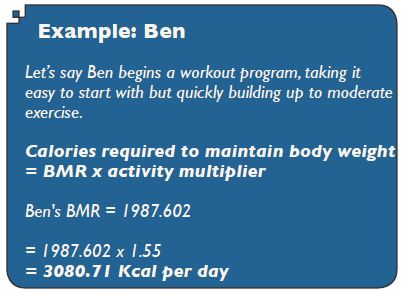
He needs to run a calorie deficit, eating fewer calories than his active lifestyle demands to maintain his
body weight (less than 3080.71). But how many less?
1 lb of fat contains 3500 calories. To lose that amount in a week, you’d need to reduce your food intake below the maintenance level by 500 calories per day:
Ben’s daily fat loss calorie allowance = 3080.71 – 500
If Ben restricts his daily calorie count to 2580.71, he should achieve his fat loss goal of 10 kg in a little over 22 weeks.
Sounds manageable doesn’t it? And because the fat loss is spread over a longer time period, he’s more likely to stabilize his body fat ratio at the lower level.
The role of macronutrients
As we explained earlier, calories are the units of energy we consume to power our bodies. But the makeup of those calories in terms of the three principal macronutrients – carbohydrate, protein, and fat – is very important for anyone wanting to burn fat rather than lean tissue.
During your fat loss program, it’s vital to maintain healthy levels of all three macronutrients.
Keep it in proportion
Your healthy fat-loss diet should contain:
| Macronutrient | % of daily calorie intake |
|---|---|
| Carbohydrate | 45-55 |
| Protein | 25 (max) |
| Fat | 20-30 |
To work out what that means for your calorie intake:
| Macronutrient | Kcal/g |
|---|---|
| Carbohydrate | 4 |
| Protein | 4 |
| Fat | 9 |
Let’s use our example of our 1.8 m tall, 90 kg, 30-year-old man, Ben. Ben’s macronutrient breakdown based on a diet consisting of 55% Carbohydrate, 20% Protein, and 25% Fat:

Carbohydrates

Carbs are broken down to make glucose, the body’s primary energy source. Glucose powers the brain, muscles, and internal organs.
If you reduce your intake of carbs below 45% of your total calorie intake, you run the risk of slowing fat loss and increasing muscle degradation.
A lack of carbs in your diet will:
- Slow your metabolism. Not only will this reduce energy levels, impact negatively on your workouts, and leave you feeling washed out and lethargic, but your body will go into starvation mode. Cut carbs too heavily and your body goes into overdrive to protect its fat stores.
- Cause muscle loss. Your body turns carbs into glucose; glucose is vital for protein synthesis. Cut your carbs too much and your body won’t be able to lay down muscle. If your body can’t find sufficient glucose to satisfy its needs, it goes for amino acids, some of which are stored as fat – some as muscle. Muscle is raided for energy.
- Lower insulin levels. You need carbs in your diet to maintain insulin levels during your fat-loss campaign. Insulin keeps catabolic (muscle eating) hormones at bay – namely cortisol. Bin the carbs and you’ll lower your protection against muscle loss.
- Compromise your immune system. Carbs are essential for keeping you fit and well. Eat too few and you could make yourself more susceptible to infection. Get sick and you won’t be able to train.
Good Carbs, Bad Carbs
Ever heard of the term Glycemic Index (GI)?
It’s the scale that measures the speed with which eating a particular food raises your blood sugar level. The quicker the increase, the shorter the sugar spike, the sooner you feel hungry again.
To avoid hunger pangs and ensure you have enough firepower for your training session, eat carbs that have a low to medium GI. Low GI carbs have the added advantage of being super healthy too. Basically, we’re talking unprocessed foods.
Sources of low GI carbohydrate:
| Breakfast | Breads | Staples | Snacks |
|---|---|---|---|
| Natural muesli | Wholemeal/grain breads | Beans/pulses | Fruit |
| Porridge | Wholegrain wheat tortilla | Sweet potatoes | Ryvita |
| All-bran | Wholemeal pitta bread | Vegetables | Nuts |
| Fruit | Wholemeal pasta | Oatcakes | |
| Rolled oats | Wholemeal rice | ||
| Natural yoghurt |

For an exhaustive list of the carbohydrate content of common foods, you can make good use of resources for people counting carbs to control their diabetes. For one such list, see here.
Protein
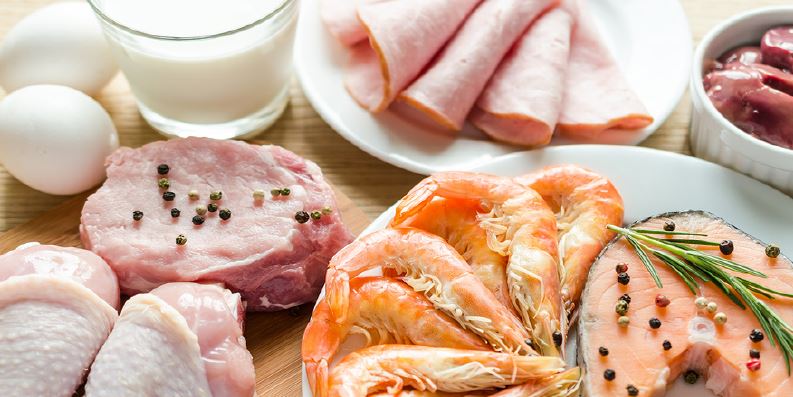
To prevent muscle wastage during your fat loss project it’s vital to maintain healthy levels of protein. But it’s not just muscles that contain protein; it plays a structural role in every cell of your body.
Without enough protein, your health is seriously compromised. And because you’re also working out, you’ll need more than your average couch potato.
The traditional approach to taking on plenty of protein was to eat red meat. But unless you’re an Inuit, a diet high in saturated fat is far from healthy.
No one’s saying don’t enjoy a steak every now and then, but if you want to reach your fat loss goal – here are some alternatives, all containing 10 g of lean protein:
| Animal foods | Plant foods |
|---|---|
| 2 small eggs | 4 slices (120 g) wholemeal bread |
| 30 g reduced fat cheese | 3 cups (90 g) whole grain cereal |
| 70 g cottage cheese | 2 cups (330 g) cooked pasta |
| 1 cup (250 ml) low-fat milk | 3 cups (400 g) cooked rice |
| 35 g lean beef, lamb, or pork (cooked weight) | ¾ cup (150 g) lentils or kidney beans |
| 40 g lean chicken (cooked weight) | 200 g baked beans |
| 50 g grilled fish | 120 g tofu |
| 50 g tinned tuna or salmon | 60 g nuts or seeds |
| 200 g reduced-fat yoghurt | 300 ml soya milk |
| 150 g light fromage frais | 100 g soya meat |
At this point we strongly suggest reading these three additional articles:
- Best High Protein Foods for Bodybuilders
- The Best Sources Of Protein For Building Muscles
- 8 practical ways to enrich your meals with protein

Fat

Even though you’re working towards your fat loss goal, you do still need to eat fat. It makes food taste great and also gives a feeling of fullness that lasts.
There are also important physiological reasons for making sure your diet contains enough fat:
- Essential vitamins A, D, E, and K are fat soluble. Your body can only metabolize them when they’re digested with fats.
- Fat keeps your skin and hair healthy and helps keep you warm.
- Fat protects your body against toxins by absorbing them and storing them out of harm’s way until they can be processed.
- Your stores of fat are a key energy source for your body.
- Fatty acids are essential nutrients. Your body can’t manufacture them itself, so you need to take them board through your diet.
Which fats?
Most of us will know that too much saturated fat is bad for you. But that doesn’t mean it should be avoided completely.
Just make sure your diet contains more unsaturated fats and omega-3 fish oils, than animal-derived saturated fats.
| Good fats | Bad fats |
|---|---|
| Olive oil | Lard |
| Linseed oil | Fried foods |
| Sesame oil | Palm oil |
| Flax oil | Whole-fat dairy products |
| Nuts/seeds | Whole-fat dairy products |
| Oily fish (mackerel, salmon, herring) | Chicken skin |

When to eat
- When shedding fat it’s important to keep topping up to stave off hunger pangs which can lead you astray! Heed your mum’s advice – never go without your breakfast. It sets you up for the day and kick-starts your metabolism, helping it burn off that fat.
- If you’re running at the lower end of the recommended intake of carbohydrates, make sure you give yourself a day a week when you relax the regime a little or your body will go into fat-storing starvation mode.
- Working out? Make sure you fuel up first. You need to arrange your calorie intake so that you get an extra carb/protein boost two hours before your workout, and a protein hit just after. You may find a whey protein supplement is an easy no-nonsense solution.
- Keep yourself satiated through the night by taking on some fats before you turn in. A hot milky drink, for example.
TRAINING FOR FAT LOSS

If you’re going to get ripped, your super healthy, balanced, calorie-controlled diet is a great start, but not enough on its own. You’re going to have to hit the gym too.
But what do you do when you get there? Should you prioritize weights or cardio?
Do it two ways
If you want to get healthy you need to make cardio part of your daily life, as well as weight training. To optimize the rate at which you burn fat, we’re going to mix it up a little and combine both.
That’s because nothing gets your metabolism going like working your body in different ways. This also prevents weight-loss plateau to occur.
A word of warning: You might be ready to take on the challenge of working out, but is your body? If in doubt, or it’s been a long time since you last trained, a quick visit to your GP will make sure you’re fit to get fit.
Cardio
HIIT
HIIT stands for High Intensity Interval Training. You take one exercise, go at it hard, rest, repeat.
It could be a treadmill, bike, rowing machine, cross trainer – it doesn’t matter. A HIIT workout could look like this:
Warm up – five minutes of jogging
| Interval | Time |
|---|---|
| Sprint | 30 seconds |
| Active rest (walking) | 1 minute |
| Sprint | 30 seconds |
| Active rest (walking) | 1 minute |
| Sprint | 30 seconds |
| Active rest (walking) | 1 minute |
Repeat three times.
Your aim is to exercise hard enough to get your heart rate to 85% of its maximum. To work out your maximum heart rate subtract your age from 220.
By resting for twice as long as you exercise, you give your body time to recover fully so you can repeat the exercise.
As you get fitter, you can increase the number of reps until your HIIT cardio workout lasts 15 – 20 minutes. This ensures maximum fat burning without your body switching to muscle tissue for fuel. Think 15 mins doesn’t seem like long enough? HIIT has been shown to be more effective than steady-state cardio for fat-burning and muscle protection.
You’re aiming for three sessions per week.
Moderate Intensity Steady State (MISS)
Moderate Intensity Steady State (MISS) exercises like jogging, swimming, or cycling are great for chewing through the calories, but keep at them for too long and you’ll erode your muscles too.
Just take a look at a marathon runner – they put in the distance, and the result is the physique of a string bean.
Fine if you want to be an endurance athlete, not so good for the rest of us.
But MISS sessions are fun. Think mountain biking, sea swimming, kayaking, hiking. Don’t miss out just because you’re shedding fat. Keep your sessions down to a couple of times a week – fun at weekends.
Pump iron
Resistance training helps you build the body you want while shedding fat through your HIIT program.
Weight training increases bone density, toughens connective tissue, and protects you from injury. You get to look good too.
Don’t reckon on your lean gains boosting your metabolism though. Instead, look at weight training as a part of a varied workout program that gets you fit for an active life. Work out three times per week.
If you’re new to weights, the staff at your gym will be more than happy to give you an induction and provide a basic workout program.
If not here’s one you can use:
| Exercise | Reps |
|---|---|
| Squat | 10 – 15 reps x 3 |
| Deadlift | 10 – 15 reps x 3 |
| Bench press | 10 – 15 reps x 3 |
| Shoulder press | 10 – 15 reps x 3 |
| Barbell row | 10 – 15 reps x 3 |
| Cable tricep extension | 10 – 15 reps x 3 |
| Standing alternate bicep curls | 10 – 15 reps x 3 |
| Medicine ball crunches/ crunches | 30 reps x 3 |
Combine
Got an hour to spend at the gym? Why not turbocharge your workout?
Split your HIIT and weights programs in half and combine them to make two interesting, varied sessions. Resistance training will help you look good while you lose fat.
Over the week each muscle group gets at least two workouts, and you keep your cardio from getting boring.
Experiment – but just remember to take it steady to start with. As you adjust to your new regime, a certain amount of soreness is to be expected.
But if you feel any ill effects – stop and seek medical advice.
SUPPLEMENTS FOR FAT LOSS

You’ve cut your calorie intake, you’re eating right. You’re giving it your all at the gym – but you just can’t seem to shift that fat.
Maybe you have time pressures that mean you can’t work out several times a week. Or perhaps you just want to give your fat loss program an extra boost. That’s where supplements come in. Responsible use of supplements can help you on your way to your fat loss goal – but only if you eat
healthily and train hard at the gym. Supplements for fat loss can be split into two broad groups: fat burners and muscle mass protectors.
Fat Burners
Fat burners are designed to work by speeding up the metabolism, suppressing appetite, and/or blocking fat absorption. Always read the manufacturers’ guidelines before taking and adopt a two-week on, two-week off cycle to avoid dependency or adrenal exhaustion.
Here are some of the main fat-burning ingredients to look out for:
1. Caffeine
Caffeine stimulates the central nervous system, raising your heart rate, suppressing appetite, and stimulating the production of adrenaline. That’s good news because it raises your metabolic rate. This in turn helps your body burn fat; the “fight or flight” hormone boost will see you catch fire in the gym.
2. Green Tea
One of nature’s superfoods, green tea is packed with antioxidants. Drinking the tea itself won’t make a significant difference to your fat loss campaign, but a green tea extract might. The active ingredient is Epigallocatechin Gallate (EGCG), an antioxidant that boosts fat processing without raising your heart rate. Don’t take green tea extracts if you’re pregnant.
3. CLA
Conjugated Linoleic Acid (CLA) works by stimulating the natural process of lipolysis. It reduces body fat by increasing metabolic rate, which allows your body can convert food into energy more efficiently. As well as reducing body fat, CLA can help with muscle growth, recovery and repair functions, and keeping your immune system healthy.
4. Acai Berry
Recent research found that after taking Acai Berry for one month, participants were less susceptible to the sugar spike after meals. This is fantastic news for fat loss, as this sugar spike is one of the main causes of fat tissue buildup. In addition, insulin, cholesterol, and fasting blood sugar levels were all lowered after the one-month period. Bonus!
There are many different weight-loss ingredients/supplements. Some of them include:
However, not all are efficient and safe. Consult with your doctor.
Muscle mass protectors
Whey protein
To protect and build lean muscle mass during your fat loss program, you need to include sufficient protein in your diet. This is particularly important before and after your workout. Pre-workout, a dose of whey protein is a fast effective way to get some protein into your system. Post-workout, you’re taking advantage of the ‘anabolic window’, the time up to two hours after your gym session when your body is most receptive to laying down muscle. Whey protein is a tried and tested protein source, and because you usually take it as a shake, it’s convenient and tasty too.
Branch Chain Amino Acids (BCAAs)
Branch Chain Amino Acids (BCAAs) are extremely useful for those training for fat loss. BCAAs work in three ways:
- Assist in protein synthesis – helping you lay down muscle and recover after training.
- Provide a fuel source for your body during training – protecting your lean muscle mass.
- Reduce perceived exertion during training – means you can work out harder for longer
If you’d like to know more about the role supplements can play in helping you achieve your training aims, please see our beginner’s guide to supplements.
CONCLUSION
If you’ve tried diets before and they haven’t worked, don’t worry. Fat loss is completely different from weight loss. Weight loss diets tend to make you lose muscle that often ends up being replaced by yet more fat. Fat loss means you eat properly, you work out, you get lean.
Here we’ve given you the tools to design your own fat loss programme. You’ll still have to work hard to achieve your goals. But so what? Your fat loss program is varied enough to keep you interested and because you’ll be eating a balanced diet, you won’t need to worry unduly about hunger pangs. Work out where you are in terms of your physical goals. Calculate the number of calories you need to consume to still lose fat. Follow the workout instructions. Go for it!
