
Introduction
Most people train the muscles they can easily see in the mirror — chest, abs, shoulders, and arms. Meanwhile, the muscles on the back side of the body are often neglected, underdeveloped, or poorly trained. Ironically, those “hidden” muscles may be the single most important system for strength, athletic performance, posture, spinal health, and long-term physical function.
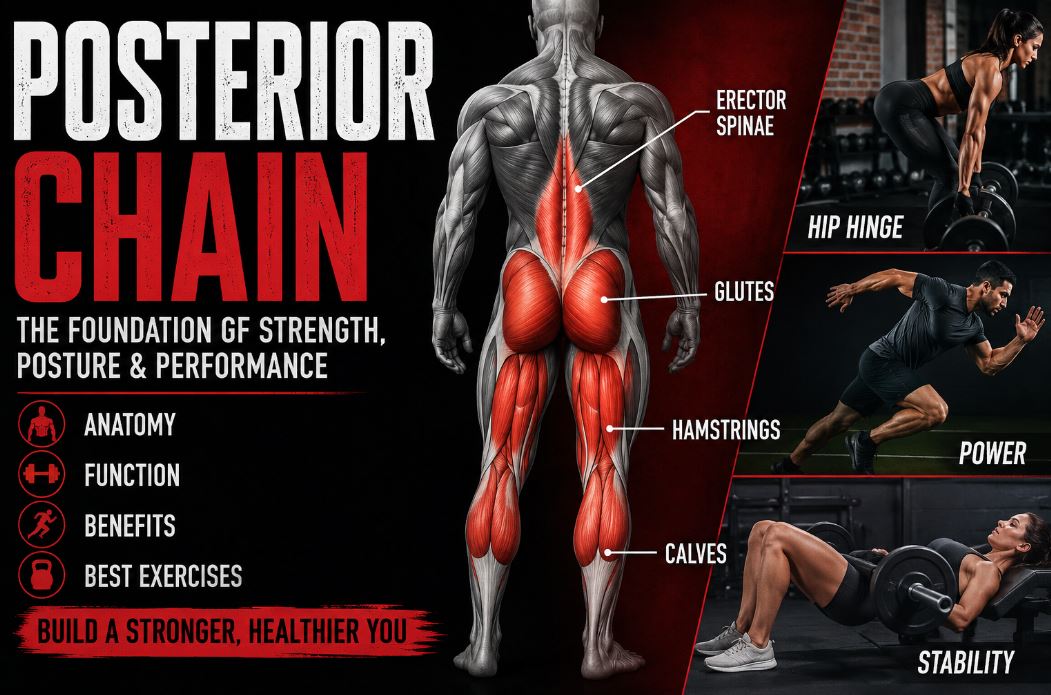
This entire system is known as the posterior chain.
The posterior chain is not just one muscle. It is a powerful network of muscles running along the backside of the body that work together to produce force, stabilize the spine, control posture, and generate explosive movement. Every time you sprint, jump, deadlift, climb stairs, pick something up from the floor, or simply maintain upright posture, your posterior chain is heavily involved.
In modern society, the posterior chain has become increasingly weak due to prolonged sitting, sedentary lifestyles, poor posture, and training programs that overemphasize “mirror muscles” while ignoring the backside of the body. Weak glutes, tight hip flexors, poor spinal stability, chronic low-back discomfort, and reduced athletic performance are often direct consequences of an underdeveloped posterior chain.
As a coach working with lifters and athletes, I often notice that many performance plateaus and movement problems stem from poor development of the posterior chain. Athletes with weak hamstrings and glutes frequently struggle with sprint speed, deadlift strength, posture control, and lower-body stability — even when their quadriceps or upper body appear strong.
A well-developed posterior chain improves far more than gym performance. It can help enhance posture, reduce injury risk, improve movement efficiency, increase power production, and support healthier aging over time. In many ways, the posterior chain acts as the body’s “engine” for human movement.
In this complete guide, we’ll break down exactly what the posterior chain is, which muscles it includes, why it matters so much for performance and health, the consequences of a weak posterior chain, and the best exercises for building a stronger, more resilient body.
What Is the Posterior Chain?
The term “posterior chain” refers to the interconnected group of muscles located along the backside of the body that work together to produce movement, stabilize the spine, maintain posture, and transfer force efficiently throughout the body.
The word posterior simply means “back side” or “rear,” while the word chain refers to the fact that these muscles function together as a coordinated kinetic system rather than as isolated structures. In other words, the posterior chain is not a single muscle — it is a highly integrated movement network.
This muscular system extends from the upper back down to the calves and feet. It includes some of the most powerful and functionally important muscles in the human body, including the glutes, hamstrings, spinal erectors, and many deep stabilizing muscles surrounding the spine and pelvis.
One of the most important concepts to understand is that the posterior chain operates as a force-transmission system. When one part of the chain is weak, tight, poorly coordinated, or unstable, the entire system becomes less efficient. This can negatively affect movement quality, posture, athletic performance, lifting mechanics, and injury resistance.
For example:
- Weak glutes may force the lower back to compensate excessively during deadlifts or jumping.
- Poor hamstring strength may increase the risk of sprinting injuries.
- Weak spinal stabilizers may reduce force transfer during squats and pulling movements.
- Poor posterior-chain coordination may contribute to inefficient movement patterns and chronic discomfort.
The posterior chain also plays a major role in the hip-hinge movement pattern — one of the most fundamental movement patterns in strength training and athletics. Exercises such as deadlifts, Romanian deadlifts, kettlebell swings, glute-ham raises, and hip thrusts all rely heavily on the posterior chain.
In contrast, the anterior chain refers to the muscles on the front side of the body, such as the quadriceps, abdominals, chest, and hip flexors. Both systems are important, but modern lifestyles and bodybuilding-focused training routines often lead to excessive anterior dominance and neglect of posterior-chain development.
This imbalance can contribute to:
- Rounded shoulders
- Forward head posture
- Tight hip flexors
- Weak glutes
- Lower-back stress
- Poor movement mechanics
- Reduced athletic performance
A strong posterior chain is therefore not only important for athletes and lifters — it is essential for healthy human movement in general.
Posterior Chain Muscles (Anatomy Overview)
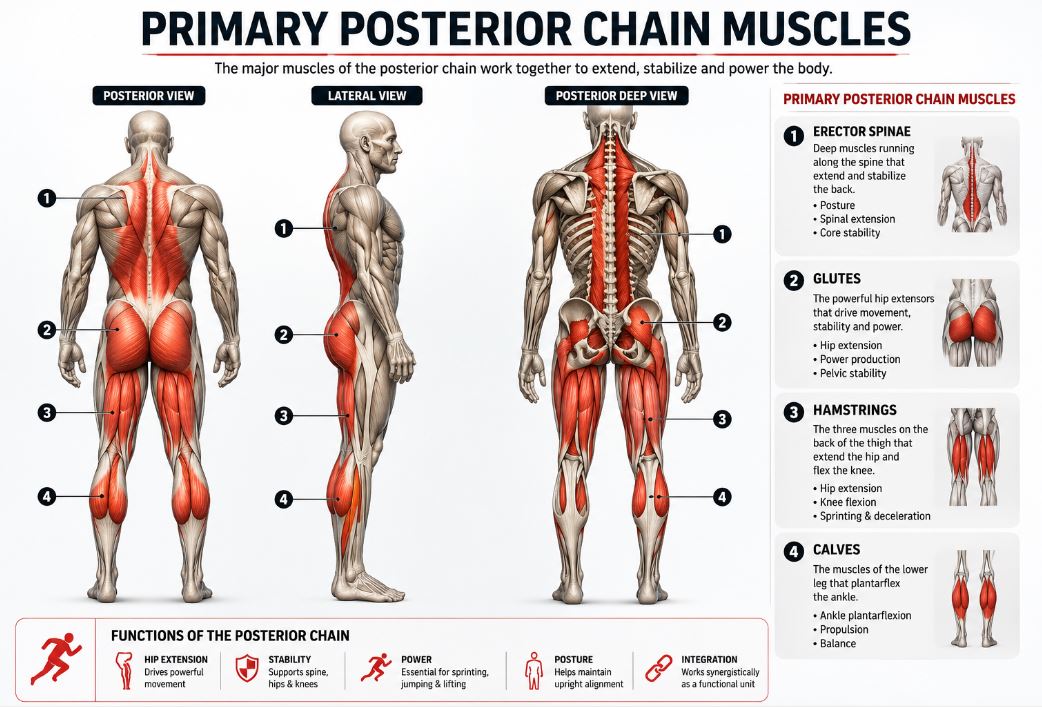
The posterior chain comprises multiple muscle groups that work together to stabilize the body, extend the hips, support the spine, and generate force during movement. Some of these muscles are large prime movers responsible for producing power, while others act primarily as stabilizers and coordinators.
Because the posterior chain functions as an integrated system, weakness or dysfunction in one area can affect the entire movement chain.
Primary Posterior Chain Muscles
These muscles form the core of the posterior chain and are most directly responsible for force production, posture, and athletic movement.
Gluteus Maximus
The gluteus maximus is the largest and most powerful muscle in the human body. It is heavily involved in:
- Hip extension
- Sprinting
- Jumping
- Deadlifting
- Climbing stairs
- Rising from seated positions
Strong glutes are critical for explosive athletic performance and spinal protection. Unfortunately, prolonged sitting and sedentary lifestyles often lead to “glute inhibition,” where the glutes become weak and underactive.
Hamstrings
The hamstrings consist of three primary muscles:
- Biceps femoris
- Semitendinosus
- Semimembranosus
These muscles cross both the hip and knee joints, allowing them to perform two major functions:
- Hip extension
- Knee flexion
The hamstrings play a critical role in sprinting, deceleration, jumping, and posterior-chain stabilization. They are also one of the most commonly injured muscle groups in sports.
Erector Spinae
The erector spinae are long muscles running alongside the spine that help maintain upright posture and spinal stability.
Their primary functions include:
- Spinal extension
- Anti-flexion stabilization
- Postural support
- Force transfer during lifting
These muscles work intensely during deadlifts, bent-over rows, squats, and nearly all hip-hinge movements.
Gluteus Medius and Gluteus Minimus
Although smaller than the gluteus maximus, these muscles are extremely important for:
- Hip stabilization
- Pelvic control
- Balance
- Single-leg stability
Weakness in these muscles is often associated with poor knee mechanics, balance problems, and movement inefficiency.
Gastrocnemius and Soleus (Calves)
The calf muscles are technically part of the lower posterior chain and contribute to:
- Walking
- Running
- Sprinting
- Jumping
- Force transfer during locomotion
The gastrocnemius also assists with knee flexion because it crosses the knee joint.
Secondary and Supporting Posterior Chain Muscles
Several additional muscles support posterior-chain movement and stabilization.
Latissimus Dorsi
The lats connect the upper body to the pelvis and play an important role in:
- Pulling strength
- Deadlift stabilization
- Scapular control
- Force transfer
The lats are heavily involved in maintaining spinal rigidity during heavy lifting.
Trapezius
The trapezius supports:
- Scapular stabilization
- Neck posture
- Upper-back positioning
- Pulling mechanics
Strong traps help maintain upper-body positioning during rows, deadlifts, carries, and athletic movement.
Rhomboids
These muscles help retract and stabilize the shoulder blades, contributing to posture and upper-back control.
Rear Deltoids
The rear delts assist with shoulder extension and external rotation while also supporting healthy posture and upper-body balance.
Deep Spinal Stabilizers
These include muscles such as:
- Multifidus
- Rotatores
- Interspinales
Although small, they are essential for spinal control and segmental stabilization during movement.
The Posterior Chain Functions as a System
One of the most important concepts in biomechanics is that the posterior chain rarely works in isolation. During real-world movement, multiple muscles contract simultaneously to:
- Stabilize joints
- Produce force
- Transfer energy
- Protect the spine
- Coordinate movement patterns
For example, during a deadlift:
- The glutes extend the hips
- The hamstrings assist hip extension
- The spinal erectors stabilize the torso
- The lats maintain bar positioning
- The core prevents excessive spinal movement
This integrated coordination is what makes the posterior chain such an essential foundation for strength, athleticism, posture, and injury prevention.
Main Functions of the Posterior Chain
The posterior chain is involved in nearly every major human movement pattern. Whether you are sprinting, lifting weights, maintaining posture, jumping, climbing stairs, or simply standing upright, the muscles on the backside of the body are constantly working to stabilize and move the body efficiently.
One of the reasons the posterior chain is so important is that these muscles are responsible for producing and transferring force through the hips and spine — the central “power zone” of the body.
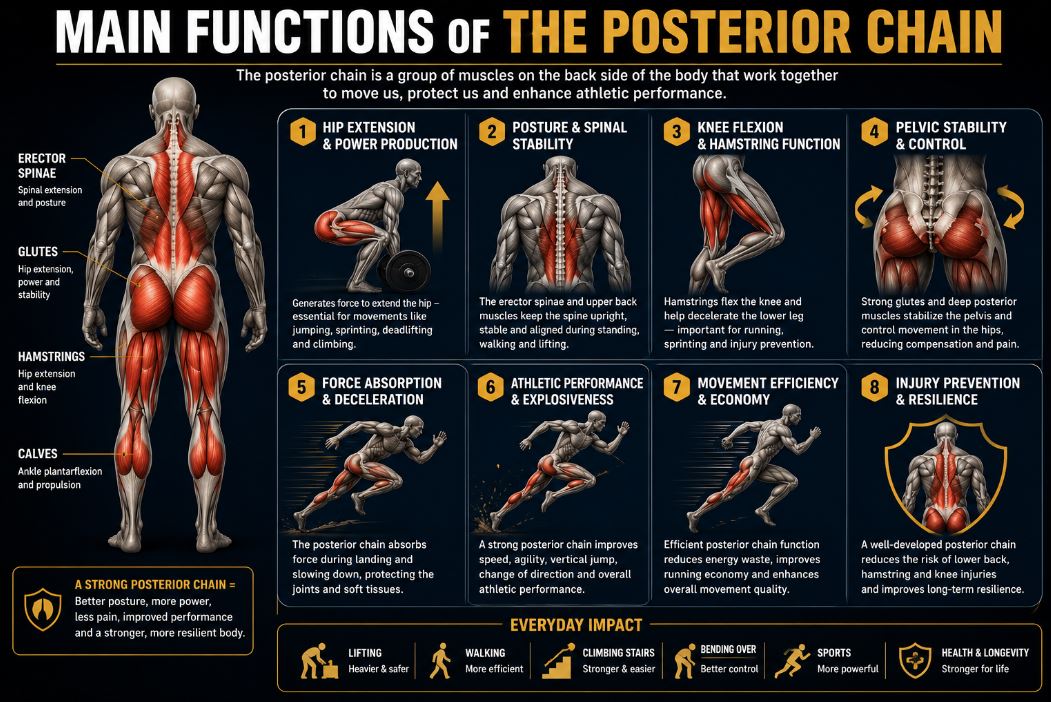
Hip Extension — The Foundation of Power Production
Hip extension is one of the primary functions of the posterior chain and one of the most important movement actions in athletics and strength training.
Therefore, hip extension occurs when the hips move from a flexed position into a straightened or extended position. This movement is primarily driven by:
- Gluteus maximus
- Hamstrings
- Adductor magnus (posterior fibers)
Examples of hip extension include:
- Deadlifts
- Romanian deadlifts
- Sprinting
- Jumping
- Climbing stairs
- Kettlebell swings
- Hip thrusts
Powerful athletes are almost always characterized by strong hip extension capacity. Sprint acceleration, vertical jumping ability, and explosive lower-body power are heavily dependent on posterior-chain strength.
Spinal Stabilization and Posture Control
The posterior chain plays a major role in stabilizing the spine and maintaining upright posture throughout the day.
The erector spinae and deep spinal stabilizers help resist excessive spinal flexion while supporting proper alignment during movement and lifting.
Without adequate posterior-chain strength:
- The torso collapses forward more easily
- The lower back compensates excessively
- Posture deteriorates
- Movement efficiency decreases
This is especially important in modern society, where prolonged sitting often weakens the posterior chain and encourages rounded shoulders, forward head posture, and pelvic dysfunction.
Force Transfer Throughout the Body
The posterior chain not only produces force, but it also transfers force between the upper and lower body.
For example, during a heavy deadlift:
- The legs generate force into the floor
- The glutes and hamstrings extend the hips
- The spinal erectors stabilize the torso
- The lats help transfer force through the upper body
If one link in the chain is weak, energy “leaks” occur and overall performance decreases.
This is one reason why posterior-chain weakness can dramatically limit strength development even when other muscle groups appear strong.
Deceleration and Injury Protection
One of the lesser-known functions of the posterior chain is deceleration control.
During sprinting, jumping, landing, and rapid direction changes, the hamstrings and glutes must eccentrically absorb force to protect the joints and stabilize movement.
This eccentric control is critical for:
- Hamstring injury prevention
- Knee stability
- Hip stability
- Lower-back protection
- Athletic resilience
Athletes with poor eccentric posterior-chain strength are often more prone to:
- Hamstring strains
- ACL-related problems
- Low-back discomfort
- Movement inefficiency
Athletic Movement and Explosiveness
Nearly every explosive athletic movement relies heavily on the posterior chain.
This includes:
- Sprinting
- Jumping
- Throwing
- Tackling
- Olympic lifting
- Change-of-direction speed
- Rotational power
The posterior chain essentially acts as the body’s “engine” for explosive movement.
This is why elite athletes across football, sprinting, rugby, basketball, combat sports, and powerlifting place an enormous emphasis on posterior chain development.
Walking, Running, and Daily Function
Even basic daily activities depend heavily on posterior-chain function.
Walking and running require constant coordination between the:
- Glutes
- Hamstrings
- Calves
- Spinal stabilizers
Simple movements such as:
- Standing up
- Bending over
- Carrying groceries
- Climbing stairs
- Picking objects up from the floor
All require posterior-chain activation to some degree.
A weak posterior chain not only affects athletic performance — it can negatively influence general quality of life and long-term movement health.
Why a Strong Posterior Chain Is So Important
A strong posterior chain improves far more than just gym performance. It influences posture, movement quality, athleticism, injury resistance, spinal health, and even long-term physical function as we age.
Because the posterior chain is involved in nearly every major movement pattern, strengthening these muscles can positively affect both athletic performance and everyday life.
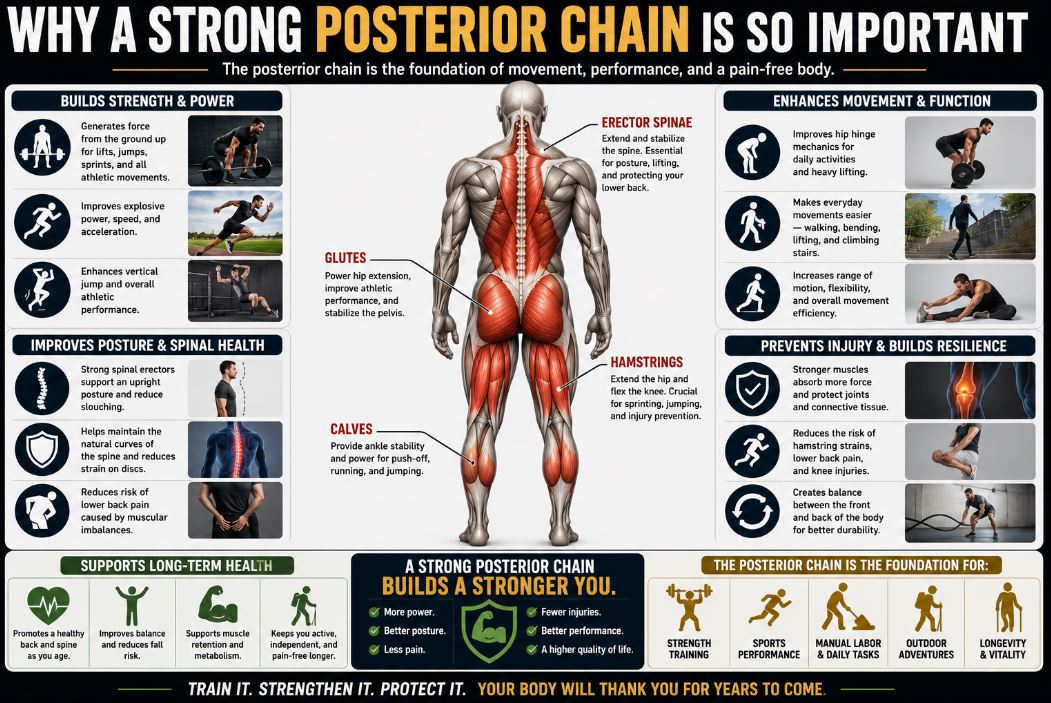
Improved Posture and Spinal Alignment
One of the most noticeable benefits of a strong posterior chain is better posture.
Modern lifestyles often involve:
- Prolonged sitting
- Forward head posture
- Rounded shoulders
- Weak glutes
- Tight hip flexors
Over time, these adaptations weaken the backside of the body while allowing the anterior muscles to dominate posture and movement.
Strong glutes, spinal erectors, rear deltoids, rhomboids, and upper back musculature help maintain a more neutral spinal position and better overall alignment.
This may help reduce:
- Rounded shoulders
- Excessive forward lean
- Postural fatigue
- Lower-back stress
Greater Strength and Power Production
The posterior chain contains some of the strongest muscles in the human body.
Exercises such as:
- Deadlifts
- Hip thrusts
- Romanian deadlifts
- Glute-ham raises
- Kettlebell swings
All rely heavily on posterior-chain strength for force production.
A stronger posterior chain often leads to improvements in:
- Deadlift strength
- Sprint speed
- Jumping ability
- Explosive power
- Overall athletic performance
In many athletic movements, hip extension power generated by the glutes and hamstrings is one of the primary determinants of explosiveness.
Reduced Risk of Injury
Weak posterior-chain musculature is commonly associated with poor movement mechanics and increased injury risk.
For example:
- Weak glutes may contribute to knee valgus and hip instability
- Weak hamstrings may increase the risk of hamstring strain
- Poor spinal stabilization may increase lower-back stress
- Weak posterior-chain control may impair landing mechanics
Strong posterior-chain muscles help absorb force more efficiently while stabilizing the hips, knees, pelvis, and spine during dynamic movement.
This is one reason eccentric hamstring strengthening has become such an important component of modern sports performance training programs.
Better Lower-Back Health
Many people assume low-back pain automatically means the lower back itself is the problem. In reality, weak glutes, poor hip mechanics, and inadequate posterior-chain strength are often contributing factors.
When the glutes and hamstrings fail to generate enough force during movement, the lower back frequently compensates excessively.
This may increase spinal stress during:
- Lifting
- Bending
- Carrying
- Rotational movement
- Daily activities
Developing stronger posterior-chain musculature may improve movement efficiency and reduce unnecessary spinal overload.
Enhanced Athletic Performance
Athletes in nearly every sport benefit from strong posterior-chain development.
This includes:
- Sprinters
- Football players
- Basketball players
- Combat athletes
- Olympic lifters
- Powerlifters
- Bodybuilders
Posterior-chain strength contributes heavily to:
- Sprint acceleration
- Deceleration ability
- Vertical jumping
- Change-of-direction speed
- Rotational power
- Stability under load
As a coach working with athletes and lifters, I often notice that improving posterior-chain strength immediately improves movement quality and power production across multiple athletic tasks.
Improved Glute Development and Lower-Body Aesthetics
From a physique perspective, the posterior chain heavily influences the appearance of the:
- Glutes
- Hamstrings
- Lower back
- Upper back
Well-developed posterior-chain musculature contributes to:
- Better glute shape
- Improved hamstring thickness
- Stronger athletic appearance
- Better overall muscular balance
Many people overtrain the quadriceps while undertraining the glutes and hamstrings, leading to imbalanced lower-body development.
Better Movement Efficiency and Longevity
The posterior chain becomes increasingly important with aging.
Strong posterior-chain musculature helps maintain:
- Balance
- Walking ability
- Stair-climbing strength
- Postural stability
- Functional independence
Loss of posterior chain strength is often associated with reduced movement capacity and increased fall risk in older adults.
In many ways, maintaining posterior chain strength is not just about sports performance — it is about preserving movement quality and physical function throughout life.
Signs of a Weak Posterior Chain
A weak posterior chain rarely affects only athletic performance. In many cases, it gradually influences posture, movement quality, joint stability, lifting mechanics, and even everyday comfort.
Because the posterior chain is involved in many fundamental movement patterns, weakness in these muscles often leads to compensations throughout the body. Some people notice reduced strength and athleticism, while others experience chronic tightness, poor posture, or recurring discomfort.
As a coach working with lifters and athletes, I frequently notice that many common movement problems stem from underdeveloped glutes, weak hamstrings, poor hip-hinge mechanics, or insufficient spinal stabilization.
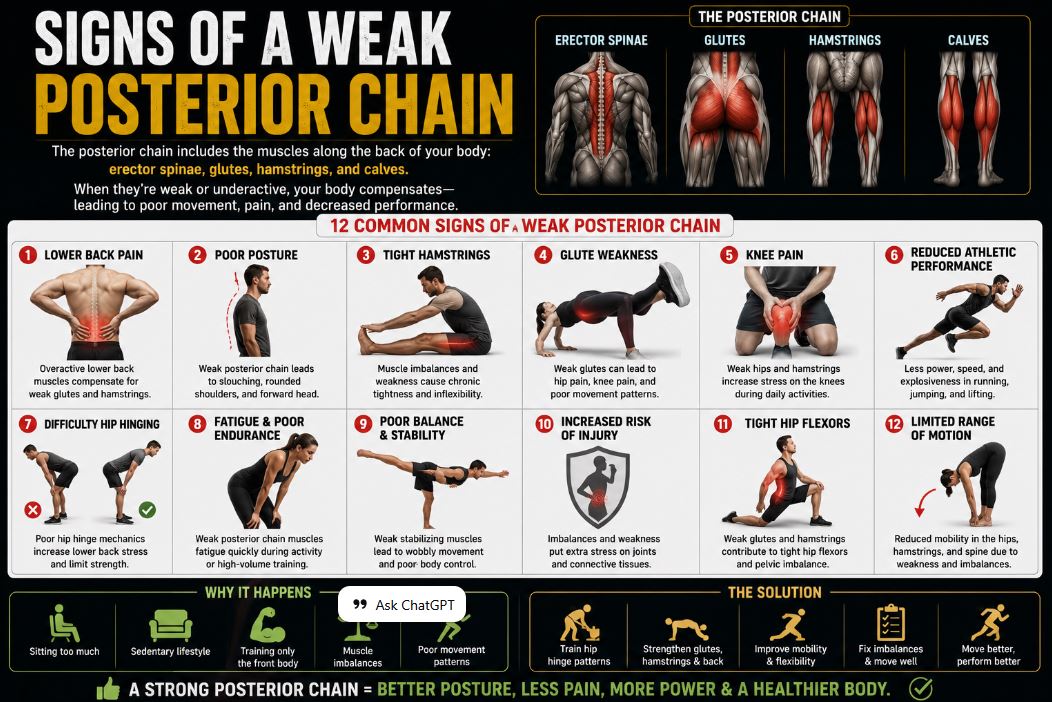
Rounded Shoulders and Poor Posture
One of the most common signs of posterior-chain weakness is postural collapse.
Weak upper-back muscles such as the:
- Rhomboids
- Rear deltoids
- Trapezius
- Spinal erectors
may contribute to:
- Rounded shoulders
- Forward head posture
- Excessive thoracic flexion
- Poor standing alignment
This problem is especially common in people who spend long hours sitting at desks or looking downward at screens.
Chronic Lower-Back Discomfort
Weak glutes and hamstrings often force the lower back to compensate excessively during movement.
When the posterior chain cannot properly generate force or stabilize the pelvis, the lumbar spine may absorb more stress than it should during:
- Lifting
- Bending
- Walking
- Carrying objects
- Athletic movement
Over time, this may contribute to chronic lower-back tightness, fatigue, or discomfort.
Weak Glutes and Hip Instability
Glute weakness is extremely common in sedentary populations.
Signs of weak or underactive glutes may include:
- Poor hip stability
- Knee collapse during squats or lunges
- Reduced sprint power
- Poor balance
- Difficulty generating explosive movement
Weak glutes also reduce the efficiency of the hip-hinge pattern, which negatively affects exercises like deadlifts and Romanian deadlifts.
Tight Hip Flexors and Anterior Dominance
Sitting for prolonged periods often creates a muscular imbalance between the anterior and posterior chains.
Tight hip flexors combined with weak glutes may contribute to:
- Anterior pelvic tilt
- Reduced hip mobility
- Poor posture
- Reduced glute activation
This imbalance is sometimes referred to as “lower-crossed syndrome.”
Hamstring Strains and Athletic Injuries
Athletes with poor eccentric hamstring strength are often more susceptible to hamstring injuries.
Weak posterior-chain musculature may impair the body’s ability to:
- Decelerate efficiently
- Absorb force
- Stabilize joints during sprinting
- Control landing mechanics
This is one reason posterior-chain strengthening has become such an important part of modern sports-performance programs.
Poor Sprinting, Jumping, and Explosive Performance
Explosive athletic movements rely heavily on posterior-chain power production.
A weak posterior chain may contribute to:
- Reduced sprint speed
- Lower vertical jump
- Poor acceleration
- Slower change-of-direction ability
- Reduced power output
Many athletes unknowingly rely too heavily on their quadriceps while underutilizing the glutes and hamstrings.
Difficulty Performing Hip-Hinge Movements
Weak posterior-chain musculature often makes it difficult to perform exercises such as:
- Deadlifts
- Romanian deadlifts
- Good mornings
- Kettlebell swings
- Back extensions
Common signs include:
- Excessive spinal rounding
- Poor hip control
- Difficulty maintaining a neutral spine
- Lower-back dominance during lifting
Balance Problems and Poor Single-Leg Stability
Posterior-chain weakness frequently affects single-leg control and overall movement stability.
Weak gluteus medius and deep stabilizers may contribute to:
- Wobbling during lunges
- Poor balance
- Knee instability
- Reduced coordination
- Inefficient gait mechanics
Single-leg exercises often expose these weaknesses very quickly.
The Body Functions as a Chain
One of the most important concepts to understand is that weakness in the posterior chain rarely stays isolated.
When one area becomes weak:
- Other muscles compensate
- Movement efficiency decreases
- Joint stress increases
- Force transfer becomes less efficient
Over time, these compensations may contribute to chronic dysfunction, performance limitations, and increased injury risk.
What Causes a Weak Posterior Chain?
A weak posterior chain usually does not develop overnight. In most cases, it results from years of poor movement habits, muscular imbalances, sedentary behavior, and training programs that neglect the backside of the body.
Modern lifestyles have created an environment in which posterior chain weakness has become extremely common — even among people who exercise regularly.
Prolonged Sitting and Sedentary Lifestyle
One of the biggest contributors to posterior-chain weakness is prolonged sitting.
Sitting for long periods places the hips in a constantly flexed position while reducing activation of the:
- Glutes
- Hamstrings
- Deep spinal stabilizers
Over time, this may contribute to:
- Weak glutes
- Tight hip flexors
- Reduced hip mobility
- Poor pelvic control
- Postural dysfunction
This phenomenon is sometimes referred to as “gluteal amnesia” or gluteal inhibition, in which the glutes become underactive due to a lack of regular use.
Overemphasis on “Mirror Muscles”
Many training programs place enormous focus on anterior muscles such as the:
- Chest
- Abs
- Quadriceps
- Front deltoids
- Arms
Meanwhile, posterior-chain muscles often receive far less direct training volume.
This imbalance can gradually create:
- Anterior dominance
- Poor posture
- Reduced hip strength
- Lower-back compensation
- Movement inefficiency
As a coach, I frequently see lifters with impressive upper-body development but severely underdeveloped glutes, hamstrings, and spinal stabilizers.
Lack of Hip-Hinge Training
The hip-hinge movement pattern is one of the most important movement patterns for posterior-chain development.
Unfortunately, many people rarely perform exercises such as:
- Deadlifts
- Romanian deadlifts
- Good mornings
- Hip thrusts
- Kettlebell swings
Without proper hip-hinge training, the glutes and hamstrings often remain weak and poorly coordinated.
Many beginners also squat excessively while neglecting hip-dominant exercises entirely.
Poor Exercise Technique
Even when people perform posterior chain exercises, poor technique may prevent effective muscle development.
Common technical problems include:
- Excessive lumbar rounding
- Poor glute activation
- Limited hip mobility
- Using momentum instead of muscular control
- Quad-dominant movement patterns
- Lack of eccentric control
For example, many people perform deadlifts primarily using the lower back rather than properly loading the hips and hamstrings.
Weak Core Stability
The posterior chain and core function together during nearly all major movement patterns.
Weak abdominal stabilization may impair:
- Pelvic positioning
- Spinal alignment
- Force transfer
- Hip mechanics
Without proper trunk stability, posterior-chain muscles often struggle to generate force efficiently.
Limited Mobility and Flexibility
Restricted mobility may also contribute to posterior-chain dysfunction.
Common mobility limitations include:
- Tight hamstrings
- Tight hip flexors
- Poor ankle mobility
- Limited thoracic mobility
When mobility restrictions exist, movement quality often deteriorates, and compensatory patterns develop.
Poor Training Balance
Some people unknowingly create muscular imbalance by performing too much:
- Machine training
- Isolation work
- Seated exercises
- Sagittal-plane dominant training
while neglecting:
- Posterior-chain integration
- Stabilization work
- Single-leg training
- Athletic movement patterns
The body functions best when multiple muscle groups work together through coordinated movement.
Insufficient Eccentric Training
Eccentric posterior-chain strength is critical for athletic performance and injury prevention.
However, many people rarely emphasize:
- Slow lowering phases
- Deceleration training
- Hamstring eccentric work
- Controlled movement tempo
Exercises such as:
- Nordic hamstring curls
- Sliding leg curls
- Romanian deadlifts
- TRX hamstring curls
can be extremely valuable because they improve eccentric control and posterior-chain resilience.
Modern Life Reduces Natural Posterior-Chain Activity
Human movement has changed dramatically over time.
Modern lifestyles involve:
- More sitting
- Less walking
- Less climbing
- Less manual labor
- Less natural movement variability
As a result, many people no longer challenge the posterior chain enough to maintain optimal strength and function.
In many ways, posterior-chain weakness has become one of the defining physical consequences of modern sedentary living.
Best Posterior Chain Exercises
Building a strong posterior chain requires more than simply training one muscle group in isolation. The most effective posterior-chain exercises usually involve coordinated movement between the hips, glutes, hamstrings, spinal stabilizers, and upper back.
Some exercises emphasize maximal strength and force production, while others focus more on stabilization, eccentric control, athleticism, or muscular endurance. Ideally, a well-designed training program should include a combination of hip-dominant compound lifts, unilateral exercises, stabilization work, and eccentric hamstring training.
Deadlift Variations
Deadlift variations are among the most effective posterior-chain exercises ever created.
They heavily train:
- Glutes
- Hamstrings
- Spinal erectors
- Lats
- Trapezius
- Core stabilizers
Conventional Deadlift
The conventional deadlift is one of the best full-body posterior-chain strength exercises for building maximal force production and total-body stability.
Romanian Deadlift (RDL)
The Romanian deadlift places greater emphasis on the hamstrings and glutes by increasing hip-hinge loading and stretch tension.
Stiff-Leg Deadlift
The stiff-leg deadlift further increases hamstring stretch by reducing knee flexion and increasing posterior-chain tension.
Trap Bar Deadlift
Although slightly more quad-dominant than conventional deadlifts, the trap bar deadlift still provides excellent posterior-chain loading while often reducing spinal stress.
Glute-Ham Raise
The glute-ham raise is one of the most advanced bodyweight posterior-chain exercises available.
It simultaneously trains:
- Hamstrings
- Glutes
- Spinal stabilizers
while heavily emphasizing eccentric control and knee-flexion strength.
This exercise is particularly valuable for athletes because of its strong carryover to sprinting and injury prevention.
Nordic Hamstring Curl
The Nordic hamstring curl is one of the most research-supported hamstring injury-prevention exercises.
Its primary benefit comes from extreme eccentric hamstring loading, which improves:
- Deceleration strength
- Sprint resilience
- Hamstring durability
Very few exercises overload the hamstrings eccentrically as effectively as the Nordic curl.
Hip Thrusts and Glute Bridges
Hip thrusts are excellent for directly targeting the glutes and improving hip extension strength.
Compared to deadlift variations, hip thrusts generally produce:
- Greater peak glute contraction
- Less spinal loading
- More direct glute emphasis
Glute bridges are often used as beginner-friendly posterior-chain activation exercises.
Back Extensions and Reverse Hypers
Back extensions strengthen the:
- Spinal erectors
- Glutes
- Hamstrings
while improving lower-back endurance and posterior-chain coordination.
Reverse hyperextensions may also help reduce spinal compression during dynamic hip extension training.
Kettlebell Swings
Kettlebell swings are highly effective for developing explosive hip extension and posterior-chain power.
This exercise teaches aggressive hip drive while also improving:
- Conditioning
- Athletic explosiveness
- Posterior-chain endurance
Proper swing mechanics rely heavily on the hip hinge rather than squatting mechanics.
Walking Lunges and Reverse Lunges
Although often considered leg exercises in general, lunges can strongly involve the posterior chain when performed with:
- Longer step length
- Slight forward torso lean
- Controlled hip loading
Walking lunges and reverse lunges also improve:
- Single-leg stability
- Glute activation
- Hip control
Sliding Leg Curls and Stability Ball Leg Curls
These bodyweight hamstring exercises combine:
- Knee flexion
- Hip stabilization
- Core control
- Eccentric hamstring loading
They are especially useful for home workouts, athletic training, and posterior-chain endurance development.
TRX Hamstring Curls
TRX hamstring curls increase instability demands significantly by suspending the feet during the movement.
This variation strongly challenges:
- Hamstrings
- Glutes
- Core musculature
- Pelvic stabilization
The instability component makes this exercise highly effective for coordination and athletic control.
Single-Leg Romanian Deadlift
The single-leg Romanian deadlift combines posterior-chain strengthening with:
- Balance training
- Hip stability
- Coordination
- Pelvic control
This exercise is excellent for exposing left-to-right asymmetries while improving athletic movement quality.
Good Mornings
Good mornings are advanced hip-hinge exercises that strongly target the:
- Hamstrings
- Glutes
- Spinal erectors
Because the load is positioned on the upper back, proper technique and spinal control are extremely important.
The Best Posterior Chain Programs Combine Multiple Movement Types
The posterior chain functions best when trained through multiple movement patterns, including:
- Hip hinges
- Knee flexion
- Single-leg exercises
- Explosive movement
- Eccentric control
- Stabilization training
Relying on a single exercise is rarely enough to comprehensively maximize posterior-chain development.
Posterior Chain and Athletic Performance
The posterior chain plays a central role in nearly every explosive athletic movement. Sprinting, jumping, accelerating, changing direction, tackling, lifting, and throwing all depend heavily on the posterior chain’s ability to generate and transfer force efficiently.
In many sports, the posterior chain essentially acts as the body’s primary “power system.”
Athletes with well-developed glutes, hamstrings, spinal stabilizers, and upper-back musculature are generally able to produce more explosive movement while maintaining better control and stability under high physical demands.
Sprinting and Acceleration
Sprinting is one of the clearest examples of posterior-chain dominance.
During sprint acceleration:
- The glutes generate powerful hip extension
- The hamstrings assist propulsion and deceleration
- The calves transfer force into the ground
- The spinal stabilizers maintain posture and force transfer
Research consistently shows that elite sprinters typically possess extremely strong, well-developed posterior chain musculature.
Weak hamstrings or glutes may reduce:
- Sprint speed
- Stride efficiency
- Acceleration power
- Running mechanics
while also increasing injury risk.
Jumping and Explosive Power
Vertical jumping and explosive lower-body power rely heavily on hip extension strength.
Movements such as:
- Broad jumps
- Vertical jumps
- Olympic lifting
- Plyometrics
All require coordinated posterior-chain force production.
The glutes and hamstrings act as major contributors to explosive triple extension involving the:
- Hips
- Knees
- Ankles
Athletes with stronger posterior chains generally demonstrate greater explosive output and improved movement efficiency.
Deceleration and Change of Direction
One of the most overlooked aspects of athletic performance is deceleration control.
Athletes do not only need to accelerate — they must also rapidly stop, stabilize, and redirect movement safely.
During deceleration:
- The hamstrings absorb force eccentrically
- The glutes stabilize the pelvis
- The posterior chain helps protect the knees and spine
Poor posterior-chain strength may contribute to:
- Hamstring strains
- Knee instability
- ACL injury risk
- Poor cutting mechanics
This is one reason eccentric hamstring training has become a major focus in modern sports performance programs.
Strength Sports and Powerlifting
Posterior-chain strength is foundational in strength sports such as:
- Powerlifting
- Olympic lifting
- Strongman
- CrossFit
Exercises such as:
- Deadlifts
- Squats
- Cleans
- Snatches
- Carries
All require substantial posterior-chain involvement.
In many cases, posterior chain weakness becomes the limiting factor for maximal strength performance.
Combat Sports and Rotational Power
Combat athletes also rely heavily on posterior-chain function.
Punching, kicking, grappling, throwing, and rotational force production all require coordinated interaction between the:
- Hips
- Glutes
- Core
- Upper back
The posterior chain helps create the stability and force transfer necessary for efficient rotational movement.
Bodybuilding and Physique Development
Even in bodybuilding, posterior-chain development is critical for creating a balanced and athletic physique.
Well-developed posterior-chain musculature contributes to:
- Glute shape
- Hamstring thickness
- Lower-back density
- Upper-back development
- Overall symmetry
Many physiques appear incomplete or unbalanced when the posterior chain is underdeveloped relative to the front side of the body.
Athletic Movement Is Never Isolated
One of the most important principles in sports biomechanics is that athletic movement rarely occurs in isolation.
Real-world movement requires the posterior chain to:
- Produce force
- Stabilize joints
- Transfer energy
- Control deceleration
- Coordinate multiple movement planes simultaneously
This is why posterior-chain training is often more than simply “building muscles” — it is about improving integrated movement capacity and athletic resilience.
Strong Athletes Almost Always Have Strong Posterior Chains
Across nearly every sport, powerful and explosive athletes tend to share one common characteristic:
- Strong glutes
- Strong hamstrings
- Strong spinal stabilizers
- Efficient hip extension mechanics
In many ways, the posterior chain forms the physical foundation of athletic performance itself.
Posterior Chain and Lower-Back Health
The posterior chain plays a critical role in protecting the lower back during both athletic movement and everyday activities. In fact, many cases of chronic lower back discomfort are not caused solely by the spine but by poor movement mechanics, weak glutes, weak hamstrings, and insufficient posterior chain support.
When the posterior chain cannot efficiently generate force or stabilize the pelvis, the lower back often compensates excessively.
Why the Lower Back Often Compensates
The body naturally tries to accomplish movement using whatever muscles are available and strongest at the moment.
If the:
- Glutes are weak
- Hamstrings are underdeveloped
- Core stability is poor
- Hip mobility is limited
The lumbar spine frequently absorbs more stress than it should.
This commonly occurs during movements such as:
- Lifting objects from the floor
- Deadlifts
- Squats
- Bending forward
- Carrying heavy loads
- Athletic movement
Over time, excessive compensation may contribute to chronic lumbar fatigue, stiffness, or discomfort.
Weak Glutes and Lower-Back Stress
The glutes are the primary hip extensors in many movement patterns.
However, when the glutes become weak or inhibited due to prolonged sitting and inactivity, the lower back often attempts to take over hip extension.
This can create excessive lumbar loading during:
- Deadlifts
- Hip hinges
- Running
- Jumping
- Daily movement patterns
As a coach, I frequently see people who believe they have a “back problem” when the real issue is poor glute activation and posterior chain weakness.
Spinal Stability and Force Distribution
Strong posterior-chain musculature helps distribute forces more evenly throughout the body.
The spinal erectors, glutes, hamstrings, lats, and deep stabilizers work together to:
- Maintain spinal positioning
- Resist excessive flexion
- Control pelvic movement
- Stabilize the torso under load
Without this coordinated support system, spinal stress increases significantly during movement.
The Importance of Hip-Hinge Mechanics
One of the most important movement patterns for spinal protection is the hip hinge.
A proper hip hinge allows force to be distributed through the:
- Hips
- Glutes
- Hamstrings
instead of overloading the lumbar spine.
Exercises such as:
- Romanian deadlifts
- Deadlifts
- Good mornings
- Kettlebell swings
teach the body how to load the hips efficiently while maintaining spinal stability.
Poor hip-hinge mechanics are extremely common and often contribute to excessive lower-back dominance.
Sedentary Lifestyle and Low-Back Problems
Modern lifestyles have dramatically reduced natural posterior-chain activity.
Long periods of sitting may contribute to:
- Weak glutes
- Tight hip flexors
- Reduced spinal endurance
- Poor pelvic control
- Reduced movement variability
Over time, these adaptations may impair movement efficiency and increase stress on the lower back during even simple daily activities.
Posterior Chain Training Is Not a Cure-All
It is important to understand that not all lower back pain is caused by posterior chain weakness.
Serious spinal conditions, injuries, and medical problems require proper professional evaluation.
However, improving posterior-chain strength, hip mechanics, movement quality, and spinal stability often plays an important role in reducing unnecessary stress on the lower back and improving overall movement function.
Strong Posterior Chains Help the Spine Work More Efficiently
A strong posterior chain helps the body distribute force more efficiently during movement.
Instead of relying excessively on the lumbar spine alone, the body learns to:
- Use the hips properly
- Stabilize the pelvis
- Transfer force effectively
- Maintain better posture under load
In many ways, a strong posterior chain acts as a protective support system for the spine itself.
How to Train the Posterior Chain Properly
Building a strong posterior chain requires more than randomly performing a few deadlifts or hamstring curls. Effective posterior-chain training should develop strength, coordination, stability, mobility, and movement efficiency across multiple movement patterns.
Because the posterior chain functions as an integrated system, the best results usually come from combining heavy compound lifts, unilateral exercises, eccentric hamstring work, and stabilization training.
Prioritize Hip-Hinge Movements
The hip hinge is one of the most important movement patterns for posterior-chain development.
Exercises such as:
- Deadlifts
- Romanian deadlifts
- Stiff-leg deadlifts
- Good mornings
- Kettlebell swings
teach the body how to load the hips correctly while strengthening the:
- Glutes
- Hamstrings
- Spinal erectors
- Deep stabilizers
Learning proper hip-hinge mechanics is often a major turning point in posterior-chain development.
Train Both Hip Extension and Knee Flexion
Many people focus heavily on hip-dominant exercises while neglecting direct hamstring knee-flexion work.
The hamstrings perform two primary functions:
- Hip extension
- Knee flexion
For complete hamstring development, both functions should be trained.
Hip-extension focused exercises:
- Romanian deadlifts
- Hip thrusts
- Kettlebell swings
- Good mornings
Knee-flexion focused exercises:
- Lying leg curls
- Seated leg curls
- Nordic curls
- Sliding leg curls
- TRX hamstring curls
Combining both movement categories generally produces better overall posterior-chain development.
Include Eccentric Hamstring Training
Eccentric strength is critical for:
- Sprinting
- Deceleration
- Injury prevention
- Athletic resilience
Exercises that strongly emphasize eccentric control include:
- Nordic hamstring curls
- Sliding leg curls
- Romanian deadlifts
- Slow-tempo hamstring curls
Controlling the lowering phase, rather than simply dropping the weight, significantly improves posterior-chain strength and muscular control.
Use Unilateral Exercises
Single-leg training improves:
- Hip stability
- Pelvic control
- Coordination
- Balance
- Left-to-right symmetry
Excellent unilateral posterior-chain exercises include:
- Single-leg Romanian deadlifts
- Reverse lunges
- Walking lunges
- Single-leg glute bridges
- Single-leg TRX hamstring curls
Many people discover hidden weaknesses and movement asymmetries only after performing unilateral exercises.
Don’t Neglect Core Stability
The core and posterior chain function together during nearly all major movement patterns.
Strong abdominal and pelvic stabilization improves:
- Force transfer
- Hip mechanics
- Spinal control
- Lifting efficiency
Exercises such as:
- Planks
- Pallof presses
- Farmer’s carries
- Anti-rotation drills
can complement posterior-chain training effectively.
Focus on Quality Movement, Not Just Weight
One of the biggest mistakes in posterior-chain training is prioritizing load over movement quality.
Poor technique may shift tension away from the glutes and hamstrings while excessively stressing the lower back.
Focus on:
- Controlled tempo
- Neutral spine positioning
- Proper hip mechanics
- Full muscular control
- Effective range of motion
As a coach, I often find that improving technique dramatically improves posterior-chain activation even before additional weight is added.
Train Through Multiple Movement Patterns
A well-developed posterior chain should be trained through:
- Hip hinges
- Knee flexion
- Single-leg patterns
- Explosive movement
- Stabilization drills
- Eccentric loading
Relying exclusively on one exercise category is rarely enough for comprehensive development.
Progressive Overload Still Matters
Although movement quality is critical, progressive overload remains necessary for continued adaptation.
Progressive overload may include:
- Increasing resistance
- Increasing volume
- Improving control
- Increasing range of motion
- Slowing eccentrics
- Improving exercise complexity
Even bodyweight posterior-chain exercises can become extremely demanding when progression is applied intelligently.
Recovery and Mobility Are Important
Posterior-chain muscles often experience high levels of mechanical tension and fatigue.
Adequate recovery should include:
- Sleep
- Mobility work
- Proper exercise selection
- Load management
- Soft tissue care
- Recovery between intense sessions
Tight hamstrings and hip flexors can impair movement quality if mobility is neglected.
Consistency Builds the Strongest Posterior Chains
Developing a powerful posterior chain takes time and consistent training.
The athletes and lifters with the strongest posterior chains are rarely those who perform the fanciest exercises — they are usually the ones who consistently train fundamental movement patterns correctly over long periods.
Common Posterior Chain Training Mistakes
Many people technically “train” the posterior chain but still fail to develop it effectively due to poor exercise selection, improper movement mechanics, muscular imbalances, or a lack of training variety.
In many cases, posterior-chain weakness is not caused by a complete lack of exercise — it stems from inefficient training habits that fail to adequately challenge the muscles responsible for hip extension, spinal stability, and force production.
As a coach working with lifters and athletes, I often notice that correcting a few major training mistakes can dramatically improve posterior-chain strength, movement quality, and overall athletic performance.
Overtraining the Anterior Chain
One of the most common problems in modern fitness culture is excessive focus on “mirror muscles.”
Many people spend most of their training time emphasizing:
- Chest
- Arms
- Abs
- Quadriceps
- Front deltoids
while neglecting:
- Glutes
- Hamstrings
- Upper back
- Spinal erectors
Over time, this imbalance may contribute to:
- Poor posture
- Reduced hip strength
- Lower-back compensation
- Movement inefficiency
- Anterior dominance
A balanced physique and movement system requires both the anterior and posterior chains to be trained properly.
Neglecting Hip-Hinge Movements
The hip hinge is one of the most important movement patterns for posterior-chain development.
Unfortunately, many people rarely perform exercises such as:
- Romanian deadlifts
- Deadlifts
- Good mornings
- Kettlebell swings
Without proper hip-hinge training, the glutes and hamstrings often remain weak and underdeveloped.
Some lifters squat frequently but perform almost no true hip-dominant training.
Using Too Much Weight with Poor Technique
Posterior-chain exercises are highly technical and heavily dependent on movement quality.
One of the biggest mistakes is using excessive weight while sacrificing:
- Spinal alignment
- Hip mechanics
- Tempo control
- Muscular tension
This often shifts stress away from the glutes and hamstrings and into the lower back.
Poor technique commonly includes:
- Excessive lumbar rounding
- Jerking the weight
- Using momentum
- Losing core tension
- Turning hip hinges into squats
In many cases, lighter weight with better mechanics produces far superior posterior-chain activation.
Ignoring Eccentric Training
Many people focus only on lifting the weight while neglecting the lowering phase completely.
However, eccentric control is critical for:
- Hamstring development
- Deceleration ability
- Athletic resilience
- Injury prevention
Exercises such as:
- Nordic curls
- Sliding leg curls
- Slow Romanian deadlifts
- Tempo TRX curls
can dramatically improve eccentric posterior-chain strength.
Too Much Machine Work and Not Enough Integrated Movement
Machines can be useful, but relying exclusively on seated, stabilized machine exercises may limit overall posterior chain coordination.
Real-world movement requires the posterior chain to stabilize and transfer force dynamically.
Integrated movement patterns such as:
- Deadlifts
- Lunges
- Single-leg hinges
- Carries
- Kettlebell swings
often develop more functional posterior-chain capacity.
Neglecting Single-Leg Training
Posterior-chain weakness is often asymmetrical.
Many people have:
- One weaker glute
- One less stable hip
- One dominant leg
- Poor pelvic control on one side
Bilateral exercises may hide these imbalances.
Single-leg exercises such as:
- Single-leg Romanian deadlifts
- Walking lunges
- Reverse lunges
- Single-leg bridges
help expose and correct asymmetries.
Poor Core Stability During Posterior-Chain Exercises
The posterior chain and core work together during nearly all major movement patterns.
Weak core stability may lead to:
- Excessive spinal movement
- Poor force transfer
- Reduced hip stability
- Lower-back compensation
Many people attempt advanced posterior-chain lifts without first developing adequate trunk control.
Neglecting Mobility and Recovery
Tight hip flexors, restricted hamstrings, and poor thoracic mobility may negatively affect posterior-chain mechanics.
Common problems include:
- Limited hip hinge depth
- Reduced glute activation
- Poor spinal positioning
- Compensatory movement patterns
Recovery is also frequently overlooked.
Posterior-chain muscles experience high mechanical tension and often require adequate:
- Sleep
- Mobility work
- Recovery management
- Load control
to recover and adapt properly.
Thinking the Posterior Chain Is Only About Deadlifts
Deadlifts are excellent posterior-chain exercises, but they are not the entire posterior chain.
Complete posterior-chain development should also include:
- Knee-flexion exercises
- Stabilization drills
- Single-leg work
- Explosive movement
- Eccentric training
- Core integration
The strongest and healthiest posterior chains are usually built through varied, well-balanced movement training rather than relying on a single exercise.
Posterior Chain Workout Example
A well-designed posterior-chain workout should train multiple movement patterns rather than relying on a single exercise. Ideally, a balanced program combines:
- Hip hinges
- Knee-flexion exercises
- Unilateral movements
- Core stabilization
- Eccentric hamstring training
The goal is not only to build stronger muscles but also to improve movement quality, hip stability, posture, force transfer, and athletic resilience.
Below is a simple beginner-to-intermediate posterior-chain workout example that efficiently targets the glutes, hamstrings, spinal erectors, and supporting stabilizers.
How Often Should You Train the Posterior Chain?
For most people, posterior-chain training 2–3 times per week is sufficient.
The ideal frequency depends on:
- Training experience
- Recovery ability
- Overall program structure
- Exercise intensity
- Athletic demands
Because posterior-chain muscles are heavily involved in many compound lifts, recovery management is extremely important — especially when training includes heavy deadlifts or high eccentric loading.
Posterior Chain vs Anterior Chain
The human body can be broadly divided into two major muscular systems:
- The anterior chain (front side of the body)
- The posterior chain (back side of the body)
Both systems are essential for movement, posture, stability, and athletic performance. Problems usually arise when one side becomes significantly stronger, tighter, or more dominant than the other.
In modern society, many people unintentionally develop excessive anterior-chain dominance due to prolonged sitting, poor posture, and training routines focused heavily on “mirror muscles.”
What Is the Anterior Chain?
The anterior chain includes muscles located primarily on the front side of the body, such as the:
- Quadriceps
- Rectus abdominis
- Hip flexors
- Chest muscles
- Front deltoids
These muscles are heavily involved in:
- Knee extension
- Trunk flexion
- Pushing movements
- Forward movement mechanics
Anterior-chain training is important, but many people overemphasize it while neglecting posterior-chain development.
Key Differences Between the Posterior and Anterior Chains
The posterior chain is generally more involved in:
- Hip extension
- Spinal stabilization
- Pulling mechanics
- Deceleration
- Force transfer
- Explosive movement
The anterior chain is more involved in:
- Knee extension
- Pushing mechanics
- Trunk flexion
- Forward movement patterns
Both systems should work together in balance rather than competing against each other.
Why Muscular Balance Matters
When the anterior chain becomes excessively dominant relative to the posterior chain, several problems may develop:
- Rounded shoulders
- Forward head posture
- Tight hip flexors
- Weak glutes
- Reduced hip mobility
- Lower-back compensation
- Poor movement mechanics
This imbalance is extremely common in sedentary populations and even among recreational lifters who prioritize chest and quad training while neglecting posterior-chain work.
The Posterior Chain Often Acts as the “Foundation”
Although both systems are important, the posterior chain frequently acts as the body’s primary stabilization and force-production system.
Strong posterior-chain musculature helps support:
- Posture
- Hip mechanics
- Spinal positioning
- Athletic explosiveness
- Joint stability
This is one reason many strength coaches place enormous emphasis on posterior-chain development in athletic populations.
Training Both Systems Properly
Optimal movement and performance require balanced development between both chains.
A balanced training program should include:
Anterior-chain exercises:
- Squats
- Push-ups
- Bench press
- Leg extensions
- Overhead pressing
Posterior-chain exercises:
- Deadlifts
- Romanian deadlifts
- Hip thrusts
- Hamstring curls
- Glute-ham raises
Neither side should be neglected.
Balance Improves Movement Quality
The goal of training is not to completely “favor” the posterior chain, but rather to restore healthy muscular balance and movement efficiency.
When both chains function properly together, the body generally demonstrates:
- Better posture
- Improved movement mechanics
- Greater stability
- Better force transfer
- Reduced injury risk
- Improved athletic performance
In many ways, the quality of human movement depends heavily on how efficiently the anterior and posterior chains work together as an integrated system.
Final Thoughts
The posterior chain is far more than just a collection of muscles on the backside of the body. It is one of the body’s most important movement and stabilization systems, playing a central role in posture, strength, athletic performance, spinal health, and everyday function.
From sprinting and jumping to lifting weights, maintaining posture, climbing stairs, and simply standing upright, the posterior chain is involved in nearly every major human movement pattern.
Unfortunately, modern lifestyles have made posterior-chain weakness increasingly common. Prolonged sitting, reduced physical activity, poor posture, and training programs that focus heavily on “mirror muscles” often lead to underdeveloped glutes, weak hamstrings, poor hip mechanics, and excessive lower back compensation.
The good news is that the posterior chain responds extremely well to intelligent training.
Exercises such as:
- Deadlifts
- Romanian deadlifts
- Hip thrusts
- Nordic curls
- Glute-ham raises
- Lunges
- Sliding leg curls
can dramatically improve posterior-chain strength, movement quality, stability, and athletic performance when performed consistently and with proper technique.
As a coach working with lifters and athletes, I have repeatedly seen how improving posterior-chain development can transform not only strength and physique but also posture, movement efficiency, confidence, and long-term physical resilience.
In many cases, people do not realize how much stronger, more athletic, and more stable they can feel until they begin training the backside of the body properly.
At the end of the day, the posterior chain is not just important for athletes or powerlifters — it is fundamental to healthy human movement itself.
